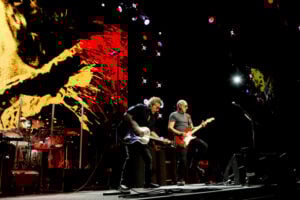
Photo: By Flickr user Michael Spencer [CC BY 2.0 (http://creativecommons.org/licenses/by/2.0)], via Wikimedia Commons
After inducting Frank Iero into the band and eventually replacing Pelissier with Bob Bryar, MCR went on to release four critically acclaimed albums, each one more theatrical and eclectic than the last. Although they were often labeled as merely an emo band, becoming the poster boys of the genre for many, they delivered songs across a plethora of genres throughout their tenure, with influences as diverse as post-hardcore, pop punk, synth-pop, and glam rock. Let’s take how they embraced a number of different concepts and alter-egos in their evolution as a band.
Having heard one of the band’s demo’s, MCR were quickly signed to indie label Eyeball Records, and just a few days after the band had properly formed (Iero joined the band very late), they began recording their debut album. At its heart, I Brought You My Bullets, You Brought Me Your Love (2002), is a post-hardcore/emo album, produced by Thursday’s Geoff Rickly, no less. This album represents the band at their most scrappy and raw, although the MCR’s flare for theatricality and pomp is hinted at by the album’s odd intro track, a cover of 19th Century guitar instrumental Romance Anónimo. It’s not long until the post-hardcore sound erupts, thanks to the album’s second single Honey, This Mirror Isn’t Big Enough for the Two of Us, which features choppy riffs, and gave listeners an introduction to Gerard Way’s distinctive blend of melodic runs and aggressive snarls and screams. Vampires Will Never Hurt You introduced the band’s recurring use of references to vampirism, death, and the occult, whilst Early Sunsets Over Monrover set the trend for the slower more peaceful album tracks which the band would produce throughout their career. Each song on the album is a variation on a theme, specifically the story of a love between two people which inevitably goes wrong. As such, it could be seen as the band’s first foray into the concept album.
Bullets holds up decently enough today, and it undoubtedly provided the blueprint for the scratchy and infectious sound which the band would build upon over the years.
Having signed to major label Reprise, it was with second album Three Cheers for Sweet Revenge (2004)that My Chemical Romance achieved breakthrough success. The band moved away from the screamo elements of their previous record and flirted, ever so slightly, with a more melodious sound. It makes sense that signing to a major label would see the band clean their sound up ever so slightly, resulting in a far more slick and polished punk rock/emo output for their sophomore effort. I’m Not Okay (I Promise) delivered the kind of anthemic hook which is guaranteed to get the attention of the mainstream, something which the song definitely managed. Part of this was no doubt down to the music video, which mimicked a movie trailer for a film in which the band, playing misfits, had a showdown with the popular kids. Second single, Helena was a pretty straight emo/punk rock track, with a brooding intro that soon explodes into a glorious cacophony of thrashy riffs. It was clear that MCR knew just how to appeal to their fans, and it was down to their emo/pop punk/goth sound and aesthetic that they managed to become the poster boys of emo, appearing on the Myspace profiles of teenagers throughout the mid-00’s.
Three Cheers is like a perfect slice of time. It represents an era when emo was widely known and yet widely misunderstood, with MCR and their contemporaries managing to re-introduce the mainstream music charts to a heavier guitar sound thanks to their soaring hooks and pin-up status.
Having achieved huge success with Three Cheers, you might expect the band to have wanted to continue riding on this success and deliver more of the same. Instead, they did the opposite. In 2006, fans attending a concert in London were devastated to find that MCR had canceled their appearance at the gig, which would instead be played by an unknown band called The Black Parade. Luckily, it soon became clear that this was simply the band playing under a pseudonym – one which would form the basis for their third album.
For many, The Black Parade (2006)is the definitive My Chemical Romance album – as evidenced by the huge fuss made of the album’s recent ten year anniversary. Perhaps this is because the band truly came of age creatively – rejecting the label of emo and embracing a ton of new and unusual influences. Above all, the album is a rock opera, and it wouldn’t be out of place amongst the popular musicals on Broadway. Gerard Way has cited Queen as a major influence on the album, and this is particularly noticeable on the epic guitars of standout single Welcome to the Black Parade. These unusual “classic” references are felt throughout the album, especially on Mama, which, bizarrely, features a duet with Liza Minelli. Indeed, the influences on this album fly thick and fast; from David Bowie’s Ziggy Stardust, to Pink Floyd and Guns N’ Roses, the album manages to deliver a range of different sounds, including 1970’s classic rock (Mama), glam rock (Welcome to the Black Parade) , pop (Dead) and pop punk (Teenagers).
Further symbolizing the departure from the band’s previous era, Way cut his iconic black locks and replaced them with a bleached blonde pixie cut. He also ditched the band’s well-known black suit/red accessory look for a more flamboyant Sergeant Pepper-esque marching uniform. This fitted in with the story of this album’s concert, which revolved around “The Patient” as he died and passed into the afterlife, reflecting on his life and what he’d left behind. Way explained that the band wanted to create a timeless album with Black Parade and, seeing as how it still resonates ten years later; there can be no doubt that they achieved this.
For what turned out to be their final studio album, Danger Days: True Lives of the Fabulous Killjoys (2010), the band once again created a whole new aesthetic and storyline. Whilst The Black Parade reflected on the past with its sounds and visuals, Danger Days very much looked to the future; replacing the bleak setting of the previous album with a very colorful post-apocalyptic California in which the band, a gang called The Killjoys, were at war with an all powerful mega corporation.
Musically, Danger Days embraced the poppier side of pop punk, with lead single Na Na Na (Na Na Na Na Na Na Na Na Na)’s ludicrous title surely being a knowing wink to the band’s pop experimentation. Incidentally, Na Na Na, is a devastatingly catchy pop punk song which is perfectly suited to the graphic novel-like visuals the band were utilizing for this album. The tracks on Danger Days combined sounds of glam, new wave, and even dance influences, with Planetary (GO!) sounding every inch like a Rolling Stones song designed for the modern day club. Meanwhile, Sing is hugely influenced by classic rock, and S/C/A/R/E/C/R/O/W could easily be a lost Beatles track. There’s a definite movie soundtrack-feel to the album, as well as some subtle anime influences; it really is hard to believe that the band responsible for this bright, colourful and overwhelming experience are the same band who brought emo to the mainstream less than ten years ago before this release.
Following their fourth album, the band put out some previously unreleased songs as digital downloads, eventually releasing them as a compilation under the title Conventional Weapons in 2012. However, on March 22nd 2013, the band announced they were breaking up, and have since gone on to pursue various solo projects. It’s hard to imagine where the band would have taken their sound for their next album, but fans will surely be forever grateful for the musical journey MCR took them on throughout their twelve-year tenure. From post-hardcore to emo, to pop punk, to glam rock and dance, there are few bands who have so successfully reinvented themselves over and over again. Although they originated in an emo bubble, their talent, bravado, and uniqueness allowed MCR to break into the mainstream, providing the perfect remedy to the stale RnB infused pop that was big at the time. There’s a reason the band is so fondly remembered today, and if ever you want to relive your youth, simply listen to those eleven piano notes which open Welcome to the Black Parade and re-embrace the undefinable, unrelenting excellence of My Chemical Romance.