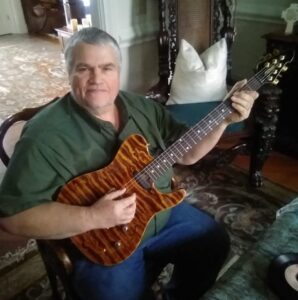
Feature Photo by Scott Ward
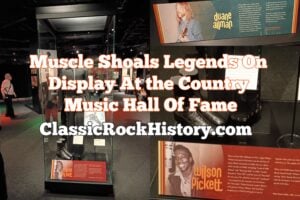
On Thursday, November 13, 2025, I had the distinct pleasure of seeing the new Muscle Shoals: Low Rhythm Rising exhibit, which celebrates Muscle Shoals music at the Country Music Hall of Fame in Nashville. It was great seeing dresses and suits worn onstage by Arthur Alexander, Dan Penn, Etta James, Aretha Franklin, Candi Staton, Percy Sledge, Mavis and Pops Staples, and Wilson Pickett. Wilson has been my hero for many years. I produced a tribute album for him in Muscle Shoals in 2024.
It was also great to see guitars, basses, and other instruments played live and in the studio by my heroes: Duane Allman, Pete Carr, David Hood, Jimmy Johnson, Spooner Oldham, Scott Boyer, and Travis Wammack. Duane’s ’64 Stratocaster is on display. He played that with the band The Hour Glass. Duane was always known more for playing Gibson Les Pauls and SGs than for any other brand.
My friend Kelvin Holly, who was part of the house band for the concert on Friday night, told me that Gregg Allman gave that guitar to Duane, who then gave it to Mickey Buckins, a legendary producer and percussionist at FAME Studios. Mickey is also part of the exhibit and was one of the first people I met in Muscle Shoals.
He and Jerry McGee hosted a Songwriter’s Showcase in Muscle Shoals at a bar and grill inside the old Holiday Inn in Sheffield, Alabama, featuring legendary songwriters and session players from that time, as well as future songwriters and musicians such as Jason Isbell, Shonna Tucker, Chris Tomkins, and others. At times, Sun Records founder Sam Phillips, a Florence native, would pop in.
Pete Carr was in the band The Hour Glass along with Duane, Gregg, Allman Brothers producer Johnny Sandlin, and Capricorn Records producer Paul Hornsby. There is also a Telecaster on display that Duane gave to Pete, which Jerry McGee owned before his passing. Every member of that band went on to become a legend.
Pete played the guitar solo on Bob Seger’s “Mainstreet.” One night in 2002, I walked into the Fizz, and I could hear the band playing that song. I noticed that the guitar player was outstanding. It was Pete. That was the first time I met him.
Being at the Country Music Hall of Fame that night was surreal, seeing so many of my heroes in one room. There was also great food and beverages provided by the Hall of Fame and a musical celebration following the press viewing of the exhibit. Dan Penn and Spooner Oldham took the stage first and performed “I’m Your Puppet.”
Spooner is known as being one of the most iconic players of the Wurlitzer electric piano. He toured with Bob Dylan on both the Slow Train Coming and Saved tours and was also the anchor for Aretha Franklin’s “I Never Loved a Man (The Way I Love You),” which was recorded at FAME Studios in Muscle Shoals.
As Dan Penn tells the story, you had all these great musicians in one room, and nobody really knew what to do with the track. All of a sudden, Spooner started playing a riff in F with a minor third thrown in, and Jimmy Johnson, rhythm guitarist at FAME, said, “Spooner’s got it!” That song became a number-one hit on the R&B charts, the album of the same name hit number two on the Billboard album chart, and it set the tone for the rest of Aretha’s career.
Bettye LaVette took the stage next, with Spooner accompanying her on a George Jones song called “Choices,” which appears on her album with the Drive-By Truckers, Scene of the Crime. That album was also recorded at FAME Studios and featured Spooner on keys and David Hood on bass. Bettye said that when she finally had the opportunity to meet George Jones, he told her, “That’s how I want my song to sound.”
The final performance of the night was by Jason Isbell, who did three classic Muscle Shoals songs. First up was Arthur Alexander’s “You Better Move On,” which is probably the unofficial anthem of Muscle Shoals. The Rolling Stones covered that song, as did the Moody Blues, and Ringo Starr also did a cut on one of his solo albums later. Bob Dylan and The Beatles also covered Arthur’s songs.
“Sally Sue Brown” was written by Arthur, Tom Stafford, and my first real friend in Muscle Shoals, Earl “Peanutt” Montgomery. Elvis Costello also recorded that one. The Beatles also covered a song Arthur recorded called “Soldier of Love,” co-written by Buzz Cason and Tony Moon.
I had the pleasure of meeting Buzz at Dan and Spooner’s 2014 Alabama Music Hall of Fame induction. Spooner told me that Buzz had a fantastic band that came to Florence to do a show in the early ’60s, which really made an impression on him. I’ve read in recent years that The Beatles were heavily influenced by Arthur’s records, especially Paul, who loved the deep bass sound.
The second song Jason did was “Wild Horses,” which the Stones recorded at Muscle Shoals Sound in 1969, along with “Brown Sugar” and “You Gotta Move.” The late, great Jimmy Johnson of the Muscle Shoals Rhythm Section engineered those because the Stones’ producer, Jimmy Miller, didn’t show up. I’ve always heard that Keith Richards wrote the lyrics to “Wild Horses” in the bathroom at Muscle Shoals Sound. Jason really did an excellent job on that one.
Lastly, he did Paul Simon’s “Kodachrome,” which Paul cut at Muscle Shoals Sound for his 1973 album There Goes Rhymin’ Simon. It’s one of my favorites because of David Hood’s bassline and Barry Beckett’s incredible piano parts. I’ve been told that Roger Hawkins played percussion on the track on a reel-to-reel tape box.
Jason has really done well for himself over the years. He grew up in Green Hill, Alabama, and attended Rogers High School. You don’t really have to worry about traffic jams there. In addition to his six Grammy Awards and further nominations, he has his own signature Fender Telecaster and Martin acoustic guitar. He also owns Ed King’s legendary “Red Eye” Gibson Les Paul.
There were some legendary authors, filmmakers, producers, and musicians there that night as well. It was great to see Norbert Putnam, who was the bass player for the first rhythm section at FAME Studios. That group opened for The Beatles a couple of days after their appearance on The Ed Sullivan Show.
Norbert, David Briggs, and Jerry Carrigan moved on to Nashville in the mid-’60s and found themselves playing on Elvis’ records, with Ray Stevens, and many others. Norbert also produced Jimmy Buffett’s biggest records.
It was also a treat to see my friend Richard Bennett, a legendary Nashville and Los Angeles producer who played guitar with Neil Diamond for decades and worked on the soundtrack for the 2025 film Song Sung Blue, starring Hugh Jackman and Kate Hudson. Hugh plays a Neil Diamond impersonator.
Richard also played guitar with Mark Knopfler’s band for 20 years and played guitar on a track for my tribute album for Wilson Pickett at Wishbone Studios in Muscle Shoals. You will not find a more giving, humble man than Richard. He sent me a copy of his instrumental album, Some Kinda Summer, shortly before the event. It is excellent.
It was also wonderful to see Marlin Greene, one of the early architects of the Muscle Shoals Sound, who doesn’t really get the credit he deserves. He co-produced and played guitar on Percy Sledge’s “When a Man Loves a Woman” and co-produced Boz Scaggs’ “Somebody Loan Me a Dime.” Marlin told me he hired Duane Allman for that session.
He also wrote some great songs with Eddie Hinton and others and was one of the backing vocalists for George Harrison, Leon Russell, Eric Clapton, Ringo Starr, and others at the Concert for Bangladesh.
When we talked, Marlin was lamenting the recent death of his friend, the legendary Donna Jean Godchaux McKay, who was a member of the Grateful Dead from 1972 to 1979 and sang backing vocals on “When a Man Loves a Woman” and Elvis’ “Suspicious Minds.” You could tell you were in the presence of greatness when you saw Donna Jean around Muscle Shoals.
I’ve been fortunate to write some new songs over the past few years with Marlin, and he did me a massive favor by designing the artwork for my tribute album for Wilson Pickett. He is also a graphic designer in Seattle.
I also had the chance to speak with Rob Bowman. Rob was co-executive producer of the Stax documentary miniseries for HBO and has a great book about the history of Muscle Shoals studios called Land of 1000 Sessions.
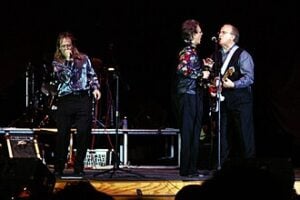
The concert at the CMA Theater on Friday, November 14, featured a fabulous lineup of artists backed by a band of legends. The bandleader was my friend Will McFarlane, who toured and recorded with Bonnie Raitt in the ’70s and became the guitarist for the Muscle Shoals Rhythm Section in 1980 at the invitation of Jimmy Johnson of the Swampers. He also appeared at the No Nukes concert, which featured Bonnie, Bruce Springsteen, Jackson Browne, and Graham Nash.
Will did a really great job. He is warm and personable and has a great sense of humor. He also has a great understanding of music and jazz chords. When he introduced Clayton Ivey, he quipped, “He never met a half diminished he didn’t like,” referring to piano chords. Spooner and Clayton were on keyboards.
Clayton was part of the FAME Gang in the early ’70s and would later found Wishbone Studios with Terry Woodford. Mark Beckett, son of Swamper Barry Beckett, was on drums. Mark is the staff drummer for the Grand Ole Opry. Mickey Buckins was on percussion. Mickey is also a legendary producer and songwriter, one of the architects of the Muscle Shoals Sound.
On bass was Bob Wray. Bob played on the Osmonds’ “One Bad Apple,” which features one of the best bass lines ever, and played on “Family Tradition” with Hank Williams Jr., which was cut at Wishbone Studios. Bob also worked with Chuck Berry, Don McLean, and many others.
Kelvin Holly was on guitar as well. Kelvin played in Little Richard’s band for many years, was also a later member of the Amazing Rhythm Aces, and played in Pegi Young’s band, The Survivors.
The Muscle Shoals Horns were on the bandstand and featured Charles Rose, Brad Guin, Steve Herrman, and Jim Hoke. The backing singers affectionately known as “The Shoals Sisters” are Marie Lewey and Cindy Richardson-Walker.
Dan Penn, a prolific songwriter, producer, singer, and one of the best rhythm guitarists in the world, who could have easily been a rock star himself, opened the show with “I’m Your Puppet,” which sounded fantastic with the horn section. He also did “You Left the Water Running,” which Otis Redding cut at FAME Studios and was written by Dan, Rick Hall, and Oscar Frank.
I was blown away by Wendy Moten’s vocal abilities on Aretha Franklin’s “Do Right Woman, Do Right Man,” written by Dan and Chips Moman, and especially on “I Never Loved a Man (The Way I Love You),” with Spooner’s integral Wurlitzer parts and the horns. Wendy is as close to Aretha as you can get.
Bettye LaVette came on and did a couple of songs, including a John Prine song, “Souvenirs.” Bettye almost didn’t make it, having travel issues and arriving about half an hour before the event started. I also associate Bettye’s Muscle Shoals recordings with “I Still Want to Be Your Baby,” written by guitarist and producer Eddie Hinton.
Shenandoah, the country music supergroup that recorded at FAME with Rick Hall, did one of their biggest hits, “Two Dozen Roses,” which was written by Coral Reefer Band member and legendary songwriter Mac McAnally and the late Robert Byrne, a legend in his own right. They also did a rollicking version of “The Church on Cumberland Road,” which they later recorded with Nickelback.
A handwritten chord chart for “Moon Over Georgia,” recorded by the band at FAME Studios and written by my friend and frequent co-writer Mark Narmore, is part of the exhibit. Mark and I drove up to Nashville for the show, and it was fun to see his excitement about being a part of the band’s legacy.
Four-time Grammy winner John Paul White performed Arthur Alexander’s “You Better Move On.” Donnie Fritts did a tribute album for his old friend Arthur for John’s label in the Shoals, Single Lock Records, a year or two before he passed away. John also did a fabulous version of Bob Seger’s “We’ve Got Tonight,” which was recorded at Muscle Shoals Sound.
Tiera Kennedy did a wonderful version of the Rolling Stones’ “Wild Horses,” which was recorded at Muscle Shoals Sound. She also did Etta James’ “I’d Rather Go Blind,” recorded at FAME and featuring David Hood, Spooner Oldham, Jimmy Johnson, and Roger Hawkins.
I could see my friend Jimmy Hall, who was the lead singer for Wet Willie and did several tours with Jeff Beck, waiting in the wings with his signature hat on. He came on and did a great version of Percy Sledge’s “When a Man Loves a Woman.”
Percy’s recording was produced at Norala Studios in Sheffield, Alabama, by Quin Ivey and Marlin Greene, and became the first million-selling record to come out of Muscle Shoals. Jimmy Johnson engineered the track. The song featured Spooner on Farfisa organ, Marlin on guitar, Junior Lowe on bass, and Roger Hawkins on drums.
I have heard that Spooner and Junior reunited a few years ago to write some songs. Junior told Spooner, “You know, I don’t think we ever even got a hamburger for playing on that.” Sadly, Junior passed away in 2024.
Things got really funky when Jimmy launched into the intro to “Land of a Thousand Dances,” which features Junior playing eighth notes on the bass and those fabulous horn blasts answering Pickett’s vocals on the original recording.
I’ve been fortunate to produce seven tracks with Jimmy over the past few years, and he did that track for my tribute album for Wilson, I Believe I’ll Run On: A Tribute to Wilson Pickett, which was released in 2024. Jimmy is the hardest-working man in show business and is constantly touring with various Southern rock bands.
I was really surprised by how great Maggie Rose really is. The adage that “dynamite comes in small packages” comes to mind. She belted out the Staple Singers’ “I’ll Take You There” as close to Mavis Staples as I have ever heard.
What really blew me away was her cover of Aretha’s “Chain of Fools,” which featured Kelvin Holly on his Danelectro baritone guitar. I have always heard that Joe South, on his first big session, tuned his Telecaster down to C. Travis Wammack played guitar on a track I produced with T. Graham Brown. I love that twangy tone.
Candi Staton came out and danced up a storm, proudly proclaiming that she was 85 years old and giving a testimony of her faith in God after some health issues over the past few years. She did a fantastic job on “I’m Just a Prisoner (Of Your Good Lovin’),” which was produced by Rick Hall at FAME Studios. She spoke about the special relationship she had with Rick and his family.
She also cut “Another Man’s Woman, Another Man’s Man,” written by Marlin Greene, Dan Penn, and George Jackson. George wrote some great songs in Muscle Shoals, including Bob Seger’s “Old Time Rock and Roll.”
To close the show, Jimmy Hall and all the artists who had performed that night came back out to do “Mustang Sally,” which was recorded at FAME Studios. That gold record on the wall at FAME really made an impression on me all those years ago when I started going to Muscle Shoals, trying to get something going.
Wilson’s recording features many familiar names that I have been fortunate to work with and came to know and love: Jimmy Johnson on rhythm guitar, Spooner Oldham on keys, Roger Hawkins on drums, and the late, great Tommy Cogbill on bass. Spooner told me a few years ago that when he was playing his keyboard part, he wanted to emulate the sound of a motorcycle driving through the studio.
Tommy Cogbill has been one of my biggest influences on bass and as a producer. He played on Aretha Franklin’s “Respect,” “Chain of Fools,” and “Do Right Woman,” which were cut at Atlantic Studios in New York City, in addition to many great recordings in Muscle Shoals with Aretha and Pickett.
Tommy also played bass on and produced records by Elvis, King Curtis, Dusty Springfield, Neil Diamond, and many others at American Studios in Memphis.
Tommy’s staccato style and the use of 16th notes and syncopations on tracks such as Pickett’s “Funky Broadway” and Dusty Springfield’s “Son of a Preacher Man” influenced Jaco Pastorius, considered by many to be the greatest bass player of all time. Tommy has never really gotten the credit he deserves, and it was wonderful to see his son, daughter, and granddaughter sitting in the front row.
To close the show, the band kicked off with Lynyrd Skynyrd’s “Sweet Home Alabama,” a song written by Ronnie Van Zant, Gary Rossington, and Ed King. Skynyrd learned how to record in Muscle Shoals in the early ’70s and did an early version of “Free Bird” at Muscle Shoals Sound. Sadly, the tapes had a muffled sound. You can hear the tracks they did on what is known as The Muscle Shoals Album.
Billy Powell was a roadie with the band, and nobody knew he was a classically trained pianist until the band had gone to lunch and came back to hear him playing an elaborate piano part for the song. He was quickly promoted from roadie to playing keyboards.
Skynyrd then moved on to Atlanta and were discovered by Al Kooper, who produced their records at Studio One in Doraville, Georgia, and put them on tour with The Who. It’s kind of ironic that “Sweet Home Alabama” was recorded in Georgia.
Still, Ronnie, Gary, and Ed wrote that song for the Swampers: Jimmy Johnson, David Hood, Barry Beckett, and Roger Hawkins. I was fortunate to talk with some of the original members over the years about their time recording in Muscle Shoals, including original drummer Bob Burns and Ed King. Ed loved Muscle Shoals and the rhythm section.
The Low Rhythm Rising exhibit is really special to me, as I’ve been able to work with and be friends with many of the musicians featured in the exhibit at iconic studios there. One person I really missed being part of the celebration was David Hood. He invited me to come to Muscle Shoals to hear his legendary band, The Decoys, almost 25 years ago.
The Decoys was a band formed by Allman Brothers and Gregg Allman producer Johnny Sandlin, known as “The Duck.” I mentioned Johnny earlier as being a member of the Hour Glass. The foundation of the Allman Brothers was actually constructed at FAME when Duane, Johnny, and Jaimoe were recording there.
I have the opportunities I have now because of David, Spooner, and all the people I met there all those years ago. When I met them, the band consisted of David on bass, Kelvin Holly on lead guitar, N.C. Thurman on keyboards, Scott Boyer on vocals and guitar, and Mike Dillon on drums. Those guys became my heroes, and it was really great to see that Scott Boyer made the exhibit.
Scott and Tommy Talton had a band called Cowboy that recorded for Capricorn Records, and their song “Please Be with Me” was later covered by Eric Clapton and Randy Meisner. The original featured Duane Allman on resonator guitar and was recorded at Muscle Shoals Sound.
Jason Isbell and Shonna Tucker of the Drive-By Truckers played in Scott’s band, along with legendary Birmingham blues harp player Topper Price, at one point. In 2014, Duane’s daughter, Galadrielle, released a book with the same title. I was fortunate to see Scott and Tommy perform that song at Muscle Shoals Sound, as well as Galadrielle reading excerpts from the book.
If there is one exhibit in any music Hall of Fame that is a must-see, this is it.
Scott Ward
Read More: Artists’ Interviews Directory At ClassicRockHistory.com
Read More: Classic Rock Bands List And Directory
Updated October 27, 2026
Muscle Shoals Legends On Display At the Country Music Hall Of Fame article published on ClassicRockHistory.com © 2026