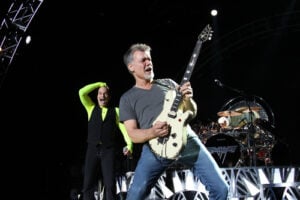
Feature Photo: Debby Wong / Shutterstock.com
Our Complete List Of Van Halen Band Members takes a look at the musicians who helped build one of the most exciting hard rock bands in American music history. When Van Halen’s debut album arrived in 1978, it sounded as if somebody had thrown open the doors of a Hollywood nightclub and turned the amplifiers up as far as they would go. Eddie Van Halen’s guitar playing was unlike anything most rock fans had heard, and the musicians surrounding him knew exactly how to turn that extraordinary talent into great songs.
I’ve always thought the original Van Halen lineup was one of the most perfectly matched groups in rock and roll. David Lee Roth was an outrageous frontman, Eddie Van Halen was a revolutionary guitarist, Alex Van Halen was a powerhouse drummer, and Michael Anthony supplied the bass and those magnificent high harmonies. Listen to “Runnin’ with the Devil,” “Ain’t Talkin’ ’bout Love,” or “Unchained,” and you hear four very different musicians working together to create a sound nobody else could duplicate.
The band’s history began in Pasadena, California, where brothers Eddie and Alex Van Halen played parties and clubs under early names that included Genesis and Mammoth. Bassist Mark Stone was part of those formative years, before Michael Anthony joined in 1974 and completed the lineup that became famous. The group attracted the attention of producer Ted Templeman and signed with Warner Bros. Records, setting the stage for a debut that changed the direction of late-1970s hard rock.
Of course, the Van Halen story didn’t end with the original four musicians. David Lee Roth departed in 1985, and Sammy Hagar became the singer during another enormously successful period. Gary Cherone then took over for a brief but interesting chapter in the late 1990s. Roth eventually returned, this time performing alongside Eddie’s son Wolfgang Van Halen, who replaced Michael Anthony on bass. Few major rock bands went through so many public changes at the microphone while retaining their unmistakable musical identity.
Van Halen was inducted into the Rock & Roll Hall of Fame in 2007. Eddie Van Halen died on October 6, 2020, bringing the band’s performing history to a close. Its last concert had taken place at the Hollywood Bowl in Los Angeles on October 4, 2015. Alex Van Halen and David Lee Roth appeared together for a public discussion in July 2026, but that meeting was not a new Van Halen concert or the announcement of a re-formed band. This article follows the musicians from the earliest Pasadena lineup through the group’s final years.
The Van Halen Brothers And The Earliest Band Members
Eddie Van Halen – Lead Guitar, Keyboards, Background Vocals (1972–2020)
Edward Lodewijk Van Halen was born on January 26, 1955, in Amsterdam, Netherlands. He moved to Southern California with his family in 1962, growing up in Pasadena alongside his older brother Alex. Their father, Jan Van Halen, was a professional musician, and both boys studied piano when they were young. Eddie eventually took up the guitar while Alex concentrated on drums. That combination would become one of the most important partnerships in the history of hard rock.
I’ve been listening to guitar players for most of my life, and I still remember how astonishing Eddie sounded on the first Van Halen album. “Eruption” wasn’t just a fast guitar solo. The two-handed tapping, harmonics, whammy-bar effects, and explosive phrasing made people reconsider what an electric guitar could do. Eddie didn’t invent every technique he used, but he brought them together with a sense of melody and excitement that inspired an entire generation of musicians.
His importance went far beyond playing solos. Eddie wrote unforgettable riffs for “Ain’t Talkin’ ’bout Love,” “Unchained,” and “Panama,” while his keyboard work became central to “Jump” and later recordings such as “Dreams” and “Right Now.” He also built and modified his own instruments, most famously the striped Frankenstrat guitar. Eddie approached the studio as another instrument, constantly experimenting with amplifiers, guitar tones, recording techniques, and arrangements.
What made Eddie so special was the balance between technical brilliance and great songwriting. Plenty of guitarists learned to play fast after hearing him, but far fewer could write a song as catchy as “Dance the Night Away” or make a riff swing the way “Hot for Teacher” does. He remained the musical center of Van Halen through the Roth, Hagar, Cherone, and reunion eras, even when the relationships within the group became complicated.
Eddie passed away on October 6, 2020, at the age of sixty-five. His death brought a tremendous outpouring of tributes from musicians across rock, metal, pop, and jazz. For all the discussion about changing singers and competing versions of Van Halen, Eddie’s guitar remained the constant. His playing altered the vocabulary of rock guitar, and the records he made with his brother continue to demonstrate how powerful a great band can sound.
Alex Van Halen – Drums, Percussion (1972–2020)
Alexander Arthur Van Halen was born on May 8, 1953, in Amsterdam. Like Eddie, he grew up in a musical family and studied piano before becoming a rock musician. The brothers initially experimented with different instruments, but Alex’s move behind the drum kit gave them the foundation for the band they would eventually form. He played alongside Eddie in the earliest Pasadena groups and remained part of Van Halen throughout its existence.
Alex is sometimes overlooked because his younger brother attracted so much attention, but that would be a serious mistake. Listen to the opening of “Hot for Teacher,” the pounding rhythm of “Everybody Wants Some!!,” or the way he drives “I’m the One.” Alex could play with enormous force while maintaining the swing that separated Van Halen from so many other hard rock bands. There is a reason those records feel like they are moving even when Eddie’s guitar is doing something wildly complicated.
His drum sound was also a major part of the group’s identity. Alex frequently performed behind elaborate kits with multiple bass drums, cymbals, and percussion instruments, yet the arrangements never depended on spectacle alone. He understood when to leave room for a guitar riff, when to accent a vocal line, and when to take control of the song. That musical relationship with Eddie remained intact through every change in the lead singer’s position.
After the band’s final performances, Alex became more publicly reflective about their history. He published the memoir Brothers in 2024, concentrating on his lifelong relationship with Eddie and the years that shaped Van Halen. In July 2026, he appeared alongside David Lee Roth at a TEDxFargo discussion, their first public appearance together since the final tour. His role in Van Halen cannot be reduced to keeping time; he helped establish the rhythm, energy, and personality of the entire band.
Mark Stone – Bass Guitar, Background Vocals (Early Lineup, Approximately 1972–1974)
Mark Stone was the bassist who played with Eddie and Alex Van Halen before Michael Anthony joined the group. The brothers and Stone performed together in the early Pasadena years, when the group used names including Genesis and Mammoth. They played backyard parties, school functions, and local venues while building a reputation for loud, energetic rock and roll. Stone was therefore part of the band’s actual beginnings, not simply someone who happened to audition later.
David Lee Roth joined during Stone’s tenure, which meant that the four musicians performed together before the better-known classic lineup took shape. Stone played bass as the group developed its repertoire and attracted increasingly enthusiastic local crowds. He departed in 1974 and was replaced by Michael Anthony. Stone later explained that balancing school and the band’s growing demands had become difficult, and the separation occurred before the group secured its major recording contract.
Stone never appeared on a commercially released Van Halen studio album, which explains why many casual fans don’t recognize his name. Still, an article about every Van Halen member would be incomplete without him. He was present when the brothers were turning a local party band into something much bigger. Stone died in September 2020, only days before Eddie Van Halen. His place belongs in the group’s early history, even though its worldwide success came after his departure.
The Classic David Lee Roth Lineup
David Lee Roth – Lead Vocals, Frontman (Approximately 1973–1985; 1996; 2006–2015)
David Lee Roth was born on October 10, 1954, in Bloomington, Indiana, and grew up partly in California. He became involved with the Van Halen brothers during the early Mammoth period and eventually took over lead vocals. Roth brought something the brothers needed: a frontman who could entertain an audience before the first guitar solo even started. With his athletic stage moves, outrageous humor, and distinctive voice, he became one of rock’s most recognizable performers.
I’ve always thought Roth was just as important to the original Van Halen sound as the instruments behind him. Eddie could create these astonishing riffs, but Roth knew how to turn them into a party. His performances on “Runnin’ with the Devil,” “Beautiful Girls,” “Everybody Wants Some!!,” and “Panama” had a swagger that fit the music perfectly. He could deliver a hard rock vocal, throw in a wisecrack, and somehow make the whole thing sound natural.
Roth fronted Van Halen during the group’s first six studio albums, from the 1978 debut through 1984. The success of “Jump,” “Panama,” and “Hot for Teacher” placed the band at the center of MTV-era rock. He left in 1985 and enjoyed major solo success with recordings such as “California Girls,” “Just a Gigolo/I Ain’t Got Nobody,” and “Yankee Rose.” His subsequent band also employed extraordinary guitarists, including Steve Vai and Jason Becker.
In 1996, Roth briefly reunited with Van Halen to record “Me Wise Magic” and “Can’t Get This Stuff No More” for Best Of – Volume I. A public appearance at the MTV Video Music Awards suggested the original lineup might be returning, but that reunion quickly ended. He came back again in 2006, this time joining Eddie, Alex, and Wolfgang Van Halen. That lineup toured beginning in 2007, recorded A Different Kind of Truth in 2012, and played Van Halen’s final concert in 2015.
Roth’s relationship with the brothers was famously complicated, but the musical chemistry is impossible to deny. He wasn’t the same kind of singer as Sammy Hagar, and he never pretended to be. Roth’s greatest strength was the way he made a concert feel like an event. For many fans, the combination of Roth’s personality, Eddie’s guitar, Alex’s drums, and Michael Anthony’s harmonies remains the definitive Van Halen experience.
Michael Anthony – Bass Guitar, Background Vocals (1974–2006)
Michael Anthony was born on June 20, 1954, in Chicago, Illinois, and developed his musical career in Southern California. Before joining Van Halen, he played bass and sang with a local group called Snake. The Van Halen brothers recruited Anthony in 1974 after Mark Stone’s departure. He completed the lineup that recorded the band’s first six albums and remained through the successful Sammy Hagar era and the later Gary Cherone period.
Anthony’s bass playing provided the solid foundation that allowed Eddie’s guitar and Alex’s drums to do their thing. He could lock into the rhythm section without crowding the song, and he had the ability to play with impressive speed when the arrangement demanded it. His live performances often included his famous Jack Daniel’s-shaped bass guitar. That instrument became part of the visual identity of Van Halen concerts, although his contribution to the band’s sound went much deeper.
For me, Anthony’s high backing vocals were absolutely essential. Listen to the chorus of “Runnin’ with the Devil,” “Dance the Night Away,” “Somebody Get Me a Doctor,” or “Why Can’t This Be Love.” Those harmonies provide a lift that is easy to take for granted until they are missing. It’s remarkable how much personality one musician can add to a record while rarely singing the lead. He helped give Van Halen a melodic sweetness that balanced the band’s harder edges.
Anthony remained associated with Van Halen through its 2004 reunion with Sammy Hagar, but he was not part of the David Lee Roth reunion that began in 2007. Wolfgang Van Halen took over the bass position, ending Anthony’s long tenure with the band. Anthony later worked with Hagar in Chickenfoot and Sammy Hagar and the Circle, maintaining their musical partnership outside Van Halen. Their subsequent concerts also brought many of the Hagar-era songs back to the stage.
The Rock & Roll Hall of Fame included Anthony among Van Halen’s inducted members in 2007, and rightly so. He may not have been the band’s principal songwriter or the person getting the most attention in the music videos, but he was one-quarter of the classic lineup’s sound. You simply cannot tell the story of Van Halen without giving Michael Anthony the recognition he deserves.
The Sammy Hagar Era Of Van Halen
Sammy Hagar – Lead Vocals, Rhythm Guitar, Songwriting (1985–1996; 2003–2005 Reunion Period)
Sammy Hagar was born on October 13, 1947, in California and had already established himself as a major rock singer before joining Van Halen. His earlier career included fronting Montrose, whose recordings helped define American hard rock in the 1970s. Hagar then developed a successful solo career with songs such as “There’s Only One Way to Rock,” “Three Lock Box,” and “I Can’t Drive 55.” When he joined Van Halen in 1985, he was hardly an unknown singer trying to replace a star.
Replacing David Lee Roth was one of the biggest challenges any rock vocalist could have faced at the time. Roth was identified so closely with the band’s image that many fans assumed Van Halen couldn’t continue without him. Hagar brought a different set of strengths: a powerful vocal range, melodic songwriting instincts, and the ability to play guitar alongside Eddie. The group didn’t attempt to recreate Roth’s personality. It developed another sound, while retaining Eddie’s guitar and Alex’s drums at the center.
The Hagar-fronted lineup included Eddie, Alex, and Michael Anthony, and its four studio albums all reached number one on the Billboard 200. Recordings such as “Why Can’t This Be Love,” “Dreams,” “When It’s Love,” “Poundcake,” and “Right Now” demonstrated a more melodic and sometimes more reflective approach. I’ve always enjoyed the contrast between the two major Van Halen singers. Roth brought a wild party atmosphere, while Hagar could push a powerful melody over even the biggest guitar arrangement.
Hagar’s first period with Van Halen ended in 1996 amid disagreements about the band’s direction and working relationships. He returned for a reunion period that produced three new studio recordings and a major tour in 2004, with Michael Anthony again on bass. Unfortunately, the reunion did not become a permanent arrangement, and the group moved on to another long period of inactivity before Roth’s return. The tensions were highly publicized, but the records Hagar made with Van Halen remain an important part of the band’s history.
After his years in Van Halen, Hagar continued recording and touring, frequently performing with Anthony. The pair also worked with guitarist Joe Satriani and drummer Chad Smith in Chickenfoot, then continued their partnership in other projects. Hagar’s contributions deserve to be judged on their own terms rather than treated as a competition with Roth. Van Halen achieved major success with two very different singers, something relatively few hard rock bands have managed.
The Gary Cherone Years
Gary Cherone – Lead Vocals (1996–1999)
Gary Cherone was born on July 26, 1961, in Malden, Massachusetts. Before joining Van Halen, he was best known as the lead singer of Extreme, a group that combined hard rock, funk, and strong vocal harmonies. Extreme achieved major success with “More Than Words” and “Hole Hearted,” but songs such as “Decadence Dance” and “Get the Funk Out” showed the heavier side of the band. Cherone was an accomplished vocalist and energetic performer when Van Halen recruited him in 1996.
Cherone entered the group during a particularly difficult period. Sammy Hagar had departed, and the brief attempt to reunite with David Lee Roth had ended almost as soon as it began. Cherone was therefore joining a band with an extraordinary history and an audience divided over its previous singers. His only studio album with Van Halen, Van Halen III, arrived in 1998 and included “Without You” and “Fire in the Hole.” The music was often more experimental and less immediately accessible than the band’s earlier hits.
I have always felt Cherone faced an almost impossible task. He was following two enormously popular frontmen while helping introduce music that didn’t always sound like the Van Halen fans expected. On the 1998 tour, however, he showed considerable commitment to the entire catalog, singing selections from both the Roth and Hagar years. His willingness to perform material associated with both previous vocalists was one of the most interesting aspects of his time with the band.
Cherone and Van Halen separated in 1999 after plans for another album failed to produce a release. He subsequently returned to work with Extreme and continued performing with other musical projects. Although his tenure was brief and commercially less successful, he was a genuine member of Van Halen, not merely a guest vocalist. Any complete history of the band needs to include the music and tours that took place during those years.
Van Halen’s Final Touring And Recording Lineup
Wolfgang Van Halen – Bass Guitar, Background Vocals (2006–2020)
Wolfgang William Van Halen was born on March 16, 1991, the son of Eddie Van Halen and actress Valerie Bertinelli. He grew up surrounded by music and learned to play several instruments, including drums, guitar, and bass. When Van Halen began preparing for another reunion with David Lee Roth, Wolfgang was chosen to replace longtime bassist Michael Anthony. It was a controversial decision, partly because Anthony had been such an important member of the band’s sound for more than three decades.
Wolfgang was still a teenager when he joined the group in 2006 and began touring in 2007. Imagine the pressure of playing alongside Eddie and Alex Van Halen while sharing the stage with David Lee Roth, particularly when you’re replacing a musician whose harmonies and bass playing are part of rock history. Wolfgang had to learn an enormous catalog, adapt to the band’s demanding live performances, and establish himself as a musician rather than simply Eddie’s son.
He recorded bass and background vocals for Van Halen’s 2012 album A Different Kind of Truth, which brought Roth back to the studio with the brothers for the first time since the 1996 compilation tracks. Wolfgang was also part of the 2012 and 2015 touring lineups, including the band’s last concert at the Hollywood Bowl. His playing helped the band revisit older material while recording a final collection of songs, some developed from ideas dating back to its early days.
Outside Van Halen, Wolfgang became an accomplished songwriter, guitarist, drummer, bassist, and singer. He founded Mammoth WVH, later known simply as Mammoth, and performed the instruments and vocals himself on his first album. His song “Distance,” released after his father’s death, was a particularly personal tribute to Eddie. That recording showed an emotional and musical identity different from the band that had made the Van Halen surname famous.
Wolfgang has also spoken about the difficulty of constantly being compared with his father. It is understandable: Eddie was one of the most influential guitarists in rock history, and few musicians could escape that shadow. Wolfgang nevertheless developed his own career while retaining an important place in the final chapter of Van Halen. He was the band’s last bassist, appearing alongside Eddie, Alex, and Roth during its final touring years.
How The Van Halen Lineups Changed
The earliest version of the band featured Eddie and Alex Van Halen with bassist Mark Stone, before David Lee Roth became the lead singer. Michael Anthony replaced Stone in 1974, establishing the four-man lineup that recorded the band’s breakthrough albums and became internationally famous. That original recording lineup remained together until Roth left in 1985, making it one of the most recognizable combinations of musicians in hard rock history.
Sammy Hagar’s arrival in 1985 created a second major version of the group, with Eddie, Alex, and Anthony remaining in place. After Hagar’s departure in 1996 and a brief recording reunion with Roth, Gary Cherone took over as lead singer for the 1998 album and tour. Hagar returned for the 2004 reunion, which brought back the musicians who had recorded the band’s commercially successful late-1980s and early-1990s albums.
The final lineup brought Roth back alongside the Van Halen brothers and introduced Wolfgang on bass. It recorded the band’s last studio album in 2012 and performed its final concert on October 4, 2015. Eddie’s death in 2020 ended any realistic prospect of continuing Van Halen as the same band. Although the surviving musicians have occasionally reunited in public or performed the music in other projects, those appearances should not be confused with a new official Van Halen lineup.
The Lasting Legacy Of Van Halen’s Band Members
When I think about Van Halen, I always return to those first recordings. Eddie’s guitar sounded dangerous and exciting, Alex’s drums gave the music an incredible groove, Anthony’s backing vocals lifted every chorus, and Roth made the entire performance feel like the biggest party in town. Very few bands have combined that much musical ability with such a natural sense of fun. The group wasn’t simply loud or technically impressive. It knew how to write songs people wanted to hear again and again.
The Sammy Hagar years proved that Van Halen could survive a major change in frontmen without becoming a nostalgic act. Hagar’s voice and songwriting helped the group reach new audiences, while Eddie continued developing his approach to guitar and keyboards. Gary Cherone’s shorter period demonstrated the difficulty of changing an established band’s musical direction, and Wolfgang’s arrival brought a younger musician into the final chapter of the story.
What makes the band’s history unusual is that all three major lead singers had different strengths, yet the music continued to sound unmistakably like Van Halen. Eddie and Alex provided that foundation, while Anthony and later Wolfgang shaped the rhythm section and vocal harmonies. The early contribution of Mark Stone should not be forgotten, either. Every musician in this article played a part in a story that began at neighborhood parties and ended with one of rock’s most celebrated catalogs.
Van Halen’s members left behind recordings that continue to inspire guitarists, drummers, singers, and bassists. The band was inducted into the Rock & Roll Hall of Fame in 2007, but its real place in music history was established through the records and performances that fans still celebrate. That is why the complete history of Van Halen deserves to recognize every member, not just the most famous names on the album covers.
Read More: Top 10 Van Halen Songs
Read More: 10 Best Van Halen Songs With David Lee Roth
Read More: 10 Best Van Halen Songs With Sammy Hagar
For more artist histories, visit our Classic Rock Bands List and Directory.
Complete List Of Van Halen Band Members article published on ClassicRockHistory.com © 2026