
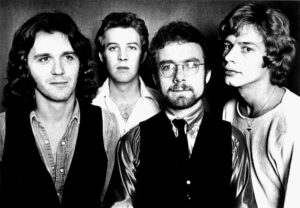
Feature Photo: Distributed by Atlantic Records, Public domain, via Wikimedia Commons
Formed in London in 1968, King Crimson became one of progressive rock’s most adventurous and influential bands. Robert Fripp and his changing circle of collaborators drew from classical music, jazz, folk, hard rock, free improvisation, minimalism, electronic music, and sounds that seemed to belong to no established category. That refusal to settle into one identity made King Crimson difficult to define and impossible to mistake for anyone else.
The original lineup of Robert Fripp, Michael Giles, Greg Lake, Ian McDonald, and lyricist Peter Sinfield introduced that vision on In the Court of the Crimson King in 1969. The album’s combination of explosive heaviness, Mellotron grandeur, jazz improvisation, and haunting ballads became a landmark in progressive rock. Its impact was immediate, yet the lineup began coming apart almost as soon as the record was released.
King Crimson continued through a succession of reinventions. In the Wake of Poseidon and Lizard arrived in 1970, followed by Islands in 1971. Fripp then assembled the extraordinary lineup responsible for Larks’ Tongues in Aspic, Starless and Bible Black, and Red. With John Wetton, Bill Bruford, David Cross, and Jamie Muir contributing at different stages, the band moved toward heavier riffs, European improvisation, rhythmic complexity, and a level of danger few studio records could capture. King Crimson disbanded in 1974, shortly before Red was released.
Fripp revived King Crimson in 1981 with Adrian Belew, Tony Levin, and Bill Bruford. The albums Discipline, Beat, and Three of a Perfect Pair introduced interlocking guitars, post-punk energy, electronic percussion, and rhythmic ideas influenced by minimalism and African music. Later versions of the band included the 1990s Double Trio, the 2000s Double Duo, and the seven- and eight-member ensembles that toured from 2014 through 2021.
The final King Crimson performance took place at Bunkamura Orchard Hall in Tokyo on December 8, 2021. Fripp described the group as having moved “from sound to silence,” but the music has continued through live recordings, archival releases, remixes, and new presentations drawn from more than five decades of performances. Selecting only ten pieces from such a vast and constantly changing body of work is nearly impossible, but these recordings offer a powerful journey through the many lives of King Crimson.
# 10 – Fallen Angel
We open our Top 10 King Crimson Songs list with “Fallen Angel,” one of the most emotionally direct pieces on Red. John Wetton sings from the perspective of a man mourning his younger brother, whose life ends in gang violence on the streets of New York. The tenderness in Wetton’s vocal makes the sudden surges of electric guitar and brass feel even more devastating.
Robert Fripp’s acoustic guitar introduces the song with a fragile beauty before the arrangement expands into darker and heavier territory. Mark Charig contributes cornet, while Robin Miller adds oboe, giving “Fallen Angel” colors rarely heard in a conventional rock recording. Fripp, Wetton, and Bill Bruford hold the performance together with the controlled intensity that defined the Red lineup.
King Crimson did not perform “Fallen Angel” during the 1970s. The song finally entered the band’s concert repertoire in 2017, allowing audiences to hear one of Red‘s long-neglected masterpieces onstage.
# 9 – In the Wake of Poseidon
The title track from the band’s second album, In the Wake of Poseidon, features one of Greg Lake’s final King Crimson lead vocals. His commanding delivery rises over Fripp’s acoustic guitar and the enormous Mellotron waves that give the song its solemn atmosphere.
The album was often criticized for following the shape of the debut, In the Court of the Crimson King, too closely, and “In the Wake of Poseidon” inevitably recalls “Epitaph.” Yet the song stands on its own through its stately melody, Lake’s vocal power, and Peter Sinfield’s images of balance, conflict, and human weakness. When the source material is this strong, resemblance is hardly a fatal flaw.
# 8 – Islands
The closing title track from King Crimson’s fourth studio album reveals the band’s softer and more spacious side. “Islands” unfolds slowly through Boz Burrell’s gentle vocal, Robert Fripp’s restrained guitar, Mel Collins’ flute and saxophone, and the jazz-influenced drumming of Ian Wallace. Rather than forcing a dramatic climax, the music seems to float beyond the horizon.
Islands was the only studio album made by the touring core of Fripp, Collins, Burrell, and Wallace. It also became the final King Crimson studio record with lyrics by Peter Sinfield. After the accompanying tour, Fripp replaced the entire lineup and moved toward the metallic improvisation and rhythmic force of Larks’ Tongues in Aspic, Starless and Bible Black, and Red.
The album divided critics, but “Islands” remains one of the most beautiful pieces in the King Crimson catalog. Its patience, warmth, and impressionistic arrangement provide a striking contrast with the band’s more violent music.
# 7 – Larks’ Tongues in Aspic Suite
“Larks’ Tongues in Aspic” is not a single composition confined to one album. It is a musical idea King Crimson revisited across three decades, changing its language whenever the band itself changed. Parts One and Two appeared on Larks’ Tongues in Aspic in 1973. Part Three arrived on Three of a Perfect Pair in 1984, while Part Four and “Coda: I Have a Dream” appeared on The ConstruKction of Light in 2000. “Level Five,” released during the next phase of the band, is widely heard as another chapter in the same lineage.
Part One begins in near silence with Jamie Muir’s delicate percussion before David Cross’s violin, John Wetton’s bass, Bill Bruford’s drums, and Robert Fripp’s guitar push the music toward eruptions of extraordinary force. Muir’s collection of found objects, metallic sounds, and theatrical percussion helped give the piece its unusual title and made the original recording sound unlike anything else in rock music.
Part Two is tighter and more riff-driven, built around one of Fripp’s most durable heavy compositions. Part Three transfers the idea into the interlocking guitar language of the 1980s lineup. Part Four makes the music denser and more mechanical, while “Level Five” turns the concept into a brutal rhythmic construction suited to the Double Duo.
Taken together, the suite captures the central King Crimson principle: musical ideas do not have to remain frozen in the time or lineup that created them. They can be dismantled, rebuilt, and made dangerous again.
# 6 – I Talk to the Wind
The second track on In the Court of the Crimson King, “I Talk to the Wind” follows the violence of “21st Century Schizoid Man” with six minutes of calm reflection. Ian McDonald’s flute provides the song’s defining sound, while Greg Lake delivers one of the gentlest vocals of his career.
That dramatic contrast became one of King Crimson’s most effective techniques. Rather than trying to match the debut album’s explosive opening, “I Talk to the Wind” clears the air and draws the listener into a completely different emotional world. Its melody is delicate, but the sense of isolation in Peter Sinfield’s lyric keeps the song from becoming merely beautiful background music.
# 5 – Red
The title track opening 1974’s Red is one of the heaviest instrumentals King Crimson ever recorded. Its polyrhythms, shifting accents, and crushing central riff carry the unmistakable Crimson character, but the dominant impression is the physical force of Robert Fripp’s guitar.
The core trio of Fripp, bassist John Wetton, and drummer Bill Bruford created an enormous sound through carefully arranged guitar overdubs and a rhythm section that seems to pull against itself without ever coming apart. Former King Crimson members and guest musicians appear elsewhere on the album, but the title track is built around the severe concentration of the trio.
Red arrived only weeks after Fripp had brought the 1970s version of King Crimson to an end. Its reputation grew steadily, and the album is now widely regarded as one of the band’s defining works. The title track announces its world immediately: hard, disciplined, unsettling, and completely without compromise.
# 4 – Starless
The final track on Red and the last studio recording on King Crimson’s final album of the 1970s, “Starless” stands as a twelve-minute epic. John Wetton developed the original melody and lyrics, but the composition was initially rejected for Starless and Bible Black. After the band reshaped the piece, it was recorded during the Red sessions and became one of King Crimson’s greatest achievements.
Wetton’s vocal opens the song in a mood of complete resignation, supported by Mellotron and David Cross’s violin. The middle section then reduces the music to a repeating guitar line while Wetton’s bass and Bill Bruford’s percussion gradually increase the pressure. When the full band finally breaks loose, the release is overwhelming.
Three selections from Red appear on this list, and “Starless” demonstrates why the album is essential listening. It combines beauty, tension, improvisational danger, and crushing power in one perfectly shaped performance.
# 3 – Epitaph
“Epitaph” captures something timeless in the original King Crimson. Peter Sinfield’s lyrics, sung with enormous conviction by Greg Lake, present a world collapsing beneath fear, confusion, and failed leadership. Ian McDonald’s Mellotron gives the song an almost orchestral scale, while his flute and Robert Fripp’s acoustic guitar bring moments of fragile beauty to the darkness.
The performance never depends on speed or instrumental display. Its power comes from the way each element supports the song’s sense of approaching catastrophe. More than half a century after its release, “Epitaph” still sounds less like a period piece than a warning that has never stopped being relevant.
# 2 – 21st Century Schizoid Man
The opening track from King Crimson’s debut album remains one of the most shocking introductions in rock history. “21st Century Schizoid Man” combines Robert Fripp’s distorted guitar, Greg Lake’s equally distorted vocal and bass, Michael Giles’ explosive drumming, and Ian McDonald’s screaming saxophone in a collision of progressive rock, jazz, and proto-metal.
The instrumental middle section, titled “Mirrors,” moves through rapid unison figures, changing accents, and a Fripp solo that turns controlled dissonance into pure momentum. Guitar World later included the performance among its celebrated list of one hundred great guitar solos. The piece does not feel like a conventional song so much as a seven-minute experience that leaves the listener breathless.
Peter Sinfield’s lyric uses violent and fragmented images to confront war, political corruption, and the dehumanizing machinery of modern life. The music answers those words with a sound every bit as brutal. Few recordings from 1969 pointed so directly toward the heavier and more experimental music that would follow.
It has always been difficult to define exactly what King Crimson is beyond the constant presence of Robert Fripp and an uncompromising commitment to change. What is easy to say is that King Crimson created a sound no other band could convincingly imitate.
# 1 – The Court of the Crimson King
Everyone knows this one. “The Court of the Crimson King” closes the band’s 1969 debut with one of the most recognizable Mellotron themes in progressive rock. Released in edited form as a single, it reached number eighty on the Billboard Hot 100, becoming King Crimson’s only appearance on that chart.
Ian McDonald composed the music, and Peter Sinfield supplied the vivid lyric. Greg Lake sings each verse with ceremonial authority while Michael Giles’ drumming, Robert Fripp’s guitar, and McDonald’s Mellotron build a world that feels medieval, psychedelic, and futuristic at the same time.
The main theme gives way to the instrumental passage “The Return of the Fire Witch” before returning with even greater force. A false ending leads into “The Dance of the Puppets,” after which the Mellotron theme rises once more for the final passage. The arrangement feels massive, but every section has a clear dramatic purpose.
“The Court of the Crimson King” gave the band its enduring image and brought the debut album to a magnificent close. It remains the perfect entry point into King Crimson’s music and our choice for the number one position.
Updated August 5, 2026.
Top 10 King Crimson Songs article published on ClassicRockHistory.com © 2026

















NOTHING from Discipline?