

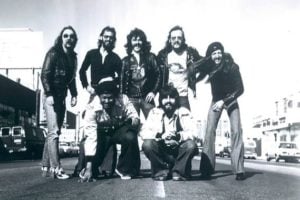
Photo: By ian [Public domain], via Wikimedia Commons
Though there have been many lineup and sound changes over the years, Carlos Santana has remained the group’s guiding musical force, and his guitar has a distinct sound. For more than five decades, Santana has recorded music that jumps and dances across styles, genres, and cultures while retaining that unmistakable Santana feel. No matter the song, album, or year, you know it’s Carlos Santana when you hear the first notes of his searing guitar. If we’re talking about the talent and influence of 1970s guitar players such as Jimmy Page, Jeff Beck, Eric Clapton, and Jimi Hendrix, Carlos Santana stands right alongside them.
What makes Santana’s catalog so enjoyable is that you can hear a real band behind that famous guitar sound. The percussion, bass, keyboards, drums, and changing vocalists have all played essential roles in the group’s greatest recordings. From the original Latin-rock experiments of the late 1960s through the huge pop crossover hits of Supernatural, these ten songs celebrate both the musicianship and the melodies that have made Santana’s music so enduring.
# 10 – Soul Sacrifice

The song that started it all never officially charted, but the band’s epic performance of this track at the original Woodstock festival catapulted them into the limelight. Watching and/or listening to the performance footage shows you why. From the percussion groove that starts it all off to the booming bassline to the kit work of Michael Shrieve, the song simply will not let you stop nodding your head. Go ahead. Try it. We’ll wait.
“Soul Sacrifice” closed Santana’s self-titled debut album, released in 1969, but it was the group’s performance at Woodstock that summer that turned the instrumental into a piece of rock history. The song’s extended percussion passages gave drummer Michael Shrieve and the band’s other rhythm players a chance to shine. Shrieve was still a teenager when he played at Woodstock, and the tension and energy of that performance helped introduce a national audience to a band unlike anything else on the bill.
# 9 – Winning

Recorded and released as part of Santana’s 1981 album, Zebop!, “Winning” features the distinctive vocals of Alex Ligertwood, whose powerful voice was central to several Santana lineups in the 1980s and beyond. Originally written and released by Russ Ballard, Santana’s version of the song reached number 17 on Billboard’s Hot 100. The bright, clean guitar sound also gives this recording a different character from some of the band’s heavier early work.
Russ Ballard originally released “Winning” on his own album of the same name in 1976, five years before Santana recorded it. Produced by Keith Olsen with Carlos Santana, the 1981 version added a polished rock-radio sound to the band’s catalog and reached number 17 on the Billboard Hot 100. It was also a major hit on American rock radio. The lyric about getting back on your feet after disappointment gave Alex Ligertwood a strong vocal showcase, while Carlos supplied enough guitar fire to make the recording unmistakably Santana.
# 8 – No One to Depend On

From Santana III, “No One to Depend On” has a few things going for it. First, the track features long instrumental passages showcasing what is considered the band’s “classic” lineup. Along with Carlos, we hear Neal Schon , later of Journey fame, on guitar. We also hear José Chepito Areas on percussion, Gregg Rolie
 on keyboards and vocals, David Brown on bass, Michael Shrieve
 on drums, and Mike Carabello on percussion. Second, it features an outstanding back-and-forth between guitar and bass, which you don’t hear all that often.
“No One to Depend On” was released as a single in 1972 and reached number 36 on the Billboard Hot 100. The song came from the band’s third studio album, Santana III, released in 1971, which also featured “Everybody’s Everything.” It is one of the clearest examples of the original band’s ability to build a piece around a repeating groove, then let the guitars, organ, bass, and percussion shift around one another without losing the rhythm. Neal Schon’s arrival as a second lead guitarist gave Santana an even wider range of possibilities on this record.
# 7 – She’s Not There
The opening keyboard and bass riff sucks you so far into this Latin beat that the drums almost seem superfluous by the time they enter. Off 1977’s album, Moonflower , this cover of the 1964 hit by The Zombies
 reached number 27 on the Billboard Hot 100. Oh, and guess what? There are some ripping guitar solos scattered throughout the 4-minute song. Didn’t see that coming, did you?
Written by Rod Argent, “She’s Not There” had originally been a hit for the Zombies in 1964, long before Santana recorded it. The 1977 Santana version featured Greg Walker on lead vocals, Tom Coster on keyboards, and Carlos Santana on guitar, with the percussion giving the song an entirely different character. It reached number 27 on the Billboard Hot 100 and number 11 in Britain. The recording appeared on Moonflower, an unusual double album that mixed new studio tracks with live performances, making it an especially interesting entry in Santana’s 1970s catalog.
# 6 – Everybody’s Everything
Another track from Santana III , “Everybody’s Everything,” reached number 12 on the American pop chart. It might have been named “Everybody’s Gonna Dance Their A*ses Off” because this sucker is a smoking groove from beginning to end. And that scorching guitar solo? It’s not Carlos. It’s Neal Schon. It was a shining example of the musicianship that flowed throughout the Santana experience. Santana’s “Everybody’s Everything” has long been a favorite jam session number for legions of blues-rock guitarists over the past forty years.
Issued as a single in 1971, “Everybody’s Everything” reached number 12 on the Billboard Hot 100 and became one of the band’s biggest early hits. In addition to Santana’s regular musicians, the recording featured the Tower of Power horn section, adding a punchy brass sound to the Latin-rock rhythm. Those horns, the vocal chants, the furious percussion, and Schon’s guitar helped give the song an almost nonstop party atmosphere. It remains one of the tracks that best demonstrate how the band could make an intricate arrangement sound completely spontaneous.
# 5 – Maria Maria

The first number-one hit on this list, “Maria Maria,” is a perfect demonstration of Santana’s genre-defying abilities. Featuring the Product G&B, an R&B duo associated with Wyclef Jean, the recording appeared on the 1999 album Supernatural . “Maria Maria” became an international number-one hit, sitting atop the charts for weeks and weeks. It also earned a place on Billboard rankings of the biggest Hot 100 hits. Many of Santana’s old-time fans were not happy with Santana’s crossover into the pop world. However, Santana’s guitar work on the record clearly demonstrated that “Maria Maria” was still a substantial and immensely enjoyable recording.
“Maria Maria” was released as a single during the promotion of Supernatural and reached number one on the Billboard Hot 100 in April 2000, remaining there for ten weeks. Wyclef Jean and Jerry “Wonda” Duplessis produced the track, which paired the vocals of the Product G&B with a hip-hop-influenced beat and Carlos Santana’s melodic guitar lines. The arrangement proved that his playing could be just as recognizable and expressive in a contemporary R&B setting as it had been on the long instrumental performances of the band’s earlier records.
# 4 – Oye Como Va
Going back to the early days of Santana, this Tito Puente cover was recorded for the band’s second album, Abraxas. Included on the 1970 album, the song became a single in 1971 and reached number 13 on the Hot 100, adding to Santana’s growing fame. Pretty impressive for what is essentially a cha-cha-cha rhythm. However, on Santana’s version, the band replaced Tito Puente’s horn section with rock guitars and the Hammond B-3 Organ. What is most significant about Santana’s recording is the popularity that his version of “Oye Como Va” brought to the legendary Tito Puente. And in some ways, Santana probably gained many of Tito’s fans himself.
“Oye Como Va” was written and first recorded by Tito Puente, whose original was a Latin dance number built around an irresistible repeating phrase. Santana included its interpretation on Abraxas in 1970 and released it as a single in 1971, when it reached number 13 on the Billboard Hot 100. Gregg Rolie’s organ, Carlos Santana’s guitar, and the layered percussion retain the heart of Puente’s rhythm while creating a sound that crosses naturally into rock music. It was a powerful example of Santana bringing Latin musical traditions to a new audience without sacrificing their energy.
# 3 – Smooth
The first single from Supernatural, “Smooth,” features the vocal work of Rob Thomas from Matchbox Twenty. An instant hit, Smooth spent 30 weeks on Billboard’s Top 10 and contributed to Supernatural selling over 30 million copies around the world. The collaboration with Thomas was the first of many successful match-ups between Carlos’ guitar and various pop or rock singers. If you like Carlos’ guitar, and you obviously do, then you’ll be happy to note that he essentially never stops soloing the entire song.
“Smooth” was written by Rob Thomas and Itaal Shur and produced by Matt Serletic for Santana’s Supernatural album in 1999. It went to number one on the Billboard Hot 100 that October and remained there for twelve weeks, spending thirty weeks in the Top Ten. The song also won major Grammy Awards, including Record of the Year and Best Pop Collaboration with Vocals. What makes it so effective is how naturally Thomas’s soulful lead vocal, the Latin-influenced groove, and Carlos Santana’s guitar answer one another. It brought Santana to a younger audience without erasing the sound that made the band famous.
# 2 – Evil Ways
You know the song. You’ve heard it hundreds of times on the radio. It was the band’s first hit, reaching number nine on the American charts in 1970. The combination of rock sensibility and Latin percussion and rhythms would prove a potent brew for the band, and it was this debut album that cemented that sound. Two other things to note about this track: awesome use of cowbell and the jump to a heavy groove at the guitar solo. I mean, why settle for Carlos’ amazing sound and style when your rhythm section can tear it up at the same time? Unfortunately, the radio edit fades us out a little early, but plenty of live versions give it all.
“Evil Ways” was written by Clarence “Sonny” Henry and recorded by percussionist Willie Bobo before Santana made it famous. The band’s version appeared on its 1969 self-titled debut and became its first Top Ten American single, reaching number nine on the Billboard Hot 100 in March 1970. Gregg Rolie sang lead and played organ, while Carlos Santana’s guitar and the percussion section gave the arrangement an edge that was new to many rock-radio listeners. The way the rhythm grows beneath the solo is a perfect introduction to the musical chemistry that defined the band’s earliest albums.
# 1 – Black Magic Woman/Gypsy Queen
A cover of Peter Green and Fleetwood Mac’s “Black Magic Woman” was recorded for Abraxas and featured Gregg Rolie on vocals. Reaching number four on the American charts, this song and sound might be the most iconic of the 70s-era Santana. Technically, this track is a medley of Green’s song and Gábor Szabó’s instrumental “Gypsy Queen,” which provides the extended instrumental passage following the vocal song. Some later versions omitted these sections, and the Abraxas edit stands as the band’s major hit.
The original “Black Magic Woman” was written by guitarist Peter Green and released by Fleetwood Mac in 1968. Santana recorded its famous version for Abraxas in 1970, with Gregg Rolie on lead vocals and organ. The album performance flows into “Gypsy Queen,” an instrumental written and recorded by guitarist Gábor Szabó in 1966, giving the track an extended Latin-jazz ending. Santana’s single reached number four on the Billboard Hot 100, and Carlos’s sustained, singing guitar tone turned it into one of the band’s signature recordings. Few songs illustrate the meeting of blues, rock, and Latin rhythm more memorably.
Check out similar articles on ClassicRockHistory.com Just click on any of the links below……
Read More: Artists’ Interviews Directory At ClassicRockHistory.com
Read More: Classic Rock Bands List And Directory
Read More: 100 Essential Albums From The 1960s That Everyone Should Own
Updated November 8, 2026
Top 10 Santana Songs article published on ClassicRockHistory.com © 2026













No Responses