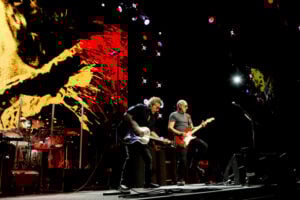
Feature Photo: Zamrznuti tonovi / Shutterstock.com
Everyone knows the legendary Black Sabbath albums released in the 1970s, from their debut album Black Sabbath to Sabotage in 1975, though there were a few more releases during that era. Fans of Ronnie James Dio are also familiar with albums like Heaven and Hell, Mob Rules, and Dehumanizer. However, the band went through several other lineups with different lead singers, including Born Again with Ian Gillan, Seventh Star with Glenn Hughes, and, of course, the Tony Martin albums.
With so much material to choose from, casual fans may have overlooked much of this music, and this article aims to showcase those hidden gems. We purposely avoided the band’s first six albums from 1970 to 1975 and a lot of the classic Dio stuff. We wanted to dig deeper and offer some surprises as well as some gems we think were overlooked or at least came off as a shocking left turn for the band.
# 10 – Trashed – Born Again

“Trashed” opens Black Sabbath’s 1983 album Born Again, the band’s only studio album with Deep Purple singer Ian Gillan. Produced by Black Sabbath and Robin Black and recorded at the Manor Studio in Oxfordshire, the track features Gillan with Tony Iommi, Geezer Butler, Bill Ward, and Geoff Nicholls. Gillan based the song on the infamous night he took Bill Ward’s car around the Manor grounds after drinking and crashed it, and the combination of that reckless story, Iommi’s heavy riff, and Gillan’s wild vocal makes “Trashed” one of the great overlooked cuts from this unusual Sabbath lineup.
# 9 – Turn to Stone – Seventh Star

“Turn to Stone” appears on Black Sabbath’s 1986 album Seventh Star, a record Tony Iommi originally intended as a solo project before it was issued as “Black Sabbath featuring Tony Iommi.” Produced by Jeff Glixman, the album features Glenn Hughes on vocals, Dave Spitz on bass, Eric Singer on drums, and Geoff Nicholls on keyboards alongside Iommi. “Turn to Stone” is one of the record’s hardest-driving tracks, with Hughes pushing his voice against Iommi’s aggressive guitar work and the band moving far from the classic Ozzy-era Sabbath sound.
# 8 – Devil & Daughter – Headless Cross

Headless Cross, released in 1989, was Black Sabbath’s second album with Tony Martin and remains one of the strongest records from that era. “Devil & Daughter” combines Martin’s commanding vocals with Tony Iommi’s heavy riffing, Cozy Powell’s thunderous drums, Geoff Nicholls’ keyboards, and the dark atmosphere that runs throughout the album; Tony Martin also contributed bass to this track. It is exactly the sort of song that demonstrates why the Martin-era Sabbath catalog deserves more attention from listeners who never ventured far beyond Ozzy Osbourne and Ronnie James Dio.
# 7 – I Witness – Cross Purposes

“I Witness” opens Black Sabbath’s 1994 album Cross Purposes with Tony Martin back on vocals alongside Tony Iommi, Geezer Butler, drummer Bobby Rondinelli, and keyboardist Geoff Nicholls. Produced by Black Sabbath and Leif Mases, the song combines a direct, driving Iommi riff with Martin’s powerful delivery and Butler’s heavy bass, giving the album an immediate sense of purpose at a time when the mainstream rock world had shifted dramatically toward alternative and grunge. “I Witness” is one of the strongest reminders that Sabbath was still capable of delivering serious heavy metal in the 1990s.
# 6 – The Mob Rules – Mob Rules

“The Mob Rules,” from Black Sabbath’s 1981 album Mob Rules, is one of the fiercest songs of the Ronnie James Dio era. Produced by Martin Birch and performed by Dio, Tony Iommi, Geezer Butler, and Vinny Appice, the track drives forward on one of Iommi’s most aggressive riffs while Dio’s lyrics warn about mob mentality and following fools. A different version appeared in the animated film Heavy Metal, and the song was also released as a single. This is how you make a rock and roll album explode, baby!
# 5 – The Shining – The Eternal Idol

At the halfway point on our 10 Most Underrated Black Sabbath Songs list is “The Shining,” the opening track from 1987’s The Eternal Idol and the first released Black Sabbath album to feature Tony Martin on lead vocals. The troubled sessions went through several personnel and production changes, with the finished album featuring Tony Iommi, Martin, Bob Daisley, Eric Singer, and Geoff Nicholls and production work by Jeff Glixman, Vic Coppersmith-Heaven, and Chris Tsangarides. “The Shining” immediately showed that Martin’s powerful voice could carry the dark, melodic side of Iommi’s writing and helped establish the sound of Sabbath’s late-1980s period.
# 4 – TV Crimes – Dehumanizer

“TV Crimes,” from Black Sabbath’s 1992 album Dehumanizer, reunited Ronnie James Dio with Tony Iommi, Geezer Butler, and Vinny Appice and delivered one of the fastest, most direct songs of that reunion. Produced by Reinhold Mack, the track takes aim at televangelists and the commercialization of religion, with Dio’s biting vocal riding over Iommi’s urgent riff and a pounding rhythm section. It was released as a single and received an official music video, but it still tends to sit in the shadow of Sabbath’s better-known Dio-era classics.
# 3 – You Won’t Change Me – Technical Ecstasy

For those exploring the more obscure corners of Black Sabbath’s discography, “You Won’t Change Me” from 1976’s Technical Ecstasy is one of the album’s darkest and most effective songs. Produced by Robin Black and recorded principally at Criteria Studios in Miami, the track features Ozzy Osbourne, Tony Iommi, Geezer Butler, Bill Ward, and Gerald “Jezz” Woodruffe on keyboards. Woodruffe’s haunting keyboard work gives the song a different texture from the band’s earlier records, while Iommi’s slow riffs and Ozzy’s weary vocal create the melancholy mood that makes the track stand out.
# 2 – End of the Beginning – 13
![13[2 LP]](https://m.media-amazon.com/images/I/51royeFTUKL._SL500_.jpg)
“End of the Beginning” opens Black Sabbath’s 2013 album 13, the first studio album featuring Ozzy Osbourne, Tony Iommi, and Geezer Butler together since 1978’s Never Say Die!. Produced by Rick Rubin and recorded with Rage Against the Machine drummer Brad Wilk, the nearly nine-minute track deliberately reconnects with the slow, ominous weight of early Sabbath while still sounding like a band confronting the modern world. The song received its world premiere during Black Sabbath’s appearance on the season finale of CSI: Crime Scene Investigation, making it one of the most visible tracks from the band’s final studio album.
# 1 – Headless Cross – Headless Cross
“Headless Cross,” the title track from Black Sabbath’s 1989 album Headless Cross, takes the top spot on our list because it captures just how powerful the Tony Martin era could be. Produced by Tony Iommi and Cozy Powell, the track features Martin on vocals, Iommi on guitar, Powell on drums, Laurence Cottle on bass, and Geoff Nicholls on keyboards, combining a huge drum opening, one of Iommi’s darkest riffs, and Martin’s dramatic vocal into a song that sounds unmistakably like Black Sabbath while belonging to a very different chapter of the band’s history. For anyone who stopped listening after the Ozzy or Dio years, “Headless Cross” is one of the first songs we would recommend.
We love Black Sabbath and have paid tribute to the band by writing many articles on the group, which you can find below……
An Interview With Geezer Butler Of Black Sabbath
Top 10 Black Sabbath Songs
Top 10 Ozzy Osbourne Black Sabbath Songs
Top 10 Ronnie James Dio Black Sabbath Songs
Top 10 Black Sabbath Albums
Complete List Of Black Sabbath Albums And Songs
Top 10 Black Sabbath Album Covers
History Of The Ozzy Osbourne Black Sabbath Years
Black Sabbath Debut Album Review
Black Sabbath Sabotage: Album Review
Black Sabbath Paranoid a Metal Masterpiece
Metallica’s Sensational Iron Man Cover of Black Sabbath’s Masterpiece
Black Sabbath’s Lollapalooza Performance in 2012 Was One for the Ages
Updated September 3, 2026.
10 Most Underrated Black Sabbath Songs article published on ClassicRockHistory.com © 2026