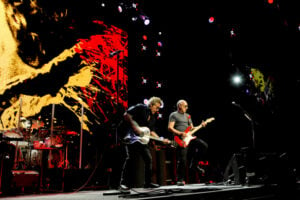
Feature Photo: Adam McCullough / Shutterstock.com
Heart took shape in the early 1970s from roots in the Seattle music scene, with Ann and Nancy Wilson becoming the band’s creative center. Their combination of hard rock, folk, acoustic textures, and powerful vocals gave Heart a sound that could move from intimate ballads to huge arena rock without losing its identity. The classic lineup included Roger Fisher on guitar, Steve Fossen on bass, Michael Derosier on drums, and Howard Leese on guitar and keyboards. Heart’s early breakthrough came with Dreamboat Annie, followed by albums such as Little Queen, Dog & Butterfly, and Bébé le Strange.
Heart has released sixteen studio albums, from Dreamboat Annie through Beautiful Broken in 2016. Along the way, the band reinvented itself during the 1980s with hits such as “These Dreams,” “Alone,” and “What About Love,” while continuing to draw on the heavier rock sound that defined songs like “Barracuda” and “Magic Man.” Heart was inducted into the Rock and Roll Hall of Fame in 2013, and the Wilson sisters remain among the most influential women in rock history. This list looks back at twenty songs that capture the band’s range across its many eras.
# 20 – “Dreamboat Annie” – Dreamboat Annie
“Dreamboat Annie” captures the softer side of Heart’s debut album with acoustic textures and a gentle, dreamlike atmosphere. Ann and Nancy Wilson wrote the song, while Mike Flicker produced the recording. Ann Wilson delivers the lead vocal, Nancy Wilson plays acoustic guitar and sings backing vocals, Steve Fossen plays bass, and Howard Leese adds bells. Additional musicians include Geoff Foubert on banjo and Kat Hendrikse on drums. Released as a single after “Crazy on You” and “Magic Man,” the song reached number 42 on the Billboard Hot 100. Its quiet beauty provides a striking contrast to the heavier songs that helped make Heart famous.
# 19 – “If Looks Could Kill” – Heart
“If Looks Could Kill” captures the polished hard rock sound that powered Heart’s 1985 comeback. Written by Jack Conrad and Bob Garrett, the song was produced by Ron Nevison during sessions at the Plant in Sausalito and the Record Plant in Los Angeles. Ann Wilson’s forceful lead vocal drives the track while Mark Andes on bass and Denny Carmassi on drums give it a muscular rhythm section. The song’s aggressive groove and sharp chorus fit naturally beside the album’s bigger hits. Released as the fifth single from Heart, it reached number 54 on the Billboard Hot 100. Even without matching the chart success of “These Dreams” or “Never,” it remains one of the album’s toughest rock performances.
# 18 – “Alone” – Bad Animals
“Alone” became one of Heart’s defining recordings and one of the biggest power ballads of the 1980s. Billy Steinberg and Tom Kelly wrote the song and first recorded it with their i-Ten project before Heart transformed it on Bad Animals. Ron Nevison produced Heart’s version, which was recorded during the album sessions in 1986 and 1987. Ann Wilson’s vocal moves from restraint to full power, while Nancy Wilson’s guitar and the dramatic keyboard arrangement build the tension underneath her. Released in 1987, “Alone” spent three weeks at number one on the Billboard Hot 100. The performance remains one of the clearest examples of Ann Wilson’s extraordinary vocal range and control.
# 17 – “Fanatic” – Fanatic
The title track from Heart’s 2012 album Fanatic shows the band sounding aggressive and contemporary without abandoning its rock foundation. Ben Mink produced the album and contributed guitar, programming, keyboards, strings, and other instrumentation throughout the project. Nancy Wilson’s guitar work gives the song its edge, while Ann Wilson delivers the vocal with the same intensity that defined Heart’s earlier decades. Ric Markmann on bass and Ben Smith on drums provide the rhythm section behind the track. The song’s dark, urgent sound reflects the consuming obsession suggested by its title. Fanatic reached number 24 on the Billboard 200, giving Heart another strong late-career album showing.
# 16 – “Make Me” – Jupiters Darling
“Make Me” comes from Heart’s 2004 album Jupiters Darling, a record that brought the Wilson sisters back toward the acoustic and hard rock textures of their earlier work. Ann Wilson, Nancy Wilson, and Craig Bartock wrote the song, while Nancy Wilson and Bartock handled production duties on the album. The track begins with an intimate acoustic feeling before growing into a heavier arrangement. Ann Wilson’s vocal carries the emotional shift from vulnerability into strength, while Bartock and Nancy Wilson build the guitar layers around her. The contrast between the quieter opening and full rock sections gives the song much of its dramatic power. It is one of the strongest examples of Heart reconnecting with its 1970s roots without simply repeating the past.
# 15 – “Black on Black II” – Desire Walks On
“Black on Black II” opens Heart’s 1993 album Desire Walks On with one of the band’s heaviest performances of the decade. The song began as Lisa Dalbello’s “Black on Black,” with Ann and Nancy Wilson receiving additional writing credits for Heart’s revised version. John Purdell and Duane Baron produced the recording. Ann Wilson attacks the vocal with enormous force while the guitars and rhythm section create a dark, relentless atmosphere. The track reached number four on Billboard’s Mainstream Rock chart in 1993. Its combination of an older song foundation and a distinctly Heart arrangement makes it one of the album’s most memorable moments.
# 14 – “WTF” – Red Velvet Car
“WTF” from Heart’s 2010 album Red Velvet Car delivers a sharp, confrontational blast of modern rock. Ann Wilson, Nancy Wilson, and Craig Bartock share the songwriting credit, while Ben Mink produced the album. Nancy Wilson’s guitar work and Ann Wilson’s vocal give the track the same kind of direct attack that made Heart’s best hard rock songs so effective. Ric Markmann provides bass, while the production keeps the arrangement raw enough to preserve its anger. The song turns frustration into a compact rock statement rather than stretching the idea beyond what it needs. It helped show that Heart could still sound forceful and contemporary more than three decades after Dreamboat Annie.
# 13 – “Straight On” – Dog & Butterfly
“Straight On” brings a strong funk influence into Heart’s 1978 album Dog & Butterfly. Ann Wilson, Nancy Wilson, and Sue Ennis wrote the song, while the recording features Steve Fossen on bass, Michael Derosier on drums, Roger Fisher and Howard Leese on electric guitars, and Nancy Wilson on acoustic guitar. The bass groove gives the track a rhythmic feel that separates it from Heart’s more straightforward hard rock songs. Ann Wilson’s vocal glides across the arrangement with confidence rather than overpowering it. “Straight On” reached number 15 on the Billboard Hot 100. Its combination of rock guitar and groove-heavy rhythm remains one of the band’s most distinctive late-1970s recordings.
# 12 – “Bébé le Strange” – Bébé le Strange
“Bébé le Strange” marked the beginning of a new phase for Heart after Roger Fisher’s departure. Written by Ann Wilson, Nancy Wilson, Sue Ennis, and Roger Fisher, the title track appeared on the band’s 1980 album. Mike Flicker produced the recording, with Ann Wilson on lead vocals and bass, Nancy Wilson and Howard Leese on guitars, and Michael Derosier on drums. Sue Ennis and Chrissy Shefts also contributed guitar to the track. The song’s dark riff and commanding vocal give it a tougher atmosphere than much of Heart’s earlier material. It became a statement that the band could move forward despite a major lineup change.
# 11 – “How Can I Refuse” – Passionworks
“How Can I Refuse” stands as one of Heart’s strongest songs from the transitional early 1980s. Ann Wilson, Nancy Wilson, Sue Ennis, Howard Leese, Mark Andes, and Denny Carmassi share the songwriting credit. Keith Olsen produced the recording, with Ann on lead vocals, Nancy and Howard on guitars, Andes on bass, Carmassi on drums, and David Paich on synthesizer. The song combines Heart’s hard rock instincts with the cleaner production style that would become even more prominent two years later. Released in 1983, it reached number one on Billboard’s Top Rock Tracks chart and number 44 on the Hot 100. Its success proved that Heart still had major radio power before the huge commercial resurgence of the 1985 album.
# 10 – “City’s Burning” – Private Audition
“City’s Burning” opens Heart’s 1982 album Private Audition with a tense and aggressive burst of rock. Ann Wilson, Nancy Wilson, and Sue Ennis wrote the song, while the Wilson sisters, Ennis, and Howard Leese produced the recording. Ann’s vocal brings urgency to lyrics filled with images of unrest and danger. The track captures Heart during a period of transition just before longtime rhythm-section members Steve Fossen and Michael Derosier left the band. Its hard-edged sound helped keep one foot in the group’s 1970s identity even as Heart was moving toward a new era. “City’s Burning” reached number 15 on Billboard’s Rock Albums and Top Tracks chart.
# 9 – “These Dreams” – Heart
“These Dreams” gave Nancy Wilson one of the defining lead-vocal moments of Heart’s career. Bernie Taupin and Martin Page wrote the song, while Ron Nevison produced the recording for the band’s 1985 self-titled album. Nancy’s restrained vocal gives the dreamlike lyric a completely different character from Ann Wilson’s more explosive style. Howard Leese, Mark Andes, Denny Carmassi, Johnny Colla, Holly Knight, and Peter Wolf were among the musicians who helped build the polished arrangement. Released as a single in 1986, “These Dreams” became Heart’s first number one hit on the Billboard Hot 100. Its success proved how effectively the band could adapt to the sound of the decade without losing the Wilson sisters’ identity.
# 8 – “Dog & Butterfly” – Dog & Butterfly
“Dog & Butterfly” is one of Heart’s most graceful combinations of folk influence and rock storytelling. Ann Wilson, Nancy Wilson, and Sue Ennis wrote the title track for the band’s 1978 album. The recording features Nancy Wilson on acoustic guitar and backing vocals, Steve Fossen on bass, Michael Derosier on drums, Howard Leese on piano, and Ann Wilson on lead vocals and chimes. Its imagery was inspired by the sight of a dog repeatedly jumping after a butterfly, turning a simple moment into a metaphor for striving and persistence. The arrangement stays deliberately spacious, allowing the melody and lyric to carry the song. It remains one of Heart’s most reflective and enduring compositions.
# 7 – “Kick It Out” – Little Queen
“Kick It Out” captures the raw speed and rebellious energy of Heart’s 1977 album Little Queen. Ann Wilson wrote the song, while Mike Flicker produced the recording during the band’s sessions at Kaye-Smith Studios in Seattle. Nancy Wilson’s rhythm guitar, Roger Fisher’s electric guitar, Steve Fossen’s bass, and Michael Derosier’s drums give the song its relentless forward motion. Ann Wilson delivers the vocal with a combination of melody and aggression that few singers could match. The arrangement is direct and uncluttered, allowing the band’s live energy to come through. “Kick It Out” remains one of the clearest examples of how hard Heart could rock during its original classic lineup.
# 6 – “Heartless” – Magazine
“Heartless” turns betrayal into one of the darkest songs in Heart’s early catalog. Written by Ann and Nancy Wilson, the track appeared on the band’s 1977 album Magazine, which was later remixed and reissued in 1978. Mike Flicker produced the finished album, and the classic lineup gives the song a tense, heavy sound built around guitars, bass, drums, and Ann Wilson’s commanding vocal. The lyric is direct and accusatory, which gives the performance an emotional edge that matches the title. Unlike the more acoustic material from the same era, “Heartless” leans into the band’s harder side. Its brooding atmosphere helped establish the range Heart could bring to its early albums.
# 5 – “Little Queen” – Little Queen
“Little Queen” gives the title track of Heart’s 1977 album a bluesy groove that sits between the band’s acoustic and electric sides. Ann Wilson, Nancy Wilson, Roger Fisher, Steve Fossen, Howard Leese, and Michael Derosier share the songwriting credit. Mike Flicker produced the recording during the Little Queen sessions. Roger Fisher’s guitar work and Nancy Wilson’s acoustic playing create the song’s layered texture, while Ann Wilson brings both control and force to the vocal. The track reached number 62 on the Billboard Hot 100 when released as a single. Even without the explosive impact of “Barracuda,” it remains an essential piece of the album’s identity.
# 4 – “Even It Up” – Bébé le Strange
“Even It Up” brings horns into Heart’s hard rock sound without softening the song’s attitude. Ann Wilson, Nancy Wilson, and Sue Ennis wrote the track for the 1980 album Bébé le Strange, and Mike Flicker produced it. Ann Wilson handles lead vocals and bass, Nancy Wilson plays lead and rhythm guitar, Howard Leese adds rhythm guitar, and Michael Derosier plays drums. The Tower of Power horn section gives the recording an extra punch that separates it from most of Heart’s catalog. The lyric demands fairness in a relationship, turning the title into a statement of defiance. Released as a single, “Even It Up” reached number 33 on the Billboard Hot 100.
# 3 – “Barracuda” – Little Queen
“Barracuda” remains one of Heart’s most powerful and recognizable songs. Ann Wilson, Nancy Wilson, Roger Fisher, and Michael Derosier wrote the track, while Mike Flicker produced the recording at Kaye-Smith Studios in Seattle. Nancy Wilson’s acoustic rhythm guitar, Roger Fisher’s electric guitar, Steve Fossen’s bass, Howard Leese’s guitar and Mellotron, and Derosier’s drums create the song’s unmistakable attack. Ann Wilson delivers the lyric with anger inspired by the band’s treatment by parts of the music industry. The galloping guitar figure and explosive vocal turned the song into a defining hard rock anthem. Released in 1977, “Barracuda” reached number 11 on the Billboard Hot 100.
# 2 – “Crazy on You” – Dreamboat Annie
“Crazy on You” introduced millions of listeners to the combination of acoustic precision and electric power that made Heart unique. Ann and Nancy Wilson wrote the song for Dreamboat Annie, with Mike Flicker producing the recording. Nancy Wilson’s rapid acoustic introduction leads into Roger Fisher’s electric guitar, Steve Fossen’s bass, Michael Derosier’s drums, and Ann Wilson’s commanding vocal. The acoustic opening became so closely associated with Nancy that it is often connected with her separate instrumental piece “Silver Wheels.” The lyric turns romantic escape into a response to a world filled with tension and uncertainty. “Crazy on You” remains one of Heart’s greatest demonstrations of how naturally the band could blend folk technique with hard rock force.
# 1 – “Magic Man” – Dreamboat Annie
“Magic Man” stands at number one because it captures so many of the qualities that made Heart extraordinary from the beginning. Ann Wilson wrote the song, while Mike Flicker produced the recording and Heart helped shape the arrangement. Ann’s autobiographical lyric drew from her relationship with Michael Fisher, giving the song a personal story beneath its mysterious atmosphere. Nancy Wilson and Roger Fisher contribute guitars, Howard Leese adds electric guitar and Minimoog, Steve Fossen plays bass, and Dave Wilson plays drums. The instrumental break expands the song into something more adventurous than a conventional radio single. “Magic Man” reached number nine on the Billboard Hot 100 in 1976 and became Heart’s first Top 10 hit in the United States.
Check out our fantastic and entertaining Heart articles, detailing in-depth the band’s albums, songs, band members, and more…all on ClassicRockHistory.com
Top 10 Heart Albums
Heart Plays First Concert In Almost Five Years
Complete List Of Heart Band Members
Complete List Of Heart Albums And Discography
Top 10 Heart Album Covers
Heart’s Stunning Performance of Stairway To Heaven Must Be Heard
Heart Beautiful Broken: Album Review
11 Best Heart Songs Sung By Nancy Wilson
10 Essential Heart Songs
Read More: Artists’ Interviews Directory At ClassicRockHistory.com
Read More: Classic Rock Bands List And Directory
Updated September 22, 2026
20 Most Classic Heart Songs article published on ClassicRockHistory.com © 2026