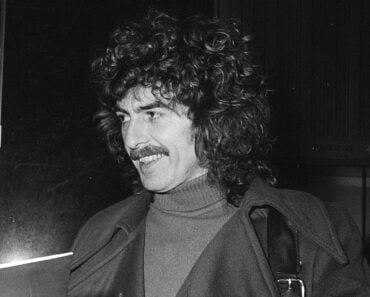
Feature Photo: Photograph: Koen Suyk. In: Nationaal Archief, Den Haag, Rijksfotoarchief: Fotocollectie Algemeen Nederlands Fotopersbureau (ANEFO), 1945-1989 – negatiefstroken zwart/wit, nummer toegang 2.24.01.05, bestanddeelnummer 928-9665, CC0, via Wikimedia Commons
The Sex Pistols emerged from the heart of London’s underground in the mid-1970s and instantly turned the music world on its head. Formed in 1975, the band’s original lineup featured vocalist Johnny Rotten, born John Lydon, guitarist Steve Jones, drummer Paul Cook, and bassist Glen Matlock, who was later replaced by Sid Vicious. Managed by Malcolm McLaren, the Pistols were not just a band; they were a cultural detonation, pushing back against the stale excess of mainstream rock with raw aggression, nihilism, and unapologetic confrontation. Their earliest performances ignited controversy and attention, helping to launch a movement that would define punk music in the United Kingdom and ripple across the world.
Although the band’s recording history is brief, it is monumental. Their only studio album, Never Mind the Bollocks, Here’s the Sex Pistols, was released in 1977 and immediately became a flashpoint. Featuring tracks such as “Anarchy in the U.K.,” “God Save the Queen,” “Pretty Vacant,” and “Holidays in the Sun,” the album was banned in multiple places yet still climbed to number one on the UK Albums Chart. With snarling vocals, explosive guitar work, and lyrics that attacked Britain’s institutions, the record captured the frustrations of a generation. It remains one of the most influential albums in rock history.
From their earliest singles, the Sex Pistols polarized the public. “Anarchy in the U.K.,” their 1976 debut, was a declaration of chaos, rebellion, and disdain for the status quo. “God Save the Queen” followed during Queen Elizabeth II’s Silver Jubilee and openly mocked the monarchy. Its release triggered outrage and was banned by the BBC, yet it still reached number two on the UK Singles Chart. The band’s presence was not just heard; it was felt across every level of society, from tabloid headlines to government discussions.
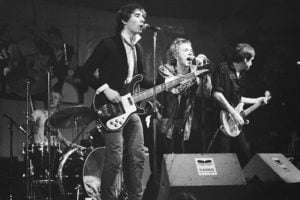
The band’s live performances were equally notorious. Concerts were often canceled because of public backlash, and when the Sex Pistols did play, the shows could be volatile and unpredictable. The addition of Sid Vicious in early 1977 increased the band’s dangerous mystique but also accelerated its internal turmoil. His erratic behavior, drug addiction, and lack of musical experience contributed to the group’s collapse. By the time the band embarked on its only American tour in January 1978, tensions had reached a breaking point. After the final show in San Francisco, Rotten walked offstage and quit after asking, “Ever get the feeling you’ve been cheated?”
The Sex Pistols disbanded in 1978, less than two years after their first single. In the wake of the breakup, the story of Sid Vicious turned tragic. He was arrested in connection with the death of his girlfriend, Nancy Spungen, in New York and died of a heroin overdose in early 1979 while awaiting trial. Meanwhile, the remaining members followed separate paths. Jones and Cook formed the Professionals, while Lydon launched Public Image Ltd., taking his music in a more experimental direction.
Despite their short lifespan, the Sex Pistols left an outsized legacy. Their impact on punk rock and rock music as a whole cannot be overstated. Countless bands have cited Never Mind the Bollocks as foundational. Their rejection of corporate music culture inspired generations of independent artists, while their fashion and image, influenced by McLaren and designer Vivienne Westwood, changed how musicians looked and what they represented. The Sex Pistols were not built for longevity, but in two short years they said and did more than many bands manage in decades.
The group reunited several times in the decades that followed, beginning with the Filthy Lucre Tour in 1996. Although these reunions were frequently described as cash grabs, they were well received and brought the band’s music to new audiences. The Sex Pistols also played major festivals and one-off shows during the 2000s. Some listeners criticized the irony of punk’s most anti-establishment band returning for large-scale concerts, while others viewed the performances as a celebration of its uncompromising spirit.
In 2006, the Sex Pistols were inducted into the Rock and Roll Hall of Fame, although they refused to attend the ceremony. Instead, they issued a scathing open letter mocking the institution as “urine in wine.” It was an entirely appropriate response from a band that never played by anyone else’s rules.
Outside music, the Sex Pistols have remained part of broader cultural conversations. Documentaries, biographical productions, and books have explored their influence, including The Filth and the Fury and Pistol, the 2022 television series directed by Danny Boyle. These projects, although varied in accuracy and tone, demonstrate the continuing fascination with a band that burned out quickly but left a lasting mark on popular culture.
Beyond the headline-grabbing image, the core of the Sex Pistols’ legacy lies in their challenge to conformity. They created music that was not about virtuosity but about message, attitude, and disruption. They did not simply criticize the system; they embodied a full-scale rejection of it, helping to clear a path for independent labels, underground scenes, and alternative voices that flourished in the decades that followed.
Each member contributed to that legacy in a different way. Johnny Rotten remained a provocative figure in and outside music. Steve Jones and Paul Cook continued performing and recording, while Glen Matlock remained a working musician and frequently discussed his role in the band’s early songwriting. Their paths diverged, but each helped shape the ethos that made the Sex Pistols endure.
The Sex Pistols are remembered not for a vast catalog, but for the fire they ignited. One album, a handful of singles, and a short tour were enough to upend the music industry and rewrite the rules of what a rock band could be. Their legacy is loud, defiant, and impossible to ignore.
Complete List Of Sex Pistols Songs From A to Z
- “Anarchy in the U.K.” – Never Mind the Bollocks, Here’s the Sex Pistols – 1977
- “Anarchy in the U.K.” – Anarchy in the UK: Live at the 76 Club – 1976/1985
- “Bodies” – Never Mind the Bollocks, Here’s the Sex Pistols – 1977
- “C’mon Everybody” – Single – 1979
- “Did You No Wrong” (B-Side of Virgin God Save the Queen) – Never Mind the Bollocks, Here’s the Sex Pistols (2012 remastered edition) – 1977
- “Don’t Give Me No Lip, Child” (Dave Berry) – Anarchy in the UK: Live at the 76 Club – 1976/1985
- “E.M.I.” – Never Mind the Bollocks, Here’s the Sex Pistols – 1977
- “Friggin’ in the Riggin’” (B-side of “Something Else”) – Single – 1979
- “God Save the Queen” – Never Mind the Bollocks, Here’s the Sex Pistols – 1977
- “Holidays in the Sun” – Never Mind the Bollocks, Here’s the Sex Pistols – 1977
- “I Wanna Be Me” (B-side of “Anarchy in the U.K.”) – Single – 1976
- “I Wanna Be Me” – Anarchy in the UK: Live at the 76 Club – 1976/1985
- “I’m a Lazy Sod” (aka “Seventeen”) – Anarchy in the UK: Live at the 76 Club – 1976/1985
- “(I’m Not Your) Steppin’ Stone” (Tommy Boyce, Bobby Hart) – Single – 1980
- “(I’m Not Your) Steppin’ Stone” (Tommy Boyce, Bobby Hart) – Anarchy in the UK: Live at the 76 Club – 1976/1985
- “Liar” – Never Mind the Bollocks, Here’s the Sex Pistols – 1977
- “Liar” – Anarchy in the UK: Live at the 76 Club – 1976/1985
- “My Way” (B-side of “No One Is Innocent”) – Single – 1978
- “New York” – Never Mind the Bollocks, Here’s the Sex Pistols – 1977
- “New York” (titled “Dolls (New York)”) – Anarchy in the UK: Live at the 76 Club – 1976/1985
- “No Feelings” – Never Mind the Bollocks, Here’s the Sex Pistols – 1977
- “No Feelings” – Anarchy in the UK: Live at the 76 Club – 1976/1985
- “No Fun” (The Stooges) – Never Mind the Bollocks, Here’s the Sex Pistols (2012 remastered edition) – 1977
- “No Fun” (Alexander, Asheton, Asheton, Pop) – Anarchy in the UK: Live at the 76 Club – 1976/1985
- “No Lip” (titled “Don’t Give Me No Lip, Child”) – Anarchy in the UK: Live at the 76 Club – 1976/1985
- “No One Is Innocent” – Single – 1978
- “PA Trouble” – Anarchy in the UK: Live at the 76 Club – 1976/1985
- “Pretty Vacant” – Never Mind the Bollocks, Here’s the Sex Pistols – 1977
- “Pretty Vacant” – Anarchy in the UK: Live at the 76 Club – 1976/1985
- “Problems” – Never Mind the Bollocks, Here’s the Sex Pistols – 1977
- “Problems” – Anarchy in the UK: Live at the 76 Club – 1976/1985
- “Satellite” – Never Mind the Bollocks, Here’s the Sex Pistols (2012 remastered edition) – 1977
- “Satellite” – Anarchy in the UK: Live at the 76 Club – 1976/1985
- “Seventeen” – Never Mind the Bollocks, Here’s the Sex Pistols – 1977
- “Silly Thing” – Single – 1979
- “Something Else” – Single – 1979
- “Submission” – Never Mind the Bollocks, Here’s the Sex Pistols (12-track version) – 1977
- “Submission” – Anarchy in the UK: Live at the 76 Club – 1976/1985
- “Substitute” (Pete Townshend) – Anarchy in the UK: Live at the 76 Club – 1976/1985
- “The Great Rock ‘n’ Roll Swindle” – Single – 1979
- “Who Killed Bambi?” (B-side of “Silly Thing”) – Single – 1979
Sex Pistols Albums and Major Releases
Never Mind the Bollocks, Here’s the Sex Pistols (1977)

The Great Rock ‘n’ Roll Swindle (1979)
Anarchy in the UK: Live at the 76 Club (1985)

Check out our fantastic and entertaining Sex Pistols articles, detailing in-depth the band’s albums, songs, band members, and more…all on ClassicRockHistory.com
Read More: Artists’ Interviews Directory At ClassicRockHistory.com
Read More: Classic Rock Bands List And Directory
Updated July 24, 2026.
Complete List Of Sex Pistols Songs From A to Z article published on ClassicRockHistory.com © 2026