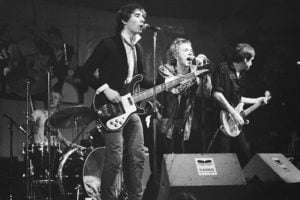
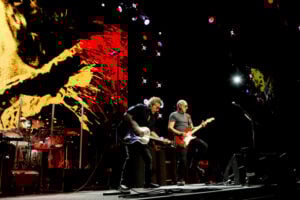
Photo: By Riksarkivet (National Archives of Norway) Photograph: Billedbladet NÅ/Arne S. Nielsen [No restrictions], via Wikimedia Commons
The group originated from Jones and Cook’s early band, known as the Strand, who often hung out in a shop on the King’s Road run by Malcolm McLaren and his then-girlfriend Vivienne Westwood. A friendship formed between McLaren and the Strand, and he became their de facto manager, inviting Matlock to join the group and dropping band member Wally Nightingale.
A member down, Steve Jones moved to lead guitar, leaving space for a new frontman. Luckily, the band stumbled upon John Lydon, who attracted them with his green hair and distinctive clothing. Rebranding himself as Johnny Rotten, Lydon joined the band in 1975, and, using a name they had informally worked under in the past, the Sex Pistols were born.
Gigging in colleges and art schools across London, the band started to build a fan base and were invited to perform at increasingly prestigious venues. This attention led to the group being picked up by EMI, who released the band’s first single, “Anarchy in the UK.” The Sex Pistols became known for their wild behavior as much as their music, which was only exacerbated after Glen Matlock was replaced by the notorious Sid Vicious, a well-known band fan famously credited with inventing the “pogo” dance.
In 1977, the band signed to A&M Records and moved to Virgin shortly afterward. Also that year, they caused immense controversy with their track “God Save the Queen,” one of the most censored and controversial records in British history, and finally released their one and only true studio album, Never Mind the Bollocks, Here’s the Sex Pistols, that October, reaching number one.
The group began a U.S. tour, which saw Vicious, now addicted to heroin, spiraling out of control. During this time, Rotten was becoming increasingly disillusioned with the band, and so few were surprised when the original run came to an end in January 1978. Following the split, Sid Vicious moved to New York and, after being charged with the murder of his girlfriend Nancy Spungen, died of a heroin overdose at age 21 before the case could come to trial. John Lydon later began legal action against McLaren over contract rights and unpaid money, a battle that ultimately reached the High Court in the 1980s.
Since then, the original members have reunited a few times but never fully reignited the magic of the past. Despite the band ending in tense and tragic circumstances, the influence and legacy of the Sex Pistols cannot be overstated; their performance style, aesthetic, and political ethos have become entirely synonymous with punk rock. Although they only released one true studio album, it is a genuine masterpiece that has been reissued numerous times.
The Sex Pistols name returned to the stage again in 2024 when Steve Jones, Paul Cook, and Glen Matlock began performing with Frank Carter on lead vocals. That lineup remained active in 2026, celebrating fifty years of punk with additional shows while John Lydon remained outside the group.
# 10 – EMI
As you can imagine, the band did not take it well. They were dropped by their record label EMI just a few months into a twenty-four-month contract, and when they finally released their debut album later that year, they used the opportunity to trash the label publicly. Thankfully, “EMI“ is not just a brainless and petty “diss track” and instead delivers some genuinely good commentary.
The band pointed out that the record label should have known precisely what they were signing up for by associating themselves with the Pistols, but instead seemed to assume the band’s wild behavior was some publicity stunt rather than a true reflection of their manic personalities. Similarly, the lyrics clarify that the band knew the label only signed them to make money off the emerging punk bandwagon and had no real passion for the genre.
The song’s central “EMI” hook is a genuine earworm that works perfectly with its accompanying guitar riff. Meanwhile, Rotten’s trademark rolled R’s give the track an edge of danger, underlined by the pulsing chords that form the heart of the track. This is a relentless punk attack targeted at EMI. Still, one can’t help but sense a slight tongue-in-cheek vibe to the track, especially when, at the end of the song, Rotten cheekily name-checks A&M, the label they would sign to after being canned by EMI, which they were with for only ten days before being dropped once again.
Undoubtedly, the Sex Pistols must have been a nightmare for their record labels to deal with, but thankfully, their turbulent label experiences led to fresh and catchy songs like this.
# 9 – Silly Thing
Throughout his work with the band, Malcolm McLaren was obsessed with producing a film about the band’s rise to fame. In 1980, two years after the band had broken up, his dream was finally realized with the release of the mockumentary film The Great Rock ’n’ Roll Swindle . The soundtrack had appeared the previous year, and with Rotten refusing to participate it was left to the other Pistols to take charge. The album version of “Silly Thing” features Paul Cook on lead vocals.
The production on “Silly Thing” is notably more polished than on Never Mind the Bollocks, lacking the scratchy punk elements, which many would argue are an essential part of the band’s oeuvre, and replacing them with a room-filling sound that almost borders on stadium rock. Similarly, odd though it is to hear a Sex Pistols track without Johnny Rotten’s unmistakable vocals, Cook does an admirable job and rightly eschews any attempt to mimic his ex-bandmate. Cook’s vocals are broad and heavily layered, making him almost reminiscent of a football chant—it’s as if the song invites listeners to sing along.
Some will dismiss tracks from The Great Rock ’n’ Roll Swindle as non-canonical, not “real” Pistols, but to do so is to do those who worked on the album a disservice. The frantic guitar on “Silly Thing” is toe-tappingly catchy, and the rousing vocals are impossible to resist. Sure, it would likely sound even better with Rotten at the helm, but instead of worrying about “what-ifs,” listeners should enjoy the track for what it is: a bouncy and well-produced Sex Pistols oddity.
# 8 – New York
There has always been a tradition of feuds between musicians, from Oasis and Blur in the ’90s to Taylor Swift and Katy Perry, so it should come as no surprise that back in the ’70s, the Pistols were feuding with the best of them. Before the band hit the big time, McLaren spent some time in New York City working with the New York Dolls, and it was the latter who would be at the receiving end of the scathing put-downs on “New York.”
The Pistols held no punches on this track, and, amongst the meaningless profanities and language that has aged badly, they hit upon some real knockout blows. The band targets the Dolls’ inability to move with the times and their glam-rock style, mocking the overly intellectual art clubs which the Dolls frequented.
Of course, a diss track will only work if a band can produce an exceptional song to deliver their burns, and, as ever, the band doesn’t disappoint. “New York” has a thumping instrumental, full of spiky riffs and barbed hooks; its non-stop assault of sound reflects the incessant lyrical destruction of their target. Thanks to the obvious spite in Rotten’s voice, there can be no doubt that he truly means every word.
“New York” is a riotous rant that you would not want to be victim to, and petty though it is, it is yet another example of the band’s acerbic personality resulting in a wondrously catchy and venomous track.
# 7 – My Way
Another highlight from The Great Rock ’n’ Roll Swindle, this cover of the song popularized by Frank Sinatra saw Sid Vicious take lead vocals. The track begins with some screeching strings, almost acting as a warning for what is to come, and it’s not long before Vicious’ vocals begin. At first, the singer adopts a mocking faux-sincere tone, the perfect foil to the excessive orchestral elements, overcompensating for not knowing the lyrics by inserting his own foul-mouthed improvisations, but it’s not long until he fully commits himself to the song.
The switch from the orchestral instrumental to a punk rock sound sees Vicious drop the silly voice and deliver his own offbeat tones, occasionally slurring just for the hell of it. The guitars here are chunky and full-bodied, and the band does an amazing job at utilizing various techniques throughout the song, delivering heated strumming, chugging chords, and some delicious guitar whooshes.
Of course, knowing what happened to Vicious following the song’s recording only heightens its bittersweet atmosphere, perfectly displaying how context can massively change the song’s effect on listeners. Something is haunting about hearing such a tortured figure having so much fun on a track, and one can’t help but sense a hint of pride in Sid’s voice throughout the song, as if he knows he truly has done it his way and that no one can take that away from him.
As well as serving as a stark reminder of the dangers of rock ’n’ roll excess, “My Way“ is simply a great track, taking an already iconic song and imbuing it with the boundless energy and danger of the Sex Pistols. There aren’t many cover songs which are worthy of such note, but “My Way“ undoubtedly is.
# 6 – Submission
During the mid-’70s, Malcolm McLaren and Vivienne Westwood ran a shop known as SEX on the King’s Road. As you might imagine, the shop specialized in fetish wear, and, inspired by this, McLaren asked Rotten and Matlock to write a song about bondage. Already growing sick of his manager, Rotten did the only logical thing and intentionally misinterpreted these instructions, helping turn the idea into a song full of submarine metaphors instead.
“Submission” is noticeably slower than a lot of the Pistols’ work, giving them time to create a much more funky atmosphere than usual. The song begins with some lovely hi-hat work, allowing Paul Cook the rare chance to take center stage, which sets the scene for a smooth and cool instrumental full of discordant guitar runs and some rich solos. For once, the bass isn’t entirely drowned out by guitars, which gives the track a slick quality missing from a lot of other Pistols tracks.
The slightly slower, Kinks-esque tempo works particularly well with Rotten’s vocals, giving his gravelly runs the indulgence they deserve. The band even utilizes some high-pitched shrieking during the track, almost as if mimicking a dolphin, even further removing the track from what McLaren must have had in mind.
As well as representing the band’s eternally rebellious nature, “Submission“ stands out on Never Mind the Bollocks by showing a different side to the band. The track does not lack any of the qualities which make the Pistols so exciting; it just delivers these elements in a different, funkier way.
# 5 – No Feelings
If you’ve ever doubted the impact the Sex Pistols had on rock music, then simply listening to “No Feelings” should tell you that the band’s legacy is still felt today. Indeed, their legacy can literally be heard today, as “No Feelings” features some incredible chords which have surely influenced innumerable contemporary rock musicians.
You might not expect a Sex Pistols track to be the place to find references to high culture, but the band showed they were full of surprises by using the Greek myth of Narcissus as inspiration for the song’s first verse, which introduces a narrative about a guy so in love with himself that he doesn’t care at all about anybody else. The rest of the song sees the protagonist try to shake off an admirer who doesn’t seem to accept or understand his lack of interest.
The track features some massive chords, which are effortlessly magnetic and utterly futile to ignore. The song’s instrumental is a ceaseless storm of punk energy which somehow manages to reflect the song’s story; just as the protagonist is too narcissistic to care about anybody else, the track’s perpetual wall of guitars is too all-consuming to allow the listener to even consider thinking about anything else.
“No Feelings” is an agitated and unhinged track that doesn’t stop for even a second. Like a tidal wave of rock, this song will sweep you up and not let you go until it’s finished with you. Truly incredible.
# 4 – Holidays in the Sun
The band’s fourth single saw them put their unique stamp on the classic “summer vacation” song, but rather than celebrate days on the beach and hot weather, the Pistols deliver an altogether more cynical take on the trope.
“Holidays in the Sun” came about after the band felt trapped and claustrophobic in Britain and decided to take a trip to Berlin, which, at the time, was divided by the Berlin Wall, splitting West Berlin from communist East Germany. The track’s big irony is that it sees Rotten seemingly desperate to escape the “free world” and stare into the communist East—a typically arch subversion of what it means to go on vacation.
The track begins with the sound of military-type marching on gravel, making it immediately obvious that this is certainly not your everyday summer bop. This marching is soon joined by some growling guitar runs and an epic drum intro before Rotten’s vocals join the mix, the roguish glee in his voice making it clear that he’s giddily excited to be corrupting the listener’s expectations about what a vacation song can be like.
One of the best elements of the track is the militaristic “Reason” chant which underscores the song’s chorus. As well as injecting the track with yet more violence-tinged drama, the chant is perfect for audience participation and, even on first listen, you can picture hordes of Pistols fans punching the air along with the hook. The lead guitar on “Holidays in the Sun” is also worthy of note, with the post-chorus chords being particularly stirring and suitably fast-paced while still being pleasantly melodious.
In fact, were the lyrics different, it would only take a small bit of toning down for the instrumental to be perfectly suited for a genuine vacation song. Of course, the Sex Pistols would never be interested in something so banal, and frankly, we should be thankful that this was the case, as “Holidays in the Sun” is an outrageous, utterly singular spin on a classic concept.
# 3 – Pretty Vacant
The band’s third single, “Pretty Vacant,” undoubtedly has the best guitar of any Sex Pistols song. It is simultaneously distorted and crunchy, while also being robust and broad.
The song begins with some chunky riffs, which are soon joined by climactic drums and Rotten’s idiosyncratic voice. In many ways, “Pretty Vacant” is one of the band’s most conventional productions, featuring a standard verse/chorus structure, which is lacking on a lot of the band’s tracks. This is the closest the band ever came to making a traditional pop song. Of course, this being the Sex Pistols, they avoided fully adhering to the status quo by enunciating the song’s titular hook in a way that made it sound like a particularly rude curse word—something which did not go down well following the band’s appearance on the historic British music show Top of the Pops.
The lyrics are perhaps the least interesting thing about this song, being rather repetitive and lacking the edge of controversy or irony usually associated with the band. Luckily, the incredible guitar work more than makes up for this, featuring some hugely infectious and magnificently danceable riffs which saw Q magazine place the song at number 26 on a list of the 100 Greatest Guitar Tracks of all time.
While the two songs remaining on the list have earned their place partly because of their cultural impact, “Pretty Vacant” is an equally important, arguably musically superior, Sex Pistols classic.
# 2 – Anarchy in the UK
You need only speak to someone who was a teenager during the ’70s to learn just how genuinely revolutionary the Sex Pistols were. They provided a much-needed antidote to the safe and sterile music of the time and gave youths an outlet for their repressed anger and discontentment. With tracks like this, it’s easy to see why the Pistols managed to cause such a moral panic; it must have been alarming for parents to see their teenage kid suddenly obsessed with a scrawny green-haired singer who aggressively growled about being the antichrist.
“Anarchy in the UK” is an explosive mix of tightly produced guitars and a viciously addictive set of vocals. Rotten sounds at his very best on this track, his voice gritty and gravelly, and his intonation utterly outrageous.
Seeing Rotten sing during his prime must have been something to behold; he truly embodied the band’s brash and cocksure attitude—so confident and bold that even on video it truly feels like nothing can stop him. Although some might not approve of the song rhyming “Antichrist” with “Anarchist,” to do so is to fundamentally misunderstand what the Pistols were about. They seem to be making the point that they refuse even to follow the rules of language, let alone anything else society has to offer.
This abrasive and spiky track was an unbelievably ballsy way for the Pistols to announce their arrival on the pop charts, forcing teenagers, parents, and wider society to take note of four charismatic upstarts who, in their own words, came to destroy everything.
# 1 – God Save the Queen
There are very few songs that can claim their first few seconds are instantly recognizable to people from every living generation, but “God Save the Queen“ is one of them. The electrifying riff of the track’s intro is the very definition of iconic.
This second single from the band is easily one of the most controversial songs ever, attacking the Queen as a figurehead for the establishment and everything else the band saw as wrong in ’70s Britain. Of course, with hindsight it’s obvious that the band was trying to provoke people into thinking rather than attempting to organize any kind of meaningful coup, but, at the time, people were furious.
The song was banned by the BBC, and many other broadcasters and retailers also kept their distance from it, effectively blocking the song from much of the mainstream. Despite this censorship, the single officially reached number two on the UK chart. The long-running argument that it was deliberately denied the top spot during the Queen’s Silver Jubilee has become part of Sex Pistols mythology.
As well as picking up on the high levels of youth disenchantment, the track’s immense success is no doubt down to the fact that it is an absolute banger—the central guitar riff alone is absolutely phenomenal. It is next to impossible not to find yourself nodding your head, at the very least, for the duration of this extraordinary song. It is one of those tracks that is imbued with a certain kind of alchemy; it gets hearts racing and toes tapping almost at a subconscious level.
Perhaps it’s because, for Brits at least, the treasonous lyrics feel dangerous and forbidden, and yet, the song’s anarchic appeal seems to be international; the track was even used during the introduction of the London 2012 Olympic Games, which, coincidentally, the Queen herself was attending.
There can be no doubt that this spine-tingling track is punk’s finest achievement and its wild legacy lives on to this day. Even the song’s iconoclastic artwork has gone down in history. “God Save the Queen” is one of those rare tracks which has deservedly reached an almost mythical status, single-handedly bringing the punk movement into mainstream consciousness.
Over their short and tumultuous original career, the Sex Pistols rocked the music industry—and Britain as a whole—to its very core. No one knew what to do with these wild kids who genuinely seemed not to give a damn and managed to cause controversy wherever they went. That their music still resonates today is a reflection of the pure talent and sheer magic possessed by both classic incarnations of the unparalleled four-piece. There are very few bands who can be said to have genuinely changed the world, but, undoubtedly, the Sex Pistols are one of them.
Sex Pistols Studio Album and Major Soundtrack
Never Mind the Bollocks, Here’s the Sex Pistols (1977)
The Great Rock ’n’ Roll Swindle (1979)
Updated August 7, 2026.
Top 10 Sex Pistols Songs article published on ClassicRockHistory.com © 2026