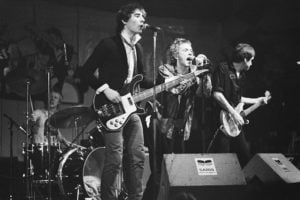
Feature Photo: English: Photograph by Daniel Corrigan. Distributed by Warner Bros. Records., Public domain, via Wikimedia Commons
Three musicians from Saint Paul, Minnesota formed Hüsker Dü in 1979, creating a band that would release six studio albums during their initial nine-year existence, along with an early live release and several EPs. The trio maintained a stable lineup throughout their entire career, with no member changes occurring between their formation and their breakup in January 1988.
The band emerged from the American hardcore punk scene and became associated with the independent label SST Records, which issued three of their six studio albums during the 1980s.
Hüsker Dü signed with Warner Bros. Records in 1986, becoming one of the first American underground rock bands to join a major label while maintaining creative control over their recordings. Their albums Zen Arcade and Warehouse: Songs and Stories received particular attention from critics, with the former being a double album released in 1984 and the latter being a double album released in 1987.
The band toured extensively throughout the United States and internationally during their active years, building a following within alternative music communities.
The group disbanded in January 1988 following internal conflicts and personal struggles that made continuation impossible. Their catalog includes the 1982 live debut Land Speed Record; the 1983 Metal Circus EP; and six studio albums: Everything Falls Apart, Zen Arcade, New Day Rising, Flip Your Wig, Candy Apple Grey, and Warehouse: Songs and Stories. The original lineup never reunited after their breakup.
Archival releases have continued to document their work, including the live collection 1985: The Miracle Year, issued in 2025.
Bob Mould
Bob Mould co-founded Hüsker Dü in 1979 and served as guitarist, vocalist, and primary songwriter alongside drummer Grant Hart throughout the band’s entire existence until their dissolution in January 1988. He appeared on every Hüsker Dü release, including their debut live album Land Speed Record in 1982, their first studio album Everything Falls Apart in 1983, and the Metal Circus EP later that year.
His guitar work and songwriting reached fuller expression on the double album Zen Arcade in 1984, where he contributed numerous compositions and handled lead vocals on many of the songs. He continued as a primary creative force on New Day Rising and Flip Your Wig, both released in 1985, contributing major songs to each album and delivering intense guitar performances that combined speed with melodic sensibility.
Mould’s contributions to Candy Apple Grey in 1986 marked the band’s major label debut on Warner Bros. Records, with his songwriting demonstrating increased polish while maintaining the intensity of earlier work. On Warehouse: Songs and Stories released in 1987, he wrote the majority of the twenty songs across the double album’s four sides, including tracks like “Could You Be the One?” and “Ice Cold Ice”.
Throughout his tenure with Hüsker Dü, he handled lead guitar duties, provided lead and backing vocals, and occasionally played keyboards, bass, and percussion on various recordings when arrangements required additional instrumentation beyond the core trio format.
Following Hüsker Dü’s breakup in 1988, Mould formed Sugar in 1992, releasing two studio albums, Copper Blue (1992) and File Under: Easy Listening (1994), as well as the Beaster EP (1993), before the band ended its initial run in 1995. He launched a solo career beginning with Workbook in 1989 and released his fifteenth solo studio album, Here We Go Crazy, in March 2025.
Mould also worked as a writer for professional wrestling organization WCW during the late 1990s and has been recognized as a significant figure in alternative rock history. He published an autobiography titled See a Little Light: The Trail of Rage and Melody in 2011 and has continued touring and recording new music into the 2020s.
Grant Hart
Grant Hart co-founded Hüsker Dü with Bob Mould and Greg Norton in 1979, serving as the band’s drummer, vocalist, and co-primary songwriter throughout their nine-year run until January 1988. He appeared on every Hüsker Dü recording from their debut Land Speed Record through their final album Warehouse: Songs and Stories. His drumming provided the rhythmic foundation for the band’s sound from their early hardcore punk approach through their later, more melodic material.
On Everything Falls Apart and the Metal Circus EP, both released in 1983, he contributed several songs including “Newest Industry” and “Diane”. The latter became one of the band’s most recognized compositions, addressing the real-life murder of Diane Edwards.
Hart’s songwriting and vocal contributions became more prominent on Zen Arcade in 1984, where he wrote and sang lead on multiple tracks including “Never Talking to You Again” and “Pink Turns to Blue”. “The Biggest Lie”, another song on the album, was written and sung by Bob Mould.
He continued splitting songwriting duties roughly equally with Mould on New Day Rising and Flip Your Wig in 1985, contributing memorable tracks including “Girl Who Lives on Heaven Hill” and “Keep Hanging On”. On Candy Apple Grey in 1986, he wrote and sang several songs including “Dead Set on Destruction”, and his contributions to Warehouse: Songs and Stories in 1987 included “She Floated Away” and “Up in the Air”.
Throughout the band’s career, Hart also occasionally played keyboards and piano on studio recordings when songs required additional instrumentation.
After Hüsker Dü disbanded in 1988, Hart formed the band Nova Mob, which released two studio albums, The Last Days of Pompeii (1991) and Nova Mob (1994). He subsequently pursued a solo career, releasing albums including Intolerance in 1989, his first full-length post-Hüsker Dü release. Hart continued recording and performing throughout the 1990s and 2000s, releasing albums including Hot Wax in 2009 and The Argument in 2013.
His 2013 concept album The Argument drew on John Milton’s Paradise Lost and a treatment of that work by William S. Burroughs. Grant Hart died on September 13, 2017, at age fifty-six from kidney cancer, ending a career that spanned nearly four decades and left a lasting impact on alternative music.
Greg Norton
Greg Norton co-founded Hüsker Dü with Bob Mould and Grant Hart in 1979 and remained with the band as bassist and occasional vocalist until their breakup in January 1988. He appeared on every Hüsker Dü release throughout their career, providing the bass foundation that anchored the band’s sound across all their studio and live albums.
His bass playing on Land Speed Record in 1982 demonstrated the aggressive approach of their early hardcore period, while his work on Everything Falls Apart and Metal Circus in 1983 showed the band’s developing musical complexity. Norton contributed backing vocals on numerous tracks throughout the band’s discography and occasionally took lead vocal duties on select songs.
His bass work on Zen Arcade in 1984 helped ground the ambitious double album’s diverse arrangements, providing consistent rhythmic support across the record’s varied tempos and styles. Norton continued this role on New Day Rising and Flip Your Wig in 1985, where his bass lines locked tightly with Hart’s drumming to create the band’s powerful rhythm section.
On Candy Apple Grey in 1986 and Warehouse: Songs and Stories in 1987, he maintained his position as the band’s rhythmic anchor while the songwriting partnership between Mould and Hart became increasingly strained. Unlike Mould and Hart, Norton was not one of the group’s two principal songwriters, focusing instead on his instrumental role within the trio.
Following Hüsker Dü’s dissolution in 1988, Norton stepped away from professional music performance for many years. He became a restaurateur in Minnesota, operating a restaurant while pursuing a life outside touring. Norton initially maintained the lowest profile of the three Hüsker Dü members, but later returned to recording and performing.
He recorded with the experimental group Gang Font, joined the rock band Porcupine in 2016, and subsequently played bass in UltraBomb, whose album Dying to Smile appeared in 2024. Norton was diagnosed with prostate cancer in 2022 and later returned to performing following treatment. He expressed little interest in a Hüsker Dü reunion during the years when both Hart and Mould were still alive, citing the conflicts that ended the band as insurmountable.
Check out more Hüsker Dü articles on ClassicRockHistory.com Just click on any of the links below……
Top 10 Husker Du Songs
Read More: Artists’ Interviews Directory At ClassicRockHistory.com
Read More: Classic Rock Bands List And Directory
Updated October 14, 2026.
Complete List Of Hüsker Dü Band Members article published on ClassicRockHistory.com © 2026