Feature Photo: Imperial Records, Public domain, via Wikimedia Commons
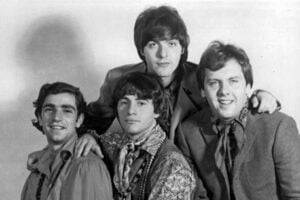
Liverpool’s club circuit in the early 1960s gave the Swinging Blue Jeans their runway, and the group’s sound and look quickly aligned with what became known as Merseybeat. They became best known as a four-piece British beat band through hit singles released on the His Master’s Voice label, including “Hippy Hippy Shake,” issued in December 1963, and “Good Golly Miss Molly” and “You’re No Good,” both released in 1964. The band’s later singles did not match that early impact, although their 1966 recording of “Don’t Make Me Over” reached number 31 on the UK Singles Chart.
Their story begins earlier than the hits. The group’s roots stretch back to the late 1950s, when Bruce McCaskill formed a jazz-influenced skiffle band called the Bluegenes. Early members included Tommy Hughes, Norman Kuhlke, and Spud Ward, followed by personnel changes that brought in Ralph Ellis and Les Braid, then Johnny Carter and Paul Moss. By the early 1960s, the musicians were working steadily, playing skiffle and traditional jazz around Liverpool and at the Star-Club in Hamburg, where initially hostile audiences pushed them to rethink their musical direction.
They shifted toward rock and roll, adopted the name the Swinging Blue Jeans, and moved into the familiar two-guitar, bass, and drums format associated with the era. Their stage clothes became part of their identity, but the real change was in the music. What had begun as a skiffle and jazz act developed into one of the energetic Liverpool groups attracting attention as British beat music gathered momentum.
That change led to a recording contract and a national breakthrough. By the time the band recorded for His Master’s Voice with producer Walter Ridley in 1963, the established quartet consisted of Ray Ennis on vocals and guitar, Ralph Ellis on guitar, Les Braid on bass, and Norman Kuhlke on drums. Their first single, “It’s Too Late Now,” written by Ennis, reached number 30 in Britain. Their December 1963 release of “Hippy Hippy Shake” then climbed to number two on the UK chart in early 1964, establishing them as stars at the height of the Merseybeat wave.
The band’s biggest singles are anchored by those chart peaks. “Hippy Hippy Shake” hit number two in the United Kingdom and charted internationally, reaching number 24 on the Billboard Hot 100 in the United States. In 1964, they followed it with “Good Golly Miss Molly,” which reached number 11 in Britain and number 43 in America, and “You’re No Good,” which climbed to number three in Britain and number 97 on the American Hot 100. Their early success also reflected their live visibility in Liverpool, including appearances at the Mardi Gras Club and the Cavern Club.
Their album catalog reflects both British and international marketing patterns, with different editions and territory-specific releases. Their original British studio album, Blue Jeans a-Swinging, arrived in 1964, while an American LP titled Hippy Hippy Shake reached number 90 on the U.S. album chart. Other releases included the export-market Tutti Frutti, the German live album Live aus dem Cascade Beat Club in Köln, the Canadian Don’t Make Me Over, and later albums such as Brand New and Faded and Jump ‘n’ Jeans.
Some of those titles were original albums, while others were overseas editions, reissues, or collections built around recordings already familiar to fans. The different releases show how the Swinging Blue Jeans’ music was repackaged across international markets during and after their biggest chart years. Their catalog was much more extensive than the handful of hits that most people remember from the British Invasion.
Lineup changes and stylistic shifts shaped the rest of their career. In early 1966, Terry Sylvester replaced Ralph Ellis, and the group moved toward a smoother pop approach that did not restore its earlier chart momentum. In 1967, Walter Ridley attempted to position Ray Ennis as a solo star with “Tremblin’,” recorded using session musicians and backing vocals by Madeline Bell and Kiki Dee, although the single eventually appeared under the band’s name.
That same year, Mike Gregory joined on bass, with Les Braid moving to keyboards. Sylvester left at the end of 1968 to replace Graham Nash in the Hollies, and the Swinging Blue Jeans eventually moved into the cabaret and nostalgia circuits. The band’s name continued to appear on concert bills even as the lineup moved further from the one that had recorded the original hits.
Their later history became defined by touring continuity, member turnover, and a legal fight over the band name. After Colin Manley’s health declined, Alan Lovell deputized in early 1999; Manley died that April, and Lovell became a permanent member. Ray Ennis retired from the group in May 2010, and a dispute over the Swinging Blue Jeans trademark followed. The legal proceedings ultimately left Lovell in control of the registered name, while Ennis made occasional appearances under the name Ray Ennis’s Blue Jeans.
Versions of the Swinging Blue Jeans continued to perform under Lovell’s leadership without any original members in the lineup. Whatever the changes over the decades, their 1960s recordings remain an unmistakable part of Merseybeat history.
# 10 – Sunday Morning Sunshine
This is a strange one to open up this list with, because if there is one songwriter we would not have expected this 1960s band to cover, it would be Harry Chapin. But that is exactly what they did with their 1975 single release, “Sunday Morning Sunshine.” It is interesting how they seem to intentionally echo Harry’s vocal tone on the chorus. This is a really intriguing track, and I thought it would be a fun way to open the list.
Chapin had originally released the song in 1972, and the Swinging Blue Jeans recorded their version during a much later phase of the band’s career. Their 1975 German Telefunken single paired “Sunday Morning Sunshine” with “Ain’t No Sunshine.” It is a long way from their early rock-and-roll covers, which is part of what makes it so interesting.
# 9 – Crazy ‘Bout My Baby
By October 1965, the Swinging Blue Jeans were still pressing forward with new material, releasing “Crazy ’Bout My Baby” on His Master’s Voice with “Good Lovin’” on the B-side, even as their earlier chart momentum had slowed. The song had been written and first recorded by Robert Mosley in 1963, but the Liverpool quartet reshaped it with a noticeably different arrangement that moved it closer to their established Merseybeat drive.
The record did not repeat the chart success of “Hippy Hippy Shake” or “You’re No Good,” but it demonstrated that the group was still capable of delivering a tough, energetic performance. Its flipside, “Good Lovin’,” would soon become much better known through the Young Rascals’ 1966 hit recording.
# 8 – Ready Teddy
The Swinging Blue Jeans recorded “Ready Teddy,” the rock-and-roll song written by Robert Blackwell and John Marascalco and made famous by Little Richard in 1956. It was exactly the kind of material that helped British beat groups turn American rock-and-roll records into high-energy performances of their own. The band’s version put their guitars, driving rhythm, and familiar vocal approach to good use.
Unlike their major British hit singles, “Ready Teddy” was released on a rare 1965 single in Finland and Norway, backed with “Lovey Dovey.” It was not a UK number-25 hit or a U.S. number-50 hit. The recording later appeared on collections of the band’s early material, giving listeners another chance to hear one of their less familiar rock-and-roll performances.
# 7 – Shakin’ All Over
In 1964, at the height of their commercial run, the Swinging Blue Jeans issued their version of “Shakin’ All Over” as a single in Scandinavia, pairing it with “Shake, Rattle and Roll.” The song also appeared on the American album Hippy Hippy Shake and on a British EP, although it was not a track on the original UK Blue Jeans a-Swinging LP. Written by Johnny Kidd, whose original 1960 recording with the Pirates had reached number one on the UK Singles Chart, the song fit squarely into the Liverpool quartet’s beat-driven approach.
The recording was built around Ray Ennis on lead vocals and rhythm guitar, Ralph Ellis on lead guitar, Les Braid on bass, and Norman Kuhlke on drums, working with producer Walter J. Ridley. While their version was not a major standalone single in Britain or the United States, it found an audience in northern Europe, reaching number seven in Finland and number nine in Sweden in 1964.
That success underscored the group’s international presence beyond their biggest British hits. Their interpretation maintained the song’s tense guitar figure and direct rock structure, bringing Johnny Kidd’s classic into the Merseybeat sound that defined the band’s recording peak.
# 6 – Don’t Go Out into the Rain (You’re Gonna Melt)
“Don’t Go Out into the Rain (You’re Gonna Melt)” became a 1967 single for the Swinging Blue Jeans during the later stage of their chart career. Written by Kenny Young, the song had already been recorded by the Seagulls, and Herman’s Hermits took their version into the American charts earlier in 1967. The Swinging Blue Jeans issued their own interpretation that August on His Master’s Voice, with “One Woman Man” on the B-side.
The recording continued the band’s move toward the British pop sound that had increasingly defined its mid-1960s releases. By this point, the lineup had undergone changes, including the addition of Terry Sylvester on guitar following Ralph Ellis’s departure. Ray Ennis remained on lead vocals and guitar, while Les Braid and Norman Kuhlke continued to provide the musical foundation. The record did not return the group to the British singles chart, but it remains an interesting example of their later work.
# 5 – Don’t Make Me Over
In 1966, the Swinging Blue Jeans issued their recording of “Don’t Make Me Over,” a song written by Burt Bacharach and Hal David and first recorded by Dionne Warwick in 1962. Warwick’s original version reached number 21 on the Billboard Hot 100 and number five on the American R&B chart, establishing it as an important early Bacharach and David composition. Her performance had already demonstrated how powerful the song could be in the hands of a distinctive vocalist.
The Swinging Blue Jeans released their interpretation at a time when their chart momentum had slowed, and their single reached number 31 on the UK Singles Chart in early 1966. It became their last significant British chart entry. The recording reflected the group’s transition during the mid-1960s, as lineup changes began to reshape their sound and direction, while they continued drawing on well-known American material.
For a band remembered primarily for frantic rock-and-roll performances, “Don’t Make Me Over” showed another side of their abilities. The more polished arrangement allowed their vocals to carry a song very different from “Hippy Hippy Shake,” without entirely losing the identity that had made them popular.
# 4 – Tutti Frutti
By 1964, the Swinging Blue Jeans had added “Tutti Frutti” to their catalog of rock-and-roll covers, recording their version of the song associated with Little Richard and Dorothy LaBostrie, with Joe Lubin also appearing in songwriting credits. First recorded by Little Richard in 1955 for Specialty Records and produced by Robert “Bumps” Blackwell, the track had already become a foundational rock-and-roll hit, reaching number 17 on the American pop chart and number two on the R&B chart.
The Swinging Blue Jeans included their rendition on the 1964 British album Blue Jeans a-Swinging, and it was also issued as a single in some overseas markets, paired with “Lawdy Miss Clawdy.” It’s hard to imagine a Liverpool beat group of that era not wanting to tackle a Little Richard classic, and the band’s performance fits neatly into the spirited rock-and-roll side of their catalog.
# 3 – Good Golly, Miss Molly
By the spring of 1964, “Good Golly, Miss Molly” had become another major UK hit for the Swinging Blue Jeans, reaching number 11 on the UK Singles Chart. The recording placed the Liverpool quartet firmly in the center of the British Invasion period, following the momentum generated by “Hippy Hippy Shake.” Written by John Marascalco and Robert Blackwell, the song had first been recorded by Little Richard, yet the Swinging Blue Jeans delivered a tight four-piece performance built around Ray Ennis on lead vocals and guitar, Ralph Ellis on guitar, Les Braid on bass, and Norman Kuhlke on drums.
Issued on His Master’s Voice in Britain with “Shaking Feeling” on the B-side, the single also charted in North America, peaking at number 43 on the Billboard Hot 100 in the United States. The group could hardly have chosen a better early rock-and-roll song to show off the energy of its guitar-driven Merseybeat style.
# 2 – You’re No Good
The Swinging Blue Jeans released their recording of “You’re No Good” in May 1964 on His Master’s Voice, pairing it with “Don’t You Worry About Me” on the B-side. Written by Clint Ballard Jr., the song had previously been recorded by Dee Dee Warwick and Betty Everett. The single followed the band’s hit “Good Golly Miss Molly,” and in Britain it became a major summer record, reaching number three on the UK Singles Chart.
The track also charted in France, reached number 97 on the American Billboard Hot 100, and appeared on charts elsewhere, including New Zealand. An interesting part of the song’s story is tied to the actress Sue Johnston, who has recalled bringing “You’re No Good” to the group’s attention while she was dating drummer Norman Kuhlke and working as an assistant to Peter Brown.
The band gave the composition a strong Merseybeat arrangement, driven by guitars and the harmonies that helped distinguish their biggest singles. The song would later become famous to another generation when Linda Ronstadt took her version to number one in the United States in 1975.
# 1 – Hippy Hippy Shake
The Swinging Blue Jeans recorded their version of “Hippy Hippy Shake” in 1963 and released it as a single on December 6, 1963, with “Now I Must Go” on the B-side. Written and first recorded by Chan Romero, the song became the band’s biggest hit in Britain and one of its most successful international releases. It reached number two on the UK Singles Chart in early 1964, number two on Canada’s CHUM chart, and number 24 on the Billboard Hot 100 in the United States.
The record placed the group among the British beat acts finding an American audience during the first wave of the British Invasion. Its fast tempo, infectious guitar playing, and Ray Ennis’s energetic vocal made it the performance most closely associated with the Swinging Blue Jeans. After all these years, “Hippy Hippy Shake” remains one of the great rock-and-roll recordings to come out of Liverpool during the 1960s.
Check out similar articles on ClassicRockHistory.com Just click on any of the links below……
Read More: Artists’ Interviews Directory At ClassicRockHistory.com
Read More: Classic Rock Bands List And Directory
Read More: 100 Essential Albums From The 1960s That Everyone Should Own
Updated November 5, 2026
Top 10 Swinging Blue Jeans Songs article published on ClassicRockHistory.com © 2026