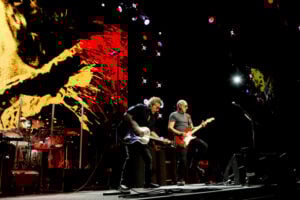
Feature Photo by Roger Salem
Growing up in South Texas, Trey Gunn knew he wanted to play guitar. What’s more, he knew he wanted to make music… he just wasn’t sure what that might look like. “It took me many more years before I got a handle on the kind of player I wanted to be,” Gunn tells ClassicRockHistory.com.
“Realistically,” he says. “I was not until I picked up the Chapman Stick and then the Warr Guitar. Then things really began to click.”
Gunn loved classic rock early on. But he says that once the ‘80s hit, his musical mind exploded, opening a world of possibilities. “You had the Talking Heads, [David] Bowie, Devo, Iggy Pop, Magazine, XTC, The Police, The Teardrop Explodes… all of these influenced me in how to be a performer and how to commit to your vision.”
But there was still more to discover. “Then,” Gunn says. “You add in the heavy jazz groups: Mahavishnu Orchestra, Weather Report, Jeff Beck. And of course, the Discipline era of King Crimson bridged the gap between these two worlds.”
The last bit there, the Crimson bit, proved pivotal for Gunn. In the late ‘80s, he met, befriended, and started working with Robert Fripp. This led to his joining Crimson in the ‘90s, where he stayed until 2003. “Robert is uniquely himself,” Gunns says of his old friend and bandmate. “Which is possibly the highest compliment you can pay to an artist. I’ve loved working with him.”
Since then, Gunn has unleashed a variety of solo and collaborative projects. Too many to name, to be honest. He also has a coaching program in which he assists others with their creative process. “I love this, and it is part of my weekly work,” he says.
Adding, “I have several projects coming along. But the biggest one is a new solo release of fully composed pieces with a combined scorebook. I have been working on this for several years, and I am finally getting close.”
Beyond that, life and music are about keeping an open mind, which has been, and never will be, a problem for Trey Gunn. For me,” he says. “The most important thing is our imagination. I feel like my work has been to imagine as far as I can and then to realize and extend that into the world of music.
What are the earliest memories of music in your life, and what inspired you to pick up the guitar?
My grandfather played the harmonica and sang me old country and American folk songs. I started playing bass guitar at 14 and guitar around 16. I had already been playing piano for several years at that point. I wanted to play the music of my heroes at that time: Led Zeppelin, the Rolling Stones, and Aerosmith.
How did the scene you grew up in affect you as a player, and overall, as a young musician?
I grew up in South Texas in the 1970s. Texas, at that time, was pretty isolated from the regular rock radio culture that you had on the East and West Coasts. I never heard Genesis or King Crimson on the radio. But we did have this strange live hard rock scene that brought many bands down to play.
So, as a teenager, I saw Led Zeppelin, Blue Öyster Cult, Black Sabbath, Budgie, Triumph, Legs Diamond, Jethro Tull, and other more obscure rock groups. My first concert was the Rush 2112 tour with Thin Lizzy as the opener, a bass player’s dream.
There was also a lot of funk music around. And I felt influenced by those kinds of grooves as well. The bands I played back then covered all kinds of rock music and more. Since we were too young to play in bars, we usually gigged at parties. Which meant someone had to always pay off the police so the party wouldn’t get crashed.
How did you first meet Robert Fripp? Was he a big hero of yours?
Yes, Robert was a hero of mine. In fact, I had already decided at the end of college that I would write to all my musical heroes to see if I could study with them. And Robert was always at the top of my list. When he first offered guitar instruction in 1985, I was right there. We began working together professionally in 1988.
What about your playing do you think appealed to Robert, and how did your friendship with him ultimately morph into you joining King Crimson?
You would have to ask Robert about my playing. But I would guess it had more to do with my willingness to venture into the unknown with full conviction rather than anything specific about my playing. The actual playing, for me, comes from what you see as a musical possibility.
Robert and I worked together in Sunday All Over the World, The Robert Fripp String Quintet, with Brian Eno, and then for several years with David Sylvian, before King Crimson started up and he invited me to participate.
It wasn’t a total surprise when he brought it up, as he would often stay at my place in NYC and we would experiment with different musical ideas, phrases, pockets, etc. Many times, these ideas would clearly be something only Crimson could handle.
Every era of King Crimson is different. The ’90s era was no exception. Tell us about the nuances of the band’s music and the various personalities you dealt with.
Well, the biggest challenge of the double-trio era Crimson (1994-96-ish) was how to manage two drummers and two bass/stick/warr guitar players. What do you do with all that sound? And how do you fit it together, both meaningfully and making it sound good?
The two guitar players—Fripp and Adrian Belew—generally could fit over the top of everything. But with Pat Mastelotto and Bill Bruford drumming simultaneously? What do you do with that to make it sound great and be innovative? And then with both Tony Levin and myself? How do you manage all the low-end possibilities?
And, adding to this, the music was often more dense than the 1980’s Crimson. And I mean “dense” not just in terms of texture, but in how many different notes are being put together. This version of KC fully took on the dark, weaving chromatic lines that more closely resembled the 1970s heavy Crimson.
How did that make its imprint on the music?
I think we did a great job of nailing all of that with Vroom, Thrak, and Vroom Vroom. All of these monster pieces definitely worked alongside the more streamlined vocal pieces: “Walking on Air” and “One Time.” Then we had the combo pieces. The ones that were heavy and dense but also had vocals like “Sex, Sleep, Eat, Drink, Dream.”
The latter four-piece, Fripp called us the double-duo, was definitely a more manageable beast. This band went from 1999-2003. We were able to be even heavier, I think, and the rhythm section was more streamlined with just Pat Mastelotto and myself. Because of the range and scope of my instrument, I was able to weave my parts around the guitarists in some places and around Pat in others. I loved this version of the band!
What can you say about the albums you recorded with King Crimson, The Power to Believe, and Thrak, the latter of which has become well-liked within Crimson circles?
Thrak was recorded pretty much in a week. Maybe two, including most of the vocals. We played in the material in Argentina for about a month before going into the studio. We did 18 shows, mostly in Buenos Aires, got the juices flowing enough that when we set up at Real World Studios, the recording went quite fast. Two or maybe three takes got us the final performances.
The Power to Believe took a little bit longer, but still, we generally only did two or three takes of the basic tracks. And then had some play around with minimal overdubbing. I wasn’t there when Adrian did his vocal tracks. But Ade is super-fast.
What led to the eventual end of King Crimson, and have you kept in touch with Robert since?
Ha! Has it ended? Did it end when I moved away from it? Did it end at the last show five years ago? Who can say? I really have no idea or any good perspective on any of it. The only thing I can say is that my time with the group ended in 2003. Robert kept my name in the hat as a player who could still come off the bench at any point. But that wasn’t to be.
You’ve kept on making music now and again with some of your Crimson bandmates, right? Tell us about that.
Pat Mastelotto and I have kept a string of projects going over the years after my time with King Crimson. We began with our duo TU. This has morphed into KTU, joined by Finnish accordionist Kimmo Pohjonen. And now, Tu-Ner, which is Pat and I in a trio with touch guitarist Markus Reuter.
And I have been participating in the “King Crimson” Three of a Perfect Pair camp with Tony Levin, Adrian Belew, and Pat. These events are amazing, with over 100 folks showing up to learn, study, and play with us.
Tell us about the gear you’re using these days?
As for gear, I have my main pedal board with is based around a Quad Cortex. The Cortex can process both sides of my instrument, but I augment that with a few other things: Zoia, Source Audio C4 Synth, and a few different controllers.
I am currently experimenting with a new kind of live system using the Quad Cortex hooked up to an iPad running the Loopy Pro software. This software is incredible. And I am not really using it for looping, but for processing my instrument live.
What’s next for you, and do you have any regrets?
Ha. No regrets. I’m building an Atmos studio space. So, more and more composing, more performances, and more and more cool recordings.
Check out similar articles on ClassicRockHistory.com Just click on any of the links below……
Read More: Artists’ Interviews Directory At ClassicRockHistory.com
Read More: Classic Rock Bands List And Directory
An Interview With Trey Gunn, Formerly of King Crimson article published on ClassicRockHistory.com© 2026
Classicrockhistory.com claims ownership of all its original content and Intellectual property under United States Copyright laws and those of all other foreign countries. No one person, business, or organization is allowed to re-publish any of our original content anywhere on the web or in print without our permission. All photos used are either public domain Creative Commons photos or licensed officially from Shutterstock under license with ClassicRockHistory.com. All photo credits have been placed at the end of the article. Album Cover Photos are affiliate links and the property of Amazon and are stored on the Amazon server. Any theft of our content will be met with swift legal action against the infringing websites.