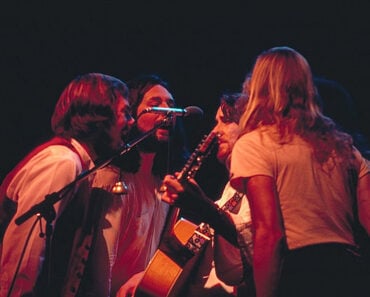
Feature Photo: John Mathew Smith & www.celebrity-photos.com from Laurel, Maryland, USA, CC BY-SA 2.0 <https://creativecommons.org/licenses/by-sa/2.0>, via Wikimedia Commons
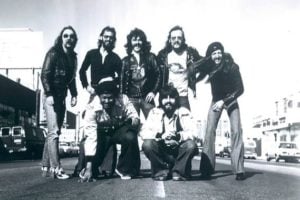
War emerged from Southern California with a sound that brought funk, soul, rock, jazz, blues, reggae, and Latin rhythms into the same musical conversation. The group’s roots reached back to the Creators, formed by guitarist Howard E. Scott and drummer Harold Ray Brown in the early 1960s. By the end of that decade, the musicians had become Nightshift and were working with saxophonist and football player Deacon Jones when producer Jerry Goldstein introduced them to former Animals singer Eric Burdon.
Eric Burdon and War released two albums in 1970 and scored an international breakthrough with “Spill the Wine.” After Burdon’s departure, the seven-piece core of Lonnie Jordan, Howard Scott, Harold Brown, Charles Miller, B.B. Dickerson, Lee Oskar, and Papa Dee Allen continued as War. That lineup developed one of the most distinctive ensemble sounds of the 1970s, built around shared vocals, deep grooves, harmonica, saxophone, keyboards, guitar, and layered percussion.
War’s classic recordings included “All Day Music,” “Slippin’ into Darkness,” “The Cisco Kid,” “The World Is a Ghetto,” “Gypsy Man,” “Why Can’t We Be Friends?,” “Low Rider,” and “Summer.” The World Is a Ghetto reached number one on the Billboard 200 and became the magazine’s best-selling album of 1973. The band’s music often joined street-level observation with calls for unity, humor, and social understanding.
The original lineup gradually changed after the departures of Charles Miller and B.B. Dickerson in 1979. New musicians carried War through The Music Band, Outlaw, Life (Is So Strange), and the 1994 album Peace Sign. In the mid-1990s, Howard Scott, Harold Brown, Lee Oskar, and B.B. Dickerson separated from the continuing War organization and performed together as the Lowrider Band.
Lonnie Jordan remained with War and became the only original member in the touring lineup. The modern group has included guitarist James Zota Baker, bassist Rene Camacho, saxophonist Scott Martin, harmonica player Stanley Behrens, drummer Salvador “Sal” Rodriguez, and percussionist Marcos Reyes. War continued touring during 2026, preserving the large-ensemble approach that has defined the band since its earliest years.
In 2025, War received a star on the Hollywood Walk of Fame, bringing together surviving original and longtime members for a public celebration of the band’s legacy. The same year also brought the archival release Live in Japan 1974 and a remastered collection devoted to the Eric Burdon and War recordings.
Eric Burdon
Eric Burdon became War’s first lead singer in 1969 after producer Jerry Goldstein connected the former Animals frontman with the musicians then performing as Nightshift. Burdon appeared on Eric Burdon Declares “War” and The Black-Man’s Burdon, and his dramatic blues-rock voice helped introduce the band to a worldwide audience. He co-wrote and sang “Spill the Wine,” the collaboration’s defining hit. Burdon left during the group’s European touring period in 1971, but his improvisational approach helped shape War’s willingness to build long, atmospheric performances from collective jams. He later reunited with the band for selected appearances, including a 2008 performance at London’s Royal Albert Hall.
Leroy “Lonnie” Jordan
Leroy “Lonnie” Jordan joined the group that became War during its formative years and has remained the only original musician in the current lineup. As keyboardist, lead singer, songwriter, and musical coordinator, Jordan played on every major era of the band’s recording history, from the two Eric Burdon collaborations through Evolutionary in 2014.
Jordan’s piano, organ, electric piano, and vocals are central to recordings including “All Day Music,” “The World Is a Ghetto,” “The Cisco Kid,” “Why Can’t We Be Friends?,” “Low Rider,” and “Summer.” After the mid-1990s division between the War organization and the musicians who formed the Lowrider Band, Jordan continued leading War through new lineups, extensive touring, anniversary projects, and archival releases.
Howard E. Scott
Howard E. Scott co-founded the Creators with Harold Ray Brown and became War’s principal guitarist and one of its lead singers. His playing moved easily between funk rhythm, blues phrasing, rock accents, and spacious jazz-influenced passages. Scott appeared throughout the classic catalog, including All Day Music, The World Is a Ghetto, Deliver the Word, and Why Can’t We Be Friends?. He remained with War through the 1994 album Peace Sign before joining Harold Brown, Lee Oskar, and B.B. Dickerson in the Lowrider Band.
Harold Ray Brown
Harold Ray Brown co-founded the Creators with Howard Scott and supplied the drumming foundation that carried the group into Nightshift and War. His playing combined firm backbeats with the loose, conversational feel needed for War’s extended studio jams. Brown also contributed vocals, songwriting, and the band’s collective approach to arrangement. He performed throughout the classic era and returned for Peace Sign in 1994. Brown later became a founding member of the Lowrider Band with Scott, Lee Oskar, and B.B. Dickerson.
Charles Miller
Charles Miller played saxophone, flute, and vocals in War’s original lineup. His horn sound supplied both melodic hooks and exploratory solos, helping the group merge soul, jazz, Latin music, and funk without separating those styles into distinct sections. Miller’s work is heard on “Spill the Wine,” “The Cisco Kid,” “The World Is a Ghetto,” “Low Rider,” and many other classic recordings. He left War in 1979 after the Galaxy and Youngblood period. Miller died in 1980, but his saxophone and flute arrangements remained a model for every horn player who followed him in the band.
Morris “B.B.” Dickerson
Morris “B.B.” Dickerson was War’s original bassist and one of its principal vocalists. His rounded, melodic bass lines gave the band’s music a powerful low-end identity without limiting the other musicians’ freedom to improvise. Dickerson sang lead on “The World Is a Ghetto” and contributed to the writing and performance of the group’s most successful 1970s material. He left during the sessions that led to The Music Band and later reunited with Howard Scott, Harold Brown, and Lee Oskar in the Lowrider Band. Dickerson died in 2021.
Lee Oskar
Danish-born Lee Oskar brought harmonica and vocals to War’s original lineup. His ability to treat the harmonica as a lead instrument rather than a decorative effect became one of the group’s most recognizable features. Oskar appeared on the band’s major 1970s recordings and remained through Peace Sign in 1994. After leaving War, he joined the Lowrider Band and continued his solo career. He also developed the Lee Oskar Harmonica company, producing instruments designed for a wide range of tunings and musical styles.
Thomas “Papa Dee” Allen
Thomas “Papa Dee” Allen played congas, timbales, percussion, and vocals with War from its original formation until his death in 1988. His rhythmic patterns brought Afro-Cuban and Latin influences into the band’s funk and rock framework, creating the layered percussion heard throughout the classic catalog. Allen also contributed ideas, lyrics, and spoken passages, and his presence helped give War the feeling of a neighborhood ensemble rather than a conventional frontman-led group. He suffered a brain aneurysm while performing and died in August 1988.
Ron Hammon
Ron Hammon joined War in 1979 on drums and percussion during the transition from the original lineup to The Music Band era. He appeared on The Music Band, The Music Band 2, Outlaw, Life (Is So Strange), and Peace Sign. Hammon’s addition expanded the band’s already dense percussion section and helped preserve its rhythmic scale after the departures of several founding musicians. He remained with War until the major lineup changes of 1996.
Pat Rizzo
Pat Rizzo joined War in 1979 as a saxophonist, flutist, and vocalist after previously performing with Sly and the Family Stone. He appeared during the Music Band, Outlaw, and Life (Is So Strange) periods, then returned for the lineup that recorded Peace Sign. Rizzo carried forward the prominent horn role established by Charles Miller while bringing his own funk and soul background to the group. He died in 2021.
Luther Rabb
Luther Rabb replaced B.B. Dickerson on bass during the sessions for The Music Band. He remained with War through The Music Band 2, Outlaw, and Life (Is So Strange), contributing bass and vocals during a period of major personnel and label changes. Before joining War, Rabb had been part of the Pacific Northwest groups Ballin’ Jack and the Emergency Exit. He left War in the mid-1980s and died in 2006.
Alice Tweed Smith
Alice Tweed Smith, also credited as Tweed Smith and Alice Tweed Smyth, joined War during the late-1970s Music Band period. She contributed vocals and percussion and became the first woman to hold a regular performing role in the group. Her recordings include The Music Band 2 and The Music Band Live. Smith’s presence added a new vocal color to a lineup that was broadening beyond the original seven-member formation.
Ricky Green
Ricky Green played bass and contributed vocals with War during the mid-to-late 1980s. He joined after Luther Rabb’s departure and worked primarily as a touring member during a period when War released little new studio material. Green helped maintain the band’s live rhythm section through the years surrounding Papa Dee Allen’s death and before the expanded reunion lineup assembled in the early 1990s.
Salvador “Sal” Rodriguez
Salvador “Sal” Rodriguez joined War in 1990 as a drummer, percussionist, and vocalist. His tenure has covered the Peace Sign sessions, the 1996 reorganization, Evolutionary, and decades of touring. Rodriguez became one of the longest-serving musicians in War’s history and a central member of the modern lineup. His ability to combine drum-kit power with Latin percussion supports the group’s classic arrangements while allowing the current band to retain the flexible rhythmic dialogue of the original ensemble.
Tetsuya “Tex” Nakamura
Tetsuya “Tex” Nakamura joined War in 1993 as a harmonica player and vocalist. He appeared on Peace Sign and remained after Lee Oskar’s departure, taking on the difficult task of performing some of the most recognizable harmonica parts in the band’s catalog. Nakamura stayed with War until 2006 and helped maintain the group’s signature instrumental balance through the first decade of the post-1996 lineup.
Rae Valentine
Rae Valentine joined War in 1993 on keyboards, percussion, and vocals and appeared on Peace Sign. He supported Lonnie Jordan’s keyboard work while adding another vocal and rhythmic layer to the large ensemble. Valentine remained during the mid-1990s transition and continued with Jordan’s version of War until 2001.
Kerry Campbell
Kerry Campbell played saxophone with War from the early to late 1990s and appeared on Peace Sign. He worked within a large horn lineup that also included Pat Rizzo and Charles Green. Campbell remained with War after the 1996 division and helped preserve the horn-driven arrangements of “The Cisco Kid,” “Low Rider,” “Spill the Wine,” and other concert staples.
Charles Green
Charles Green contributed saxophone and flute during War’s early-1990s reunion period. He appeared on Peace Sign and worked alongside Pat Rizzo and Kerry Campbell in the expanded horn section. Although his tenure was brief, Green participated in the last studio project to feature several members from War’s classic era.
J.B. Eckl
J.B. Eckl joined War in the mid-1990s as a guitarist and vocalist. His role supplemented Howard Scott’s guitar work during the final period in which several original members performed under the War name. Eckl left during the 1996 restructuring and continued as a songwriter, producer, and guitarist in other projects.
Lance Ellis
Lance Ellis played saxophone and flute with War from the mid-1990s through 2020. He remained after the original-member split and became one of the longest-serving musicians in the band’s modern history. Ellis appeared on Evolutionary and spent more than two decades performing the horn lines and solos associated with War’s classic recordings.
Smoky Greenwell
Smoky Greenwell played harmonica with War during the mid-1990s. He joined while Lee Oskar was still present, giving the band additional harmonica textures during the Peace Sign touring period. Greenwell departed around the time of the 1996 lineup reorganization and continued his career as a blues harmonica player, singer, and bandleader.
Sandro Alberto
Sandro Alberto joined War in 1996 as a guitarist and vocalist after Howard Scott’s departure. He performed during the first stage of the reconfigured lineup led by Lonnie Jordan and helped keep the group’s touring schedule active while the organization rebuilt around new musicians. Alberto remained through 1998.
Richard Marquez
Richard Marquez played drums and percussion with War during the immediate aftermath of the 1996 lineup change. Working alongside Sal Rodriguez, he helped maintain the group’s multi-percussion approach during a brief transitional tenure. Marquez left in 1997.
Kenny Hudson
Kenny Hudson joined War as a percussionist in the late 1990s. His short tenure came while the band was stabilizing its rhythm section after the departure of several original members. Hudson performed alongside Sal Rodriguez and contributed to the layered percussion required by War’s live arrangements.
James Zota Baker
James Zota Baker first joined War in 1998 as a guitarist and vocalist and remained until 2002. He returned in 2023 after more than two decades away, replacing Stuart Ziff. Baker’s current role includes rhythm and lead guitar, backing vocals, and the broad stylistic range needed to move between funk, blues, rock, Latin grooves, and extended improvisation. He was part of the lineup featured in War’s 2025 “Why Can’t We Be Friends?” global collaboration.
Marcos Reyes
Marcos Reyes joined War in 1998 as a percussionist and has become one of the longest-tenured members of the modern band. He appeared on Evolutionary and has spent decades supporting the live catalog with congas, hand percussion, and rhythmic accents. Reyes joined original and longtime members during War’s 2025 Hollywood Walk of Fame celebration and remains part of the touring lineup.
Fernando Harkless
Fernando Harkless played saxophone with War from 1998 to 2011. He joined during a period when the post-1996 lineup was becoming more stable and spent more than a decade performing the horn-centered material from War’s classic catalog. Harkless was succeeded by David Urquidi.
Stuart Ziff
Stuart Ziff served as War’s guitarist and vocalist from 2002 through 2023. His twenty-one-year tenure made him one of the longest-serving members of the modern lineup. Ziff appeared on Evolutionary and performed extensively with the group before James Zota Baker returned to the guitar position.
Pancho Tomaselli
Francisco “Pancho” Tomaselli joined War on bass and vocals in 2003. He toured with the group for more than a decade and appeared on Evolutionary, maintaining the deep funk foundation associated with B.B. Dickerson’s original playing. Tomaselli left in 2015 after Rene Camacho joined the lineup.
Mitch Kashmar
Mitch Kashmar played harmonica and sang with War from 2006 to 2011. A respected blues musician, he brought a forceful amplified harmonica sound to the role established by Lee Oskar. Kashmar later returned for selected performances and appeared with War’s modern lineup during anniversary events and archival celebrations.
Stanley Behrens
Stanley Behrens joined War in 2011 as harmonica player and vocalist. He appeared on Evolutionary and became the regular harmonica voice in the modern touring band. Behrens performs the signature parts associated with “Low Rider,” “The Cisco Kid,” and other classics while adding his own blues and jazz phrasing. He was included with the current War musicians in the 2025 Playing for Change version of “Why Can’t We Be Friends?”
David Urquidi
David Urquidi played saxophone and flute with War from 2011 to 2017. He appeared on Evolutionary and carried the band’s horn tradition through much of the 2010s. Urquidi left when Scott Martin assumed the saxophone and flute role.
David “Pug” Rodriguez
David “Pug” Rodriguez joined War in 2011 on percussion and vocals. He appeared on Evolutionary and worked within the large percussion section alongside Sal Rodriguez and Marcos Reyes. His tenure continued through 2019.
Rene Camacho
Rene Camacho joined War on bass in 2014 and became a core member of the modern lineup. A versatile bassist with extensive jazz, Latin, and popular-music experience, Camacho supplies the groove required by War’s catalog while leaving space for keyboards, harmonica, horns, guitar, and percussion. He has remained active with the group through its 2025 anniversary projects and 2026 touring schedule.
Scott Martin
Scott Martin joined War in 2017 on saxophone and flute. He performs the horn lines associated with Charles Miller and the many saxophonists who followed him while contributing his own solos and ensemble arrangements. Martin has become a regular member of the current lineup and appeared in War’s 2025 global recording of “Why Can’t We Be Friends?”
War Studio Albums
Eric Burdon Declares “War” (1970)
The Black-Man’s Burdon (1970)
War (1971)
All Day Music (1971)
The World Is a Ghetto (1972)
Deliver the Word (1973)
Why Can’t We Be Friends? (1975)
Love Is All Around (1976)
Platinum Jazz (1977)
Galaxy (1977)
Youngblood (Original Motion Picture Soundtrack) (1978)
The Music Band (1979)
The Music Band 2 (1979)
Outlaw (1982)
Life (Is So Strange) (1983)
The Music Band – Jazz (1983)
Peace Sign (1994)
Evolutionary (2014)
Selected War Live And Archival Albums
War Live (1974)
The Music Band Live (1980)
Greatest Hits Live (2008)
Live in Japan 1974 (2025)
Eric Burdon & War – The Complete CD Collection (2025)
More War Articles
Check out more War articles on ClassicRockHistory.com.
Top 10 Songs From The Band War
Read More: Artists’ Interviews Directory At ClassicRockHistory.com
Read More: Classic Rock Bands List And Directory
Updated August 1, 2026.
Complete List Of War Band Members article published on ClassicRockHistory.com © 2026