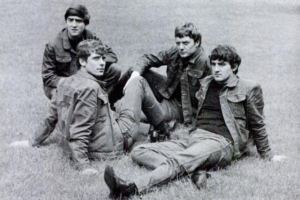
Our Top 10 Songs By The Fortunes presents the best Fortunes songs, including “Storm in a Teacup,” “Here It Comes Again,” and many more. Formed out of Birmingham, England, the harmonious beat group known as The Fortunes started in 1961 with Rod Allen, Glen Dale, and Barry Pritchard as vocalists, along with pianist Chris Capaldi, drummer Gary Fletcher, and Saxophonist Tony Britnell. When the group first started performing as a band, they were backed by an instrumental group, the Cliftones. Together, these two bands evolved beyond the stardom they achieved as national stars to international stardom. The UK-based pirate radio station, Radio Caroline, earned its name and theme song, “Caroline,” from this two-band team. This song was co-written by Tony Hiller, as well as Ivy League’s Perry Ford. By 1963, David Carr was added to The Fortunes’ lineup as their drummer, along with keyboardist Andy Brown.
Changing Fortunes
In 1966, one of The Fortunes’ vocalists, Glen Dale, left the group during the summer to pursue other interests and was replaced by Shel McCrae. This was also the same year their manager, Reginald Calvert, was shot and killed by Major Oliver Smedley over pirate radio station disputes at the Shivering Sands Army Fort, a World War II marine remnant located just off the coast of Kent, England. The court proceedings acquitted Smedley after learning more about the dispute.
The next three singles they released under the Decca label failed to achieve the same level of success the band achieved in 1965 with “You’ve Got Your Troubles,” “Here It Comes Again,” and “This Golden Ring.” This resulted in a label switch from Decca to United Artists in 1967, but did not really improve their fortunes as hitmakers until they recorded a musical advertisement for Coca-Cola in the United States. The first jingle, “Things Go Better with Coke,” was a 1967 remix of the brand’s theme tune, before it was replaced in 1969 with “It’s The Real Thing.”
In the meantime, The Fortunes were unable to make a solid chart impression and struggled to achieve much commercial success as recording artists. In 1971, they signed with Capitol Records, hoping this would change their fortunes beyond the label of Coca-Cola’s musical ambassadors. In 1972, “Storm in a Teacup” put The Fortunes back into the spotlight as chart-hitters, as well as “Here Comes that Rainy Day Feeling.”
Rod Allen’s Era
Since 1963, The Fortunes have endured various lineup changes, with founder Rod Allen remaining a constant until his death on January 10, 2008, after a two-month battle with liver cancer. During this period, he remained one of the frontmen, even after he was paired with Paul Hooper and Michael Smitham. This was the lineup that earned a gold certification from the British Phonographic Industry (BPI) in 1987 for the compilation album, All the Hits and More. In 1995, Barry Pritchard became too ill to continue with The Fortunes and was replaced by Bob Jackson of Badfinger fame. In 1999, Pritchard passed away from a heart attack, followed by David Carr’s passing in 2011. Founder Glen Dale passed away from heart disease on January 13, 2019, leaving Andy Brown as the only surviving member of The Fortunes’ original roster.
Continuing Fortunes
The current roster of The Fortunes now features Eddie Mooney as bassist and lead vocalist as of 2007, drummer Glenn Taylor as of 2010, and Chris Hutchison as of 2018. Michael Smitham, as vocalist and guitarist, has been the group’s longest-running member since 1983. This particular lineup currently makes appearances on cruises and in theatrical productions featuring music from the 1960s. In 2021, The Fortunes digitally released two hit singles, Never Too Far” and “One Special Moment,” marking these songs the first time the band’s name would realize chart success since 1972. Although it’s an entirely new lineup, The Fortunes continue to record, with the most recent album, Special Moments, released in December 2021. In total, this makes the studio album count for The Fortunes eight. Also to the band’s credit are nine compilation albums, a live album, and thirty-seven singles.
The Fortunes’ Top 10 Songs
#10 – Fire Brigade
Originally recorded by The Move in 1968, it became a UK hit for that group, reaching number three. The Fortunes released this as a single in the US, but it failed to chart. Nevertheless, it still became a fan favorite, thanks to the sampled music from Eddie Cochran’s “Somethin’ Else.” The opening sound of the fire engine led into the vocalists of The Fortunes, who shared their lyrical tale of a love interest in this British beat classic. This 1960s UK favorite also won over at least a few North American fans in the process.
#9 – Summertime, Summertime
“Summertime, Summertime” became a local favorite in Boston, Massachusetts, thanks to the Jaimes in 1958. A deejay sent this song to Epic Records that same year, and the single became a nationwide hit, peaking at number twenty-eight on the US Billboard Hot 100. In 1962, this same group released it a second time, becoming a hit yet again, this time at number thirty-eight. This musical celebration of another school year coming to an end and of embracing the summer season was also performed by The Fortunes and The Cliftones in 1963.
The trio of vocalists from The Fortunes, Allen, Dale, and Pritchard, each picked up guitars to add to this song, which was instrumental in catapulting The Cliftones to their own road of success, no longer simply as a backup band. Although The Fortunes’ version may not have charted as a hit, it’s still a fan favorite, especially among UK audiences.
#8 – Caroline
Since its 1964 recording, “Caroline” has become the theme song for the UK-based pirate radio station, Radio Caroline. As a response to the UK’s BBC’s corporate control over the broadcasting rights to the music heard on the radio, Radio Caroline used five ships owned by three different owners to air recorded music from international waters. From 1964 until 1990, this was their practice before it was replaced by satellite in 1998.
The station continues to operate today, broadcasting what it refers to as carefully selected material, emphasizing album-oriented rock. “Caroline” became the theme song for Radio Caroline, which was written as a lyric of a woman whom The Fortunes fancied. It was also common to name ships after women, as was the case with Radio Caroline, which was named after John F. Kennedy’s daughter. Radio Caroline belonged to Britain’s Ronan O’Rahilly, a businessman inspired by a photograph of Kennedy’s young daughter crawling under his desk. At the same time, he was still president of the United States of America. “Caroline” was more than simply a song. It also represented freedom.
#7 – It’s The Real Thing
Although “It’s The Real Thing” was technically a jingle for Coca-Cola, this 1969 tune officially became the new theme for the soft drink corporation, which still uses the slogan, “It’s The Real Thing,” quoted to this day in many of its commercials. Granted, this may be an advertisement, but it was still a catchy tune and became a cult favorite. Performed big-band style with a hint of Spanish flair, “It’s The Real Thing” heightened not just soft drink’s brand popularity, but The Fortunes’ as well.
#6 – That Same Old Feeling
From The Fortunes, “That Same Old Feeling” was a single released only in Canada and the U.S. On the RPM Canadian music chart, it peaked at number 40 and was a modest 62 on the US Billboard Hot 100. As for the recording by Pickettywitch, which was also in 1970, their UK version became a number five hit in that nation, as well as becoming a hit in Canada and the U.S., peaking at number thirty-six and sixty-seven, respectively.
The rivalry behind this song between Pickettywitch and The Fortunes started when Pickettywitch prompted The Fortunes to release their own version specifically for the American market. Due to record label issues, Pickettywitch’s version and The Fortunes’ version were released at the same time. The original recording of “That Same Old Feeling” belonged to The Foundations, where the chorus remained as a standard while the verses underwent radical changes, which are the versions heard by Pickettywitch, as well as The Fortunes.
#5 – Freedom Come, Freedom Go
In 1971, “Freedom Come, Freedom Go” became The Fortunes’ final hit on the US Billboard Hot 100, peaking at number seventy-two. It was, however, a number three hit in New Zealand, a number six hit in the UK, and a number twelve hit on the US Billboard Adult Contemporary Songs chart. In Australia, Canada, and Ireland, “Freedom Come, Freedom Go” was at least a top twenty hit. In the lyrics, the talk of a boy-meets-girl, combined with opposites attracting as far as societal standards go, this playful take on relationships became a catchy favorite, thanks to The Fortunes’ interpretation.
#4 – Here Comes That Rainy Day Feeling Again
1971’s depressive breakup single, “Here Comes That Rainy Day Feeling Again,” was a number 15 hit on the US Billboard Hot 100 and a number 8 hit on the US Billboard Adult Contemporary Songs chart. In Canada, it peaked at number twenty-five and charted as high as number fifty-one in the UK. The lyrical plea to win back the love interest fell short. Still, it was powerful enough to gain enough fan appeal to become an international hit, reaching number forty-three in Australia.
#3 – You’ve Got Your Troubles
On the UK Singles Chart, “You’ve Got Your Troubles” peaked at number two after it was released in 1965, and was a chart-topping hit in Canada and in New Zealand. Written by the dynamic songwriting team, Roger Cook and Roger Greenaway, this also became a major hit for The Fortunes on the US Billboard 100, peaking at number seven. Among the nations of Australia, Ireland, the Netherlands, and South Africa, it was at least a top twenty hit, marking “You’ve Got Your Troubles” as the first taste of international success for the group.
The counterpoint melody near the end of the song, instrumentally, made it a standout hit, especially with Radio Caroline. This pirate station started as a defiant voice against corporate control of the music industry. It was key to the musical British Invasion that swept North American nations and the rest of the world.
#2 – Here It Comes Again
“Here It Comes Again” peaked at number four on the UK Singles Chart after it was released as a single in 1965, as well as in Canada. On the US Billboard Hot 100, it peaked at number twenty-seven. As if sending a musical message to the world of radio stations, “Here It Comes Again” illustrated that The Fortunes were not simply one-hit wonders that would be forgotten anytime soon. One of The Fortunes’ signature songs, “Here It Comes Again,” has been covered many times by a variety of artists over the years. As for this group’s version, the feelings of a former love interest were performed beautifully as a pained victim, now out of a home, upon realizing he’s still alone while his loved one has moved on without him.
#1 – Storm in a Teacup
“Storm in a Teacup” was a number seven UK Singles Chart hit for The Fortunes after it was released in 1972, as well as a number nine hit in Ireland, and a number fifteen hit in New Zealand. Although this single failed to match the chart success of the group’s other hits, it sold over 3 million copies worldwide, making “Storm in a Teacup” their best-selling single of all time. Of all the singles recorded and released by The Fortunes, this is the one played on radio stations the most. This soulful pop-rock favorite would see The Fortunes record updated versions, first in 1979, then again in 1982, and yet again in 1994. Although nothing beats the original, “Storm in a Teacup” remains The Fortunes’ signature song.
Feature Photo: Photographer A. Vente, CC BY-SA 3.0 NL <https://creativecommons.org/licenses/by-sa/3.0/nl/deed.en>, via Wikimedia Commons
Updated December 23, 2025
Top 10 Songs By The Fortunes article published on Classic RockHistory.com© 2025
Classicrockhistory.com claims ownership of all its original content and Intellectual property under United States Copyright laws and those of all other foreign countries. No one person, business, or organization is allowed to republish any of our original content anywhere on the web or in print without our permission. All photos used are either public domain, Creative Commons photos, or licensed officially from Shutterstock under license with ClassicRockHistory.com. All photo credits have been placed at the end of the article.