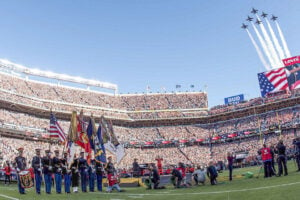
Feature Photo: Spc. Brandon C. Dyer, Public domain, via Wikimedia Commons
“The Star-Spangled Banner” began as Francis Scott Key’s poem “Defence of Fort M’Henry,” written after he witnessed the bombardment of Fort McHenry during the War of 1812. The words were set to the melody of “To Anacreon in Heaven,” and the song became the official national anthem of the United States in 1931.
The anthem has been part of the Super Bowl pregame ceremony since the inaugural championship in 1967, with one exception. At Super Bowl XI in 1977, Vikki Carr performed “America the Beautiful” instead, and no national anthem was presented.
The earliest Super Bowls relied heavily on marching bands, choirs, brass players, and other instrumental performers. Well-known recording artists became increasingly prominent during the 1970s and 1980s, and the national anthem eventually developed into one of the event’s most closely watched musical moments.
Whitney Houston’s 1991 performance remains one of the most celebrated renditions in Super Bowl history. Beginning with Super Bowl XXVI in 1992, the pregame anthem has also included an American Sign Language performer.
This chronological list covers the principal national anthem performers from Super Bowl I through Super Bowl LX in 2026, along with the stadium and host location for each game.
Complete List Of All Super Bowl National Anthem Performers
Super Bowl I (1967)
Performer: The Pride of Arizona, the Michigan Marching Band, and the UCLA Choir
Venue: Los Angeles Memorial Coliseum (Los Angeles, California)
The first Super Bowl looked quite different from the entertainment spectacle we know today. College musicians from Arizona and Michigan joined the UCLA Choir for a traditional presentation, reflecting the importance of university bands in American football. Before famous recording stars became regular anthem guests, the music came from the same marching-band and choral traditions fans heard at college games every weekend.
Super Bowl II (1968)
Performer: Grambling State University Tiger Marching Band
Venue: Miami Orange Bowl (Miami, Florida)
Grambling State’s Tiger Marching Band represented one of the most celebrated musical traditions among historically Black colleges and universities. Under longtime director Conrad Hutchinson Jr., Grambling developed a reputation for precision, showmanship, and a sound that could fill a stadium. Their involvement was an early reminder that the Super Bowl’s musical history extended well beyond recording artists and popular singers.
Super Bowl III (1969)
Performer: Lloyd Geisler of the National Symphony Orchestra (trumpet)
Venue: Miami Orange Bowl (Miami, Florida)
Lloyd Geisler was a distinguished orchestral trumpeter associated with Washington’s National Symphony Orchestra. His instrumental interpretation carried on the early Super Bowl practice of presenting the anthem without a celebrity vocalist. It is interesting to look back at a time when a single brass instrument could be entrusted with such an important moment before the championship game.
Super Bowl IV (1970)
Performer: Doc Severinsen and Al Hirt (trumpets), Pat O’Brien (spoken word), and the Southern University Band (ceremonies)
Venue: Tulane Stadium (New Orleans, Louisiana)
The fourth Super Bowl brought together an unusual collection of entertainment personalities. Doc Severinsen was already familiar to television audiences through The Tonight Show, while actor Pat O’Brien was known for his film roles, including Knute Rockne, All American. New Orleans trumpeter Al Hirt and the Southern University Band were also part of the larger ceremonies, making this one of the more elaborate early pregame productions.
Super Bowl V (1971)
Performer: Tommy Loy (trumpet)
Venue: Miami Orange Bowl (Miami, Florida)
Tommy Loy was a respected trumpeter whose professional career included performing with major orchestral and popular-music ensembles. His appearance continued the tradition of using brass players for the anthem, something that had been especially common during the Super Bowl’s first few years. It was a straightforward musical opening before the Baltimore Colts and Dallas Cowboys played for the championship.
Super Bowl VI (1972)
Performer: U.S. Air Force Academy Chorale
Venue: Tulane Stadium (New Orleans, Louisiana)
The U.S. Air Force Academy Chorale brought the precision and discipline of military music to the Super Bowl. Rather than spotlighting one famous singer, the ceremony emphasized the blended sound of a trained ensemble. The appearance came at a time when the championship’s pregame entertainment still leaned heavily on service organizations, university music programs, and traditional ceremonial performances.
Super Bowl VII (1973)
Performer: The Little Angels children’s choir of Chicago’s Holy Angels Church
Venue: Los Angeles Memorial Coliseum (Los Angeles, California)
The Little Angels children’s choir came from Holy Angels Church in Chicago, bringing a very different sound to the anthem. There is something moving about hearing young voices take on a song normally associated with brass bands or professional vocalists. Their participation was a memorable part of the festivities surrounding the Miami Dolphins’ completion of their undefeated championship season.
Super Bowl VIII (1974)
Performer: Charley Pride
Venue: Rice Stadium (Houston, Texas)
Charley Pride was one of country music’s biggest stars by the time he sang at Super Bowl VIII. With hits including “Kiss an Angel Good Mornin’” and “Is Anybody Goin’ to San Antone,” he had helped break barriers for Black performers in country music. His appearance showed how the Super Bowl was beginning to recognize nationally known recording artists as an important part of the pregame presentation.
Super Bowl IX (1975)
Performer: New Orleans Chapter of the Society for the Preservation of Barbershop Quartet Singing in America Chorus
Venue: Tulane Stadium (New Orleans, Louisiana)
This presentation was built around the close harmony of a New Orleans-area barbershop chorus, a sound far removed from the pop-star performances familiar today. Grambling State’s celebrated marching band also participated in the game’s pregame and halftime activities, which helps explain why some historical lists give the band credit as well. The combination reflected the Super Bowl’s early interest in regional musical traditions.
Super Bowl X (1976)
Performer: Tom Sullivan
Venue: Miami Orange Bowl (Miami, Florida)
Tom Sullivan was a singer, entertainer, actor, and motivational speaker whose career was all the more remarkable because he had been blind since birth. His participation put an individual vocalist back in the spotlight after several years of choirs and instrumental ensembles. It was a fitting national platform for a performer who had already built a career around both musical talent and personal determination.
Super Bowl XI (1977)
Performer: No national anthem was performed; Vikki Carr sang “America the Beautiful”
Venue: Rose Bowl (Pasadena, California)
This is the exception that makes any complete Super Bowl national anthem list a little unusual. Vikki Carr, a popular singer known for “It Must Be Him” and her recordings in English and Spanish, performed “America the Beautiful” instead. No “Star-Spangled Banner” performance is documented for the game, so Carr belongs in the historical timeline even though her selection was a different patriotic song.
Super Bowl XII (1978)
Performer: Phyllis Kelly of Northeast Louisiana University, now the University of Louisiana at Monroe
Venue: Louisiana Superdome (New Orleans, Louisiana)
Phyllis Kelly was a singer representing Northeast Louisiana University, now the University of Louisiana at Monroe. Her appearance illustrated how the NFL still made room for talented performers outside the commercial recording industry. With the game in New Orleans, it was especially appropriate to bring in a vocalist connected to a Louisiana university rather than automatically choosing a nationally famous artist.
Super Bowl XIII (1979)
Performer: The Colgate Thirteen
Venue: Miami Orange Bowl (Miami, Florida)
The Colgate Thirteen is a longstanding a cappella singing group from Colgate University, known for its carefully arranged vocal performances. A college vocal ensemble singing before the biggest football game in the country may seem unusual now, but it fit comfortably into the Super Bowl’s early traditions. Their appearance also showed that close harmony could deliver the anthem without an orchestra or a major pop star.
Super Bowl XIV (1980)
Performer: Cheryl Ladd
Venue: Rose Bowl (Pasadena, California)
Cheryl Ladd was best known to television audiences as one of the stars of Charlie’s Angels, but she also had a recording career. Her appearance at Super Bowl XIV showed how the anthem assignment was becoming attractive to entertainers whose fame crossed television and music. It was an early example of the celebrity appeal that would eventually become a major part of the pregame show.
Super Bowl XV (1981)
Performer: Helen O’Connell
Venue: Louisiana Superdome (New Orleans, Louisiana)
Helen O’Connell was a singer whose career reached back to the big-band era, particularly her work with the Jimmy Dorsey Orchestra. That made her a wonderful connection to an earlier chapter of American popular music. Long before the Super Bowl became associated with contemporary chart stars, it could still turn to a veteran vocalist whose reputation had been built during the swing years.
Super Bowl XVI (1982)
Performer: Diana Ross
Venue: Pontiac Silverdome (Pontiac, Michigan)
Diana Ross was already an international superstar, first with the Supremes and then with a solo career that included “Ain’t No Mountain High Enough” and “Upside Down.” Her appearance was a sign that the Super Bowl anthem was becoming an occasion for artists with global name recognition. There was no question that Ross had the voice, poise, and experience to handle the enormous spotlight.
Super Bowl XVII (1983)
Performer: Leslie Easterbrook
Venue: Rose Bowl (Pasadena, California)
Leslie Easterbrook was a singer and actress who would later become familiar to movie audiences through the Police Academy series. Her Super Bowl appearance came before those films made her widely recognizable. It’s a reminder that the list contains some unexpected names, not just recording stars, and that the anthem was sometimes entrusted to performers whose careers crossed several areas of entertainment.
Super Bowl XVIII (1984)
Performer: Barry Manilow
Venue: Tampa Stadium (Tampa, Florida)
Barry Manilow had spent the 1970s filling the charts with melodic pop songs such as “Mandy,” “Could It Be Magic,” and “Copacabana.” His reputation for carefully arranged performances made him an obvious choice for a major televised musical moment. The appearance also reflected the NFL’s growing willingness to feature established adult-contemporary stars rather than relying primarily on instrumentalists or choirs.
Super Bowl XIX (1985)
Performer: San Francisco Boys Chorus, San Francisco Girls Chorus, Piedmont Children’s Chorus, and San Francisco Children’s Chorus
Venue: Stanford Stadium (Stanford, California)
Four Bay Area children’s choruses joined forces for the anthem at Stanford Stadium. The performance brought together young singers from across the region and placed ensemble singing back at the center of the ceremony. It was a wonderful contrast to the growing trend toward superstar soloists, and a reminder that the anthem can have just as much impact when performed by a large group of children.
Super Bowl XX (1986)
Performer: Wynton Marsalis (trumpet)
Venue: Louisiana Superdome (New Orleans, Louisiana)
Wynton Marsalis was one of jazz’s brightest young stars, already recognized for his extraordinary command of the trumpet in both jazz and classical music. His instrumental performance connected the Super Bowl to one of America’s most important musical traditions. For listeners who appreciate great musicianship, it was especially satisfying to see a jazz artist receive a stage normally dominated by popular entertainers.
Super Bowl XXI (1987)
Performer: Neil Diamond
Venue: Rose Bowl (Pasadena, California)
Neil Diamond had already become one of the country’s most recognizable singer-songwriters through recordings such as “Sweet Caroline,” “Song Sung Blue,” and “America.” His rich baritone and theatrical delivery were well suited to the anthem’s sweeping melody. By this point, the Super Bowl had become a major showcase for legendary recording artists, and Diamond fit that changing tradition perfectly.
Super Bowl XXII (1988)
Performer: Herb Alpert (trumpet)
Venue: Jack Murphy Stadium (San Diego, California)
Herb Alpert was a trumpet player, bandleader, and recording-industry figure whose work with the Tijuana Brass brought instrumental pop to millions of listeners. His performance offered a return to the brass-led presentations of the earliest Super Bowls. Alpert was a major star without being a conventional vocal performer, which made his appearance a particularly interesting choice in the middle of the celebrity-singer era.
Super Bowl XXIII (1989)
Performer: Billy Joel
Venue: Joe Robbie Stadium (Miami Gardens, Florida)
Billy Joel arrived with a catalog of classics including “Piano Man,” “Just the Way You Are,” and “Uptown Girl.” He was one of the biggest concert attractions in the country, and his unmistakable voice made the anthem a natural fit. This appearance also became part of a rare distinction: Joel would return to sing the Super Bowl anthem again in 2007.
Super Bowl XXIV (1990)
Performer: Aaron Neville
Venue: Louisiana Superdome (New Orleans, Louisiana)
Aaron Neville brought one of the most distinctive voices in American soul music to the Super Bowl. His remarkable falsetto had been heard on records such as “Tell It Like It Is” and, more recently, in his collaborations with Linda Ronstadt. With the game taking place in New Orleans, the choice also celebrated a singer whose musical identity was inseparable from the city and its rich heritage.
Super Bowl XXV (1991)
Performer: Whitney Houston with The Florida Orchestra, conducted by Jahja Ling
Venue: Tampa Stadium (Tampa, Florida)
Whitney Houston’s performance came just days after the start of the Gulf War, adding enormous emotional weight to the anthem. Backed by The Florida Orchestra, her voice soared over a stirring arrangement that became one of the most admired recordings of the song in history. It was released as a single, reached the Billboard Hot 100, and returned to the charts after September 11, 2001. For many listeners, this remains the standard against which every Super Bowl anthem is measured.
Super Bowl XXVI (1992)
Performer: Harry Connick Jr.
Venue: Hubert H. Humphrey Metrodome (Minneapolis, Minnesota)
Harry Connick Jr. was a natural choice for a Super Bowl in Minneapolis, bringing the style of a singer and pianist whose work drew heavily from jazz and classic American standards. His popularity had grown through albums, concerts, and film work. The ceremony also marked an important step toward accessibility, with an American Sign Language interpreter included in the anthem presentation.
Super Bowl XXVII (1993)
Performer: Garth Brooks
Venue: Rose Bowl (Pasadena, California)
Garth Brooks was at the height of his country-music stardom, but the story surrounding his anthem is nearly as famous as the performance itself. A dispute over whether the television broadcast would show the video for his song “We Shall Be Free” threatened to derail his appearance shortly before kickoff. The matter was resolved, Brooks performed, and Marlee Matlin signed the anthem. It remains one of the most unusual behind-the-scenes stories in Super Bowl music history.
Super Bowl XXVIII (1994)
Performer: Natalie Cole
Venue: Georgia Dome (Atlanta, Georgia)
Natalie Cole had enjoyed major renewed success with Unforgettable… with Love, the tribute album connected to the music of her father, Nat King Cole. Her polished phrasing and jazz-influenced delivery brought elegance to the anthem at the Georgia Dome. She was a performer who could move naturally between R&B, pop, and classic standards, and that versatility made her well suited to the occasion.
Super Bowl XXIX (1995)
Performer: Kathie Lee Gifford
Venue: Joe Robbie Stadium (Miami Gardens, Florida)
Kathie Lee Gifford was familiar to millions as a television personality, but she also worked as a singer and musical performer. Her selection showed just how broad the definition of Super Bowl entertainment had become. Not every anthem performer was a chart-topping recording star, and Gifford’s appearance reflected the event’s continuing connection with the wider world of American television.
Super Bowl XXX (1996)
Performer: Vanessa Williams
Venue: Sun Devil Stadium (Tempe, Arizona)
Vanessa Williams had overcome an early public controversy to establish a highly successful career in recording, acting, and theater. Songs such as “Save the Best for Last” demonstrated the warmth and control of her voice. Her Super Bowl performance came at a time when she was one of the most recognizable women in American entertainment, giving the anthem a blend of pop-star appeal and polished musicianship.
Super Bowl XXXI (1997)
Performer: Luther Vandross
Venue: Louisiana Superdome (New Orleans, Louisiana)
Luther Vandross was one of the great voices of modern R&B, celebrated for “Never Too Much,” “Here and Now,” and his beautiful interpretations of romantic standards. Few singers could match his phrasing or the warmth of his tone. Hearing him take on the national anthem was a reminder that a performance does not have to be overloaded with vocal tricks when the singer already possesses such extraordinary control.
Super Bowl XXXII (1998)
Performer: Jewel
Venue: Qualcomm Stadium (San Diego, California)
Jewel had become a major star with her debut album Pieces of You and songs such as “Who Will Save Your Soul” and “You Were Meant for Me.” Her folk-influenced voice offered a different kind of anthem performance from the grand R&B interpretations of previous years. The selection also showed the NFL’s willingness to embrace the younger singer-songwriter generation that had emerged during the 1990s.
Super Bowl XXXIII (1999)
Performer: Cher
Venue: Pro Player Stadium (Miami Gardens, Florida)
Cher had already experienced several different careers as a pop star, television personality, and Oscar-winning actress. By the late 1990s, she was enjoying another major musical comeback with “Believe.” Her presence brought unmistakable star power to the pregame ceremony. Few entertainers could have represented so many decades of American popular culture while remaining completely recognizable to a new audience.
Super Bowl XXXIV (2000)
Performer: Faith Hill
Venue: Georgia Dome (Atlanta, Georgia)
Faith Hill was one of country music’s biggest crossover stars, thanks to songs such as “This Kiss” and “Breathe.” Her strong, expressive voice and polished presentation made her an ideal choice for the anthem. The appearance also reflected a period when country singers were becoming increasingly important to mainstream pop television, reaching well beyond the traditional Nashville audience.
Super Bowl XXXV (2001)
Performer: Backstreet Boys
Venue: Raymond James Stadium (Tampa, Florida)
The Backstreet Boys were among the world’s most popular vocal groups when they performed at Super Bowl XXXV. Known for hits such as “I Want It That Way” and “Everybody (Backstreet’s Back),” they brought the close harmonies of late-1990s pop to the anthem. Rather than relying on one lead vocalist, the performance emphasized the group sound that had helped make them international stars.
Super Bowl XXXVI (2002)
Performer: Mariah Carey with the Boston Pops Orchestra, conducted by Keith Lockhart
Venue: Louisiana Superdome (New Orleans, Louisiana)
Mariah Carey took the stage in New Orleans with the Boston Pops Orchestra under Keith Lockhart. Her exceptional range and extraordinary success with songs such as “Vision of Love” and “Hero” made her one of the most famous singers in the world. Coming in the first Super Bowl after the September 11 attacks, the anthem carried added emotional significance, and Carey’s performance was part of a particularly solemn national moment.
Super Bowl XXXVII (2003)
Performer: The Chicks, then billed as the Dixie Chicks
Venue: Qualcomm Stadium (San Diego, California)
The Chicks, then known as the Dixie Chicks, were one of the most successful country groups of their generation, with hits such as “Wide Open Spaces” and “Cowboy Take Me Away.” Their three-part harmonies and instrumental ability brought a traditional country feel to the anthem. The appearance came before the political controversy that would engulf the group later that year, making it an interesting snapshot of their place in American popular culture at the time.
Super Bowl XXXVIII (2004)
Performer: Beyoncé
Venue: Reliant Stadium (Houston, Texas)
Beyoncé performed the anthem in her hometown of Houston, which made the occasion especially meaningful. Having already enjoyed huge success with Destiny’s Child and her solo debut Dangerously in Love, she was becoming one of the defining stars of the decade. Her powerful interpretation gave the pregame show a major contemporary R&B presence, years before she would return to the Super Bowl as a halftime headliner.
Super Bowl XXXIX (2005)
Performer: Combined choirs of the United States service academies
Venue: Alltel Stadium (Jacksonville, Florida)
The combined choirs of the four United States service academies brought a military ceremonial tradition back to the anthem. The U.S. Army Herald Trumpets also took part, creating a presentation centered on service, precision, and collective performance rather than one celebrity voice. It was a fitting reminder that some of the earliest Super Bowls had relied on military and university musicians to open the championship.
Super Bowl XL (2006)
Performer: Aaron Neville and Aretha Franklin, with Dr. John on piano
Venue: Ford Field (Detroit, Michigan)
This was a remarkable gathering of American musical talent. New Orleans-born Aaron Neville and Dr. John joined Aretha Franklin for a performance that connected gospel, soul, and the city’s musical heritage. With the game taking place only months after Hurricane Katrina devastated New Orleans, their participation carried added emotional meaning. The anthem became more than another celebrity duet; it also served as a reminder of a city and musical community facing a long recovery.
Super Bowl XLI (2007)
Performer: Billy Joel
Venue: Dolphin Stadium (Miami Gardens, Florida)
Billy Joel returned to the Super Bowl nearly eighteen years after singing the anthem in 1989. That made him one of the few artists to receive the assignment twice, a distinction that says a great deal about his staying power. His familiar voice and long history as a concert performer made him an easy choice, and the appearance reinforced how much the anthem had become a showcase for enduring musical legends.
Super Bowl XLII (2008)
Performer: Jordin Sparks
Venue: University of Phoenix Stadium (Glendale, Arizona)
Jordin Sparks had won American Idol in 2007, making her one of the youngest major pop stars to take on the Super Bowl anthem. Her early success with “Tattoo” and “No Air” introduced listeners to a powerful voice at the beginning of her recording career. Singing before the championship was an enormous national stage for a performer who had only recently emerged from television competition.
Super Bowl XLIII (2009)
Performer: Jennifer Hudson
Venue: Raymond James Stadium (Tampa, Florida)
Jennifer Hudson’s anthem was one of the most emotional moments in the history of the Super Bowl pregame show. The Oscar-winning singer was making her first major public appearance after the tragic deaths of her mother, brother, and nephew in 2008. Her rendition had been prerecorded as a production precaution, but the public occasion was still an extraordinary act of courage. The performance was remembered as a powerful step in her return to the spotlight.
Super Bowl XLIV (2010)
Performer: Carrie Underwood
Venue: Sun Life Stadium (Miami Gardens, Florida)
Carrie Underwood had grown from an American Idol winner into one of country music’s biggest stars, with hits such as “Before He Cheats” and “Jesus, Take the Wheel.” Her clear, powerful voice was well suited to the anthem’s demanding range. The performance added another important national television milestone to a career that was already crossing country and mainstream pop audiences.
Super Bowl XLV (2011)
Performer: Christina Aguilera
Venue: Cowboys Stadium (Arlington, Texas)
Christina Aguilera has one of the most powerful voices in pop music, which made her selection seem perfectly natural. Unfortunately, her performance became famous for a different reason: she mixed up part of the anthem’s lyrics during the broadcast. Aguilera acknowledged the mistake afterward. It’s a reminder that even an extraordinarily gifted singer can stumble under the pressure of a live performance watched by millions.
Super Bowl XLVI (2012)
Performer: Kelly Clarkson with the Indianapolis Children’s Choir
Venue: Lucas Oil Stadium (Indianapolis, Indiana)
Kelly Clarkson was already well established as a major singer following her American Idol breakthrough and hits such as “Since U Been Gone” and “Because of You.” Joined by the Indianapolis Children’s Choir, she delivered a direct, strong-voiced interpretation that emphasized the melody rather than elaborate improvisation. The inclusion of the young singers gave the presentation a particularly warm, communal quality.
Super Bowl XLVII (2013)
Performer: Alicia Keys
Venue: Mercedes-Benz Superdome (New Orleans, Louisiana)
Alicia Keys brought a strikingly personal approach to the anthem, accompanying herself on a grand piano rather than relying on a large pop arrangement. Known for “Fallin’” and “If I Ain’t Got You,” she had already established herself as an exceptional singer, songwriter, and keyboard player. Her reflective interpretation stood apart from the more explosive versions often associated with the Super Bowl, showing that restraint can be just as effective as power.
Super Bowl XLVIII (2014)
Performer: Renée Fleming with the Armed Forces Chorus
Venue: MetLife Stadium (East Rutherford, New Jersey)
Renée Fleming made history as the first opera singer selected to perform the national anthem at a Super Bowl. The internationally acclaimed soprano brought her classical training and remarkable vocal control to an audience more accustomed to pop and country stars. Her performance was such a significant cultural crossover that the Smithsonian later acquired her custom Vera Wang ensemble. It remains one of the event’s clearest examples of classical music reaching an enormous mainstream audience.
Super Bowl XLIX (2015)
Performer: Idina Menzel
Venue: University of Phoenix Stadium (Glendale, Arizona)
Idina Menzel was already a major Broadway star through Rent and Wicked, and her recording of “Let It Go” from Disney’s Frozen had made her a household name. Her powerful theatrical voice gave the anthem a dramatic quality. The performance was another sign of how easily the Super Bowl could bring together Broadway, film music, and contemporary pop on one stage.
Super Bowl 50 (2016)
Performer: Lady Gaga
Venue: Levi’s Stadium (Santa Clara, California)
Lady Gaga surprised some listeners with a relatively traditional presentation that put the full spotlight on her voice. By then she had achieved worldwide success with songs such as “Bad Romance” and “Poker Face,” but the anthem highlighted the strength of her singing outside elaborate pop productions. It became a widely admired moment and preceded her own spectacular Super Bowl halftime show the following year.
Super Bowl LI (2017)
Performer: Luke Bryan
Venue: NRG Stadium (Houston, Texas)
Luke Bryan brought contemporary country music back to the Super Bowl anthem. Known for hits such as “Country Girl (Shake It for Me)” and “Play It Again,” Bryan was one of Nashville’s biggest concert attractions. His appearance showed how comfortably modern country stars could fit into a pregame tradition that had included performers from almost every major style of American music.
Super Bowl LII (2018)
Performer: Pink
Venue: U.S. Bank Stadium (Minneapolis, Minnesota)
Pink had long been admired for combining a powerful voice with an extraordinary physical stage show. At Super Bowl LII, however, the focus was entirely on her singing, and she delivered the anthem while recovering from an illness. Her determination became part of the story surrounding the performance. It was a reminder that some of the strongest moments in live music come when the performer simply has to get through the song and deliver.
Super Bowl LIII (2019)
Performer: Gladys Knight
Venue: Mercedes-Benz Stadium (Atlanta, Georgia)
Gladys Knight was a fitting selection for a Super Bowl held in Atlanta. The legendary singer, known for “Midnight Train to Georgia” and decades of work with the Pips, brought experience and soul to the anthem. Her performance stood out for its musical confidence and for the connection between a celebrated Georgia-associated artist and the host city. It was wonderful to see a veteran performer command such an enormous stage.
Super Bowl LIV (2020)
Performer: Demi Lovato
Venue: Hard Rock Stadium (Miami Gardens, Florida)
Demi Lovato had already earned a reputation for a powerful voice through pop hits and deeply personal performances. Their anthem before Super Bowl LIV placed that vocal ability front and center at an important moment in their public comeback. The rendition was widely discussed as an assured performance, reminding audiences that behind the headlines was a singer with formidable technical ability.
Super Bowl LV (2021)
Performer: Eric Church and Jazmine Sullivan
Venue: Raymond James Stadium (Tampa, Florida)
The pairing of Eric Church and Jazmine Sullivan was unusual precisely because the two artists came from different musical worlds. Church represented contemporary country, while Sullivan brought the phrasing and power of modern R&B. They blended those approaches into a duet rather than taking turns performing separate versions. Warren “Wawa” Snipe also performed in American Sign Language, expanding the musical presentation’s accessibility.
Super Bowl LVI (2022)
Performer: Mickey Guyton
Venue: SoFi Stadium (Inglewood, California)
Mickey Guyton’s performance was an important moment for a country artist who had worked to broaden the genre’s representation. Her album Remember Her Name had attracted major Grammy attention, and her Super Bowl appearance introduced her voice to a huge new audience. Joined by a supporting vocal ensemble, she delivered a soaring rendition that kept the focus on the power of the song and the singer.
Super Bowl LVII (2023)
Performer: Chris Stapleton
Venue: State Farm Stadium (Glendale, Arizona)
Chris Stapleton performed with little more than his guitar and that extraordinary, weathered voice. Rather than turning the anthem into a grand pop production, he gave it the feeling of a deeply personal blues or country ballad. Cameras caught Philadelphia Eagles coach Nick Sirianni in tears as Stapleton sang, a moment that spread widely afterward. It was a wonderful example of how a simple musical approach can have enormous emotional impact.
Super Bowl LVIII (2024)
Performer: Reba McEntire
Venue: Allegiant Stadium (Paradise, Nevada)
Reba McEntire was a natural choice for a Las Vegas Super Bowl after decades as one of country music’s most recognizable stars. Her long career included classics such as “Fancy” and “The Night the Lights Went Out in Georgia,” as well as major success in television. She brought warmth and veteran confidence to the anthem, showing why she has remained such a beloved performer across several generations.
Super Bowl LIX (2025)
Performer: Jon Batiste
Venue: Caesars Superdome (New Orleans, Louisiana)
Jon Batiste made the performance unmistakably his own by singing and playing a decorated grand piano in New Orleans, the city that helped shape his musical identity. He brought elements of jazz, gospel, and local rhythmic traditions into his arrangement. The piano featured artwork by his wife, Suleika Jaouad, adding a personal visual element to the occasion. It was a performance that celebrated both the anthem and the city’s extraordinary musical heritage.
Super Bowl LX (2026)
Performer: Charlie Puth, with an American Sign Language performance by Fred Beam
Venue: Levi’s Stadium (Santa Clara, California)
Charlie Puth approached the anthem as both a singer and keyboard player, accompanying himself on a Rhodes electric piano while a choir and small orchestra joined the arrangement. Known for hits such as “See You Again” and “Attention,” Puth emphasized melody and musicianship rather than staging a flashy production. Deaf performing artist Fred Beam presented the anthem in American Sign Language. The result was a fitting modern closing chapter to six decades of Super Bowl anthem performances.
More Super Bowl And Music Articles
Check out similar articles on ClassicRockHistory.com.
Read More: Complete List Of All Super Bowl Halftime Performers Since 1967
10 Best Band Picks For Next Year’s Super Bowl Halftime Show
The Only Two Artists Who Have Sung the National Anthem Twice at the Super Bowl
Read More: Artists’ Interviews Directory At ClassicRockHistory.com
Read More: Classic Rock Bands List And Directory
Updated November 5, 2026
Complete List Of All Super Bowl National Anthem Performers Since 1967 article published on ClassicRockHistory.com © 2026