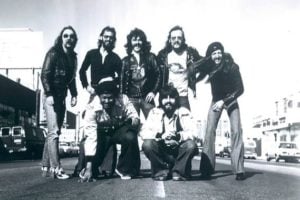
Photo: By ABC / Dunhill Records (Billboard, page 21, 13 March 1971) [Public domain], via Wikimedia Commons
From 1968 to 1972, Steppenwolf became one of the most famous rock and roll bands in the world. Steppenwolf disbanded in 1972, and John Kay began recording as a solo artist. In 1974, the band reformed and released a series of albums before breaking up again in 1976. Kay reclaimed the Steppenwolf name in 1980 and continued touring and recording as John Kay & Steppenwolf for decades. John Kay & Steppenwolf performed their final show on October 14, 2018, after which Kay retired the band.
Our Top 10 Steppenwolf Songs list looks at the band’s glory years in the late 1960s and early 1970s. During that time, they became one of the most essential bands in history, delivering authentic rock and roll that served as a soundtrack for the tumultuous times of the Vietnam era.
# 10 – A Girl I Knew
We start our Top 10 Steppenwolf Songs list with the band’s first-ever single release. The song “A Girl I Knew” was released as a single in 1967. The song has a heavy psychedelic vibe, fueled by the slow, opening harpsichord intro. Of course, it doesn’t stay there for too long, as the full band kicks into a pretty cool mid-tempo rocker that still carries that psychedelic aura. Don’t miss the fantastic guitar solo halfway through the song.
The song would appear a few months later on the band’s debut album, Steppenwolf, in 1968. On the band’s debut album, John Kay performed lead vocals and played guitar and harmonica, Michael Monarch played guitar and provided backing vocals, and Goldy McJohn handled the organ, piano, and Wurlitzer electric piano. Rushton Moreve played bass guitar and also contributed backing vocals. Jerry Edmonton was on drums, added backing vocals, and played percussion.
# 9 – Who Needs Ya
This one opens with a rocking guitar riff and some kicking drums, which all melt into a hook that sets it all up. The song “Who Needs Ya” was released on the band’s seventh album, titled appropriately Steppenwolf 7. John Kay and Larry Byrom wrote the song. “Who Needs Ya” was released as a single from the album. It’s a cool tune, but it failed to do much damage on the charts. The song’s killer opening guitar lick was simply to die for. It’s a great track and one of the most underrated in Steppenwolf’s catalog.
# 8 – Move Over
In 1969, Steppenwolf released their fourth album called Monster. The first single released from the album, “Move Over,” had a bass line reminiscent of the great Motown track “Get Ready.” It’s interesting how all musical genres at the time significantly influenced each other when listening to this great rock music. Many rock bands like Steppenwolf and Creedence Clearwater Revival seemed to be heavily influenced by the Motown sound in their rock rhythms.
# 7 – Chicken Wolf
“Chicken Wolf” may not be among the most popular Steppenwolf songs. But in our book, it’s one of their best. The song was released on the band’s third album, At Your Birthday Party. The album was released in 1969. At Your Birthday Party was the first Steppenwolf album to include Nick St. Nicholas on bass and the final one with Michael Monarch as guitarist, who departed from the band in August 1969. Ultimately, it was a pretty successful album, as it peaked at number seven on the Billboard 200 album chart.
# 6 – Hey Lawdy Mama
Now, I know you know this one. “Hey Lawdy Mama” was a single released by Steppenwolf in 1970. The song can be found on many of the greatest-hits vinyl albums and CDs released over the years by the band’s record company. It would also appear on the album Steppenwolf Live, released in 1970. The song “Hey Lawdy Mama” broke into the Billboard Top 40, peaking at number thirty-five.
# 5 – Don’t Step on the Grass, Sam
At the halfway mark on our Steppenwolf songs list, we turn to a very laid-back, groovy tune called “Don’t Step on the Grass, Sam.” The song stood as the closing track on the first side of the band’s second album, simply called The Second. The song was never released as a single, but it was played heavily on album-oriented radio in the 1970s. There is a bit of a Grateful Dead feel to the song, but in the end, that heavy Steppenwolf sound drives the song home. Listen to that organ, baby.
# 4 – The Pusher
As we continue our Top 10 Steppenwolf songs list, we turn to one of the band’s most popular songs. Everyone loved this one. The iconic track “The Pusher” was released on the band’s 1968 debut album entitled Steppenwolf. Along with the legendary song “Born to Be Wild,” the track “The Pusher” was also included on the Easy Rider soundtrack. Hoyt Axton wrote the song. It has been covered by various artists over the years, including Nina Simone’s smoldering version. There were some other great cover versions of the song done by UFO, Blind Melon, and Helix.
# 3 – Rock Me
There really is no doubt about which are the three most popular Steppenwolf songs. With many bands, the most popular songs do not always translate to the band’s best songs. However, with Steppenwolf, it would be hard to argue that the next three were not their best. The great song “Rock Me” was released on the band’s third album, entitled At Your Birthday Party. It was the album’s lead-off single.
# 2 – Magic Carpet Ride
When Steppenwolf was faced with the task of following up one of the biggest rock and roll songs of all time in “Born to Be Wild,” they stepped up to the plate and hit one way out of the park with “Magic Carpet Ride.” The song was released on the band’s second album, brilliantly titled The Second.
“Magic Carpet Ride” was penned by band members John Kay and Rushton Moreve. The song achieved significant success, reaching number three on the US charts and spending 16 weeks on the chart, making it Steppenwolf’s longest-charting single. Unlike the album version, the 45 rpm single features a unique vocal take on the opening verse. Despite the single’s widespread acclaim, classic rock stations and compilations often favor the album version, known for its extended playtime and richer soundscapes, partly due to its frequent rotation on FM radio.
The genesis of “Magic Carpet Ride” occurred during the sessions for The Second, sparked by Moreve’s catchy riff. The creative process saw contributions from various band members, including an innovative guitar feedback introduction by Michael Monarch and a guitar collaboration with Mars Bonfire, Jerry Edmonton’s brother. The song’s lyrics, inspired by Kay’s new high-fidelity stereo system, celebrate the joy of music and auditory experience, weaving in fantastical imagery akin to a wish-granting adventure.
Kay’s lyrics also subtly nod to his personal life and relationships, particularly with his wife, Jutta. Despite Kay’s later admissions that a casual joint might have influenced the songwriting session, he has consistently refuted claims that the song alludes to drug use. Instead, Kay suggests the song’s essence captures a broader spectrum of wishful thinking and imaginative escape, bolstered by the band’s collaborative musicianship and innovative studio techniques.
# 1 – Born to Be Wild
If we were to define the classic rock era of the late 1960s songs, “Born to Be Wild” would be one of the most essential tracks selected in defining an era of music. The Beatles, The Rolling Stones, Jimi Hendrix, and The Doors all defined that era of music in so many ways. Steppenwolf’s “Born to Be Wild” stood with the best of them. Recorded in 1967 and released in 1968 as part of their self-titled debut album Steppenwolf, the song quickly became synonymous with motorcycle culture and the counterculture movement.
“Born to Be Wild” was produced by Gabriel Mekler, who had worked closely with the band during this pivotal period. The song was laid down at American Recording Co. in Studio City, California. The recording featured John Kay on lead vocals and guitar, Michael Monarch on lead guitar, Goldy McJohn on organ, Rushton Moreve on bass, and Jerry Edmonton on drums.
As we all know, “Born to Be Wild” is celebrated for its hard-driving rhythm, gritty guitar riffs, and growling vocals. The song became a staple on rock radio stations and, many years later, appeared in music video games including Rocksmith 2014 and Rock Band 4, where new generations of players encountered the song.
“Born to Be Wild” has been widely covered and featured in countless movies, commercials, and television shows, most notably in the 1969 cult classic film Easy Rider. This association cemented the song’s iconic status and linked it indelibly with the imagery of open roads and boundless freedom.
Critically and commercially, “Born to Be Wild” was a significant success for Steppenwolf. It soared to the top of the charts, reaching number two on the Billboard Hot 100, and became one of the most recognizable songs of the era. Its gritty sound, combined with the evocative lyrics penned by Mars Bonfire, a stage name for Dennis Edmonton, brother of drummer Jerry Edmonton, spoke to a generation in flux and searching for meaning. The song’s lasting appeal lies in its universal call to break free from societal constraints and embrace the wildness within.
Updated August 11, 2026.
Check out similar articles on ClassicRockHistory.com. Just click on any of the links below……
Read More: Artists’ Interviews Directory At ClassicRockHistory.com
Read More: Classic Rock Bands List And Directory
Read More: 1970s’ Saddest Rock And Pop Songs
Read More: 25 Best Classic Rock Live Albums Of All Time
Top 10 Steppenwolf Songs article published on ClassicRockHistory.com © 2026
Classicrockhistory.com claims ownership of all its original content and Intellectual property under United States Copyright laws and those of all other foreign countries. No one person, business, or organization is allowed to republish any of our original content anywhere on the web or in print without our permission. All photos used are either public domain Creative Commons photos or licensed officially from Shutterstock under license with ClassicRockHistory.com. All photo credits have been placed at the end of the article. Album Cover Photos are affiliate links and the property of Amazon and are stored on the Amazon server. Any theft of our content will be met with swift legal action against the infringing websites.