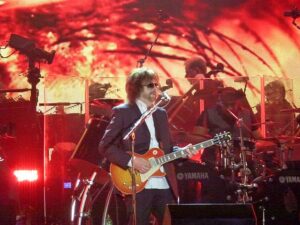
Feature Photo: Paul Carless (at Flickr), CC BY 2.0 <https://creativecommons.org/licenses/by/2.0>, via Wikimedia Commons
Electric Light Orchestra (ELO) was formed in Birmingham, England, in 1970. They are one of our favorite bands here at ClassicRockHistory.com. They are renowned for their unique blend of rock, pop, and classical music with orchestral arrangements. ELO was initially conceived as a project to create modern rock and pop songs with classical overtones. It was founded by Jeff Lynne, Roy Wood, and Bev Bevan, who were all members of The Move. Their innovative sound quickly captured the attention of the music world. ELO released a string of successful albums throughout the 1970s and into the early 1980s, including Out of the Blue and Discovery. These albums featured a number of hit singles such as “Mr. Blue Sky” and “Don’t Bring Me Down,” helping to cement their place in rock history. The band has sold over 50 million records worldwide and continues to influence a wide range of musicians. Jeff Lynne revived ELO for the Zoom album in 2001 and returned to live performance under the name Jeff Lynne’s ELO in 2014. The group announced its final tour, the Over and Out Tour, in 2024. A planned final performance at BST Hyde Park in July 2025 was canceled because Lynne was being treated for a systemic infection and could not be rescheduled.
Jeff Lynne
Jeff Lynne is the lead vocalist, songwriter, producer, and driving force behind ELO. Joining at the band’s inception in 1970, his leadership and creative direction shaped the distinctive sound of ELO, blending rock with classical music elements. Lynne’s production skills and songwriting have been central to the band’s success, contributing to every ELO studio album and major hit. He later revived the name for Zoom in 2001 and, beginning in 2014, performed as Jeff Lynne’s ELO with a large touring ensemble. Beyond his work with ELO, Jeff Lynne is a respected producer and collaborator, having worked with some of the biggest names in the music industry, including the Traveling Wilburys, a supergroup with Bob Dylan, George Harrison, Roy Orbison, and Tom Petty. Lynne has also produced albums for artists like Tom Petty and George Harrison.
Bev Bevan
Bev Bevan, a founding member of ELO, was the drummer from the band’s creation until 1986. His robust and innovative drumming was crucial in supporting the complex arrangements that characterized ELO’s music. Bevan played on the band’s studio albums from the debut through Balance of Power, contributing not only his drumming skills but also his energy and stage presence. He also toured with Black Sabbath during the 1980s. After the original ELO era ended, Bevan formed ELO Part II in 1989 and remained with that group through the end of the 1990s.
Roy Wood
Roy Wood co-founded ELO with Lynne and Bevan and was a major creative force in the band’s early years. He played a wide array of instruments, including guitar, bass, cello, oboe, and other woodwinds, significantly shaping the band’s early sound. Wood was part of the debut album The Electric Light Orchestra (1971) and remained through the early sessions for the second album before leaving ELO in 1972 to form Wizzard. Roy Wood’s influence on ELO’s formation and initial sound was profound, though his time with the band was brief.
Rick Price
Rick Price was the bassist in The Move during the period when Electric Light Orchestra was being conceived and is included in some histories of ELO’s earliest transitional lineup. Price contributed bass to an early version of “10538 Overture,” although his part was replaced before the final ELO recording was released. He did not continue into the band’s established touring lineup and later worked again with Roy Wood in Wizzard.
Bill Hunt
Bill Hunt was an early member of ELO, contributing French horn to the debut album and later playing keyboards and horn in the band’s first live lineup. His playing added depth to the orchestral aspirations of the band. Hunt remained with ELO through the first half of 1972 before leaving with Roy Wood and Hugh McDowell to join Wizzard.
Steve Woolam
Steve Woolam was an early member of ELO, contributing violin to the band’s debut album The Electric Light Orchestra (1971). Woolam’s violin was part of the orchestral sound that defined ELO’s early attempts to merge rock with classical music elements. His tenure was tragically short; Woolam died in 1971, around the time of the debut album’s release. His contributions nevertheless helped establish the string-driven concept at the center of early ELO.
Richard Tandy
Richard Tandy joined ELO’s early live lineup in 1972, initially playing bass and piano before moving primarily to keyboards. He became one of the band’s most significant members, and his work on piano, synthesizers, clavinet, Mellotron, and other keyboards was pivotal in shaping ELO’s sound through the 1970s and 1980s. Tandy’s contributions are heard throughout the classic ELO catalog, including albums like Out of the Blue and Discovery. He later reunited with Jeff Lynne for the Zoom era and the 2014 return of Jeff Lynne’s ELO. Tandy was inducted into the Rock and Roll Hall of Fame with ELO in 2017. He died in 2024 at the age of 76.
Andy Craig
Andy Craig was a cellist in ELO’s first touring lineup in 1972. He performed at the band’s earliest concerts alongside fellow cellists Mike Edwards and Hugh McDowell as ELO worked to reproduce its unusual orchestral-rock concept onstage. Craig’s tenure was brief, and he left before completing a studio album with the group.
Mike Edwards
Mike Edwards was a cellist with ELO from 1972 to 1974. His cello playing added a rich, classical texture to the band’s albums during his tenure, including ELO 2, On the Third Day, and Eldorado. Edwards was known for his energetic and visually engaging performances. Tragically, he died in 2010 in an unusual road accident, but his contributions to ELO’s sound are still fondly remembered by fans of the band.
Mike de Albuquerque
Mike de Albuquerque served as the bassist and backing vocalist for ELO from 1972 to 1974. He played on several key albums during a crucial period of the band’s history, including ELO 2, On the Third Day, and portions of Eldorado. De Albuquerque’s work helped solidify the rhythmic and melodic foundation of ELO during their early successes. He left during the Eldorado period and later pursued solo and collaborative music projects.
Wilfred Gibson
Wilfred Gibson was a violinist who joined ELO in 1972. He contributed to the band’s orchestral sound, playing violin on ELO 2 and portions of On the Third Day. Gibson’s classical background was valuable in helping ELO achieve the fusion of rock and classical music that they were aiming for at the time. He left the band in 1973, shortly before Mik Kaminski became ELO’s principal violinist.
Colin Walker
Colin Walker was a cellist for ELO from 1972 to 1973. He joined after Roy Wood’s departure and contributed cello to ELO 2, On the Third Day, and the single “Showdown.” Walker’s classical expertise added depth to the band’s developing orchestral-rock sound during one of its earliest periods. After leaving ELO, he continued his career as a professional cellist.
Glenn Hughes
Glenn Hughes, later famous for his work with Trapeze and Deep Purple, had an extremely brief association with ELO in 1972. Hughes later recalled that he agreed to join the band after being approached by manager Don Arden but remained involved for only about two weeks before returning to Trapeze. His brief tenure produced no released ELO studio recordings.
Trevor Smith
Trevor Smith was briefly associated with ELO during the band’s early 1972 period as a cellist and sound engineer. His tenure was short and did not result in a credited appearance on one of the band’s major studio albums, but he is included in historical personnel listings from ELO’s rapidly changing early lineup.
Mik Kaminski
Mik Kaminski is best known for his striking blue violin and was a key member of ELO during their peak years. Kaminski joined the band in 1973, replacing Wilfred Gibson during the sessions for On the Third Day, and his violin became a central feature of ELO’s sound. He contributed to albums including On the Third Day, Eldorado, Face the Music, A New World Record, and Out of the Blue. Although the resident string trio was dropped from the main studio lineup by the Discovery period, Kaminski later returned for the Time tour, contributed violin to Secret Messages, and performed with ELO again during the 1986 live dates. After his time with ELO, Kaminski continued to perform in ELO Part II and The Orchestra.
Hugh McDowell
Hugh McDowell was a cellist who played with ELO during two distinct periods. He joined the band’s first live lineup in 1972, left with Roy Wood and Bill Hunt to join Wizzard, and then returned to ELO in late 1973. McDowell’s studio contributions after his return can be heard on Eldorado, Face the Music, A New World Record, and Out of the Blue. He was known for his dynamic playing style and stage presence, often performing energetic and visually engaging parts during live concerts. McDowell remained associated with ELO through the end of the classic string-section era and later briefly performed with ELO Part II.
Kelly Groucutt
Kelly Groucutt joined ELO in 1974 as the bass guitarist and backing vocalist, contributing to the band during their most commercially successful period. Groucutt’s harmonies and vocal contributions were featured prominently on albums from Face the Music through Secret Messages. His playing and vocals are particularly notable on hits like “Sweet Talkin’ Woman” and “Shine a Little Love.” Groucutt remained with ELO until 1983, after which he pursued a solo career and later joined ELO Part II. He died in 2009.
Melvyn Gale
Melvyn Gale joined ELO as a cellist in 1975, becoming part of the classic string trio with Hugh McDowell and Mik Kaminski. His classical training was an important part of albums including Face the Music, A New World Record, and Out of the Blue. The resident string section was phased out around the Discovery period, although Gale appeared with Kaminski and McDowell in the album’s promotional videos. After leaving ELO, Gale largely stepped away from the limelight to focus on other interests, including recording and music-related business ventures.
Associated And Touring Musicians
Louis Clark
Louis Clark became one of ELO’s most important associated musicians beginning with Eldorado in 1974. Working with Jeff Lynne and Richard Tandy, Clark arranged and conducted orchestral and choral parts across much of the band’s classic catalog, including Face the Music, A New World Record, Out of the Blue, and Discovery. He later joined ELO’s touring lineup on keyboards and synthesizers for the Time tour and again for the band’s limited 1986 performances. Clark later worked with ELO Part II and The Orchestra. He died in 2021.
Dave Morgan
Dave Morgan, also known professionally as Dave Scott-Morgan, joined ELO’s touring lineup for the Time tour in 1981 and 1982, contributing guitar, keyboards, synthesizers, and backing vocals. He also contributed backing vocals to Secret Messages and returned for ELO’s limited live appearances in 1986. Morgan later collaborated with Richard Tandy and continued performing music connected to the ELO family.
Martin Smith
Martin Smith served as ELO’s touring bassist and backing vocalist for the band’s limited 1986 live performances supporting Balance of Power. He joined Jeff Lynne, Bev Bevan, Richard Tandy, Mik Kaminski, Louis Clark, and Dave Morgan in what became the final live lineup of ELO’s original era.
In the later Jeff Lynne’s ELO era, Lynne worked with a large touring ensemble rather than establishing a new permanent ELO membership. Longtime live musicians included musical director Mike Stevens, guitarists Milton McDonald and Iain Hornal, bassist Lee Pomeroy, drummer Donavan Hepburn, keyboardists Marcus Byrne and Jo Webb, and additional string, keyboard, and backing-vocal performers.
Check out more Electric Light Orchestra articles on the site….
Electric Light Orchestra’s Best Song On Each Of Their Studio Albums
Complete List Of Electric Light Orchestra Albums And Songs
Updated August 29, 2026.
Complete List Of Electric Light Orchestra Band Members article published on ClassicRockHistory.com © 2026