Feature Photo: Bruce Alan Bennett / Shutterstock.com
Our article on the 10 coolest guitars of all time isn’t a comprehensive history of the guitar—that would be a far more detailed piece than we’re presenting here. Instead, this is a fun look at what we believe are 10 of the coolest-looking guitars in rock and roll history. While “history” is a word we take seriously as a classic rock history site, our focus here is to showcase photos, videos, and stories behind these visually iconic instruments.
Though these guitars are undeniably cool on their own, it was the musicians who played them that truly made them legendary. And, of course, we can’t forget the brilliant minds who designed and built these guitars. The magic happened in the creative partnership between the players and the makers. We hope you enjoy this article, and let us know: what are your favorite-looking guitars?
# 10 – Les Paul – Klunker
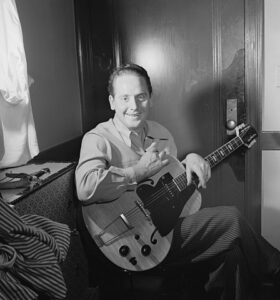
Photo: William P. Gottlieb, Public domain, via Wikimedia Commons
Les Paul’s “Klunker” holds a legendary place in the history of electric guitar experimentation. The Klunker was an Epiphone hollow-body guitar that Paul equipped with powerful pickups as he searched for more volume, sustain, and control. It should not be confused with “The Log,” the solid-body experiment Paul built at the Epiphone factory in 1941. Both instruments reflected the same relentless drive to rethink what an electric guitar could do.
The Klunker became one of the instruments Paul used while experimenting with electronics, pickups, recording, and amplified guitar sound. His work during this period went far beyond guitar design and extended into overdubbing, multitrack recording, and other techniques that would transform recorded music. The instrument itself was rough and heavily modified, but that was part of the point: Les Paul treated guitars as working laboratories.
Paul’s experiments with the Klunker, The Log, and other instruments helped establish his reputation as one of the great technical innovators in popular music. Gibson later introduced the Les Paul model in 1952, creating one of the most influential electric guitars ever made. The Klunker remains part of the larger story of a musician who was never satisfied with simply playing the equipment that already existed.
Read More: Top 10 Les Paul Songs
# 9 – Stevie Ray Vaughan – Number One
Feature Photo: Jason Lam, CC BY 2.0 <https://creativecommons.org/licenses/by/2.0>, via Wikimedia Commons
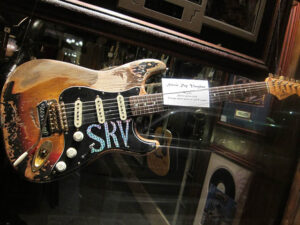
Stevie Ray Vaughan’s Fender Stratocaster, famously known as “Number One” or “First Wife,” is one of the most legendary guitars in blues and rock history. Vaughan relied on this guitar throughout his career to craft his signature sound. Number One is a hybrid Stratocaster built around a 1963 body and a 1962 neck, with pickups associated with 1959. Vaughan acquired the guitar in 1973 from Ray Hennig’s Heart of Texas Music shop in Austin, and it quickly became his favorite instrument, accompanying him on stage and in the studio for most of his career.
Number One is easily recognizable by its heavily worn sunburst finish, which shows the signs of years of intense playing. The guitar had a thick neck profile that suited Vaughan’s powerful hands and famously heavy strings, which he sometimes used in gauges as heavy as .013. This setup, combined with Vaughan’s aggressive playing style, contributed to the Stratocaster’s distinctive, powerful tone and his unmistakable blend of Texas blues, rock, and jazz influences.
Another iconic feature of Number One is the “SRV” lettering on the pickguard, making it instantly identifiable to fans. Vaughan also installed a left-handed tremolo system on the right-handed guitar, an idea inspired in part by the upside-down Stratocaster setup used by Jimi Hendrix. That unusual placement gave Vaughan another way to work the vibrato bar into his physical playing style.
Vaughan used Number One throughout his recording career, and it became inseparable from classics such as “Pride and Joy,” “Texas Flood,” and “Scuttle Buttin’.” His aggressive picking, heavy strings, and command of the Stratocaster helped define his sound and influenced countless guitarists who followed. After Vaughan’s tragic death in 1990, Number One became a revered piece of rock history. Fender later produced Stevie Ray Vaughan signature and replica Stratocasters based on the famous instrument.
Read More: Top 10 Stevie Ray Vaughan Songs
# 8 – Jimi Hendrix – Flying V
Feature Photo: Eden, Janine and Jim from New York City, CC BY 2.0 <https://creativecommons.org/licenses/by/2.0>, via Wikimedia Commons
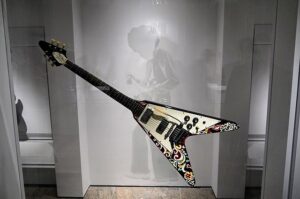
Jimi Hendrix’s 1967 Gibson Flying V, famously known as the “Love Drops” guitar, is one of the most distinctive instruments associated with him. Hendrix brought his own visual identity to a model already known for its radical shape. The guitar was originally finished in sunburst, later refinished black, and Hendrix painted the psychedelic design himself using nail polish. He also modified the nut and strap-button placement for left-handed playing.
Hendrix played the Flying V extensively from 1967 through 1969. It is believed to have been used during his 1967 BBC Radio 1 sessions and during work connected with Electric Ladyland, including “All Along the Watchtower.” The guitar’s two humbucking pickups gave Hendrix a different tonal option from the Fender Stratocasters with which he is most closely identified. Its sweeping shape also created one of the most memorable stage images of his career.
Hendrix gave the guitar to Mick Cox of Eire Apparent in 1969. Cox later refinished it, removing Hendrix’s psychedelic design, but the artwork was restored in the 1990s after the instrument was acquired by musician Dave Brewis. The “Love Drops” Flying V has since been displayed as an important surviving piece of Hendrix history and a perfect example of how his visual creativity extended to the instruments themselves.
Read More: 10 Most Underrated Jimi Hendrix Songs
# 7 – Prince – Cloud
Prince’s Cloud guitar is one of the most iconic instruments in pop music, famous for its unique shape and its association with the artist’s revolutionary sound and style. The first Cloud was built in 1983 by Minneapolis luthier Dave Rusan at Knut-Koupee Enterprises for Prince’s film Purple Rain. Originally painted white, it made its unforgettable screen debut in the movie and quickly became a visual signature for Prince. Its elongated horn and flowing body matched his genre-blurring music and theatrical stage presence perfectly.
The original Cloud featured maple construction, gold-colored hardware, a brass nut, and Prince’s distinctive fingerboard inlays. Its electronics included an EMG SA single-coil pickup in the neck position and an EMG 81 humbucker at the bridge. Over the years, Prince used multiple Cloud guitars in different finishes and colors, including white, yellow, blue, black, and purple. These were not simply stage props; they were fully functional instruments built for Prince’s demanding performance style.
Prince’s Cloud guitar became symbolic of his ability to blend music, fashion, theater, and visual art into one identity. Fans quickly associated its unmistakable silhouette with his on-stage energy. Replicas and later versions of the Cloud have allowed the design to live far beyond the original Purple Rain era. Today, the Cloud remains one of the most immediately recognizable artist-associated guitars in popular music.
Read More: 10 Most Rocking Prince Songs
# 6 – Zakk Wylde – The Grail

Feature Photo: TDC Photography / Shutterstock.com
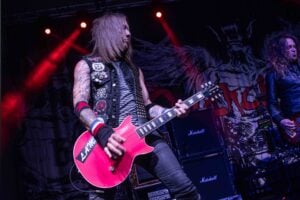
Zakk Wylde’s guitar known as “The Grail” is one of the most recognizable instruments in rock and metal. The Grail is a 1981 Gibson Les Paul Custom that became famous for Wylde’s black-and-white bullseye design. Wylde acquired the cream-colored Les Paul after joining Ozzy Osbourne’s band, trading for it with his friend Scott Quinn after Gibson supplied Quinn with a doubleneck in exchange. The guitar already had the feel and sound Wylde loved, and it became central to his work with Ozzy.
The bullseye design came about by accident. Wylde wanted the guitar refinished because the original cream Les Paul reminded him too much of Randy Rhoads’ famous instrument, and his idea was to use a design inspired by Alfred Hitchcock’s Vertigo. The guitar came back with the bullseye instead. Wylde liked the mistake, kept it, and the pattern became permanently associated with him.
The Grail’s sound is a perfect match for Wylde’s aggressive playing style. Its EMG 81 and 85 active humbuckers deliver the high-output tone and clarity that became a huge part of his sound. Wylde used The Grail extensively with Ozzy Osbourne, including on material from the No Rest for the Wicked and No More Tears eras, while its bullseye appearance became almost as recognizable as his pinch harmonics and blazing solos.
The guitar also has one of the wildest survival stories of any instrument on this list. Around 2000, it fell out of a gear trailer on a Texas highway and disappeared. Three years later, a fan who had bought it from a pawn shop realized what he had and helped return it to Wylde. That story only added to The Grail’s status as one of the great battle-worn guitars in hard rock history.
Read More: Top 10 Black Label Society Songs
# 5 – B.B. King – Lucille
Feature Photo: Nina Alizada / Shutterstock.com
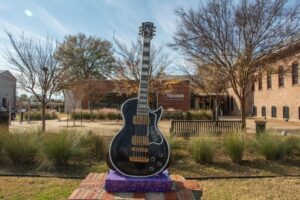
B.B. King’s iconic guitar, affectionately named “Lucille,” is as legendary as the bluesman himself, carrying a story and legacy that resonate far beyond its strings. The name “Lucille” originated in 1949, when King was playing in a club in Twist, Arkansas. During his performance, a fight broke out between two men, causing a fire. Everyone evacuated, but King, realizing he had left his guitar inside, risked his life to run back and retrieve it. Later, he learned that the fight had been over a woman named Lucille. From that day on, he called his guitars “Lucille” as a reminder never to fight over a woman or do anything as foolish as running into a burning building.
King’s “Lucille” was not a single guitar but rather the name he gave to a series of instruments over the years, most famously Gibson ES models. Gibson eventually developed the B.B. King Lucille model around King’s preferences. One of its defining features was the elimination of the traditional f-holes from the semi-hollow body, a change King requested to help reduce feedback. Lucille’s warm electric sound combined beautifully with King’s unmistakable bending and vibrato, making the guitar seem to cry in his hands.
Gibson produced B.B. King Lucille models for decades, and the guitar’s ebony finish, gold hardware, Varitone circuitry, and “Lucille” headstock inlay became instantly recognizable. King used guitars carrying the Lucille name throughout the most celebrated decades of his career. The instrument and the man became so closely linked that it is almost impossible to think of one without the other.
Read More: Top 10 B.B. King Songs
# 4 – Jerry Garcia – Tiger
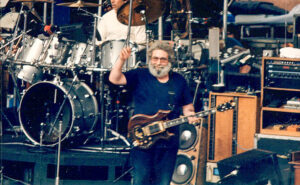
Photo: Grateful Dead, CC BY-SA 3.0 <http://creativecommons.org/licenses/by-sa/3.0/>, via Wikimedia Commons
Jerry Garcia’s custom guitar, “Tiger,” is one of the most famous and revered instruments in rock history, crafted specifically for him by master luthier Doug Irwin. Garcia first played Tiger with the Grateful Dead in August 1979, and it became his primary guitar through much of the 1980s. Even after Rosebud became his principal Grateful Dead instrument around 1990, Garcia continued to play Tiger, including with the Jerry Garcia Band, through 1995. Known for its intricate inlays, custom electronics, and rich tonal capabilities, Tiger was not just an instrument for Garcia; it became an extension of his improvisational style.
Doug Irwin built Tiger from a combination of exotic woods and meticulous craftsmanship. Cocobolo gives the guitar much of its striking visual identity, while laminated hardwood construction, brass hardware, elaborate inlays, and careful balance made the instrument immediately distinctive. The famous tiger inlay near the bridge became the image that gave the guitar its name. Even among custom-built guitars, Tiger looks like nothing else.
What truly set Tiger apart were its custom electronics, which gave Garcia extraordinary control over his tone. The guitar used DiMarzio pickups and an onboard effects loop along with multiple switches and controls that allowed Garcia to integrate his effects while maintaining control from the instrument itself. That flexibility suited the Grateful Dead’s famously exploratory live performances and Garcia’s constant movement between tones and textures.
After Garcia’s death in 1995, Tiger became part of a legal dispute involving Garcia’s estate, the Grateful Dead, and Doug Irwin. A settlement ultimately returned Tiger and Wolf to Irwin, who sold Tiger at auction in 2002 for $957,500 including commission. The guitar was sold again at Christie’s in March 2026 for $11.56 million including fees, setting another extraordinary chapter in the history of one of Garcia’s most famous instruments.
Read More: 10 Essential Jerry Garcia Songs That Defined His Solo Career
# 3 – Bo Diddley – The Twang Machine
Feature Photo: Masao Nakagami, CC BY-SA 2.0 <https://creativecommons.org/licenses/by-sa/2.0>, via Wikimedia Commons
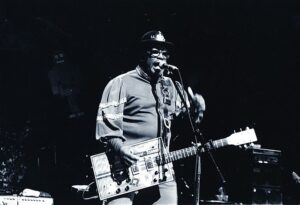
Bo Diddley was a musical innovator who helped shape the sound of early rock and rhythm and blues. His rectangular guitars were an extension of his personality—bold, unconventional, and immediately recognizable. He had experimented with homemade cigar-box-style instruments long before his fame, building an early electric version himself in the 1940s.
The guitar most closely associated with his classic image came later. After Diddley developed his own rectangular-body concept, Gretsch built him custom versions at its Brooklyn factory beginning in the late 1950s. The famous red rectangular Gretsch became known as the Twang Machine. Its stripped-down shape looked radically different from the conventional archtops and solid-body guitars surrounding it.
Diddley’s rectangular guitar was not just a gimmick; it became part of his stage identity and matched the pounding rhythmic attack of his music. The simple geometric design gave him freedom of movement while creating a silhouette that audiences could recognize instantly. Like the Bo Diddley beat itself, the guitar looked like something only Bo Diddley could have invented.
The Twang Machine and Diddley’s other custom rectangular guitars remain among the most distinctive instruments in rock history. Gretsch later produced signature rectangular models that kept his design alive for new generations. Few performers ever connected a guitar shape so completely with their own identity.
Read More: Top 10 Bo Diddley Songs
# 2 – Eddie Van Halen – Frankenstrat
Feature Photo: RobinStrower / Shutterstock.com
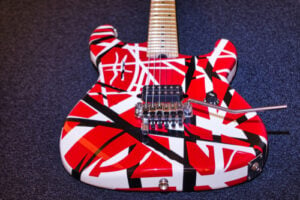
Eddie Van Halen’s Frankenstein, often called the Frankenstrat, is a groundbreaking guitar that not only defined his sound but also became one of the most iconic instruments in rock history. Born out of Eddie’s desire to combine the qualities he liked in Gibson electronics with the feel and design elements he preferred from Fender-style guitars, the instrument was his answer to a guitar the major manufacturers were not making. Eddie took matters into his own hands and built an instrument that gave him the power, playability, and freedom he wanted.
Eddie began with an inexpensive Strat-style body and maple neck, then installed a Gibson-style humbucking pickup at the bridge. He famously chiseled the body himself to make the parts fit and wired the guitar around a single volume control whose knob was labeled “Tone.” As the guitar continued to evolve, Eddie installed an early Floyd Rose locking tremolo system. He mounted a 1971 quarter beneath the tremolo as a simple stop, one of many improvised details that became part of the Frankenstein legend.
Visually, Eddie first created the famous black-and-white striped pattern associated with Van Halen’s debut era. In 1979, he added the red finish over a new taped pattern, creating the red, white, and black appearance that became one of the most recognizable guitar designs ever made. He also added reflectors and continued changing hardware and components as the years went on. The guitar was never really finished because Eddie never stopped experimenting with it.
Frankenstein became famous on stages around the world and embodied Eddie Van Halen’s willingness to tear apart accepted guitar design and build exactly what he needed. Its combination of humbucker power, Strat-style playability, locking tremolo technology, and do-it-yourself attitude helped influence the rise of the high-performance “superstrat.” To this day, the guitar symbolizes Eddie’s creative genius and relentless pursuit of innovation.
Read More: Van Halen’s Best Song On Each Of Their Studio Albums
# 1 – Jimmy Page – Gibson EDS-1275
Feature Photo: Bruce Alan Bennett / Shutterstock.com
Now you know this just had to be number one. I remember as a kid seeing Jimmy Page play this at Madison Square Garden in 1977 and being just completely blown away by just how cool this was. Between that guitar and that white outfit with the rose, I was staring at a rock and roll God. Jimmy Page’s iconic Gibson EDS-1275 is one of rock history’s most distinctive instruments, known for its double-neck design and association with some of Led Zeppelin’s most legendary live performances. Page used the guitar to solve the problem of performing songs such as Stairway to Heaven, where he needed access to both six-string and twelve-string guitar parts without changing instruments in the middle of the song.
The EDS-1275 features one six-string neck and one twelve-string neck. Gibson had been building electric doubleneck guitars since the late 1950s, but Page’s use of his cherry EDS-1275 turned the model into a rock and roll icon. He used it for live performances of “Stairway to Heaven” and later for songs including “The Song Remains the Same,” “The Rain Song,” “Celebration Day,” and “Tangerine.” Once Page walked onstage carrying that huge double-neck, the guitar became part of the entire Led Zeppelin visual experience.
Page’s use of the EDS-1275 was practical, but there was nothing ordinary about the way it looked under the lights. The guitar became a powerful visual symbol that amplified Led Zeppelin’s mystique and Page’s image as one of rock’s great guitar heroes. Gibson has continued to honor that connection with Jimmy Page EDS-1275 recreations built with Page’s direct involvement. More than half a century after Page made it famous, the cherry doubleneck remains one of the coolest-looking guitars ever carried onto a rock and roll stage.
Read More: Top 20 Jimmy Page Guitar Solos
Updated September 15, 2026.
10 Of The Coolest Looking Guitars In Rock History article published on ClassicRockHistory.com © 2026