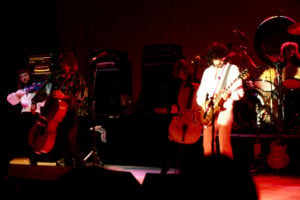
Feature Photo: TimDuncan, CC BY 3.0 <https://creativecommons.org/licenses/by/3.0>, via Wikimedia Commons
Pink Floyd emerged from the creative explosion of 1960s London and evolved from an experimental psychedelic band into one of the most influential groups in rock history. Formed in 1965 by Syd Barrett, Roger Waters, Richard Wright, and Nick Mason, the band first built its identity around Barrett’s eccentric songwriting and guitar work before David Gilmour joined in 1968 and Barrett departed. Albums such as A Saucerful of Secrets, Atom Heart Mother, and Meddle documented the group searching for a new collective identity while steadily expanding the possibilities of studio recording. That evolution reached another level with The Dark Side of the Moon in 1973, followed by Wish You Were Here, Animals, and The Wall. Those records turned Pink Floyd into one of the defining album-oriented rock bands of the era.
Roger Waters assumed an increasingly dominant creative role during the late 1970s before leaving the group in 1985. Pink Floyd continued under David Gilmour with Nick Mason and, eventually again, Richard Wright, releasing A Momentary Lapse of Reason in 1987 and The Division Bell in 1994. Their final studio album, The Endless River, arrived in 2014 as a largely instrumental tribute to Wright, who died in 2008. Across every era, Pink Floyd created music that could be psychedelic, intimate, political, cinematic, blues-based, or almost orchestral in scale. These twenty-five songs offer a broad path through that extraordinary catalog.
# 25 – Arnold Layne – Non-Album Single
“Arnold Layne” serves as the opening chapter of Pink Floyd’s recorded journey and introduced audiences to Syd Barrett’s strange, darkly humorous storytelling. Released as the band’s debut single in 1967, it centers on an eccentric character and immediately established Barrett’s ability to turn unusual subject matter into memorable pop. The track was recorded at Sound Techniques in London and produced by Joe Boyd. Barrett’s guitar, Richard Wright’s Farfisa organ, Roger Waters’ bass, and Nick Mason’s drums give the song the colorful psychedelic sound of the band’s earliest period. “Arnold Layne” reached number 20 on the UK Singles Chart. It remains one of the clearest entry points into the imaginative world that defined the original Pink Floyd.
# 24 – See Emily Play – Non-Album Single
“See Emily Play” captures Pink Floyd’s early psychedelic identity at its most accessible and melodic. Syd Barrett wrote the song, which was released as the band’s second UK single in 1967 and quickly became a major breakthrough. Norman Smith produced the recording, with Barrett’s guitar and Richard Wright’s organ helping create its bright, dreamlike atmosphere. Roger Waters and Nick Mason give the track enough rhythmic drive to keep the studio experimentation from floating away completely. The single reached number six on the UK Singles Chart. More than half a century later, its melody and strange sense of wonder still sound like a perfect snapshot of British psychedelia.
# 23 – Paintbox – B-Side
“Paintbox” revealed Richard Wright as an important songwriter and lead vocalist during Pink Floyd’s early years. Written and sung by Wright, the song first appeared in 1967 as the B-side to “Apples and Oranges.” It was recorded at De Lane Lea Studios in London and produced by Norman Smith. Wright’s piano and keyboards carry much of the arrangement, while Syd Barrett, Roger Waters, and Nick Mason complete the band’s distinctive psychedelic sound. The song’s melancholy view of social disconnection gives it a very different emotional tone from Barrett’s more whimsical material of the same period. “Paintbox” remains one of the strongest early examples of Wright’s melodic voice inside Pink Floyd.
# 22 – Apples And Oranges – Non-Album Single
“Apples and Oranges” was the final Pink Floyd single written by Syd Barrett and one of the most densely packed examples of his late-period writing with the band. Released in November 1967, the song turns an everyday romantic encounter into the kind of colorful, unpredictable scene Barrett could make completely his own. Norman Smith produced the recording during sessions at EMI Studios in London. Barrett’s guitar, Wright’s organ, Waters’ bass, and Mason’s drums move through an arrangement that is much less straightforward than the band’s first two singles. The record failed to reach the UK singles chart, but its commercial performance does little to diminish its historical importance. It remains an essential document of Pink Floyd at the end of Barrett’s period as the group’s primary creative force.
# 21 – Astronomy Domine – The Piper at the Gates of Dawn
“Astronomy Domine” opens The Piper at the Gates of Dawn with a burst of cosmic psychedelia that immediately announces how different early Pink Floyd sounded from almost everyone around them. Syd Barrett wrote the song, and Norman Smith produced the 1967 recording at EMI Studios in London. Barrett and Richard Wright share the vocals while guitar, Farfisa organ, bass, and drums create the track’s hypnotic momentum. Manager Peter Jenner’s distorted spoken introduction gives the recording an almost radio-transmission quality before the band fully enters. The song’s space imagery became one of the defining features of Pink Floyd’s earliest identity. It remained important enough to return to the band’s live repertoire even after Barrett had left.
# 20 – Set the Controls for the Heart of the Sun – A Saucerful of Secrets
“Set the Controls for the Heart of the Sun” captures Pink Floyd in the middle of its transition from the Syd Barrett era to the David Gilmour lineup. Roger Waters wrote the song, and the recording began in 1967 before additional work continued into 1968 under producer Norman Smith. David Gilmour later said the studio version contains small guitar contributions from both him and Barrett, making it the only Pink Floyd recording generally credited with material from all five members. Waters’ restrained vocal, Richard Wright’s Farfisa organ and vibraphone, and Nick Mason’s mallet-driven percussion create the song’s hypnotic atmosphere. The lyric drew inspiration from translations of classical Chinese poetry rather than conventional rock imagery. Its dark, meditative pulse became a bridge between the band’s early psychedelia and the more expansive music that followed.
# 19 – Cymbaline – Soundtrack from the Film More
“Cymbaline,” from Pink Floyd’s 1969 soundtrack album More, offers an early example of Roger Waters turning anxiety and disorientation into a direct lyric. Waters wrote the song, while David Gilmour handles the lead vocal and guitar. Richard Wright’s keyboards and the understated rhythm section give the recording a gentle surface that contrasts with its uneasy subject matter. The band produced the album themselves during sessions in London as they continued moving away from the sound of their first two records. “Cymbaline” became a regular live piece during this period and often expanded far beyond the compact studio arrangement. Its mixture of folk-like melody, dream imagery, and apprehension points toward the more introspective Pink Floyd writing of the 1970s.
# 18 – Atom Heart Mother – Atom Heart Mother
“Atom Heart Mother” was Pink Floyd’s most ambitious studio undertaking up to that point, stretching across the entire first side of the band’s 1970 album. David Gilmour, Richard Wright, Roger Waters, Nick Mason, and Ron Geesin share the composition credit. Pink Floyd produced the recording, while Geesin created the brass, choir, and orchestral arrangements that transformed the band’s basic musical framework into a full-scale suite. Recorded at Abbey Road Studios, the piece moves through recurring themes, heavy rock passages, choral sections, sound effects, and long instrumental transitions. The John Alldis Choir and brass players greatly expand the sonic scale beyond the four musicians themselves. Whatever one thinks of its excesses, “Atom Heart Mother” remains a crucial step in Pink Floyd’s development toward large-form conceptual music.
# 17 – Echoes – Meddle
“Echoes,” the twenty-three-minute closing piece on Meddle, stands as the recording where Pink Floyd’s experimental instincts finally became a completely unified long-form composition. The music is credited to David Gilmour, Richard Wright, Roger Waters, and Nick Mason, with Waters supplying the lyrics. Pink Floyd produced the recording during sessions at Abbey Road, AIR, and Morgan Studios in London. Wright’s famous opening piano note processed through a Leslie speaker introduces a piece that moves through vocal harmony, extended guitar passages, abstract sound, and a powerful final return. Gilmour and Wright share the lead vocals, giving the song an unusually collaborative character. “Echoes” became the clearest bridge between the band’s exploratory late-1960s work and the focused conceptual albums that would soon follow.
# 16 – One Of These Days – Meddle
“One of These Days” opens Meddle with one of the most aggressive instrumental grooves Pink Floyd ever recorded. The entire band shares the writing credit, and Pink Floyd produced the track during the same experimental sessions that produced “Echoes.” Roger Waters and David Gilmour both contribute to the doubled bass-guitar pattern, while Richard Wright’s keyboards and Nick Mason’s drums steadily increase the tension. Gilmour’s slide guitar enters as the arrangement turns from hypnotic to explosive. Mason delivers the track’s only spoken line through heavy processing, making his brief vocal appearance one of the strangest moments in the band’s catalog. The song remains a perfect example of Pink Floyd creating drama through sound and dynamics rather than conventional verse-and-chorus writing.
# 15 – Time – The Dark Side of the Moon
“Time” is one of the central songs on The Dark Side of the Moon and one of Pink Floyd’s most powerful meditations on mortality. David Gilmour, Richard Wright, Roger Waters, and Nick Mason share the composition credit, while Pink Floyd produced the album and Alan Parsons engineered the sessions at Abbey Road. Parsons had recorded the famous clock sounds separately before they were assembled into the startling opening sequence. Mason’s tom-heavy drum introduction leads into Gilmour and Wright sharing the vocals, while Gilmour delivers one of his defining guitar solos. Waters’ lyric turns the ordinary passage of days into a warning about how easily a life can disappear without being fully lived. The song remains one of the moments where Pink Floyd’s studio craft and universal subject matter came together perfectly.
# 14 – Money – The Dark Side of the Moon
“Money” turned Roger Waters’ critique of greed into Pink Floyd’s first major American hit. Waters wrote the song, while David Gilmour delivers the lead vocal and the extended guitar solo. Pink Floyd produced the recording at Abbey Road, with Alan Parsons engineering and helping shape the famous tape loop of cash registers, coins, and other money-related sounds. The main groove is built in 7/4 before shifting into 4/4 for Gilmour’s solo section, giving the track an unusual rhythmic identity that still feels immediately accessible. Richard Wright’s electric piano and Dick Parry’s saxophone add a strong blues and jazz character to the arrangement. The single reached number 13 on the Billboard Hot 100 and helped carry The Dark Side of the Moon far beyond the usual progressive-rock audience.
# 13 – Us And Them – The Dark Side of the Moon
“Us and Them” began with a Richard Wright piano piece written during Pink Floyd’s work on the film Zabriskie Point. Roger Waters later added lyrics that turned the music into a meditation on war, social division, and the distance people create between one another. Pink Floyd produced the recording at Abbey Road with Alan Parsons engineering the album. David Gilmour’s restrained lead vocal sits over Wright’s spacious piano and organ, while Dick Parry’s saxophone solos provide some of the most beautiful instrumental moments on The Dark Side of the Moon. The verses remain quiet and almost suspended before the choruses expand dramatically. That contrast between intimacy and scale makes “Us and Them” one of Pink Floyd’s most emotionally effective arrangements.
# 12 – Welcome To The Machine – Wish You Were Here
“Welcome to the Machine” is one of Pink Floyd’s coldest and most unsettling recordings, turning Roger Waters’ criticism of the music business into an oppressive electronic landscape. Waters wrote the song, and David Gilmour sings the lead vocal. Pink Floyd produced Wish You Were Here, with Brian Humphries recording the album at Abbey Road and Peter James assisting. Synthesizers dominate the arrangement, while Gilmour’s acoustic guitar provides a human contrast to the mechanical pulse surrounding it. The song’s structure deliberately avoids the warmth of a conventional rock-band performance, reinforcing its themes of control and exploitation. It remains the harshest counterweight to the more mournful material elsewhere on Wish You Were Here.
# 11 – Wish You Were Here – Wish You Were Here
“Wish You Were Here” is one of Pink Floyd’s most intimate recordings and the emotional center of the 1975 album that shares its name. David Gilmour and Roger Waters wrote the song, while Pink Floyd produced the album at Abbey Road. The opening radio effect makes Gilmour’s first acoustic guitar sound distant before a second guitar enters and pulls the listener fully into the performance. Gilmour’s lead vocal carries a lyric about absence, alienation, and the feeling of losing connection with someone who is still deeply present in memory. The song is closely associated with Syd Barrett, but its language is broad enough to reach far beyond the band’s own history. Its simplicity is exactly what makes it so powerful beside the elaborate studio constructions surrounding it.
# 10 – Shine On You Crazy Diamond – Wish You Were Here
“Shine On You Crazy Diamond” frames Wish You Were Here with one of Pink Floyd’s grandest tributes to Syd Barrett. Roger Waters, Richard Wright, and David Gilmour share the writing credit, while the complete composition is divided into nine parts split between the beginning and end of the album. Pink Floyd produced the sessions at Abbey Road, with Brian Humphries engineering. Gilmour’s four-note guitar theme, Wright’s keyboards, Waters’ vocal, and Dick Parry’s saxophone give the work an enormous emotional range without ever rushing its development. The piece balances admiration, grief, memory, and frustration as the band looks back at the friend whose imagination helped create Pink Floyd. Few recordings capture the band’s ability to let atmosphere become part of the composition as completely as this one.
# 9 – Sheep – Animals
“Sheep” closes Animals with one of Roger Waters’ most aggressive political allegories. Waters wrote the song, which had developed from an earlier composition called “Raving and Drooling” before being reshaped for the 1977 album. Richard Wright’s electric piano creates the calm opening before the arrangement grows increasingly tense and violent. Waters’ vocal performance drives the narrative, while David Gilmour’s guitar and the band’s rhythm section build toward the explosive final section. The piece turns the passive “sheep” of the album’s social hierarchy into a force capable of revolt, giving the record a bitter and unstable conclusion. Its mixture of progressive-rock scale and punk-like anger makes “Sheep” one of the hardest-hitting Pink Floyd tracks of the 1970s.
# 8 – Dogs – Animals
“Dogs” is the longest song on Animals and one of Pink Floyd’s most detailed studies of ambition, betrayal, and moral collapse. David Gilmour and Roger Waters wrote the piece, which evolved from the earlier live composition “You Gotta Be Crazy.” Gilmour’s acoustic guitar pattern and long electric solos dominate the first half, while he also handles much of the lead vocal before Waters takes over later in the song. Richard Wright’s keyboards create the eerie suspended middle section, where the arrangement seems to lose all sense of ordinary time. The lyric portrays ruthless professional climbers as predators who eventually become trapped by the same system they serve. At more than seventeen minutes, “Dogs” uses its scale not as decoration but as part of the slow psychological breakdown at the center of the song.
# 7 – Run Like Hell – The Wall
“Run Like Hell” brings one of the most forceful rhythms on The Wall into the darkest section of the album’s story. Roger Waters and David Gilmour wrote the song, while Waters, Gilmour, and Bob Ezrin produced the album with James Guthrie serving as co-producer and engineer. Gilmour’s delay-heavy guitar creates the track’s relentless pulse, with Nick Mason’s drums pushing the music forward like a march. Waters and Gilmour share the vocal performance as the character Pink descends into an authoritarian fantasy. The polished, almost danceable groove deliberately clashes with the ugliness of the scene being portrayed. Onstage during The Wall concerts, the song became one of the production’s most theatrical and unsettling moments.
# 6 – Goodbye Blue Sky – The Wall
“Goodbye Blue Sky” is one of the quietest recordings on The Wall, yet its images of war make it one of the album’s most disturbing moments. Roger Waters wrote the song, while David Gilmour sings the lead and harmony vocals and supplies acoustic guitars, bass, and synthesizer. The child’s voice at the beginning belongs to Waters’ young son Harry Waters. Bob Ezrin, David Gilmour, James Guthrie, and Roger Waters share the production credits for the recording. The gentle arrangement creates a sharp contrast with the fear and destruction at the center of the song. Within the larger story of The Wall, it connects personal childhood trauma with the wider memory of wartime violence.
# 5 – Hey You – The Wall
“Hey You” opens the second half of The Wall with Pink calling outward after completing the emotional barrier he has built around himself. Roger Waters wrote the song, while David Gilmour and Waters share the lead vocals. The recording features Gilmour on guitars, Waters on bass and vocals, Richard Wright on keyboards, and Nick Mason on drums, with Bob Ezrin contributing to the arrangement and production. The song begins quietly but grows increasingly desperate as the character realizes that the isolation he wanted has become a prison. Although “Hey You” was recorded for the album and became one of its best-known tracks, it was omitted from the finished 1982 film. Its combination of intimacy, tension, and a classic Gilmour guitar performance makes it essential to any overview of Pink Floyd’s major songs.
# 4 – Comfortably Numb – The Wall
“Comfortably Numb” became one of Pink Floyd’s most celebrated recordings because it brings Roger Waters’ narrative writing and David Gilmour’s melodic instincts together at exactly the right moment. Waters and Gilmour wrote the song, with Waters singing the verses and Gilmour taking the choruses. Bob Ezrin, Gilmour, and Waters produced the album with James Guthrie as co-producer and engineer, while Michael Kamen created the orchestral arrangement. The contrast between the clinical verses and the expansive choruses mirrors Pink’s emotional disconnection inside the story. Gilmour’s two guitar solos, especially the closing performance, became defining moments in the band’s catalog. “Comfortably Numb” is both a crucial scene in The Wall and a recording powerful enough to stand completely on its own.
# 3 – Another Brick in the Wall – The Wall
“Another Brick in the Wall” appears in three separate parts across The Wall, each marking another stage in Pink’s withdrawal from the outside world. Roger Waters wrote all three sections, while the second part became the famous single built around a disco-influenced groove encouraged by producer Bob Ezrin. David Gilmour’s guitar solo and the children’s choir turned Part 2 into one of the most recognizable Pink Floyd recordings ever made. The single reached number one in both the United States and the United Kingdom. Parts 1 and 3 place that hit inside a much darker narrative about loss, education, anger, and emotional isolation. Heard together, the three pieces show how Pink Floyd could turn one recurring musical idea into a structural device running through an entire concept album.
# 2 – Learning to Fly – A Momentary Lapse of Reason
“Learning to Fly” introduced the post-Roger Waters version of Pink Floyd with one of David Gilmour’s most memorable later songs. David Gilmour, Anthony Moore, Bob Ezrin, and Jon Carin share the writing credit, while Gilmour and Ezrin produced the recording. The track was developed during sessions centered on Gilmour’s Astoria houseboat studio, with Nick Mason and session drummer Jim Keltner contributing percussion and drums. Gilmour’s interest in aviation shaped the imagery, but the song also works as a metaphor for uncertainty, freedom, and starting over. It reached number one on Billboard’s Album Rock Tracks chart and number 70 on the Billboard Hot 100. The song gave A Momentary Lapse of Reason a clear identity while proving that Pink Floyd could continue successfully after Waters’ departure.
# 1 – What Do You Want from Me – The Division Bell
“What Do You Want from Me” closes this list with Pink Floyd in the David Gilmour-led era sounding bluesy, powerful, and fully engaged. David Gilmour, Richard Wright, and Polly Samson wrote the song, and Gilmour and Bob Ezrin produced the recording. Gilmour handles lead vocals and guitar, Wright contributes Wurlitzer piano, Hammond organ, and backing vocals, Nick Mason plays drums, Guy Pratt plays bass, and Jon Carin adds synthesizers. The track was recorded during the sessions for The Division Bell, including work at Gilmour’s Astoria studio. Its lyric centers on frustration, expectation, and the impossible demands people can place on one another, while Gilmour answers with one of the album’s strongest blues-rock performances. As an example of later Pink Floyd, “What Do You Want from Me” shows that the band could still create tension and atmosphere without simply copying its 1970s records.
Check out more Pink Floyd articles on ClassicRockHistory.com. Just click on any of the links below.
Top 10 Pink Floyd Deep Tracks
10 Best Covers Of Pink Floyd Songs
Top 25 Pink Floyd Songs
10 Pink Floyd Album Covers We Love
Complete List Of Pink Floyd Band Members
Top 100 Pink Floyd Songs
Ultimate Pink Floyd Page: Complete History, Songs, Albums & More
Top 10 Syd Barrett Pink Floyd Songs
Top 10 Roger Waters Pink Floyd Songs
Top 10 David Gilmour Pink Floyd Songs
A Look Back At Pink Floyd’s Wish You Were Here Album
Complete List Of Pink Floyd Songs A-Z Plus Discography
Top 10 Pink Floyd Albums
Pink Floyd’s Live 8 Performance Proved Why They Should Have Never Broken Up
Best Pink Floyd Box Sets
Read More: Classic Rock Bands List And Directory
Read More: Artists’ Interviews Directory At ClassicRockHistory.com
Updated September 18, 2026
25 Classic Pink Floyd Songs Everyone Should Know article published on ClassicRockHistory.com © 2026