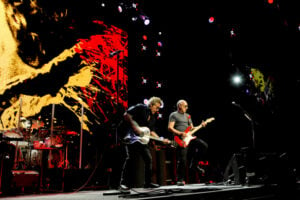
Feature Photo: Jean-Luc, CC BY-SA 2.0 <https://creativecommons.org/licenses/by-sa/2.0>, via Wikimedia Commons
During the summer of 1977, I went to see ELP perform at Madison Square Garden with a full orchestra. This was the same summer that I saw Led Zeppelin on their 1977 North American tour, Fleetwood Mac’s Rumours tour, Pink Floyd’s Animals tour, and many other shows.
The competition for the greatest concert of the summer was pretty fierce. Yet, that’s not what this article is about, even though watching ELP perform with a full orchestra on the Works tour was about as jaw-dropping as rock and roll shows ever get.
No, here’s the point: Emerson, Lake & Palmer deserves a far more prominent place in the conversation surrounding the greatest bands in classic rock history, especially within the progressive rock genre.
Formed in 1970, ELP was not just another group of musicians coming together. They were a groundbreaking trio whose innovation reshaped what rock music could achieve.
When they took the stage at the Isle of Wight Festival in 1970, at an event whose total attendance was widely reported at up to 600,000 people, they announced themselves as a new kind of musical force. They were a power trio that combined classical sophistication with the power of pure rock and roll.
With Keith Emerson’s pioneering use of synthesizers and keyboards, Greg Lake’s beautiful vocals and underrated musicianship, and Carl Palmer’s skills as a drumming monster, ELP introduced classical compositions seamlessly into rock. They captivated audiences in a manner few bands ever had before.
Despite their enormous popularity in the 1970s, selling an estimated 48 million records worldwide and earning nine RIAA-certified gold albums in the United States, ELP is frequently overlooked in classic rock retrospectives. As of 2026, they also remained outside the Rock & Roll Hall of Fame and were absent from the Hall’s 2026 nominee list.
I mean WTF? What is wrong with the people who vote for the Hall?
This neglect is puzzling when considering how significantly they elevated the genre through their intricate adaptations of classical pieces, such as Mussorgsky’s “Pictures at an Exhibition” and Copland’s “Fanfare for the Common Man,” bringing symphonic grandeur to arena-sized audiences. Their fusion of heavy riffs with classical sophistication wasn’t mere gimmickry; it redefined progressive rock entirely.
One factor that may explain their unjust neglect could be the absence of traditional radio-friendly hits. I mean, of course, there was “Lucky Man,” “From the Beginning,” and Greg Lake’s “I Believe in Father Christmas,” which ELP later recorded in a full-band version, but not many others.
Unlike other bands from the era who benefited from frequent airplay due to concise and catchy singles, ELP thrived in the realm of album-oriented rock. Their ambitious and lengthy compositions, like “Tarkus” and “Karn Evil 9,” challenged conventional radio formats, which unfortunately limited their exposure to newer generations.
Consequently, younger listeners raised on streamlined playlists are largely unaware of their remarkable contributions, depriving ELP of the continued acclaim they deserve.
Furthermore, ELP’s groundbreaking stage shows have received inadequate documentation over time. Unlike contemporaries whose legacies were bolstered by widely available concert films and documentaries, comprehensive visual documentation capturing ELP’s monumental performances remains comparatively scarce.
Their legendary appearance at the Isle of Wight Festival in 1970, their extravagant theatrics on tours throughout the 1970s, and their memorable California Jam performance in 1974 were monumental. Yet those performances have not been preserved or promoted to the same degree as the live legacies of many of their peers, limiting modern audiences’ access to ELP’s impressive live capabilities.
Another reason ELP deserves recognition is the uniqueness of their identity as a progressive rock power trio. Unlike other celebrated trios like Cream or the Jimi Hendrix Experience, who focused on blues-infused rock improvisations, ELP operated with meticulous musical precision.
Each member brought equal weight, producing a complex, symphonic sound previously unheard of from just three musicians. This profound originality established new creative possibilities, inspiring countless musicians who followed but were often more visibly recognized due to simpler, more digestible music or greater media presence.
Ultimately, the case for celebrating Emerson, Lake & Palmer rests upon their fearless creativity and undeniable influence. They transcended the expected boundaries of rock, pushed technological and musical innovation to unprecedented heights, and achieved immense popularity in their prime.
If you graduated high school in the 1970s or early 1980s, you are very much aware of how popular and loved this band was. The ongoing lack of acknowledgment from institutions like the Rock & Roll Hall of Fame, classic rock radio stations, and current popular culture isn’t just a simple oversight; it’s an injustice that diminishes the historical record of progressive rock.
I can feel my blood pressure rising as I write this, so I have to wrap it up. For those of us who vividly recall the 1970s, Emerson, Lake & Palmer weren’t just another rock band; they defined an era, changed our perception of musical possibilities, and forever deserve to be celebrated as true pioneers of progressive rock.
They still weren’t in the Rock & Roll Hall of Fame in 2026, and they were not among that year’s nominees. That is incredibly stupid and just shows how badly progressive rock history can be overlooked. Are you listening, HALL OF FAME VOTERS?????
Check out similar articles on ClassicRockHistory.com Just click on any of the links below……
Carl Palmer Of ELP & Asia: The ClassicRockHistory.com Interview
Emerson Lake & Palmer Albums Ranked
A Look At The Two Spinoff Versions Of Emerson Lake & Palmer
Top 10 Emerson, Lake & Palmer Songs
Complete List Of Emerson, Lake & Palmer Albums & Songs
Complete List Of Emerson, Lake & Palmer Band Members
Complete List Of Emerson, Lake & Palmer (ELP) Songs From A to Z
A Look At The Two Spinoff Versions Of Emerson Lake & Palmer
ELP Virtual Tour: Why Carl Palmer Is Set To Revitalize ELP’s Music
10 Essential Songs From Keith Emerson And The Nice
Keith Emerson: A Career Retrospective
Read More: Artists’ Interviews Directory At ClassicRockHistory.com
Read More: Classic Rock Bands List And Directory
Updated September 29, 2026
Why ELP’s 70s’ Dominance Deserves More Attention In Rock History article published on ClassicRockHistory.com © 2026