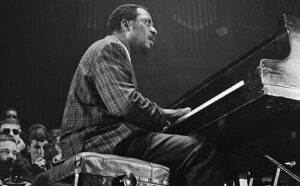
Feature Photo: Anefo, CC0, via Wikimedia Commons
Thelonious Sphere Monk was born on October 10, 1917, in Rocky Mount, North Carolina. His family moved to New York City when he was a child and settled in Manhattan’s San Juan Hill neighborhood. Monk began playing piano at age nine, absorbing church music, classical training, stride piano, blues, and the sound of New York jazz.
By the early 1940s, Monk had become the house pianist at Minton’s Playhouse in Harlem. The club served as an important gathering place for musicians developing the language later called bebop. Monk’s unusual harmonies, rhythmic displacement, percussive touch, and willingness to leave open space made him one of the movement’s most original thinkers.
Monk made his first commercial recordings with Coleman Hawkins in 1944 and began recording as a leader for Blue Note Records in 1947. Those early sessions introduced compositions including “Ruby, My Dear,” “Well, You Needn’t,” “In Walked Bud,” “Epistrophy,” and his own recording of “’Round Midnight.” Although many listeners initially misunderstood his playing, other musicians quickly recognized the depth of his writing.
The loss of Monk’s New York City Cabaret Card in 1951 limited his ability to work in clubs for several years. He continued composing and recorded for Prestige before signing with Riverside Records in 1955. The Riverside period produced major albums including Brilliant Corners, Monk’s Music, Thelonious Himself, and the recordings documenting his partnership with John Coltrane.
After his Cabaret Card was restored in 1957, Monk began a celebrated residency at the Five Spot Café with Coltrane. The engagement helped establish Monk as a major attraction and gave his compositions a prominent place in modern jazz. Charlie Rouse later became his longest-serving tenor saxophonist, remaining with Monk’s quartet for more than a decade.
Monk signed with Columbia Records in 1962 and reached the largest audience of his career. Monk’s Dream became his best-selling album, and he appeared on the cover of Time magazine in February 1964. His Columbia recordings revisited earlier compositions while also introducing pieces including “Ugly Beauty,” his only published waltz.
His final studio sessions as a leader were recorded for Black Lion in 1971. Monk gradually withdrew from public performance during the 1970s and spent his final years at the New Jersey home of his friend and patron Baroness Pannonica de Koenigswarter. He died on February 17, 1982.
Monk received the Grammy Lifetime Achievement Award in 1993 and a posthumous Pulitzer Prize Special Citation in 2006. The educational organization founded in his name in 1986 became the Herbie Hancock Institute of Jazz in 2019. Monk remains one of the most recorded composers in jazz history, while “’Round Midnight” stands as the most widely recorded jazz standard written by a jazz musician.
# 10 – Little Rootie Tootie
“Little Rootie Tootie” was named for Monk’s son, the drummer and bandleader T. S. Monk. The pianist first recorded the composition for Prestige on October 15, 1952, with bassist Gary Mapp and drummer Art Blakey.
The piece begins with a bright, train-like figure that immediately establishes its motion. Monk turns stride-piano gestures into something thoroughly modern, using repeated notes, sharp accents, whole-tone runs, and sudden rhythmic turns. The melody sounds playful, but the performance demands complete control of touch and timing.
Monk later expanded “Little Rootie Tootie” for the 1959 Town Hall concert, where Hall Overton transformed Monk’s original piano solo into a striking orchestral passage. The composition demonstrates how Monk could turn a family nickname and a simple image into music of great wit and architectural strength.
# 9 – Monk’s Dream
Monk first recorded “Monk’s Dream” during his Prestige period, but the best-known version opens his 1963 Columbia album of the same name. The quartet featured Charlie Rouse on tenor saxophone, John Ore on bass, and Frankie Dunlop on drums.
The melody moves with a relaxed, almost mischievous bounce. Beneath that approachable surface, Monk places accents in unexpected locations and repeatedly bends the listener’s sense of where each phrase should land. Rouse’s dry tenor sound fits naturally beside the piano, while Ore and Dunlop keep the performance light and flexible.
Monk’s Dream introduced the pianist to a broader audience without simplifying his musical language. The title track captures the balance of humor, precision, blues feeling, and rhythmic surprise that made his classic quartet so effective.
# 8 – Epistrophy
“Epistrophy” was written by Thelonious Monk and drummer Kenny Clarke during the formative years of bebop. It became one of Monk’s earliest copyrighted compositions and eventually served as the closing theme for many of his live performances.
The title refers to the repetition of a word or phrase at the end of successive statements. Monk and Clarke translate that rhetorical idea into music through a recurring rhythmic figure that feels both mechanical and unpredictable. The tune’s clipped melody and unusual harmonic movement made it an ideal summary of Monk’s musical personality.
Monk first recorded “Epistrophy” under his own name during a 1948 Blue Note session featuring vibraphonist Milt Jackson. He returned to the piece throughout his career, continually altering its tempo, spacing, and dramatic shape.
# 7 – Brilliant Corners
“Brilliant Corners” is the title composition from Monk’s landmark Riverside album. The piece was recorded in October 1956 with Sonny Rollins on tenor saxophone, Ernie Henry on alto saxophone, Oscar Pettiford on bass, and Max Roach on drums.
The composition changes tempo and meter while forcing the musicians to navigate an angular melody filled with wide intervals. The session became famous for its difficulty. The released master had to be assembled from multiple takes because the ensemble never completed a single fully satisfactory performance from beginning to end.
That struggle became part of the recording’s power rather than a weakness. “Brilliant Corners” presents Monk as a composer capable of challenging even the finest improvisers while still producing music with humor, swing, and memorable melodic identity.
# 6 – Well, You Needn’t
Monk recorded “Well, You Needn’t” for Blue Note on October 24, 1947, with bassist Gene Ramey and drummer Art Blakey. It became one of the essential compositions from the sessions later collected as Genius of Modern Music.
The tune is built around a compact ascending-and-descending harmonic pattern. Monk uses that movement to create tension while leaving the melody open enough for forceful improvisation. His accents can sound abrupt, yet every note strengthens the piece’s internal rhythm.
“Well, You Needn’t” became a jazz standard because its structure invites different approaches without losing Monk’s identity. Musicians can change the tempo, instrumentation, and solo language, but the composition’s stubborn, witty character remains unmistakable.
# 5 – In Walked Bud
“In Walked Bud” was Monk’s tribute to his friend and fellow pianist Bud Powell. The composition uses harmonic movement related to Irving Berlin’s “Blue Skies,” but Monk reshapes that familiar foundation with a new melody and his own rhythmic language.
The first Monk recording came from a 1947 Blue Note session. The melody enters with the confidence suggested by the title, and the performance celebrates Powell’s brilliance without attempting to imitate his rapid, flowing piano style.
Monk revisited the piece several times. The 1968 version on Underground added lyrics and vocals by Jon Hendricks, revealing how naturally the melody could support words. The composition remains both a portrait of friendship and a lasting acknowledgment of Powell’s importance to modern jazz.
# 4 – Blue Monk
“Blue Monk” is one of the clearest examples of Monk transforming the traditional twelve-bar blues. He first recorded the piece in 1954 with bassist Percy Heath and drummer Art Blakey.
The opening melody is immediately memorable, but its descending chromatic shape and delayed accents create a tension that separates it from a conventional blues head. Monk makes the music sound simple enough to sing while placing small rhythmic and harmonic obstacles inside every phrase.
Because its structure is accessible and its character is unmistakable, “Blue Monk” became one of his most frequently performed compositions. It offers an ideal introduction to the way Monk could honor older musical forms while making them sound entirely new.
# 3 – Ruby, My Dear
“Ruby, My Dear” reveals the lyrical side of Monk’s writing. He recorded the ballad for Blue Note on October 24, 1947, with Gene Ramey and Art Blakey.
The melody unfolds patiently, with tender phrases interrupted by notes that seem to lean outside the harmony before resolving. Monk’s use of silence is especially important. He gives every chord time to resonate and allows the emotional weight of the piece to emerge without sentimental excess.
Later versions featuring Coleman Hawkins and John Coltrane demonstrated how strongly the composition could support individual saxophone voices. “Ruby, My Dear” remains one of Monk’s most beautiful works and one of the clearest answers to the mistaken belief that his music was concerned only with dissonance or difficulty.
# 2 – Straight, No Chaser
Monk first recorded “Straight, No Chaser” for Blue Note in 1951. The composition is another twelve-bar blues, but its jagged melody and carefully placed rhythmic gaps make it impossible to mistake for anyone else’s work.
The theme circles around a short descending figure, using repetition to build momentum. Its apparent simplicity gives improvisers room to develop ideas, while the unusual accents continually pull the performance back toward Monk’s original conception.
Miles Davis helped bring the tune to an even wider audience through his 1958 album Milestones. Monk later made a commanding extended version for the 1967 Columbia album Straight, No Chaser with Charlie Rouse, Larry Gales, and Ben Riley.
# 1 – ’Round Midnight
“’Round Midnight” began taking shape during the early 1940s and became Thelonious Monk’s most famous composition. Cootie Williams made the first commercial recording in 1944, while Monk recorded his own version for Blue Note in November 1947.
The song opens with one of the most recognizable melodies in jazz. Its descending line, dark harmony, and dramatic pauses create the feeling of solitude suggested by the title. The bridge raises the emotional intensity before the main theme returns with even greater weight.
Miles Davis’s performance at the 1955 Newport Jazz Festival and his later album ’Round About Midnight helped establish the composition as an international standard. Dizzy Gillespie, Coleman Hawkins, Sarah Vaughan, Ella Fitzgerald, and countless other artists also recorded important versions.
“’Round Midnight” has endured because it preserves Monk’s harmonic originality while communicating an emotion that reaches far beyond any single style of jazz. It is haunting, elegant, and instantly identifiable, making it the essential Thelonious Monk composition.
More Thelonious Monk And ClassicRockHistory.com Articles
Check out similar articles on ClassicRockHistory.com.
Read More: Artists’ Interviews Directory At ClassicRockHistory.com
Read More: Classic Rock Bands List And Directory
Updated August 1, 2026.
Top 10 Thelonious Monk Songs article published on ClassicRockHistory.com © 2026