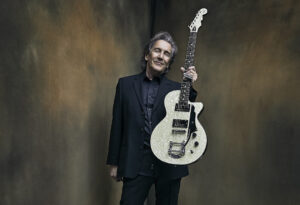
Featuce Photo courtesy of Rick Vito:
Though he’s been on records by John Prine, Roger McGuinn, Bob Seger, and been a member of Fleetwood Mac, Rick Vito remains underrated.
Even he admits it, telling ClassicRockHistory.com: “Apart from the high visibility time with Fleetwood Mac, I never felt like I was looked at as a guitar hero. If some people felt that way, I’m glad to hear of it.”
Vito’s bluesy vibe, sinful slide technique, and tasteful gear choices are a few of the reasons his phone keeps ringing. “I’d played mainly a Telecaster since high school, then got a Les Paul gold top Standard in college,” Vito says of the gear that accented his early days.
Adding, “I used both when I went to California. I had mostly Fender amps before receiving a Dumble as a gift from Jackson Browne after working in his band in ’82 and ’83. My intention was to keep improving as a guitarist, singer, and performer and to get my own recording deal.”
Vito did that and then some. It’s why he hooked up with Bonnie Raitt as a touring guitarist and was handpicked by Mick Fleetwood to replace Lindsey Buckingham, delivering Peter Green-like blues that the Mighty Mac had been missing.
With this, Vito became known as a player’s player, whose presence was always felt—and missed after it had gone. “That’s great,” Vito says. “I used to not feel comfortable onstage, but gradually over the years, and having worked with some of the great performers, I’ve learned how to project myself.”
“If that is also felt in the studio, I’m grateful to hear it,” Vito says. “Playing music in front of people is an opportunity to convey so many things. It’s an honor to be able to get up there and do that.”
In April 2026, Vito will release his latest solo album, Slidemaster. The album documents the 76-year-old maestro’s slide career highlights, a reminder of what he does best. “I try to always think about the people you’re playing for and have found that you can get a reciprocal energy going between you and them, which is a special thing.”
What are your earliest memories of music in your life?
My mother had a lot of 78 rpm records in the early ‘50s. I remember hearing Les Paul & Mary Ford, Sinatra, Rosemary Clooney, Bill Haley… music like that, just before rock ‘n’ roll really hit. I still have many of those old records.
What specifically drew you to the guitar, and when did you decide what sort of player you wanted to be?
Well, Elvis turned everything around for just about everybody, one way or another. Of course, seeing him on TV with that guitar was pretty inspiring. My mother had an old Oahu acoustic steel guitar, and I’d jump around the living room pretending to be Elvis with it.
From there, I received a little Stella and some lessons. Deciding what sort of player I wanted to be has spanned my whole life, maybe even to this day. But generally, I wanted to play that early rootsy rock & roll like Duane Eddy, and all of the guitar players I saw on the Bandstand TV show, which was broadcast from Philadelphia, my hometown.
How did the scene you grew up in affect you as a player?
I mentioned Bandstand, but there was also Ricky Nelson with James Burton on the Ozzie & Harriet TV show. I thought that they were really cool, and it made me want to have an electric guitar, which took many years to happen. The first live rock ‘n’ roll I saw was the Everly Brothers performing on the Steel Pier in Atlantic City, NJ. I was hooked!
What led you to work with Delaney and Bonnie and Todd Rundgren? Was Todd as tough to work with as he’s made out to be?
I’d been playing semi-professionally in high school and college. During that time, I was learning from all kinds of records, and when a friend turned me on to Delaney & Bonnie Live with Eric Clapton, I fell in love with their music.
I learned all their tunes, and when they came to my area, I got up the nerve to introduce myself and played them some tapes I’d made. At another show in 1970, Bonnie asked if I had my guitar, which I did, and invited me up to play at Lehigh U.
I guess I did well because they were impressed and encouraged me to move to Los Angeles if I wanted to get into the business. Around that same time, my bandmate, Rick Valenti, got us an opportunity to go to NYC and record for Todd Rundgren at Electric Ladyland studio. That led to one of our tunes being recorded by James Cotton and a friendship with Todd.
He then moved to L.A., and in June 1971, I decided that I’d go out there and try to connect with both Todd and D&B. As it turned out, Todd gave me a place to stay, and Delaney offered me a job to go on tour with them! I was guided by angels, I guess.
I could see that Todd was very serious about his music. When I did a recording session for his Something, Anything album, it was meant to be very loose and rock ‘n’ roll, so I never experienced him as being tough to work with.
You worked with John Prine and John Mayall in the ‘70s. How did that come to be, and how did you approach those sessions?
I’d met Steve Cropper, another guitar hero of mine, when working with Bobby Whitlock in ’72. He asked for my number for a future session date and kept it for two years before contacting me for the John Prine’s Common Sense sessions in Memphis.
He flew me out, and I brought one Telecaster, and I just did what I do. Around that same time, I heard from a friend, Larry Taylor, bassist with Canned Heat and Mayall. He liked my playing, so when John Mayall was looking for a guitarist, Larry recommended me.
We went up to John’s famous home in Laurel Canyon and just jammed on a few tunes. At the end of that, he looked at me and said, “Ok, that’s it, you’re in!” We started on a record within weeks, and it was very much just, “Play what you play.”
And that was what John wanted. I went on to work on three or four more Mayall albums. I last performed with John at the 2020 Concert honoring Peter Green at the London Palladium, and he was still in great form.
You also worked with Roger McGuinn in the late ‘70s. How did that come about, and what was it like working with him?
I knew Roger’s road manager, and he kept after me to come and play with him. I really didn’t know much about the Byrds’ music other than the hits on the radio. One day, he called to say that Roger was putting a band together called Thunderbyrd, and asked again if I’d at least come and jam.
This was a stretch for me because I was really a blues player, but I knew how to do that country-sounding thing with a B-string palm pedal, which Roger loved. So, I would end up doing the album and traveling for about a year with him, and it was fun. It was a great band with Charlie Harrison on bass and Greg Thomas on drums.
You worked with Bob Seger, playing slide guitar on “Like a Rock.” What can you remember from that session?
I was recommended to Seger around ’85, who was looking for a guitarist to overdub lead on a couple of tracks he had done. He put up one with a very ethereal quality, with long sections that needed solos, and I suggested trying slide guitar, but Seger said he didn’t really want that.
I asked if I could have one pass at it anyway. So, he agreed, and I just let the creative side of my brain take over and came up with the solos all in one take that turned out to be “Like A Rock.” It was a good marriage of guitar work, sound, and mood on a great tune.
It amazes me that after forty years, people still ask me about my playing on that song. So, I guess it resonates with people, and I do appreciate that.
What are your memories of working with Dolly Parton and Roy Orbison in the late ‘80s?
I’d been staying at home around the time that my son was born when I got a call to possibly do some road work with Dolly. Again, it wasn’t my thing necessarily, but I tried it, and it turned out to be fun, so I went on the Dolly tour for a little while until I got an offer to go on tour with Seger.
My association with Roy came about through Billy Burnette. He’d written a song he was hoping that Roy would cut, and I played on the demo. Roy did want to cut it, and he requested to use the guitarist who played on the demo, which was me. The song was called “Dream You,” and I later played on more of Roy’s album.
How did you first meet Bonnie Raitt, and what led to your becoming a member of her touring band?
I met her while touring with Roger McGuinn. Her guitarist, Will McFarlane, had to stay at home because he and his wife were having twins, so she asked me to replace him for part of her tour. I later came back in ’80 and ’81, and again in ’98 and ’99.
What can you say about Bonnie as a player and front person? And what did she expect from you as the guitar goes?
Bonnie does her thing very well, and she has a very strong stage presence and rapport with her fans. I think she wanted someone with similar musical tastes, who could solo when needed, and also do a song in her show.
What led to your getting the call to replace Lindsey Buckingham in Fleetwood Mac?
I played on a Billy Burnette session that Mick [Fleetwood] was also on. We talked a lot about the Peter Green era of the group, and I think that stuck in his mind. He and Billy came to one of my live shows, sat in, and he heard me playing more of the kind of blues that he used to play with Peter in the ‘60s.
When the lead guitar position came up, he called me and asked if I’d learn some Mac songs and come to a rehearsal. He wanted Billy, whom he had been working with, as a vocalist and me as a lead player, so when we all played that day, it was obvious that the combination would work out well.
You’re a very different player from Lindsey. Had you ever met him? Why do you think they chose you as the band’s new guitarist?
We are very different and I had not ever met him. I think Mick wanted me because of my Peter Green influence and because I was able to play the Stevie [Nicks] and Christine [McVie] songs. They were not going to do Buckingham songs except “Go Your Own Way.”
And also, a few he did as part of the ensemble. So, I didn’t have to replicate too much of his playing and just concentrated on capturing the feel and major licks of the songs from that era of the band.
What can you recall about the recording of the Behind the Mask album with Fleetwood Mac?
It was a year-long process where we all brought in song demos and sifted through a lot of material. I wound up writing two songs with Stevie and one with Billy, plus writing one on my own that was selected for the album.
My recording setup included the ’56 Les Paul TV and Dumble amp that I used with Seger on “Like A Rock,” plus guitars that I had designed and built myself. I used a nylon-string guitar given to Mick by Peter, Mick’s electric sitar, a vintage National resonator guitar, my customized Tele, and a ’58 Stratocaster.
Throughout the ‘90s and 2000s, you steadily put out solo work. What kept you inspired and pushing boundaries?
I didn’t get that elusive deal until 1992 when my first album, King of Hearts, was released on Modern/Atlantic Records. At that point, I wanted to try to keep the momentum going, so I kept writing and recording.
Eventually, I had another release in the States and quite a few in Europe. I had reached a pretty high level with Fleetwood Mac, and that made me want to continue producing the highest-quality music on my own records.
You reconnected with Mick in the 2000s and played on a couple of his records. Did Fleetwood Mac ever call you when Lindsey left for a second time?
Mick invited me out to his place on Maui to play again around 2006 after hearing my album, Band Box Boogie. We tried some gigs with Billy as The Mick Fleetwood Band, but he soon abandoned that.
Mick then suggested we form a partnership in The Mick Fleetwood Blues Band, that would do songs from the Peter Green era and my own songs from my records. It was not considered a solo Mick project, and I was the frontman and coproducer. As far as the latter Mac goes, I wasn’t involved.
Tell us about your main guitars, along with the amps and pedals that accent your notable tone.
I’ve designed some guitars that have an Art Deco look to them and have had prototypes built. They’re pretty much one-of-a-kind guitars. About twenty years ago, I started collaborating with Joe Naylor at Reverend Guitars on what would become my signature model.
To date, we’ve put out four different Rick Vito Signatures, which have some of the features of my prototypes and some Reverend features. I’ve used these extensively to tour and record with. I’ve also always been a vintage guitar collector and have owned just about every model I’ve ever wanted.
In recent years, I’ve pared down the number of instruments I own and play, but I still have my old TV Les Paul, a ’58 Burst, a ’56 Tele, and some others. I use Reverend amps, a ’59 Bassman, a ’63 Deluxe Reverb, and various Supro, Ampeg, and National small amps.
The only pedal I’ve stuck with over the years is a Stamps Drive-o-Matic, mostly because it doesn’t sound like a drive pedal, and it gets a good natural tone.
Catch us up on what you’re doing now and what’s next for you?
I’m just completing a new album that will be released in April 2026 called Slidemaster. It’s a collection of all-instrumental slide guitar tracks I’ve done both recently and some that have been remixed and remastered from past releases. I’m very happy with it, as there are pretty few instrumental slide guitar albums out there.
Do you have any regrets?
As far as regrets, I think everybody has some if they’re being completely honest. Most of this would be personal. I have way more to be happy and thankful for, because I’ve been very fortunate and continue to be.
Check out similar articles on ClassicRockHistory.com Just click on any of the links below……
Read More: Artists’ Interviews Directory At ClassicRockHistory.com
Read More: Classic Rock Bands List And Directory
Read More: 1970s’ Saddest Rock And Pop Songs
Read More: 25 Best Classic Rock Live Albums Of All Time
Rick Vito: The ClassicRockHistory.com Interview article published on ClassicRockHistory.com© 2026
Classicrockhistory.com claims ownership of all its original content and Intellectual property under United States Copyright laws and those of all other foreign countries. No one person, business, or organization is allowed to republish any of our original content anywhere on the web or in print without our permission. All photos used are either public domain Creative Commons photos or licensed officially from Shutterstock under license with ClassicRockHistory.com. All photo credits have been placed at the end of the article. Album Cover Photos are affiliate links and the property of Amazon and are stored on the Amazon server. Any theft of our content will be met with swift legal action against the infringing websites.