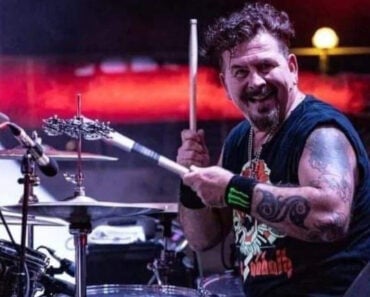
Feature Photo by @unai_endemonium
Primarily known for his time with Ozzy Osbourne from 2009 to 2017, producing one album, 2010’s Scream, and several world tours, Gus G has proved that when it comes to hard and heavy metal, he’s hard to beat.
His gigs with his band, Firewind, solo records, and stint as a touring guitarist with Arch Enemy prove this, but Gus remains humble, telling ClassicRockHistory.com, “I’m still learning the instrument, even though I’m an advanced-level player by now,” he says.
“There’s always new things to discover, more songs to write, and more techniques to master,” Gus adds. “I hear stuff that inspires me from my favorite players, but also from new generation players, or even other styles of music.”
Gus is currently working on two records: one solo, due in the Spring of 2026, and one with Firewind, which will follow thereafter. There’s excitement there, as Gus has been working harder than ever at his craft. “I think I’ve gotten a lot better on many levels,” he says.
He continues, “My improvisational skills have developed a lot, for one, but also, I’ve been working on my technique; I can do things today that I couldn’t do 10 years ago. But there comes a point where you reach a plateau.”
But that doesn’t scare Gus, as it’s all part of ebbing and flowing within a life of making music. “My development is slower today than it was, say, five years ago,” he says. “But I try to practice as much as I can, even though time is limited nowadays, being a father and juggling the business and touring activities.”
What inspired you to pick up the guitar?
Originally, it was Peter Frampton. My dad had the Frampton Comes Alive vinyl, and it changed my world when I heard the talk-box solo on “Do You Feel Like We Do.” As for now, picking up the guitar gives me the same joy as it did when I was a kid. Every single time.
What sort of scene did you grow up in, and how did that shape you?
I’m from Greece, and rock and metal aren’t really “the thing” here. [laugh] It’s more about Greek folk and pop music. Back in the ‘90s, very few international bands came through town. I was always a pretty introverted kid; I just stayed in my room practicing guitar and reading my guitar magazines.
And I’d be watching my VHS tapes with lessons from Paul Gilbert, Marty Friedman, and the ‘80s shredders. But anything I could get my hands on, I’d try to learn. So, you could say I wasn’t really connected with the local scene, I was living in my own bubble and couldn’t wait to finish high school and get out of the country to find my own path.
Tell us about your early bands, Night Rage, Dream Evil, and Mystic Prophecy.
Those were the first bands I played in. I was a co-founder of all three. Back then, I wanted to be involved in a lot of things to gain experience and learn. Night Rage was my friend Mario’s vision, and I helped him get it off the ground at the time.
Mario is an excellent player, and I demoed all the music for the first two albums, programmed all the drums, and even sang some death-metal vocals on those early demos! We couldn’t find anyone, so I said, “Screw that, I’ll do it!”
Eventually, we got a production deal, and the band signed to Century Media Records. I played on the first two albums before I moved on. Mystic Prophecy was a side project that singer R.D. Liapakis, who is now with Michael Schenker, was putting together.
He wanted to find a young guitarist from Greece, because he was Greek. A mutual friend introduced us, and I flew to Germany to do the debut album. Since then, I co-wrote and played on two more albums until I couldn’t continue due to my commitments with Firewind.
As for Dream Evil, that was my first taste of success in Europe and Japan. Swedish producer Fredrik Nordstrom asked me to write some songs together in late 1999. After writing together for about two years, we finally put together this fantasy power metal band.
We were originally called Dragonheart, but when we signed the deal, our label told us we
needed to change names. There was another band with that name, turns out it was DragonForce! So, I suggested Dream Evil, which is from the Dio album [of the same name].
All in all, I had a really good time playing different types of metal with these bands, and they gave me my start in the music industry.
How did Firewind form?
Firewind has always been my own baby, since I was 18. I did countless demos with help from various friends. Some were recorded while I lived in America, and others while I was in Sweden, working with Dream Evil at the same time.
In the end, I signed a record deal with Leviathan Records, owned by ‘80s guitar hero David T. Chastain, and David helped me complete the lineup. The first few albums had revolving lineups, with people primarily coming in for the album sessions.
What was your intention from an artistic perspective?
My intention was always to make Firewind a recognizable name worldwide and a touring band. It was much harder than I thought it would be—especially with all the constant line-up changes, musicians in various parts of the world, etc.
How did you first come in contact with Ozzy Osbourne, leading to your audition to replace Zakk Wylde?
Right after I left Mystic Prophecy in 2005, I was asked to join Arch Enemy as a touring guitarist for their summer tour at OzzFest. It was a great opportunity for me, of course. During that Ozzfest tour, there was a press release that Ozzy was looking for a new guitarist.
One day, I actually knocked on the production office and left a Firewind CD there and asked them to check it out. I’m not sure if that had anything to do with it—probably not, because it wasn’t until 2009 that I was contacted to audition.
I had no inside contact with Ozzy’s camp or anything. One day, out of the blue, I just got an email. I guess I somehow made the list of possible guitarists.
How did you find out you got the gig, and why do you think Ozzy liked you as a player?
I got the gig the very same day I auditioned. Ozzy really liked how we rolled through the songs. We played five or six tunes, and then he and Sharon Osbourne went to another room to talk for a bit. Then, they came back and asked me to do a gig with them. I don’t know what he liked about my playing… maybe the fact that I had a good tone, and the respect for his catalogue? Maybe he liked my approach, I don’t know.
How did your style compare and contrast with Randy Rhoads, Jake E. Lee, and Zakk Wylde’s?
It’s not really for me to say or make those comparisons. Those guys are such legends. All I did was stay as close to their parts as possible and just add my tone and feel. But a lot of fans tell me they liked my approach because, at that time, it seemed like a fresh change, with a modern touch, yet still maintaining the roots of that [classic] playing style.
A lot of people say that Tony Iommi’s parts and style are the hardest to cop. Do you agree?
Yes, I agree. Tony improvised a lot of the solos and even his riffs, so you can never play them exactly. And he’s got such a unique sense of rhythm, and he even bends the strings when he riffs. Nobody sounds like him.
Were you very influenced by the guitarist who had been in Ozzy’s band before?
I was influenced by Randy, Jake, and Zakk for sure. I grew up with their records! So, it always felt very natural for me to play those songs. I loved Randy’s melodic scale runs and his blend of metal with classical. I also got a lot of the chordal stuff that Jake did, as well as his riffing. And of course, Zakk had a harder style with the fast pentatonic licks, which are very influential.
What was it like working with Ozzy? How do you two form songs for the album you did with him, Scream?
It was very easy working with him. When I recorded Scream, we did it in his home studio. He would let me work with producer Kevin Churko, and he’d just pop in a couple of times a day to listen to some of the progress. He was always easy-going.
Unfortunately, I never got to record songs that I wrote solely with him. We did work on a couple of demos while on the road during the Scream tour, but those never materialized, as by the end of that tour, the plan for the [Black] Sabbath reunion was well underway.
So, I think our collaboration was too short-lived to get a chance to write songs from scratch with him.
What led to your leaving Ozzy, who had Zakk rejoin his band in 2017, or thereabouts? That must have been a huge letdown.
Well, after the Scream tour and the Ozzy & Friends tours that we did, there were three years of no work cause of the Sabbath 13 album and tour, and then their farewell tour. During that time, I was already back with Firewind and busy with my own stuff.
At some point, in early 2017, Sharon called me and said that they planned on having the Ozzy farewell tour up next and that they’d bring back Zakk for it. And honestly, it was the most understandable bummer of my life!
I mean, of course, I was bummed out that I wasn’t gonna play with him again. But as a fan, it totally made sense to me that he would get back with Zakk for the final chapter of his career.
Was it freeing to launch your solo career, which really took off after you left Ozzy’s band?
For sure it was! When I did my first album, I Am The Fire, I was so fed up with trying to be in a band, even though Firewind is my own thing as well. Maybe I expected too much from other people, and it got frustrating after a point—especially when singers quit.
So, around 2013, I felt I needed to branch out of Firewind and just collaborate with other people to see where that took me. It was a strange feeling in the studio after we were done with a song. I looked around, and there was no one there except the engineer.
So, there were no other members to ask them what they think. My whole solo project is based on that philosophy: that I can do things that I can’t in Firewind. I can do instrumental tracks that can be either complex or simple. I can write a radio rock song or a metal song. I can be more bluesy if I want to, and so on.
I’m really enjoying putting out solo records, and funnily enough, my most successful one so far has been my all-instrumental album, Quantum Leap, which I released back in 2021.
What was it like working with Jason Becker in 2018 on his Triumphant Hearts record?
I’ve been fortunate to have met Jason and his family. That was at a benefit concert for Jason back in 2013. Since then, I’ve had the opportunity to visit him in his house a few times, and eventually, when he put his latest album together, he invited me to record a solo for this epic track that featured so many guitar legends. It was an honor to play a few notes on Jason’s album. He’s such an inspiration and a musical icon.
What’s the latest on your rig, including guitars, amps, and pedals?
My guitars are my Jackson signature models. I have two: a star-shaped guitar and a San Dimas. One has active pickups, and the other has passive. Obviously, I use both for different sounds, depending on the occasion.
Amp-wise, the last couple of years I went into in-ear monitoring on stage, and have been experimenting with modelers, particularly the ToneX. I love using it for fly-in shows at festivals. But I also love the versatility and the fact that I can run MIDI program changes on that, without having to tap-dance on stage anymore to switch presets.
But every now and then, I got back to the tube amps as well. On the last solo tour I did, I took out the Blackstar St. James amp and head with my old pedalboard, and that’s always fun. My pedalboard has always been simple: a Morley wah, a J Rocket Archer overdrive, and a BOSS DD-7 delay. That’s it.
What are your short and long-term goals? How will you achieve them?
I want to keep making music and keep touring, keep developing my guitar skills and my compositions. I already know the next two years will be busy ones—I have been working on two new albums. My solo album is already done and comes out in April or May, and then Firewind will follow. So, there will be lots of shows and tours with both projects of mine. I’m excited to see where this takes me.
Check out similar articles on ClassicRockHistory.com Just click on any of the links below……
Read More: Artists’ Interviews Directory At ClassicRockHistory.com
Read More: Classic Rock Bands List And Directory
Read More: 1970s’ Saddest Rock And Pop Songs
Read More: 25 Best Classic Rock Live Albums Of All Time
An Interview With Former Ozzy Osbourne Guitarist Gus G article published on ClassicRockHistory.com© 2026
Classicrockhistory.com claims ownership of all its original content and Intellectual property under United States Copyright laws and those of all other foreign countries. No one person, business, or organization is allowed to republish any of our original content anywhere on the web or in print without our permission. All photos used are either public domain Creative Commons photos or licensed officially from Shutterstock under license with ClassicRockHistory.com. All photo credits have been placed at the end of the article. Album Cover Photos are affiliate links and the property of Amazon and are stored on the Amazon server. Any theft of our content will be met with swift legal action against the infringing websites.