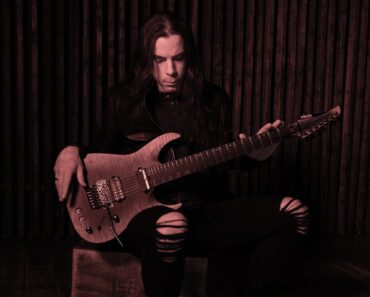
Feature Photo by Milton Keynes
On the heels of hit records with Easy Action and Europe, Swedish-born gunslinger Kee Marcello found himself amongst the cream of the ‘80s guitar crop.
Marcello earned every bit of it, but as he tells ClassicRockHistory.com, he loved—and appreciated—it while it lasted. “It felt like everyone knew we were coming to town,” Marcello says of the hysteria that surrounded Europe after the success of “The Final Countdown.”
Adding, “I feel really privileged to have had the pleasure to experience this, ‘cause there are really not that many who have. We were at the very top, not only when that style of music was peaking, but when it was mainstream. Everyone and their mothers not only knew who we were, they knew all the words to our songs. Unbelievable concert memories.”
Grunge put Marcello’s time with Europe to an end in the ‘90s. By the time the band resurfaced, he’d shifted his focus to his solo efforts, leading to five records. In 2026, Marcello is working on his next solo record—and he’s reunited with Easy Action to celebrate the 40th anniversary of their beloved record, That Makes One.
But that’s not all. Marcell and his old pals in Easy Action are planning to unleash a new LP, and festival dates are to follow. It’s all par for the course for a player whose presence has proven to be a difference maker. “It’s probably my curiosity,” Marcello says of the X factor associated with his chops. “When I participate/collaborate in other projects, I’m very rarely content with what’s at hand.”
“I always try to find a way to develop the song/production/arrangements further,” he explains. “I know that it must be annoying to other people sometimes. Hell, it’s sometimes annoying to me. Because in my mind, a song is never completely finished.”
He continues, “I can find myself trying to enhance riffs I recorded 20 or 30 years ago… what’s the point? Well, I’ll tell you what the point is: if it enhances the riff/song, then it deserves to be played that way. It doesn’t matter if it makes it slightly different than what’s on the record from some 20 years ago.”
What are your earliest memories of music in your life?
Playing my black plastic toy guitar in front of the TV when The Beatles were on. I must’ve been around three or four years old. I’ll have to add that I’m not sure whether this is entirely my own memory or whether it’s been enhanced by my mum reaffirming it so many times. One thing’s for certain, though; I went nuts when The Beatles were on.
What specifically drew you to the guitar, and when did you decide what sort of player you wanted to be?
My general interest in music was sparked by the 45s I listened to on my four-year-older sister Ingela’s gramophone record player, mostly the Beatles and the Swedish pop group Hep Stars. But it wasn’t until my friends and I started listening to Deep Purple, the Sweet, T. Rex, Alice Cooper, and Uriah Heep that I realized I wanted to play music.
The first LP record I bought for my own money was Deep Purple’s Who Do We Think We Are. If it weren’t for Ritchie Blackmore, I probably wouldn’t have picked up the guitar. But since these were the ‘70s and the era of fusion, I soon became into players like John McLaughlin, Alan Holdsworth, Jeff Beck, Tommy Bolin, and (perhaps my favorite) Ollie Halsall.
Ollie, in my point of view, did his best stuff in the short-lived British band Patto and, unfortunately, never gained the reputation he so well deserved. A parallel line to this is my discovery of Todd Rundgren. (Pun intended). I was blown away by his musicality; the songwriting, guitar playing, singing, arranging, and producing.
The Utopia records, Todd Rundgren’s Utopia, RA, and Oops, Wrong Planet, together with Todd’s solo album Hermit Of Mink Hollow, I would say, have left the most profound imprint on my musical soul. He’s also the reason I got so heavily into producing and songwriting.
How did the scene you grew up in affect you as a player?
Since I grew up in the eras of both hard rock and fusion, early on got me into some interesting techniques and out-of-the-box thinking that I otherwise would have overseen. In a way, it felt like I got the best of both worlds.
What led to the formation of Easy Action?
Before Easy Action, I was in a band called Noice. The band, which sang in Swedish, was immensely popular and already a multi-platinum act when I joined. I produced and played guitar and harmonica on their 1982 album Europa, and after the release, we embarked on a tour. It was in the midst of this tour that I and bass player Peo Thyrén (aka Alex Tyrone)—a founding member and the main songwriter—decided it was time to move on. T
The destructive lifestyle of the other original member and keyboard player, Freddie Hansson, made it impossible to picture a future for Noice. (In December 2001, he sadly passed away as a result of his drug abuse. The original lead singer, Hasse Carlsson, suffered the same fate seven months later, losing 50% of the original band to drugs.)
Me and Peo started to frequently travel to the UK between tour dates, since we had a vision of putting together our dream glam rock band with British musicians. During one of these journeys, we unfortunately got robbed when someone stole our travel money from Peo’s coat during a train ride in an unguarded moment.
It led to us being refused entry into the UK since immigration wanted us to prove that we had funds to support ourselves during our stay. So, they put us in a cell and sent us back to Sweden. They’d also made us sign a document in which we confessed to trying to enter the UK illegally, which gave us a two-year ban from entering the country.
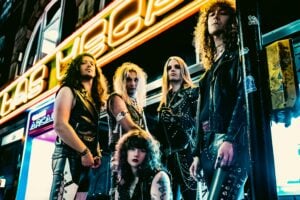
So that was the end of the ”forming-the-band-with-Brits” dream. It was, of course, disappointing, but it didn’t take us long to lick our wounds and hook up with Zinny Zan (later Shotgun Messiah), who became the lead singer and frontman. Then, Noice drummer Freddie Von Gerber and guitarist Danne Lagerstedt (aka Danny Wilde) made the line-up complete.
What do you remember about the recording of the band’s two albums, Easy Action and That Makes One?
We started by recording a four-track EP, which was later popularly referred to as a ’mini-LP’. The songs “Number One” and “We Go Rocking” soon got extensive airplay on the local radio stations, and we quickly became a thing on the Stockholm rock scene. We then recorded the eponymous album, which our manager Sanji Tandan brought to the music industry event MIDEM in Cannes.
There, he got us signed to Warner Bros. legend Seymour Stein’s label, Sire, making us historical by becoming the first Swedish rock band ever signed by a US major label. By now, Chris Lind had replaced Danne Lagerstedt on the guitar, and we recorded some additional tracks for the international SIRE release of the album with Chris in the ABBA studio, Polar.
Although I’d already recorded Noice’s Europa at Polar, it felt unreal to record my own songs in the same studio as Led Zeppelin did In Through The Out Door with my own band. After the release, extensive touring followed as we also recorded some new songs for the follow-up record. We were in the middle of a tour of Finland when we suddenly got the word from our manager that the label had dropped us.
At the time, I was working a lot as a producer. Me and Peo wrote and produced for a lot of Swedish artists, and when we had time off in the studio, worked on new Easy Action material. In 1985, the whole band went on location in the Swedish mountains of Funäsdalen to shoot a horror movie originally named Blood Tracks, later renamed Shocking Heavy Metal.
The band was both “acting” and performing. We played ourselves, but the band in the movie is called Solid Gold. A tip of the hat to Marc Bolan and his T. Rex song “Solid Gold – Easy Action.” In the movie, we had a standout song called “In the Middle of Nowhere,” the notorious big ballad during the end credits, as in all ‘80s movies.
How did things change after Zinny left Easy Action, leading to Tommy Nilsson joining?
Some time later, when Zinny had left the band, we got in touch with Tommy Nilsson, who had returned to Stockholm after pursuing a solo career, recording albums in France and the US. We lured him into the studio under the (untrue) pretext that we wanted him to sing on a motion picture soundtrack.
Now, the film had long been released with Zinny singing the song, but we took a chance on Tommy, being abroad for years, not knowing that. Which he luckily didn’t. He liked the song and did an amazing first take on it (the majority of which ended up on the final version), and after that, there was no question in mine or Peo’s minds that Tommy Nilsson was the new lead singer of the band.
We just had to inform him first. He took the message in stride, and we soon were working on new stuff for Easy Action Mark II. I got a call from the journalist Stefan Johansson, who asked me if I wanted to produce a charity song with the bands of the metal scene in Sweden. He’d met Bob Geldof in London and discussed doing this project through Geldof’s web of contacts, who’d already paved a way with Band Aid and Live Aid.
Europe’s Joey Tempest had written the song. So, we did Swedish Metal Aid. The singers from all these great bands were singing verse parts while Joey and Tommy, now the new lead singer of Easy Action, were fronting, doing all the ad-libs. We performed on Swedish television with all the rockers in the studio, me playing the grand piano, switching to guitar for the solo, and everybody joining in for the typical ‘80s massive sing-along chorus.
That record ended up gaining some major traction, right?
The record was a huge success; it reached platinum status and helped raise a lot of money for the cause, which was a catastrophic famine in Ethiopia. This was the first time me and Joey worked together, but I think we both knew it wasn’t gonna be the last.
What led you to replace John Norum in Europe? What made you the right player for the job?
I had quite a reputation as a guitarist at that point. I don’t think I’m blowing my own horn too hard if I say I was the obvious choice. Also, the fact that Joey and I had had the opportunity to work together on Swedish Metal Aid—which was both a lot of fun and a great success—just six months before this, of course, must have played a role. I think they already had a pretty good idea of what I was capable of.
Was John a tough act to follow, given that he and Europe were already pretty established?
I never really felt that kind of pressure. What I experienced from the fans was more a sense of curiosity than comparison. One must also remember that Europe wasn’t the super successful mainstream rock act it became later, since this was before the real international “Final Countdown” take-off.
But there sure were a bunch of songs to learn and a lot of material to absorb. I wanted to stay faithful to the melodies in the guitar playing while simultaneously contributing something new, giving it my own touch.
What was it like coming into the band just as “The Final Countdown” was taking off? It must have been hysteria.
It was a big deal in the media when I joined the band, which I, of course, was expecting. The song was already a big hit in Sweden and had just started to climb on the charts in a couple of countries in Europe. But after we started to rehearse for the tour, it really got crazy. It climbed on literally every chart around the globe and ended up the number one single in 25 countries.
So, when we eventually embarked on the TFC World Tour, we sold out the biggest arenas in front of amazing crowds. We had to do “runners” after every show, which meant, after the last encores, we ran offstage through the back entrance into the waiting cars that took us out of there straight to the hotels.
The alternative would have been to become trapped in the arenas while surrounded by gigantic crowds. When we arrived at the hotels, there were normally big crowds there too. A lot of times, we needed to enter through a back entrance or through the garage to not get stuck. On more than one occasion, situations escalated and became really dangerous.
What was it like navigating that?
I remember we needed to use fake names so the fans wouldn’t figure out which room we were staying in. I remember mine was “K. Mann” and Joey’s “J.Thompson.” In retrospect, you didn’t really have to be Sherlock to break those codes. But they actually worked. But these were, of course, nice problems. We were living the dream.
One has to wonder why John would walk away from that.
Regarding my predecessor’s departure from the band, there were two very different explanations floating around for it. The official media one was that he left because of disagreements regarding the band’s musical direction. The one I learned from the band and the manager is that they sacked him because he was impossible to work with.
Tell us about your first album with Europe, Out of This World, which was a hit as well.
I flew into London straight from Nassau, where I was living at the time. I brought with me my home studio and rigged it up in the apartment on Hertford Street in Mayfair. I came very well prepared. I’d written and made demos of a bunch of songs and worked a lot on guitar arrangements.
We made preparations and rigged everything at the Olympic Studios in Barnes and started the recordings with legendary producer Ron Nevison. It felt amazing for me to be back in the studio after the massive TFC World Tour. Ron did an amazing job recording and producing the album, and he knew exactly what I was after when it came to my solo tone. He was a big part of enhancing it with his Massenburg EQ’s and his unmatched fingerspitzgefühl.
What stories can you offer about touring with Def Leppard, one of the biggest groups on the planet at the time?
That summer tour of the US was unforgettable. Def Leppard was probably the biggest band in the world at that time, and Europe was at least one of the biggest. It was an amazing bill. Every time the tour bus passed the city limits to a new metropolitan area, we heard announcements for the coming concerts on all the radio stations.
What led Europe to go on hiatus in the early ’90s? How big an impact did grunge have on the band’s fortunes?
The emerging grunge movement really brought on a lot of changes. Although Prisoners in Paradise sold well over a million copies, the changing musical climate made us feel like it wasn’t relevant to release a new Europe album at that time. The label, of course, wanted a follow-up to that, which record company doesn’t want a new release from a million-selling act?
But since it didn’t feel like we had a musical voice in the midst of this era, we decided to take a break and regroup. That break turned out to be longer than we thought, but not because of the musical climate. Grunge faded away only years after its explosive invasion of the music industry.
So, why didn’t Europe reunite after that happened?
The reason we didn’t reunite is because we all got busy with other stuff. For me personally, my solo career.
Speaking of that, throughout the ‘90s and 2000s, you steadily put out solo work. What kept you inspired and pushing boundaries?
Curiosity. That’s what has always been pushing me forward. When I recorded my first solo album, Shine On, in 1995, I wanted to explore the singer/songwriter streak I’ve always felt I had. So subsequently, I wrote all the material on acoustic guitar or piano. It felt like something I needed to do at the time, since by now I had already toured the world multiple times with screaming audiences and roaring amp stacks, making my trouser legs flutter.
It was time for something different. The sparse production and the acoustic vibe to it made the recordings feel like a catharsis. My second album, K2: Melon Demon Divine, in 2004, worked the opposite way. I wanted to crank the amps up to eleven and get back in the game. I wrote most of the songs on a guitar tuned in drop D. That was the avenue I really wanted to explore at the time. The same can be said about all five of my solo albums to date—they are all curiosity-driven.
You put out a book called The Rock Star that God Forgot. Do you feel forgotten within your era, meaning you don’t get enough credit?
Well, yes and no. First of all, that’s not really a correct translation of the title. The book, which is only released in Swedish as of now, is called Rockstjärnan Gud Glömde, which (at least if you use Google Translate) means The Rockstar God Forgot. But the idea for the title came from the ‘80s horror movie series Amityville Horror, which in Swedish cinemas was named Huset Som Gud Glömde, or The House God Forgot.
So, the title of my book is actually a paraphrase of a Swedish ‘80s movie title that the publisher believed would feel strangely familiar/appealing to the reader demographics we were aiming for. Given the horror film context, it’s just a bit more subtle than calling it: The Rock Star from Hell, which I’m sure you agree would have been incredibly cheesy.
But the “forgotten” aspect is, of course, at play. I think a lot of people, more or less, lost track of my movements after my time in Europe. So, that’s the idea about the book title. Unfortunately, it really doesn’t translate that well into English. So, for the coming English edition, I’ll have to come up with a different one.
Tell us about your notable guitars.
During my early days in Europe, I was playing L’arrivée Guitars, a Canadian brand. It was the kind of axe I really needed for that guitar work. I had a couple of Strat models; namely, a yellow one with 24 frets, which was my main guitar on Out Of This World, and a 22-fret Tele with my name in mother-of-pearl fretboard inlays.
Those were my mains, both live and in the studio. In the late ‘80s, I became a Gibson endorsee, so on Prisoners, I’m using a Les Paul Junior and an SG, but also my 1958 Fender Strat and a Les Paul-type guitar by the Swedish luthier Malmberg, which I purchased before the recording of the first Easy Action album.
I used pretty much the same gear on Shine On. On the K2 album, I was playing my Washburn CTS. I worked with Washburn for a number of years until 2009, when I started working with Gibson again, and since then, I’ve been using two custom LP Axcess with 22 True Temperament frets. They’ve been real workhorses.
And I’ve used it for a number of albums; Redux: Europe from 2011, Judas Kiss from 2013, Scaling Up in 2016, and The Kee of Hearts album in 2017, and the Out of This World project with Tommy Heart in 2021, and numerous other cooperations and guest performances.
Today, I’m mostly playing my two vintage Valley Arts Strats, 7/8 scale, 24 frets with Floyd Rose: a Fireburst and a Blonde. The 7/8 scale length means it’s 24,5’, as opposed to Gibson’s 24,75’ and Fender’s 25,5’. Personally, this marginally shorter scale length is absolutely ideal. And since their bodies are also slightly smaller, the guitars sit much better on my body than a regular Strat. I just love the overall feel of these beautiful instruments.
How about your amps and pedals?
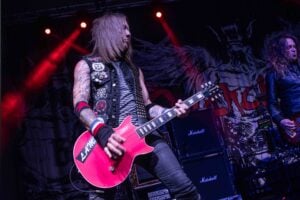
Regarding amps, I’ve always been a Marshall guy. In Easy Action, I was always using either a JMP or a Plexi. When I joined Europe, I had Tommy Folkesson modify my JMP’s, which I’ve used on and off since. I still have the OOTW JMP. On PIP, I was using that, but also a Kitty Hawk 100W head. When it comes to stomps, I’ve mostly used a Cry Baby wah and a delay. I’ve had all kinds of delays. It’s not a big deal which brand, as long as you didn’t buy it under a bridge.
Catch us up on what you’re doing now and what’s next for you?
Right now, I’m writing what will be my sixth solo album. I’ve got a couple of interesting cowrites that I have to complete before recording the last five or six tracks. I already have half of the album mixed and mastered. Since I’ve been very fortunate with chart action for my singles the past four or five years, I’ve just kept on releasing singles until I felt it was time for a full-length release.
And since the songs “I’m Your Catcher,” “Still Got My Heart,” “Tonight’s Tonite,” and “Don’t Miss You Much” have all been at the top of sales charts throughout the EU and UK, I have a pretty solid foundation for an album. I felt what I needed was a couple of up-tempo songs and rockers, so that’s what I’m aiming for with the cowrites and the songs I already have in the pipeline.
The word is that Easy Action is going to do some shows.
Yes, Easy Action. Since 2026 marks the 40th anniversary of That Makes One, we’re putting the band back together with a new album and festivals. We have the lion’s part of a full-length with all new songs in the can, and we’re already booked on some big festivals for the summer.
Do you have any regrets?
“Non, rien de rien – non, je ne regrette rien.” Without going too Édith Piaf on your ass, I can reveal that I have very few regrets in my life. A lot of people ask me the “sliding door” question: if you could do it all again, would you have turned Europe down and stayed in Easy Action?
Hell no. I’m very happy with my choices. My regrets are of a much more mundane character, like, “Why the hell did I sell that 1963 Fender Strat?” or “Why didn’t I buy Microsoft shares in the ‘80s?” But I guess a lot of us suffer from those.
Check out similar articles on ClassicRockHistory.com Just click on any of the links below……
Read More: Artists’ Interviews Directory At ClassicRockHistory.com
Read More: Classic Rock Bands List And Directory
Read More: 1970s’ Saddest Rock And Pop Songs
Read More: 25 Best Classic Rock Live Albums Of All Time
An Interview With Kee Marcello of Easy Action, & Formerly Of Europe article published on ClassicRockHistory.com© 2026
Classicrockhistory.com claims ownership of all its original content and Intellectual property under United States Copyright laws and those of all other foreign countries. No one person, business, or organization is allowed to republish any of our original content anywhere on the web or in print without our permission. All photos used are either public domain Creative Commons photos or licensed officially from Shutterstock under license with ClassicRockHistory.com. All photo credits have been placed at the end of the article. Album Cover Photos are affiliate links and the property of Amazon and are stored on the Amazon server. Any theft of our content will be met with swift legal action against the infringing websites.