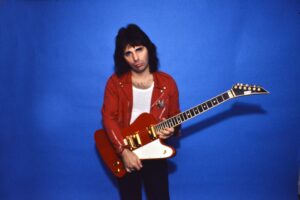
Feature Photo: Courtesy of Jack Starr
As a youngster, Jack Starr bounced between Frank and the United States, developing a unique musical palette and a knack for guitar. By the time he came of age, he knew what he wanted to do with his life: play guitar and make music.
In fact, Starr was so smitten with the idea that he even told a young woman with whom he was on a date about it. “I remember going out on a date with a beautiful girl, and walking her home,” Starr tells ClassicRockHistory.com. “I told her my dream of moving to Chicago so I could jam with Michael Bloomfield and Muddy Waters and have Little Walter play the harp.”
“Thinking back,” Starr laughs. “She must have thought I was totally crazy. On top of it all, she had no idea who these people were, as she was into Paul Revere and the Raiders, which I didn’t like back then.”
As evidenced by his catalog—which includes everything from heavy metal to country music—Starr is more open-minded now. “I am much more open to different music,” he agrees. “I actually like Paul Revere and the Raiders now. And Tommy James, The Grassroots, and a lot of music that I viewed as ‘bubble gum’ back then.”
Starr did not make it to Chicago to jam with Mike Bloomfield, Muddy Waters, and Little Walter. But he did start his own band, Virgin Steele, which is now regarded as one of the finer groups of the post-New Wave of British Heavy Metal scene.
After leaving Virgin Steele, Starr was restless. He formed Burning Starr, released solo albums, one of which, 1984’s Out of the Darkness, remains halcyon, and the latest of which, 2025’s Out of the Darkness Part II, picks up where its predecessor left off, and then some.

As for what’s kept him inspired, Starr shrugs, saying, “For me, it has always been to stay true to my music and not be a follower of trends. Once you follow a trend and put out your version of whatever that trend is, it’s usually too late, and the trend has passed. It’s a waste of time. I try not to play follow the leader, and instead, march to my own beat.”
Now in his 70s, Starr is as active as ever. At any given time, he’s got dozens of guitar-related irons in the fire, with no intention of slowing down. “Music is music,” he says. “I don’t want to put barriers on it. I want to explore it and make it its own reward. If I can make a living, then it will be even better.”
What are your first memories of music in your life?
For me, it was growing up in France, my father running a jukebox business, and going with him to bars and cafes, loading up the latest hits every couple of weeks and listening to American rock ‘n’ roll, which I could not get enough of.
And then, everything changed when our family wanted to move back to the US, and we moved to New York. I would listen to great DJs like Cousin Brucie and Murray the K on my little transistor radio and dream of making music myself.
What drew you to the guitar, and when did you decide the sort of player you wanted to be?
When I got into Long Beach High School, some of the guys played guitar, and I had one that lay under my bed. [laughs] I finally decided to put the time in and learn how to play it, and one of my classmates showed me some basic chords so I could play some songs by the Rolling Stones, like “(I Can’t Get No) Satisfaction,” and presto, I was hooked.
How did the local scene you grew up in impact you as a player?
It had a huge effect. One of my friends was Hispanic and very proud that his ethnic group had their own guitar hero, Carlos Santana. We would jam on songs like “Oye Como Va.” And I had another friend who loved Jimi Hendrix, and I would play those songs with him, but the biggest influence for me was Michael Bloomfield and his work with the Paul Butterfield Blues Band. I loved his style of playing and his smooth vibrato. I wanted to play like him.
The ‘60s and ‘70s were a wild time to come of age. How did that affect you as you were getting into things?
Well, I graduated from high school in 1970, so I really lived through those wonderful and wild times. I practiced guitar a lot. I remember sometimes some of my friends would come by and ask me to come out with them and go to clubs and pick up chicks, but most of the time, I would say, “No.”
I’d stay home with my records and my guitar and try to learn some new riff or some new way of looking at the guitar. Also, I discovered that when I would play in public at a dance or a party, making friends became a lot easier. The music I played broke down all the barriers that existed because of the fact that I did not grow up in America, and English was my second language.
There are conflicting reports, but some sources say that your first “semi-professional band” was Les Variations. Can you clarify that?
I didn’t join Les Variations, but I did play with the bass player [from Les Variations], Petite Pois Grande, in a band I started called Starr System. And the guitar player, Marco, did some recording with my first band, based in France, which was called California.
There is a song on YouTube, one of our single releases called “Gin Gin Woman,” which is one of the earliest examples of heavy metal, as it came out in 1972. Also, I wrote a song for Les Variations called “Silver Girl,” for which I agreed to be paid a flat fee.
When I moved back to France in 1972, I also became friendly with Trust, another French band, and actually got to play on stage with them at their first gig at the L’Olympia Theatre in Paris. It didn’t go unnoticed by me that this was a venue that The Beatles and Jimi Hendrix had played only a few years before.
**Editor’s Note: after Starr clarified this, ClassicRockHistory.com writer/journalist, Andrew Daly, edited Jack Starr’s official Wikipedia page to reflect his statements regarding his involvement with Les Variations, etc.**
What led you to form Virgin Steele? Were you very into heavy metal?
When my family moved back to America, and after high school, I started listening to music from Britain, specifically the New Wave of British Heavy Metal. These were bands like Angel Witch, Budgie, Saxon, and Iron Maiden—that was what I wanted to do.
I wanted to create a band with that sound and that image and lyrically similar, and thus Virgin Steele was born. I knew I could do it because those bands had a European sound that people liked. And growing up in France, I absorbed the same influences as those bands did, so it was a perfect fit for me.
And when we came out with our first album [Virgin Steele], the critics would say Virgin Steele sounds like a European metal band… and they were right because in France a lot of classical music gets played on the radio. And when I wasn’t listening to American rock ‘n’ roll, I was listening to Bach and Beethoven. That was the style of music.
You made two classic records with Virgin Steele, the self-titled and Guardians of the Flame, before leaving. What led to that?
Actually, I made two albums with Virgin Steele and two EPs. And we were on six different compilation albums, including Metal Massacre and Shrapnel Records’ U.S. Metal (Unsung Guitar Heroes) Vol. II, which included our song, “Children of the Storm.”
I left the band because of musical differences. I wanted the band to be more guitar-driven and less keyboard-oriented. It became more apparent that in order to do that, I would have to go a different way. That led to me doing Out of the Darkness with Rhett Forester, the former singer of Riot.
And now, 40-plus years later, I am still making albums and touring. A few months ago, I played with my band Burning Starr in Barcelona, Spain. And my most recent album, Out of the Darkness Part II, is out now on BraveWords Records and is doing very well.
What was it like launching your solo career, and how had your rig evolved by then?
It was not so difficult starting a solo career because I had received a tremendous amount of positive press with Virgin Steele. A lot of it singled me out, like Kerrang! Magazine naming me a “guitar hero” in their monthly feature. That created a lot of interest and made it easier to get a record deal, which I did with Passport Records.
They were the biggest independent label in America in 1984 and had artists that I looked up to, like Bill Wyman of the Rolling Stones, who had an album out with them called Willy and the Poor Boys. It was cool. I could tell my friends, “I’m on a record label with one of the Stones…” [laughs]
That also helped me get an endorsement deal with ESP Guitars back then. I was one of the first, and it resulted in a lot of publicity. Some of the metal magazines ran Jack Starr promotional contests like: “win an ESP guitar like the one Jack Starr plays.” These promo contests ran in Brazil, France, Italy, Germany, and in the US in Hit Parader Magazine and in Circus.
Your solo album, Out of the Darkness, remains beloved. What do you remember about making it?
Out of the Darkness, for me, was a labor of love. I wanted to prove to the world that I was good and could write songs. I went about getting great musicians for it, like Carl Canady on drums, Gary Driscoll [former Rainbow drummer] as a guest, and the great Rhett Forester on vocals.
I remember going to Rochester to this amazing recording studio in the downtown area and walking into an ultra-modern control room. I looked out into the playing area, which was an old, converted ballroom where artists like Bing Crosby and Glen Miller had performed.
It was almost an eerie feeling to know that, forty years later, I would be using that same room to make a heavy metal album with some of the greatest musicians of the day. I had something to live up to, and I was going to make sure that I did.
Where did you go from there, and why do you feel you’ve gotten more recognition in recent years?
Well, that’s a good question. Really, the answer is simple: I just keep going. Plus, it’s the only thing I know how to do: make records, do shows, make more records, and do more shows. I never get tired of it. The strange thing is that, unlike a lot of artists, who lose their passion and start to make worse product, I really feel I have gotten better with each album.
Though I am not a household name, I have gotten more known and sold more albums with each release. So, I keep going and strive to make better and better releases, like my new one, Out of the Darkness Part II, which made it onto many 2025 best-of-the-year lists, including one from KNAC radio and about 20 others from various magazines, etc.
What’s been the key to your tone, and where does the progression of your playing stand today?
I think good sound starts with playing with focus and good vibrato, and being melodic as opposed to playing fast and saying nothing. Speed is okay if it serves the song, but a guitar solo has to fit the song and not be a showcase of how fast or flashy a guitarist can play.
For me, I go for a very classic sound, like Joe Walsh in the James Gang, Eric Clapton on the John Mayall and the Bluesbreakers “Beano” album, or Pink Floyd. The one recognizable trait of my sound is that I use a lot of delay.
In fact, when I play live, the delay is on all the time. I remember seeing Yngwie Malmsteen once in a magazine, and he had a T-shirt that said on it: “Compression is my friend.” I think I will get a T-shirt that says: “Delay is my friend.” [laughs]
What’s something about you as a musician—and listener—that might surprise fans?
I think that it might surprise fans to know that, besides playing heavy metal music, I have made blues albums. I did an album called Take it to the Bank, which can be found online and on YouTube. Also, I did a southern rock album called Swimming in Dirty Water, which is also on YouTube.
And I released a Latin album called Soon Day Will Come and a jazz-fusion album called A Minor Disturbance, featuring Randy Coven on bass and other great musicians. And also, I did some thrash [metal] albums entitled DevilChilde and Phantom Lord. I even did a country album called South of Georgia.
Plus, in 2021, I made a plain old rock album called Escape from the Night. That was basically mainstream rock and something I had never done before, as opposed to a lot of the niche kind of music that I have done through the years. So, if fans really are interested in my career, they will find a lot of stuff that they will be surprised to hear.
I had a friend named Gari Saint, a fellow Long Island guitar player, who played in a band called Tangiers, and sometimes, I would go over there to jam with him. And when he had a new riff or idea for a song, I would ask him where it came from.
He would always say, “I was just jamming with myself, and I came up with this.” That is what I also do. I pick up the guitar, plug it in, and see where it will take me. And sure enough, each time it is somewhere new. For me, that makes it exciting.
What’s next for you?
Playing and recording. For instance, yesterday I was playing guitar in the studio for a song to be included on the new Thor album. And I am also working on some songs for a new Burning Starr album, tentatively titled Chasing the Ghost.
And I played guitar on my drummer Rhino’s solo album called Ixora, which as of yet has not been signed. Also, I am working up some of the early songs of Virgin Steele, where it all started for me, as I will be playing them live again.
I guess you could say everything old is new again—and that includes me. I would like to share these final thoughts: don’t just read about me. Look up all the stuff I mentioned, because it’s pretty good. Some of it is even great! [laughs] Thanks for listening.
Check out similar articles on ClassicRockHistory.com Just click on any of the links below……
Read More: Artists’ Interviews Directory At ClassicRockHistory.com
Read More: Classic Rock Bands List And Directory
An Interview with Jack Starr of Virgin Steele & Burning Starr article published on ClassicRockHistory.com© 2025
Classicrockhistory.com claims ownership of all its original content and Intellectual property under United States Copyright laws and those of all other foreign countries. No one person, business, or organization is allowed to re-publish any of our original content anywhere on the web or in print without our permission. All photos used are either public domain Creative Commons photos or licensed officially from Shutterstock under license with ClassicRockHistory.com. All photo credits have been placed at the end of the article. Album Cover Photos are affiliate links and the property of Amazon and are stored on the Amazon server. Any theft of our content will be met with swift legal action against the infringing websites.