Feature Photo by @JaneStuartPhotos
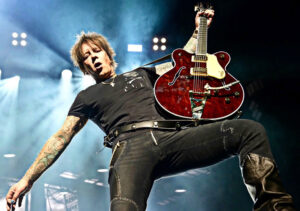
Though he’s just 56, guitarist Billy Morrison has lived the life of a man double his age, and then some. His early years were that of rock ‘n’ roll excess, giving way to star-studded gigs with The Cult, Camp Freddy, and for a long spell now, beside Steve Stevens in Billy Idol’s band.
But that’s not all. Morrison’s last solo record, 2024’s The Morrison Project, featured many of Morrison’s pals, like Steve Vai, Steve Stevens, and most notably, two songs he penned with Ozzy Osbourne, a dear friend of Morrison’s.
Sure, the cast of characters across Morrison’s record shows that he’s well-respected within the biz. But what’s most endearing is that, despite all he’s been through, Morrison has come out the other side with the same spirit that drove him in the first place.
“What keeps me inspired is that you don’t have to look very far to find things to shout about,” he tells ClassicRockHistory.com. “We are surrounded by inconsistency, questionable decisions, and volatile situations. Plus, there’s my own life experiences… that’s more than enough fuel for so many songs.”
As for what he wants fans to understand about him, he says, “Most of it is all out there already,” he admits. “But I think maybe understanding that music is subjective, to remain open-minded, to remain teachable, to remain creative.”
“These are the things I strive for every day as a human being and a musician,” he explains. “That would be a good start at understanding who I am underneath the sparkly jewelry and the tattoos.”
What are your earliest memories of music in your life, and what drew you to the guitar?
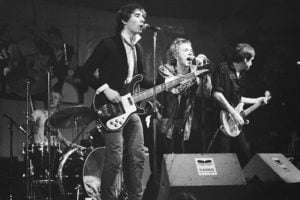
I remember being into glam rock when I was just starting to appreciate music. Roxy Music, The Glitter Band, Slade, Sweet, I was always glued to the TV as a kid to watch Top of the Pops. And one day, I saw the Sex Pistols being interviewed on the Bill Grundy show, and I couldn’t believe how cool they looked, how much they didn’t give a shit, and how the whole country completely over-reacted to that interview. As far as I was concerned, that was the turning point, and the day I decided that’s what I wanted to do.
How did the scene you grew up in impact your outlook on life and as a musician?
Punk rock completely influenced me, more as an attitude than a haircut. I realized that having something worth saying was way more important than being formally trained as a musician. I opened my eyes to the disrepair and the weird dichotomy that was England in the late ‘70s and watched as kids like me picked up instruments and taught themselves to make a noise. It made me feel that I could do that too.
What led you to pursue a life in music, and what challenges did you face?
I realized early on that the creative gene that I have is extremely strong, and that attempting to conform in a 9-to-5 job and just settling for a weekly wage was never going to work for me. The few jobs I had as a teenager fell apart very quickly, due to my attitude and a rising substance abuse problem.
Pursuing a life in music wasn’t necessarily what I was doing…. It was more like making sure I didn’t pursue a regular life. By default, music came rushing in as a solution. And the challenges that I faced were all of my own making. A 15-year heroin and cocaine addiction would be all the challenge anyone needs to prevent success.
How did Into a Circle form, and then Stimulator form, leading to the signing of a major-label record deal? Why did that band never release the record it made for Geffen?
Into A Circle was a band way before the major-label deal. That was a cool alternative UK band that I was in. But the band you are thinking of was called Stimulator, which was the band that signed to Geffen and recorded in LA.
But nothing came out because Geffen was bought out by Seagram’s, and hundreds of bands were dropped. One of the biggest upsets in record label history! I managed to get the master’s back in the exit deal and released it years later as the first Billy Morrison solo album.
What can you tell us about joining The Cult as a bass player, a different role than your usual rhythm guitar stylings?
Joining The Cult was a wonderful experience. And no, you are correct, playing bass guitar is not something I had done before… or since. [laughs] But if I was going to ever be a bass player, it would be with that band.
The bass lines are solid and relatively easy. I knew all the songs already, as I was a fan, and when [guitarist] Billy Duffy asks you to audition for The Cult, you say, “Yes!” I got the job and had a great time traveling the world with them for a couple of years there.
What can you say about being in a band with Ian Astbury and Billy Duffy?
Oh, The Cult is Ian and Billy, always has been and always will be. I’m just fortunate to have been involved for a while there, and at a great time in the band’s history. The Beyond Good and Evil album was fantastic, and that tour went everywhere, so I just count myself lucky.
Ian is one of rock’s greatest frontmen with such a unique and powerful voice, and Duffy has a tone that you just can tell is him from a mile away. He also knows how to write a hit song! So yeah, being in a band with those two was formative, exciting, and I’m very grateful.
How did you become involved with Camp Freddy, and what was it like working with Dave Navarro?
I formed Camp Freddy from a phone call to me from Donovan Leitch asking if I could put a line-up together to open The Standard Hotel in downtown LA. I was sitting with Dave when the call came through. I ran it past Dave, who said, “Yes.”
And seeing as I had just come off the road with The Cult, I called [drummer] Matt [Sorum], who also said, “Yes.” That’s how Camp Freddy was started… 24 years ago. Somewhere down the line, it morphed into what is now, which is Royal Machines. But it’s been a fun journey for sure.
In 2010, you joined Billy Idol’s band. How did that happen, and what was your role, given that Steve Stevens has played guitar with him for so long?
Billy had been taking a break. When it came time to gear up again, Steve suggested to Billy that a two-guitar lineup would sound better, and Billy trusted Steve to put that together. So, it was me who got the call from Steve—and there was absolutely no question.
I jumped at the chance to be guitar partners with someone as incredible as Steve. And also, I had been the biggest Generation X fan back when I was a kid, when punk rock was sweeping the UK. So, it was a no-brainer for me.
I’m super grateful to Steve, as I credit being in this band as the reason my playing has exponentially become better and better. It has to when you are on there every night with someone like Steve.
You and Steve developed a strong partnership. Tell us about that.
I would say that Steve definitely encouraged me to be myself, to play in my own style, with my own tone. And having that kind of support helped me feel that I was bringing something strong to the table. You have to feel that if you are going to gel well with such an iconic player.
I also know my place; Steve is “the guy.” He is such an inspirational player and wrote all those amazing songs with Billy. So, I am happy to fit in there and support him with what I do. He allows me to stretch when the time is right as well. We just kinda understand each other’s guitar language, I guess!
You’ve been releasing solo records since 2008. What brought that on?
Well, I guess it started by releasing that Stimulator album, just because I wanted those songs to see the light of day. After that, I had invested in a pretty good studio in my house, and once you have that, you do what a creative musician should be doing… you write music!
So, after a while, I found myself with a selection of songs, a body of work, and it just feels right to put them out into the world. The last record [2024’s The Morrison Project] was a different animal because I went with a label [TLG Zoid/Virgin].
They truly believed in the songs, made a ton of videos, supported multiple singles, released vinyl 12” singles, and just went above and beyond. And that paid off, as we had a bunch of chart success and glowing reviews. So, I guess I’m doing a follow-up album in 2026!
Where does your rig stand today?
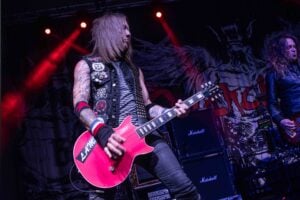
I have the most bulletproof rig right now. I’m so very happy with the latest round of upgrades that Dave Friedman built for me. Dave has been responsible for my rigs for years now, and the latest incarnation centers around a couple of BE100 Friedman heads.
And we are now using the Fractal Axe FX just for FX (no amp modeling), then out into a fun pedal tray for different overdrives, a few fun things like a Phase 90 and an octaver, and then either out into Friedman cabs or through some Two Notes IRs.
Guitars are Knaggs and Gibsons. I have a signature model with Knaggs right now, based on a Junior with noiseless P90s, that is just beautiful and pairs nicely with Steve’s Bare Knuckles humbuckers. There’s also a [Gretsch] Country Gentleman and an [Ibanez] Jem that Steve Vai gave me in the rack for certain songs.
Do you have any regrets?
I don’t really live with professional regrets, although there are a couple of personal regrets where I wish I’d grown up sooner and not done. But regret is pointless as we can’t turn back time. All we can do is try to be better next time.
What are you proudest of, and what’s next?
I would say I am proudest of the two songs I wrote and recorded with Ozzy. We had a personal relationship for 28 years or so. To have had the opportunity to write and record those last two songs, “Crack Cocaine,” and “Gods of Rock ‘N’ Roll,” and to have shared the joy together of watching them get success… yeah, I’m proud of that. What’s next? I’m thinking, let’s do it all again with some different friends this time.

Check out similar articles on ClassicRockHistory.com Just click on any of the links below……
Read More: Artists’ Interviews Directory At ClassicRockHistory.com
Read More: Classic Rock Bands List And Directory
An Interview With Billy Morrison Of Billy Idol’s Band And Formerly Of The Cult article published on ClassicRockHistory.com© 2026
Classicrockhistory.com claims ownership of all its original content and Intellectual property under United States Copyright laws and those of all other foreign countries. No one person, business, or organization is allowed to re-publish any of our original content anywhere on the web or in print without our permission. All photos used are either public domain Creative Commons photos or licensed officially from Shutterstock under license with ClassicRockHistory.com. All photo credits have been placed at the end of the article. Album Cover Photos are affiliate links and the property of Amazon and are stored on the Amazon server. Any theft of our content will be met with swift legal action against the infringing websites.