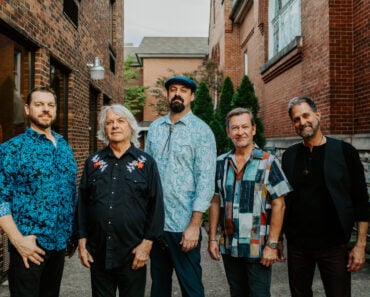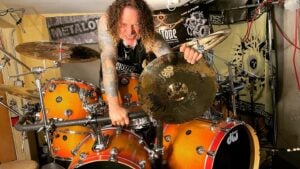
Feature Photo courtesy of Ivan de Prume
Drummer Ivan De Prume had a rough childhood. Most of the time, he felt like an outcast. But once he found hard rock and heavy metal music, all of that changed.
Peers stopped pushing him around. He found a sense of belonging. And most importantly, De Prume locked in with the drums, leading him to hook up with bassist Sean Yseult and vocalist Rob Zombie to form White Zombie.
The band launched in the ‘80s, but wasn’t hair metal, thrash, or hardcore punk. Truly, White Zombie were outliers, hooked on doing things their own way. This led to a few cult recordings and unground fanfare, but nothing resembling widespread success.
Things changed when Jay Yuenger, White Zombie’s fifth guitarist, entered the fold, leading to the recording of 1992’s La Sexorcisto: Devil Music Volume One, a landmark record that put White Zombie at the forefront of alternative and heavy music.
Unfortunately for De Prume, the fun wouldn’t last, as Zombie’s combative personality led to a clash that saw the drummer quit the band at its apex while on tour for La Sexorcisto. For a time, he checked out of the industry, though he never gave up on the drums.
As for White Zombie, they released one more mega album with a new drummer in 1995, Astro-Creep: 2000, before disbanding in 1998. In the years since, Zombie has gone on to have a massive solo career, while his bandmates chose to keep things more low-key.
Fans keep calling for a White Zombie reunion… and Zombie keeps refusing. As for De Prume, he’s open to it, but admits it won’t happen. Still, he’s proud of what he accomplished. “Based on what I’ve seen fans say about me,” he tells ClassicRockHistory.com. “I think they got a good grasp of what I’m trying to say as an artist in my role within the legacy of the music I helped create. I really appreciate all of my fans and the White Zombie fans out there.”
But he’s not without regrets. “I do wish that I was a little bit more mature about the way I handled my distance with Rob when we first had that uncomfortable silence with each other. I think my ego got in the way.”
He adds, “And his ego got in the way. I was just too full of myself to speak from my heart. We were both so stubborn that we created a wall between us. It was awful. I think if I had been more transparent and compassionate, things would’ve gone differently, perhaps. I just didn’t know how. I don’t know. But what I do know is that what doesn’t kill us makes us stronger.”
What are the earliest memories of music in your life?
I think it was when I was around four years old. I remember playing with the Fisher Price turntable that had the four plastic discs, and each one was a different color and played a different classical song. I remember really enjoying the music and loving the orange disc the most. I don’t know if it was because of the color of the disc or the music it was playing, but it really inspired me.
I also remember my father was always playing music from around the world. He had a huge vinyl record music collection as well as the old 78s. He would play Chinese music, Russian music, German music, folk music, and good old traditional classical music.
I’ll never forget a composition that moved me so deeply called “Maurice Ravel’s Boléro.” My brother and sister loved it too, and we always called it the snake record because the album cover had a big snake on it.
What inspired you to pick up the drums, and when did you decide what type of player you wanted to be?
I was always fascinated by drum grooves and drumbeats that I would hear all over the streets of Brooklyn, New York, growing up. Kids would be break dancing to hip-hop, and I would be pounding away on classroom tables with the beats that I’d hear.
Then one day at some vegetarian yoga retreat that my mom would always take me to, there was a drum kit on the stage, and when I looked at that drum kit, I knew right away I wanted to pound on that thing.
That’s my first experience finding myself really wanting to play on a drum kit. And then, in 1981, when I was about 13 years old, after completing a summer job, I saved up enough money and wanted to buy something.
So, this guy that lived up in a room above us in our Brooklyn brownstone house showed me the Buy Lines newspaper classified section and told me to go through and see if anything pops out at me. And right there, I found my first drum kit.
The drummer that really influenced me and helped shape my rock/metal style was mainly Dave Lombardo from Slayer and John Bonham from Led Zeppelin. As far as all the groovy stuff, it mainly came from Mitch Mitchell of Jimi Hendrix and old East Coast hip-hop beats, like the stuff we would hear from the Beastie Boys.
How did the scene you grew up in affect you as a player, and overall, as a young musician?
Growing up in Brooklyn, New York, wasn’t easy for me. I actually had a pretty rough childhood, always running for my life. They would scream, “There’s white boy, Ivan. Let’s kick his ass.” It started in the fourth grade and went through all my middle school years. The kids were just so cruel.
I dressed differently. I was picked on every day and had to sneak out of school to avoid the bullies. Then, learning how to play the drums gave me a healthy outlet. I practiced a lot, took some lessons, got pretty good, and joined the junior high school band while I was in the eighth grade of middle school, allowing me to be seen for more of who I was.
And then discovering heavy metal music took it that much further. Changing the way I dressed in high school, wearing denim vests with band patches over MC leather jackets and spiked bracelets, made me feel powerful and scary. No one ever bullied me again. I was a true metalhead, and that shaped me as a person and as a drummer.
The ’80s were a wild time to come of age. How did that, and the popular music of the era, shape you and what you wanted to pursue?
I mostly avoided what was popular on the radio at the time in the ‘80s. I really appreciated the underground punk rock, hardcore, and metal music. I loved jumping on the subway in Brooklyn, heading into Manhattan, and exploring the Lower East Side and Greenwich Village, where we could witness the city’s real grit.
It was so alive with wild, creative young artists and musicians. I truly loved the culture there. It was there that shaped the image of White Zombie. I believe when you put it all together, all of these little parts, it shaped the whole flavor of what we did and became throughout the early years of the band. It came from there.
How did you first meet Rob Zombie and end up joining White Zombie?
I first met Rob Zombie when I played in a peace punk band called Life with [bassist] Shauna Yseult. Sean was already dating Rob, and he would come to our rehearsal studio, pick her up, and leave. When I watched that man grab Shauna and take her, I thought he was some homeless guy that she was just trying to help out or something.
He was Ragley with dreadlocks, and honestly, I was a little bit concerned, but he picked her up regularly. After that band split up, Sean and Rob put together a new band and called it White Zombie. And at the time, they had the drummer Peter Landau. Then, Shauna called me one day and asked if I wanted to come jam with them, and I was immediately a band member.
What appealed to you about the band musically? Did you have an idea that the band would be different and could make an impact?
What appealed to me about the band when I first joined was how extreme the vibe was right away. I loved how Rob and Sean packaged the band as if they were trying to sell old horror movies or porn; it was intense. It was graphic, and that was cutting-edge to me. I’ve never seen anything like that.
I really respected how serious they were about having a band. I loved it. I got hooked on that right away, and I really enjoyed how we connected as musicians, but I absolutely had no idea we would make an impact on the industry at all. Honestly, I thought we were way too different to be accepted by anybody.
How did things ramp up for the band, leading up to the recording of Soul-Crusher and Make Them Die Slowly?
We were all proud of our band. We would get together, rehearsing five days a week, working hard on our songs, recording, and releasing records on our own label, Silent Explosion. We released 45s of “Pig Heaven” and “Slaughter the Gray,” then an EP, Psycho Head Blowout, and our first LP, Soul Crusher.
And then, after playing a whole bunch of live shows in the area, Caroline Records picked us up and re-released Slow Crusher on its own label. And then, after Soul Crusher, guitarist Tom Five left the band, and John Ricci came on board. We developed more of the metal sound and eventually developed the songs for Make Them Die Slowly.
Producer Bill Laswell got a tip from Iggy Pop to jump on board to produce the record. We were actually already almost done recording at Fun City with Wharton Tiers when Bill Laswell walked into the studio to talk to us about it. Although we completely depleted our Caroline recording budget and had to start over from scratch with him, I was excited. He also agreed to produce the record for free.
How did things change, leading to the difference in sound and overall success of La Sexorcisto?
During a United States tour, Rob Zombie got really sick and tired of his music collection and really wanted me to let him play the Metallica cassette I had. It was Ride the Lightning or Master of Puppets, and he immediately got so hooked on it. He kept wanting me to throw that tape back in there over and over and over again.
That’s when Rob Zombie was sold on metal. I took him to a lot of Slayer concerts, and that’s when we changed our sound from what it was to the sound of La Sexorcisto. It wasn’t until our fifth guitarist, Jay Yuenger, that we landed on the sound that brought us to major success.
Once we landed on that sound, we got the attention of producer Daniel Rey, who produced the Ramones, and he produced our EP God of Thunder with the songs “Love Razor” and “Disaster Blaster” on there. Daniel Rey connected us with Michael Alago, who signed Metallica to Elektra and was the A&R rep for Geffen Records.
Michael attended a couple of our shows and was sold. After signing with Geffen Records, we were connected with Concrete Management and Andy Gould. The band Pantera was also on Concrete Management, and that led us to getting connected to play live shows with them and tour. But having producer Andy Wallace for the recording of La Sexorcisto helped shape our sound overall.
He was so amazing. He helped with some of the arrangements. I loved how he handled all of our songs in preproduction. Many of the songs didn’t really take full shape until he gave us his love. But our biggest boost in record sales and success was when the MTV cartoon Beavis and Butthead fell in love with us in some of the episodes.
When did things start to go south with Rob, and what led you to leave White Zombie?
During the tour of La Sexorcisto around May of 1992, Rob and I just suddenly stopped talking to each other. That happened after a couple of dumb, unpleasant conversations, which I can’t even remember. But I do remember that as things got busier, we became more and more agitated.
After about four months of this unpleasant silence and distance between us, things just got worse, leading to an unacceptable assault by Rob on stage. He just turned around and spat on me. That evening, I tried to have a conversation with him on the telephone, and he literally just said, “If you don’t like it, just quit the band,” and hung up on me. It was at that point that I knew I could not accept a single day of this any longer.
Did you stay in touch with your bandmates, and were you surprised at what became of the band, given what you knew, and who was involved?
I do stay in touch with Sean regularly, and I also try to stay in touch with Jay. But he’s more difficult to get a hold of, I guess, since he moved to Spain and has a new baby. I actually saw Sean in New Orleans a couple of years ago. I could not and still cannot believe the long-lasting success that we have had over all these years. So yes, I was definitely surprised by what came of the band.
Where did you go, and what did you do after White Zombie?
After I left White Zombie, I immediately went back to Brooklyn, New York, to be with my family. I knew I did not want to be in another band after all those years with White Zombie, and then I realized that I wanted to stick to the drums. With the incredible wide range of music on this planet, I knew I wanted to delve into deeper education of drumming and percussion.
I enrolled in the Percussion Institute of Technology in Los Angeles and studied jazz, Latin, reggae, and all kinds of other styles. It was a hell of a lot of fun, and then after that, I had the itch and jumped into playing with bands again.
Some of the highlighted bands that I’ve played with and cut full-length records with were Anchor, Anomie, Healer, Kreep, Big News, and, currently, I’m playing with Boundless Joy, getting ready to release our second album.
Around 1996, I got into engineering and producing bands and opened Burningsound Studios in North Hollywood, California. I relocated in 2007 up to the Salem, Oregon area, where I am continuing with my recording studio.
Are you still friends with your former bandmates, and if Rob would agree—which he never has—would you reunite the original lineup of White Zombie?
I would love the opportunity to reunite with J, Sean, and Rob. I am still friends with Sean and J. I don’t think there’s any more bad blood with Rob since we do shake hands when we come across each other at events. However, I know he slammed the door on the idea of a reunion several times in the past. But you know, I heard time can heal all wounds, so it may be time for the band to reunite for at least one show and play La Sexorcisto in its entirety for the fans!
What’s next for you?
I would love for all of my fans to check out my new band, Boundless Joy, as we’re about to release our second album. I am proud of it. I love these songs and can’t wait for you guys to check it out.
I’m also hoping to release a book about my experience with White Zombie within the next year. I’m glad I never gave up on the drums. Check out Boundless Joy. This new album we’re releasing, hopefully in June 2026, is going to be so refreshing for your ears. I promise.
Check out similar articles on ClassicRockHistory.com Just click on any of the links below……
Read More: Artists’ Interviews Directory At ClassicRockHistory.com
Read More: Classic Rock Bands List And Directory
Read More: 100 Essential Albums From The 1960s That Everyone Should Own
An Interview With Ivan De Prume, Formerly Of White Zombie article published on ClassicRockHistory.com© 2026
Classicrockhistory.com claims ownership of all its original content and Intellectual property under United States Copyright laws and those of all other foreign countries. No one person, business, or organization is allowed to re-publish any of our original content anywhere on the web or in print without our permission. All photos used are either public domain Creative Commons photos or licensed officially from Shutterstock under license with ClassicRockHistory.com. All photo credits have been placed at the end of the article. Album Cover Photos are affiliate links and the property of Amazon and are stored on the Amazon server. Any theft of our content will be met with swift legal action against the infringing websites.