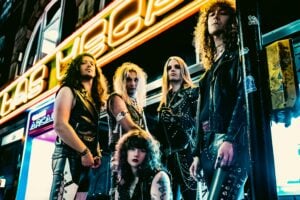
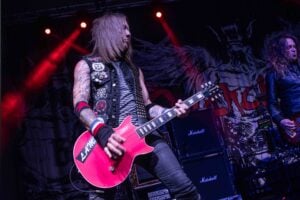
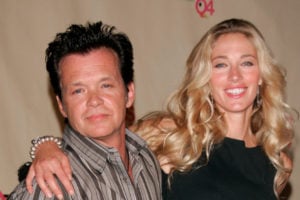
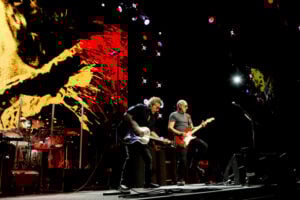
Oni Logan hit the scene via the success of Lynch Mob’s 1990 debut, Wicked Sensation. The album, which was Logan’s first with former Dokken guitarist George Lynch, is beloved among hard rock enthusiasts.
Songs like “No Bed of Roses,” “Wicked Sensation,” and “River of Love” showcase Logan’s soulful vocals, which accent Lynch’s heavy riffs and searing solos. For these reasons, Lynch Mob’s initial lineup of Logan, Lynch, drummer Mick Brown, and bassist Anthony Esposito remains beloved.
Of course, they didn’t stay together. In fact, Lynch Mob’s revolving door has become a bit of a punchline, but that’s no fault of Logan’s, who did return to Lynch Mob in the 2000s to wrap up his unfinished business. But like most things in the land of Lynch Mob, this didn’t last, leading to Logan moving on in 2018.
In the years since, he has maintained a low profile, but he does plan to explore spoken-word-style music. As for Lynch Mob, who dropped a somewhat off-putting reimagined version of Wicked Sensation in 2020, Logan tells ClassicRockHistory.com, “Not to exclude myself in any way, but I wasn’t around.”
He explains, “By this time, I had moved to the Utah desert and wasn’t in the mix. The idea was mentioned to me, and the next thing I knew, I was sent different versions of the songs, really without any input from my side. At that point, I was going with the flow; I did it with a bit of hesitation at the end of the day…”
Like the rest of us, Logan watches from afar as Lynch Mob’s lineup carousel continues to spin, and fans continue to call for him to rejoin. “I don’t blame the original OG fans for not taking a liking,” he says. “I mean, we all knew that we wouldn’t be able to compare.”
It’s true. So true, in fact, that Logan remains open to working with Lynch again. “I definitely would like to make a Lynch/Logan recording,” he says. “Whenever he’s up for it and feeling genuinely creative, to break new ground.”
As for what’s next in 2026, Logan shrugs, “I have visions of recording and collaborating and making new music. As far as the direction stylistically, I wouldn’t be able to tell you. We’ll see you when I get there…”
From a young age, what first piqued your interest in rock music?
The power of FM radio in classic rock. It would consume my youthful ears in hearing all the greats. Seeing Peter Frampton’s Comes Alive! tour amongst 60,000 other rock ‘n’ roll people at the age of 12 certainly had a huge impact on me. It was then that it would be woven into my soul.
What was the moment that put you in the direction of being a vocalist?
There were a few people who gave me an indication that I had a natural ability to sing. One was my middle school bus driver; my schoolmates all knew I played drums in my brother’s band around different towns at rec centers, skate rinks, etc.
They also knew that I messed around in singing to [Led] Zeppelin and Bad Company, so they would egg me on while waiting for our school bus. Then it started happening on the bus, to and from school. One day, the bus driver mentioned to me while the door was opening, “Hey kid, you should be a singer…” That was it, I never looked back.
What sort of music scene were you exposed to prior to coming up?
The earliest music scene in South Florida that I was exposed to was mostly top 40 bands that would gig from the Fort Lauderdale strip down to Hallandale Beach, where you would have the Button South and the Tree House Club, you could walk into the Agora Ballroom pre-Button South, and there was Johnny Depp playing in his cover band, The Kids.
What sort of challenges did you face around that time?
The only challenge I had when I started getting serious about being a singer was learning to become a songwriter. I would drive at 4 AM, two hours south to a studio in Miami to cut vocals for an engineer who would expect me to show up and deliver his material; those were the days in the mid-eighties. The two bands that I had been involved in as a singer were both original rock bands that would let me be a writer, so I didn’t experience the top 40 life at all.
Walk me through your time with Racer X and why it didn’t last.
I thought they were very impressive, solid like nails, and top-notch musicians. My one and only concern was that my involvement would be overshadowed by their over-the-top playing. I wanted to be in a song band.
What do you recall about meeting George Lynch and eventually joining Lynch Mob?
George was at his peak. Platinum success, living large in his rock ‘n’ roll fantasy. He was fire, and I was earth. It had already been written when I had seen him perform at New Jersey’s Meadowlands. That night, I summed it up to be, and it happened. The universe led him to me.
Our early interactions were pretty mellow; he’d come over to the apartment where they had put me up with his guitars and a four-track. He showed me a few ideas… I do remember us both being very passionate about making a great record.
Lynch Mob’s first record, Wicked Sensation, is one of the best of the era. What do you recall regarding the sessions?
My recollection was that it had been a lengthy process. George took his time with good reason. Anthony [Esposito] took time to nail down his parts, and when it came to cutting vocals, it was a bit challenging. And that came with some budding heads between producer Neil Kernon and me.
Most of what had been recorded that ended up on Wicked had been sung twice. One being demo vocal recordings recorded on a Tascam reel-to-reel 8-track with an SM58 microphone at our rehearsal space in Arizona.
And two being the real studio recordings I had recorded at One on One studios in LA, Rumbo Studios in LA, and Vintage recorders in AZ, all with the best Neumann microphones, etc. In the end, most of what you hear on that recording is the demo vocals.
They were all recorded on a $150 mic, as opposed to a 15k microphone. It was Max Norman’s ultimate belief that the demo recordings had more swagger and feel than the studio vox recordings. Someday, if given the opportunity, I’d like to hear and print from the master’s all the proper studio vocals as an addition for the fans of Wicked Sensation.
How did you approach “No Bed of Roses” and “Wicked Sensation”?
My approach was pure gut instinct, blue notes, and soul-jabbing with regard to delivery. There’s a certain amount of urgency you have when you’re young and getting up to bat, so you take a bit of [Steven] Tyler, and then you mix some James Brown into it. And what ya got is those two songs.
You ultimately left Lynch Mob under some murky circumstances after the Wicked Sensation tour. What happened?
Besides having some challenging issues getting my voice above the guitar decibels, there were legitimate concerns as to why we were not moving more in sales. So, fire the biggest manager in the business and start pointing fingers. What was puzzling to me was that Keith Olson called my management to ask if I would come to the studio while they were recording the second album.
I went and heard Glenn Hughes’s voice on the tracks as he was hired to be a guide/blueprint for the next vocalist. It sounded great, though the Lynch Mob sound had turned into a completely different vibe. The element of danger was gone, so I declined, as the album had already been written.
Violets Demise with Scot Coogan and Rowen Robertson is a gem of a record, but you faced hardships in creating it and getting it released.
Violet’s Demise was very unique in that I was really wanting to conjure up a mood, a feeling of the old and futuristic. It was art rock, and the record company didn’t understand or hear that—a very passionate recording and album for minds of the arts. The Violets Demise recording deserves a proper remastered release. Producer Dave Jerden and engineer Brian Carlstrum, who are no longer with us, were key in giving that recording a futuristic sound.
Fast-forward to the 2000s, and you began working with George Lynch again. Did you feel you had unfinished business?
In 2008, I was living in Switzerland and received an email asking if I would like to do a tour with George, Marco Mendoza, and Tommy Aldridge. I said, “Yes.” So now, I’m in the States, ready to start rehearsal, and the tour got cancelled due to Tom Kiefer’s vocal issue. So, I said, “George, let’s write a record, and we’ll do it the old school way of getting in a room, and hashing out the jams…” This ended up being Smoke and Mirrors with Marco Mendoza and Scot Coogan.
You were Lynch Mob’s vocalist once again from 2012 through 2018. Your final two records with the band Rebel and The Brotherhood were fantastic.
From 2008 to 2017, we had released several Lynch Mob recordings: Smoke and Mirrors in 2009, Sound Mountain Sessions in 2012, Sun Red Sun in 2014, Rebel in 2015, and The Brotherhood in 2017. Rebel had been in the process of building blocks in the studio, as opposed to creating a band effort in rehearsals.
Producer/mixer Chris Collier, the Wizard, and I would take George’s riffs and semi-arrangements and rearrange them to where we both thought we had a solid bed for me to write to. I would take them with me and come back and cut a vocal to tracks.
It was a fairly easy recording to be a part of. I was in a very good vocal and creative space, and some of my best works went down on that effort. Brian Tichy and Jeff Pilson added a top-notch addition to Rebel. The Brotherhood record was a bit different in that with Jimmy D’Anda and Sean McNabb, we had road miles together.
At the start of that album, we’d go into Jimmy’s home studio so George could flesh out some riffs. As to my involvement, the writing process was a bit more laborious and slower after they delivered. I had hit a wall in my personal life, and I think some of that may be heard on that recording. There are some real gems on it that I’m very proud of when I listen back years later.
The Brotherhood in Sean and Jimmy, who had our backs, we continued to tour and perform some of those songs on the road. Ultimately, The Brotherhood album was in good hands with Chris Collier at the helm, aka The Wizard.
How do you keep your voice in shape?
There is no secret. I’ll be the first to tell you that I have gone months without holding a note, all the while discovering and digging deep and really listening to old music or vocalists I’ve never heard before.
I will let you in on the latest, though: for the past year, I’ve found a creative way to rediscover my voice. I spend time with a Djembe, creating rhythms while using my voice in an unconventional way that keeps my interest growing.
What are you up to now?
My mind is always surrounded by sounds and rhythms; I wish to form a real musicians’ band that is a little farther out than what I’m known for. What I mean is a little farther out with musicians that can really stretch, is where I’ll be able to utilize spoken word and stretch vocally. Let’s see what happens.
Check out similar articles on ClassicRockHistory.com Just click on any of the links below……
Read More: Artists’ Interviews Directory At ClassicRockHistory.com
Read More: Classic Rock Bands List And Directory
Read More: 100 Essential Albums From The 1960s That Everyone Should Own
An Interview With Oni Logan, Formerly Of Lynch Mob article published on ClassicRockHistory.com© 2026
Classicrockhistory.com claims ownership of all its original content and Intellectual property under United States Copyright laws and those of all other foreign countries. No one person, business, or organization is allowed to re-publish any of our original content anywhere on the web or in print without our permission. All photos used are either public domain Creative Commons photos or licensed officially from Shutterstock under license with ClassicRockHistory.com. All photo credits have been placed at the end of the article. Album Cover Photos are affiliate links and the property of Amazon and are stored on the Amazon server. Any theft of our content will be met with swift legal action against the infringing websites.