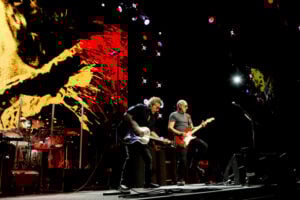
Feature Photo courtesy of Jay Schellen
Dating back to his days on the Sunset Strip with Hurricane, Jay Schellen has been a go-to sticksman for groups in need of a consummate pro who can fill any space within any genre.
It’s with this in mind that when Yes needed someone to fill Alan White’s shoes on and off, starting in 2016, and full-time beginning in 2023, Jay Schellen got the call. It was an obvious choice, as Schellen had worked with various members of Yes dating back to 1981.
What’s more, Schellen was a good friend of White, leading to a smooth transition. “Alan passed along so many great life lessons that I treasure to this day,” Schellen tells ClassicRockHistory.com.
He adds, “I think towards the execution of his parts, it was obviously fun between the two of us, in that he would often say, when I’d ask a particular technical question, ‘Aww, Jay, you’ve got it! You sound like me!’”
Yes has no plans to stop in 2026. Shows are booked across the globe, and a new album is on the horizon. It’s with this in mind that when fans clamor for a lineup closer to the original ‘70s core, Schellen isn’t bothered. “No, I don’t find it frustrating,” he insists. “I admire every one of the members in the classic Yes lineups.”
“Going forward,” he says. “This group is now the longest-standing lineup of Yes. The reason for that is we truly enjoy each other‘s company, respect each other’s talents and contributions, and we simply love performing the music together, getting out there on stage, and just having a great bash!”
What are your earliest memories of music in your life?
I grew up in a household where my father was a classical guitarist and a ragtime piano player. As young children, my brother, sister, and I would often go to sleep with him playing Segovia pieces in the living room, which I could hear through the bedroom wall, and ragtime piano pieces would often echo through the house, which was very influential.
What drew you to the drums?
The way I ended up getting into the drums was that I was taking classical piano lessons when I was very young, and in order to get to my teacher’s studio for my piano lesson, I had to walk through a drum shop. It was Nick Lucchetti‘s drum and guitar shop, and I was captivated by all the shiny objects and the beautiful drums everywhere.
Too many times, my teacher, Paul Mensch, had to come find me and take me into the studio for my lesson, and then, of course, wait for my mother to pick me up. I would start banging around on things, and Nick, an accomplished jazz drummer, took me under his wing, suggested to my mom that we go ahead and get a snare drum, and began teaching me.
I had several other teachers there, Harlan Goldberg and Kenny Battat, who added Funk, rock, and Latin styles to my repertoire, and that was the beginning of my getting into drums.
How did the scene you grew up in impact your outlook on life and as a musician?
I grew up in New Mexico, and the Albuquerque music scene at the time was very active with a lot of super-talented people. Ranging from all ages and musical styles, I found myself hanging out and jamming a lot with guys who were a bit older than me, and we would Freeform jam.
I really learned how to listen and express myself to support the themes and solos in the styles we would free-flow, very much like a jazz structure, but it would entail everything from jazz, fusion, pop, rock, to Latin. You know we would begin with The Allman Brothers and end with Al Di Meola.
We would choose all kinds of things and just play, play, play, and eventually, I had my own group, and funny enough. I named it Ritual after, of course, one of the sides of Tales of Topographic Oceans, so by that time I’d say I was about 15, 16, and I was firmly in the Yes world in my mind.
What led you to pursue a life in music, and what challenges did you face?
Growing up, I was quite athletic, involved in tennis, skiing, baseball, motocross, and many other sports, and I really enjoyed all of that, but Music just overrode everything after a while.
Soon, a group formed called Kick, and we started booking our own shows. We started becoming quite successful by my early high school years, and later, with the group Ritual, which I mentioned, we got a booking agency based out of Denver. We started touring all around the southwest, middle, and northern parts of the country, and there I crossed paths with my friend Randy Castillo and his band The Offenders.
We were friends, and we were both taught by Nick growing up in Albuquerque. Glenn, his guitarist, suggested I come to Los Angeles because he had a recording project he thought I’d be perfect for, and so, pretty much. I just packed up and headed out to Los Angeles in 1981.
From there, that very first opportunity I had was recording a record being produced by Tony Kaye, the original keyboardist of Yes and my dear friend for over 40 years at this point, and that was it: Sound City and Keith Olsen’s Studio Good Night LA were right there. I pretty much got to work after only being in town about three hours.
From there, Tony invited me, along with Tommy Evans, Joey Molland, and Glenn, into Badfinger, and it just kind of kept going from there. As far as challenges go, I would say I was very fortunate, and I never take that for granted, and it’s just been a wonderful succession of musical experiences and a great ride ever since.
How did you end up with Al Wilson, where you supported The Ohio Players?
That was an opportunity that came from our bass player in Ritual. He was a musical director in the Albuquerque scene, and he got a call from Al Wilson and put together a band, and so, pretty much, Ritual became the core band for him as the opening group for The Ohio Players.
One of my favorite drummers, Floyd Snead from Three Dog Night, was sitting in with The Ohio Players, so that was a real treat for me, and I got some good tips from him on Funking it up! Al Wilson was a fantastic performer and just an amazing singer, and that opportunity introduced me to performing for large audiences at Tingley Colosseum and other venues like that. “
You touched on this earlier, but in 1982, you were invited to join Badfinger. What happened there, and how did it work out?
As I mentioned earlier, Tony Kaye invited me to meet Tommy, Joey, and Glenn. Of course, I knew, and they invited me to join the group, and we got to work on a new record for radio records, and we went into the studio and began working on that, and we produced quite some good songs, and I believe at some point those will probably get released.
We actually opened the Central club on the Sunset Strip, and we had a really good time performing the songs. It was right at that time that Tony was asked to go to England and work with Trevor Rabin, Chris, and Alan on a new project, which was 90125 eventually.
I went off on the road with a group called Danny Johnson and the Bandits, which I love; that group has just so much style and energy. Danny is an amazing guitarist, and we were opening for ZZ Top on their Eliminator tour in the South, which was another great opportunity to play to large audiences.
As I was in the south and Tony was in the UK, I received a phone call from Tony, and he informed me that Tommy Evans had died, and it was very emotional for both of us. We had a lot of plans ahead, and another sad ending really to the story that revolves around Badfinger, a super talented band with just so much heartache and tragedy involved.
I have a lot of fond memories, and I learned a lot from Tommy as he was the bass player about the power in the pocket of a groove, and then that it doesn’t come from hitting hard, it really comes from the placement of your notes for dynamic power.”
You were with Hurricane from 1985 to 1991. Tell us about that band and why, despite some success, the band is perceived as underrated.
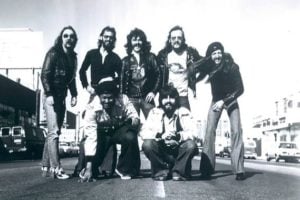
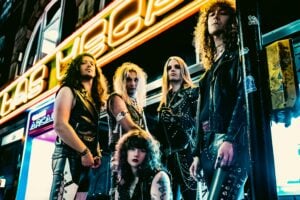
I was invited to meet the guys, Kelly Hansen, Tony Cavazo, and Robert Sarzo, who are forming a group, Hurricane, by Gary Ballen, who was working with Lita Ford as well as the manager of this new band, Hurricane.
I pulled up, and it was in that first rehearsal, we wrote three songs, and we cemented our friendship and the group, and we continued on for five years from there. I think the underrated part would be that we were supported by some independent record companies, Greenworld at first, and then Enigma Records.
The group itself was extremely dynamic and creative. We had the attention of some extraordinary producers and a singer, Kelly, who was one of the best then and now. He’s been the singer for Foreigner for 20 years, and we also eventually had Doug Aldridge replacing Robert Sarzo as our guitarist. Of course, he went on to play with Whitesnake and Ronnie Dio, a star in his own right.
We were one of the Sunset Strip bands that sold out consistently on Sunset Strip, Gazzari’s, the Roxy, the Whisky, and we went on to make many MTV videos, had a top-five summer single, and everything was looking up.
What led to the end of Hurricane? Did grunge put a major damper on the band?
We were scheduled to tour our Slave to the Thrill record with the band Extreme, and our record company collapsed, and the contract was following forward with Capitol, Enigma’s parent company. Just didn’t make sense, so we were somewhat left at the altar, I would say.
Tell us about what came next, leading to your joining Yes in 2016, in place of Alan White?
Well, after we left the Capitol agreement, Hurricane did make one more record for Frontiers Records. After that, a friend of mine, Bruce Gowdy, a great guitarist, asked me to come over and take a listen to a new band that he was putting together. It was called Unruly Child and featured Guy Allison on keyboards, Larry Antonino on bass, and Marcie Free on vocals.
This was a fantastic group of some of the greatest songwriting and talented players. I enjoyed every minute of working with these guys, and we’re still a group working together, writing and recording new music and videos for Frontiers Records and doing the occasional festival shows. Sadly, our beloved Marcie passed away last year.
Bruce introduced me to Billy Sherwood and thought we would get along famously. We ended up working on a record, continuing their band World Trade, and that sparked a friendship and a working relationship between Billy Sherwood and me that has lasted almost 40 years at this point.
In between all the sessions Billy and I were engaged in, I was also a member of and writing songs for the groups Circle of Silence and Heaven and Earth, and doing a lot of recording sessions around town. Billy, who was also working in recording and live, then went on to join Yes.
Chris and Billy had a very close and creative relationship, and they inspired me to form the band Conspiracy, which I joined on drums. We made several very cool records and a live in-studio video. That was my introduction to working with Chris, which was a highlight and gave me a lot of insight into the inner workings of the rhythm section of Yes.
But all along the way through Tony Kaye, involved of course previously with 90125, I got to know all the members of Yes, including Alan. At that point, I realized I had been working with individual members of Yes all the way back from ‘81 with Tony and Peter Banks.
And later, I worked in Las Vegas in a residency lasting seven years in an all-star production show called Raiding the Rock Vault with many of my good friends and super-talented colleagues, each an all-star and platinum record individual. Jon Anderson was a very special guest, joining us for several weeks; he was phenomenal.
In 2016. I got a phone call from Billy saying that Alan, and Yes, his manager would be giving me a ring. Shortly after, I received a phone call from Alan, and we were good friends by that time. He asked if I could sit in for him on the Tales for the Topographic Oceans and Drama tour due to his recent back surgery. Of course, I said an absolute “yes!” My goal from that day onward was to support Alan and the band in any way I could.
You became a “full-time” member of Yes in 2023, which was really a formality. What can you say about why you’ve been the right guy for the gig?
I think a lot of the above-mentioned… I’ve really got a great understanding. And of course, as a young drummer, I was influenced by Bill and hugely influenced by Alan all the way back to “Instant Karma” and “Imagine.”
And then, having opportunities to make music with and hang with the other members, I had an intimate and unique working knowledge of the inner workings of the group as well as strong ties through the Yes family tree with working previously with Peter Banks and Tony Kaye, so it seemed a very natural and comfortable fit.”
How big an influence was Alan on you, and what’s the toughest thing about executing his drum parts?
As I mentioned, I was hugely influenced by Alan White as a young listener. When Yes Songs came out, it blew me away to hear my already-favorite drummer, Alan, bring the power and drive to the group I loved. It was primal and spoke to me directly. He was my main influence beginning then.
I’ve had many other influences, but his influence is still the strongest. Getting to know him better and better as the years went by, with our partnership performing together with the band, I learned so much not only towards the music and drumming, but also much more. Those moments shared and memories of our times together are with me every show and every song we play.
Along the way, in 2005, you joined Geoff Downes in Asia.
I’ve made several very cool records and a live in-studio video. That was my introduction to working with Chris, which was a highlight and gave me a lot of insight into the inner workings of the rhythm section of Yes.
In 2005, I joined Geoff Downes in his supergroup Asia, along with John Payne and Guthrie Govan, for an amazing tour of the U.K./Europe with Uriah Heep and Dio. We had a blast; I loved performing those iconic songs.
But all along the way through Tony Kaye, involved of course previously with 90125, I got to know all the members of Yes, including Alan, and at that point I realized I had been working with individual members of Yes all the way back from ’81.
Where does your rig stand today? And why do those choices work perfectly for Yes?
My rig has always involved a lot of toms. starting on piano. I love the melody that I can create with a lot of toms, which also follows a similar setup to Alan’s choices. He was so creative with toms. I am a die-hard Drum Workshop man. I’ve been with them 35+ years, and Don, John, Garrison, and Chris are truly family to me.
From day one, we bonded over discussing engineering and invention. I really appreciate and admire John Good’s pursuit of perfection; I could hear and feel it the first time I played them. My setup includes a 22-inch kick drum, eight 10, 12, 14, 16, and 18-inch toms with a custom rack to support them.
I have been with the Zildjian company for 40+ years and consider them family as well. I literally grew up with them. I use Zildjian cymbals and drumsticks, Remo drumheads. And recently, over the last couple of years, I’ve added my old favorite Remo Roto Toms, which have proved to be a very nice addition for playing the entire fragile record, giving a very Bill Bruford tone.
Do you have any regrets, and what are you proudest of when you look back?
No regrets whatsoever. I’m grateful for every moment I mentioned, and more. This musical ride is more than I could have dreamt of as an 11-year-old. I am proud that I was wise enough to believe in myself and others I would meet along the way, and trust that my hard work to always be ready to give my best would keep me true and on course, following my dreams.
What’s next for Yes, and have you thought about what life will be like once the band plays its final show?
We have a tour booked for this year that will carry us to the UK, Europe, Japan, and finally the United States. We have a new record coming out this year that we’re very excited about. As for my thoughts on a final show: the music of YES, created in this configuration or another, will be eternal, I believe. All of us, fans included, are here to keep this music alive and going forward as long as our bones will carry us.
Check out similar articles on ClassicRockHistory.com Just click on any of the links below……
Read More: Artists’ Interviews Directory At ClassicRockHistory.com
Read More: Classic Rock Bands List And Directory
Read More: 100 Essential Albums From The 1960s That Everyone Should Own
An Interview With Jay Schellen Of Yes & Asia article published on ClassicRockHistory.com© 2026
Classicrockhistory.com claims ownership of all its original content and Intellectual property under United States Copyright laws and those of all other foreign countries. No one person, business, or organization is allowed to re-publish any of our original content anywhere on the web or in print without our permission. All photos used are either public domain Creative Commons photos or licensed officially from Shutterstock under license with ClassicRockHistory.com. All photo credits have been placed at the end of the article. Album Cover Photos are affiliate links and the property of Amazon and are stored on the Amazon server. Any theft of our content will be met with swift legal action against the infringing websites.