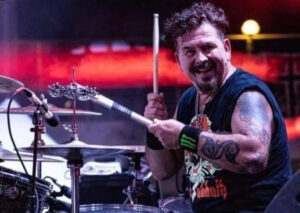
Feature Photo by Joe Schaeffer
As one of the hardest-hitting drummers in the business, Shawn Duncan has been at it since the halcyon ‘80s Sunset Strip era.
Along with mainstays Phil Lewis (vox), Tracii Guns (guitars), Ace Von Johnson (guitars), and Johnny Martin (bass), Duncan rounds out a cohesive L.A. Guns lineup that’s seen the rockers rise to the top of the glam-meets-heavy scene like it’s 1988 all over again.
Of course, Duncan was a perfect fit. In addition to being at the forefront of DW Drums launching into the stratosphere in the ‘80s, he’s previously been a member of cult favorites, Odin, and worked with Gilby Clarke, Rudy Sarzo, BulletBoys, and more.
For these reasons, when Duncan looks back, he’s nothing but appreciative. “Regrets are really just lessons if you pay attention,” Duncan tells ClassicRockHistory.com. Though he admits, “I wish I was more of a social butterfly because that is essential in this business. I guess we are always a work in progress.”
On the flipside, Duncan adds, “I am most proud of being a father and stepfather. Our children have grown to become good people, and for this I am very proud.”
What are your earliest memories of music in your life, and what led you to err toward rock and metal music?
Music has always been a part of my life. I honestly do not have a memory of it not being there. Our father was a songwriter/arranger/performer. One of my earliest memories was going to see a rehearsal for The Fifth Dimension with my father, who was working for their label at the time.
I also remember going to rehearsals for my father’s various projects and watching the musicians play and thinking, “Wow, that looks like fun.” We had a Volkswagen Camper, and my father had installed big speakers in the back. Anytime we would be driving anywhere, he always played music.
At family gatherings at Christmas, various members of the extended family would sing together. Music was always there. As I got older, I became very captivated by harder music, Led Zeppelin, Queen, Aerosmith, Van Halen, etc. From my earliest memories, I have always wanted to play drums.
When did the drums come into the picture, and who were your biggest influences?
When I would go to my father’s rehearsals, I would focus on the drummer. One of them gave me a pair of sticks, and those sticks forever changed my life. I would take my mother’s pots, pans, and Tupperware and beat on them to music. We were surrounded by instruments, but I only wanted to play drums.
I think my earliest influences were Danny Saraphine, Hal Blaine, and Motown drummers such as Uriel Jones, Richard Allen, and Benny Benjamin. We grew up listening to a lot of Chicago, the Temptations, the Spinners, the Four Tops, etc. So, these drummers are in my head, in my deepest ties to rhythm.
Then, as I got older and started to go on my own musical journey, hard rock entered the picture. Drummers such as John Bonham, Roger Taylor, Joey Kramer, Bill Ward, and Alex Van Halen were front and center for me. Over the years, there have been so many drummers that flipped a switch for me, and it really never ends.
When did you start to get a sense of the type of drummer you wanted to be, and what did that process look like for you?
I was practicing in my room one day, and my brother, Jeff Duncan, who is a rather accomplished guitarist in his own right, came into my room holding Long Live Rock and Roll by Rainbow. He said, “You have to hear this singer!” He then played a song called “Kill the King.”
Yes, I was blown away by Dio’s voice, but I looked at him and said, “Wow, that singer is great, but that drummer is amazing!” That was the moment I knew I wanted to be a drummer with that kind of power. Big drums, big sounds, loud crashes, present! Cozy Powell entered the room. [laughs]
What was your first professional-level kit, and what’s the story behind how you got it?
I had a used white marine pearl set of Ludwigs as my first drum set; they were definitely used, but sounded really good. I can’t really say they were “pro-level,” only because of their age and condition. The stamp inside said 1959. I still have the snare.
I would say, for pro-level, it was a Cherry-lacquered DW. They were a new company at the time. The band Odin was taking off, and I was introduced to Don Lombardi. They showed me a chain drive pedal, which I thought was cool, but it was a bit flimsy on the bottom. I told them I had this beefy Sonor pedal that I loved because it was so sturdy.
I have always been a heavy hitter, even on mom’s Tupperware. [laughs] So, Don asked me to bring it in. I had broken the footboard, as I said, “heavy hitter,” but the bottom of the pedal had a plate that held the metal braces down. This idea eventually turned into the Turbo series pedals, which are an industry standard today. I currently use the 9000 series myself.
They took an ad out with me, Tommy Lee, Frankie Banali, Carmine Appice, and Jeff Holland in it to promote it. All of us contributed in one way or another. I still have the ad framed. Anyhow, I ended up with a double bass, four toms, and one floor set, which I used to record the first Odin album and toured with.
DW was so new that I had them use Tama Titan mounts for the toms because they didn’t make mounting hardware yet, and they’d put whatever hardware you asked for on them.
Do you still have that DW kit?
No, unfortunately. I sold that kit years ago. There have been a few I sold in my lifetime, but that was my first professional-grade, brand-new drum set.
What did the scene look like around you coming up, and how did that impact you and your decision to become a professional musician?
As I said, I was always surrounded by music and musicians. I knew it was what I wanted to do. While in Jr. High School, I joined a band with my brother Jeff. This band eventually morphed into Odin, and then came the ‘80s and the Sunset Strip.
What was the L.A. scene like by the time you got out there, leading to Odin gaining a reputation as a hot young band?
Odin was a progression of bands that my brother and I had. We always had a band. The first band we played in together was called The Termites; the band’s progression eventually led to Odin. We were too young to go to a lot of clubs, but we could get into the Whisky, and while there one night, we saw Motley Crue.
They had a residency for a while, and we were blown away by the stage show. I was blown away by Tommy with his stick spinning and showmanship, as well as his playing; he hit hard like me! [laughs] Anyhow, we went to a few of those shows. Bands like Micky Rat, which became Ratt, and Dante Fox, which became Great White, opened for them. It was the beginning of the Sunset Strip Scene, and we were almost ready.
You shared bills with W.A.S.P. and rubbed elbows with a lot of notables with Odin. Tell us about that and the exposure it granted you.
Chris Holmes was an early supporter of Odin. He would come to our rehearsals, party with us, teach Jeff about “Tone,” and watch us develop. I love Chris. We started to gather a significant following by doing backyard parties, some hall gigs, and clubs.
We had just finished recording our EP Don’t Take No for an Answer. Chris had us as direct support for W.A.S.P. at The Troubadour for a weekend event called The Blood Drive. That show basically ushered us into the Sunset Strip with serious cred. We were headlining all the big clubs shortly after.
Tell us about the rise of Odin, leading to the band being included in The Decline of Western Civilization. Did you feel like you’d made it by then?
There was a meeting at IRS Records we were asked to attend. It was more of an interview, really. I remember Penelope Spheers and Ian Copeland being there along with a few other people. I must have went well because we ended up as a featured band in the film!
Weird thing about it is that when the movie was released, and we went to the premiere, the band was already broken up. Jeff was in Armored Saint, and Randy was working in Lostboys. I don’t think we ever felt like we “made it.”
Why do you think Odin never fully took off, and how do you look back on the band now?
We were really young and made dumb business decisions. We sort of imploded. But we had fun and made some great music. Odin has gained a bit of cult status, which I think is cool. The band also gave us a foundation to build careers out of. For that, I am thankful. We still play occasionally and are all friends. We are doing a memorial to a dear friend on March 23rd at The Troubadour, along with Leatherwolf, Slash, Gilby Clarke, and others.
Tell us about staying in demand and picking up gigs with Gilby Clarke, Rudy Sarzo, Dizzy Reed, and Frank Hannon.
Staying busy is work. But we all do it because we love playing. I let people know I am available, and then things may fly to me. Most of those guys I have played with at jams, benefits, and/or recorded with, etc. But I have toured with BulletBoys, Odin, and now L.A. Guns.
How did you hook up with L.A. Guns? Was there an audition?
I did a tour with Bulletboys, and we shared a bus with Gunzo, which was a project with Tracii Guns and Rudy Sarzo. Me and Tracii became friends and he liked the way I played. We remained in sporadic contact after that tour.
One day in April, he sent me a text which simply said, “Hey, what are you doing this summer?” I asked what he needed, and he said he would get right back to me. About a day later, I got a call from management stating a nine-week tour opening for Tom Keifer, money, etc., with a quick “Can you do it?” I said, “Yes,” and I have been in the band ever since.
This lineup of L.A. Guns has been remarkably stable. Why do you think that is?
Honestly, we all get along exceptionally well. There is a mutual respect for what everyone brings to the table, and our personalities seem to mesh well. We also have also surrounded ourselves with amazing people who tour with us and when you are on a bus for six to nine weeks at a time this is vital. Also, there is a level of professionalism and maturity that keeps us all from going crazy. It’s become a family.
What’s the best part of being in a band with Tracii Guns and Phil Lewis?
Tracii and Phil are wonderful people. I feel like I am working with them and not necessarily “for them.” They both bring it every night, and I am honored to share the stage with them. I also love that they are true-blue rock-and-roll MFRs! We don’t use tracks or any sort of “enhancements”; we are a real rock band that throws down hard and honest. That’s what they want, and that makes me happy.
You’ve toured with L.A. Guns for years now, but have not appeared on a studio record. Would you like to, and do you think that will change?
Tracii and producer Adam Hamilton have a long-standing working/writing relationship. They basically put the albums together, etc. Unfortunately for me, Adam is also a drummer, so the parts are already done.
When I joined, The Black Diamonds album had already been recorded, and Leopard Skin was put together while we were on the road. But you never know, maybe I will do some studio recording in the future. On the upside, there is a live album in the can that is all me, which you will hear about in the near future.
What’s the story behind the vintage red Ludwig kit you’ve got? Why don’t you use it live anymore?
I have a set of 1969 Red Sparkle Ludwigs. I have had this set for about 25 years or so. I purchased it used and absolutely love it. I used it on DC4 albums, and it was my primary kit for many years. I have decided to keep it at home and use it to practice and record with. I just don’t want to put it through the rigors of travel anymore. And I get to play it more, set up here in my practice room.
What’s your main live kit with L.A. Guns like now?
I have been using a set of Red Sparkle Ludwig Centennials live with Guns—also, a great set of drums. Big [John] Bonham sizes, the finish is a sparkle lacquer, so they look great on stage. All of my cymbals are Sabian. Heads are all Aquarian. Big and powerful drums. This set stays stored with our touring gear, and I can’t wait to get behind them again.
What’s next for you and L.A. Guns in 2026 and beyond?
We head out on tour in the States again in early May, and this goes until around the end of July. It’s a long one. There is a live album/DVD scheduled to come out this year. We head to Europe in late October and will be hitting England, Scotland, Germany, the Netherlands, Italy, France, and Spain. Beyond this has yet to be written. I am hoping for another album and more tours.

Check out similar articles on ClassicRockHistory.com Just click on any of the links below……
Read More: Tracii Guns of L.A. Guns: The ClassicRockHistory.com Interview
Read More: Artists’ Interviews Directory At ClassicRockHistory.com
Read More: Classic Rock Bands List And Directory
An Interview With Shawn Duncan Of L.A. Guns article published on ClassicRockHistory.com© 2026
Classicrockhistory.com claims ownership of all its original content and Intellectual property under United States Copyright laws and those of all other foreign countries. No one person, business, or organization is allowed to re-publish any of our original content anywhere on the web or in print without our permission. All photos used are either public domain Creative Commons photos or licensed officially from Shutterstock under license with ClassicRockHistory.com. All photo credits have been placed at the end of the article. Album Cover Photos are affiliate links and the property of Amazon and are stored on the Amazon server. Any theft of our content will be met with swift legal action against the infringing websites.