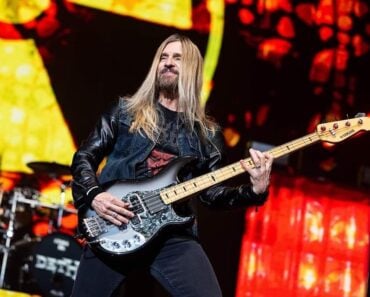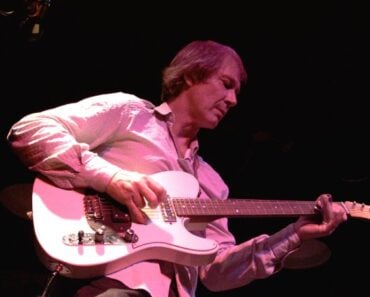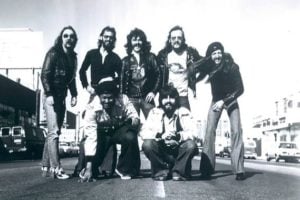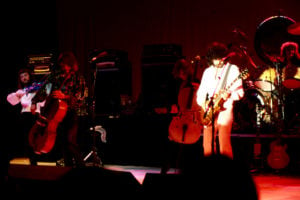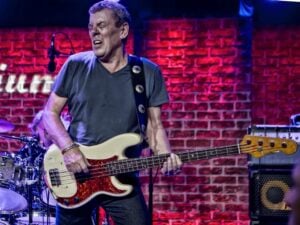
As a member of Rory Gallagher’s solo band, Irish-born bassist Gerry McAvoy lent his licks to classic albums, like 1971’s Deuce, 1973’s Tattoo, 1976’s Calling Card, and more.
If you’ve heard hard-hitting blues-rocking songs like “Bad Penny” and “Shadowplay,” then you’ve heard what McAvoy brought to the party. Those songs sound free-flowing, which, according to McAvoy, is just how it was. “The sound I made within the band came naturally,” he tells ClassicRockHistory.com.
Things got choppy in the late ‘70s and ‘80s when Gallagher’s drinking became a problem, but that’s not why McAvoy left Gallagher’s band. “I had always written songs, from as far back as Deep Joy,” McAvoy says. I just felt it was time to move on.”
McAvoy did just that. He joined Nine Point Zero, leaving in 2011. Since then, he’s played solo and with his current outfit, Band of Friends. Though he still makes time to celebrate Gallagher’s music, as he did last summer beside Joe Bonamassa in Cork during the summer of 2025.
“It was a fantastic three nights at the Marquee in Cork, attracting 15,000 people,” McAvoy says. “Rory lives on in our hearts.”
Given this, it goes without saying that McAvoy cherishes the time spent with Gallagher. “No regrets,” he insists. “I would not change what I’ve done for anything. To have stood on stage next to the brilliant Rory Gallagher for 20 years was epic.”
What are your earliest memories of music in your life?
The earliest memories of music in my life were of my father, who would wake me up on Christmas morning, playing jingle bells on his harmonica. He was an accomplished player. Also, family get-togethers, where the harmonica would come out, and my grandfather played the mandolin; he was actually in a travelling minstrel band during the 1930,s. My mother would hold it all
When did the bass guitar come into the picture, and when did you decide what sort of player you wanted to be?
I started playing guitar when I was around 14. I was asked to join a band by my old school friend Brendan O’Neill. We named the band Pride, later morphing into Deep Joy. Our bass player at that time was a trainee butcher. We would rehearse after school.
Don, our bass player, would come to rehearsals directly from his butcher training ground. His fingers were covered in cuts and bandages. To state the obvious, Don left the band pretty quickly. [laughs] So, I was nominated as the band’s bass player.
How did you make the jump from amateur to professional musician?
After the band was renamed Deep Joy, we were playing quite regularly around Ireland. This was difficult because, at the same time, I was working as a trainee solicitor. So late nights and early mornings were becoming a bind. So, with the rest of the band members, we decided to try to go professional, much to the disappointment of my father.
What gear were you working with early on, and what inspired those choices?
When I was playing guitar in Pride, I was using a Hofner Club 60 guitar, plugged into a Vox AC30, with a range master treble booster. Thank you, Rory! When I switched to bass, my mother purchased a 1963 Fender Precision on HP, obviously. Thanks, Mum. For amplification, I had a Vox Foundation bass amp, AC50, and a 1×18 cab.
How did you first meet Rory Gallagher? Was the chemistry immediate?
I first met Rory before I got into a band. Rory had come to Northern Ireland with his band Taste. They lived outside Belfast in a seaside town called Ballyholme. The band would play the clubs and halls in and around Belfast. I would often see Rory and the band in these clubs. I was a fan.
At that time in Belfast, the best music store was Crymbals Furniture and Music Store. Saturday mornings would see myself and other budding musos go to the store to try out the instruments, if you were allowed. One Saturday morning, I was about to enter the store when, through the window, I saw Rory sitting on a stool trying out an acoustic guitar.
I plucked up the courage and said, “Hello.” Rory was such a gentleman. I told him I was trying to get into a band. He told me to rehearse and play with as many musicians as you can. That advice has stood by me to this day. Thanks again, Rory.
What was your typical rig like with Rory?
After I joined Rory, my first rig was a 100-watt Stramp head and two 4×12 cabinets. They were German-made and very sturdy gear. In later years, I progressed to an Ampeg SVT with an 8×10 cab—still my favorite.
What was it like working on classic songs, like “Bad Penny,” “Shadowplay,” and “Shinkicker?” How big a role did you play in the creation of the music?
Playing those classic Rory tracks in the studio was just fantastic. Rory was the songwriter. He would bring the songs to the rehearsals and just start playing them. We, myself and the rest of the band would join in. I played guitar so I could follow Rory’s chords quite easily. Rory would always let his musicians add their own texture to the song.
When did Rory’s drinking begin to get out of control, and how did that impact the band as you moved into the ‘80s?
Rory developed a fear of flying around the late ‘70s. He would have the odd drink before we flew. He was also on medication, which was a disastrous combination. It wasn’t so much the drinking getting out of control, it was the combination of the two which didn’t help.
Was the band comfortable within the ‘80s music scene, given that sounds were changing?
The ‘80s were a very strange time musically. The music we loved was getting sidelined for electronic music. It wasn’t a good time… but we kept on working.
You left Rory’s band in 1991. Did you end on good terms?
The last tour I played with Rory was in the USA; we played our last show on Easter Saturday in 1991 at the Marquee in New York City. There were so many people trying to get into the show that night that the NYFD had to cordon off the street. An amazing night. Rory was not drinking at this period. He was in great form.
Did you keep in touch with Rory before his death, and do you remember the last time you two spoke?
I would speak to Rory on different occasions—mostly birthdays and Christmas. The last time we spoke would have been Christmas ‘93. After Rory, Brendan O’Neill, and I joined Nine Below Zero. We toured through the ‘90s and 2000s. I left the band in 2011.
What are you up to now?
At the moment, I’m touring with my band, Band of Friends. I’m also doing some guest spots with different musicians. Thank you, Rory, for that advice back in 1968. Last summer, I was invited to play with Joe Bonamassa in Cork; it was a celebration of Rory’s music.
Check out similar articles on ClassicRockHistory.com Just click on any of the links below……
Read More: Artists’ Interviews Directory At ClassicRockHistory.com
Read More: Classic Rock Bands List And Directory
Read More: 100 Essential Albums From The 1960s That Everyone Should Own
An Interview With Gerry McAvoy Of The Rory Gallagher Band article published on ClassicRockHistory.com© 2026
Classicrockhistory.com claims ownership of all its original content and Intellectual property under United States Copyright laws and those of all other foreign countries. No one person, business, or organization is allowed to republish any of our original content anywhere on the web or in print without our permission. All photos used are either public domain Creative Commons photos or licensed officially from Shutterstock under license with ClassicRockHistory.com. All photo credits have been placed at the end of the article. Album Cover Photos are affiliate links and the property of Amazon and are stored on the Amazon server. Any theft of our content will be met with swift legal action against the infringing websites.