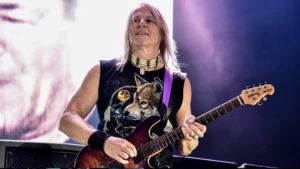
Feature Photo by Tim Mosenfelder
Steve Morse’s resume, which includes long stints with The Dixie Dregs, Kansas, Deep Purple, and with his solo group, The Steve Morse Band, says it all.
But you still can’t figure out what he’s putting down; just look at the veteran guitarist’s retrospective feelings toward the guitar. “I knew, even as a kid, that I could make a living,” Morse tells ClassicRockHistory.com. “I also knew that it would be hard… I loved it.”
When it comes to the music biz, “hard” doesn’t begin to describe it. Really, no matter how you slice it, it’s a life that’s hard to describe unless you’re in it. But Morse, a player of humble origins and in possession of massive talent, made the most of the changes he had.
This is why, despite fans giving him a hard time, he succeeded in situations—like joining Deep Purple in place of Ritchie Blackmore—where others might fail. “I knew going in that it’s hard to replace somebody that is a cornerstone of a band’s history,” Morse says. “But it went as well as I could have hoped.”
It went more than well. Morse stuck with Purple longer than any other guitarist had previously, and most likely, ever will. Sadly, due to personal issues, things didn’t end well, but it is what it is. Morse is on to a new chapter now, creating music solo and with his son.
As for what keeps Morse coming back for more, despite the music business being unsavory as it is, he shrugs, saying, “I’ve always realized that the people in the audience paid for the food in my refrigerator.”
Adding, “I would like them to understand that I know there wouldn’t have been a music business for me if they didn’t show up and encourage me to get back onstage after my occasional disillusionments with the business.”
What inspired you to pick up the guitar, and when did you decide what sort of player you wanted to be?
I loved the versatility of the guitar. As a 10-year-old kid, I saw a guy running a local carnival ride sitting in a chair, playing a song fingerstyle on his acoustic, and then easing down the ride at the end of the song. It felt complete and very musical to a kid like me.
Then, The Beatles, Chuck Berry, playing basic R&R on electrics, made me want to learn. I started on a rented acoustic for many months, and it took me a long time to get into electric playing. I decided that I would be a player of different styles and knew that I couldn’t be popular because the music I would be writing would probably not be fashionable.
How did the scene you grew up in impact you as a player and songwriter?
In Michigan, we had a neighborhood band, and there were lots of opportunities to play for an audience. Something I really mourn for the young players today is missing the opportunity to perform live, without phones recording, without second chances, just learning to adapt and roll with it. The scene was like many places in the world in the ‘60s: exploding with sounds, ideas, different-sounding groups, concerts everywhere, and music lovers enjoying it all.
Tell us about the early days of The Dixie Dregs and the development of your style?
I really got a big start on playing more advanced when I went to music school at U of Miami. Stan Samole helped me quickly learn modes, scales, and guitarcraft as a teacher at the school. I finally requested my own ensemble to write for.
They gave us some rehearsal slots in the big rehearsal room (to the horror of the jazz traditionalists at the school), and I wrote out charts, learning what worked and what didn’t. Previously, Andy West and I had a version of the Dregs in Augusta, Ga., which was a trio, then a four-piece.
In my school ensemble, we had as many as six players, but the biggest change was getting Allen Sloan on violin and Rod Morgenstein on drums. We were able to play free concerts outside, and I watched what people responded to and what turned them off.
As a result, we ended up with more concise arrangements, with limits on the solo time, and I concentrated on writing melodic parts as much as possible.
When do you feel like people started to take you seriously as a player, and was it hard for you to avoid comparing yourself to others when you were young?
As a young player, I definitely wasn’t ready for the big show, as I played too much, and mostly with older players who could get annoyed at my exuberance. I don’t think anybody took me seriously until I was writing the Dregs music, and we got some fans.
Even then, the first time I heard my music on the radio, it was in the background of a commercial for a porn movie in L.A. So, even though I couldn’t take myself seriously, but my writing was my focus, always.
What led to your joining Kansas, a gig that seemed very different from what you were known for?
I was always a Kansas fan. I felt a kinship with Kerry Livgren, with him also being a pilot, having a small farm like me, and writing prog-type music at the same time as the Dregs were going full steam. I saw Phil Eheart at a concert we were both watching, and he informed me that the band was getting back together with Steve Walsh.
Big news for me, as a fan, since he had left right in the middle of their biggest album tour at the peak of their career. He asked if I had any song ideas, and that Kerry wouldn’t be joining them. I was disappointed in Kerry being absent, but he did come to the rehearsal/writing session with the guys, and we hit it off well, coming up with a solid tune.
Then, we scheduled another, another, and pretty soon there was an album’s worth. Then a tour, then another album, but this time with much more pressure to come up with hit tunes, while I was stuck on the idea of doing orchestral, big Kansas-instrumental stuff.
How do you look back on Kansas’ ‘80s era, a period that’s a bit decisive amongst ‘70s fans?
This was where I didn’t fit in, the ‘80s MTV/VH1 machine. I learned a lot and discovered that I wasn’t cut out for certain things that were changing in the music business. I became disillusioned and ended up distancing myself from the music business after that… for a while.
How did being in Kansas prepare you for being in Deep Purple, and what led you to join?
Steve Walsh taught me a lot about what a vocalist wants to hear and depends on, as well as giving me some hints and encouragement to be a better performer. It didn’t change me much, but I still loved playing all the Kansas music.
Joining Purple was because Roger Glover saw my trio (SMB) in Orlando while they were recording something there, and he later recommended that band to try me. Both myself and the band had no idea what to expect, so we agreed to play four shows only, then decide. Well, it went great, and we were all smiling after the first hour of us plugging in for the first time.
Was it hard coming in after Ritchie Blackmore, a player with a very idiosyncratic style and cult following?
Sure, but the band (at the time) wanted somebody who had their own voice, contributed writing, and they knew it would be different than Ritchie. Ritchie had made a huge body of great guitar riffs and songs, so that was fun to play.
The tough part for the audience was watching me play Ritchie’s material, and obviously not sounding the same, but most of them realized that I had great respect for what he had done, and they begrudgingly stopped throwing things at me!
Would you say you won Deep Purple fans over in a way that you weren’t able to win Kansas fans over?
No, with Purple, I just had enough years for the real haters to get tired of buying tickets to heckle me. Seriously, the fans just loved the band and were generous with me, once again, knowing that I had so much fun onstage with the band. I never felt much outright hate with the Kansas fans, and my leaving had to do with the changes in the music business and my inability to adapt.
Considering how long you were with Deep Purple, did the way things ended bother you?
There’s nothing good about me not finishing my touring with the band, or the way it ended, but I have to be proud of the musical victories and the many years of being able to play rock and roll with them.
Has it been freeing focusing on your solo work after being associated with legacy bands for so long?
I did continue to work on my music all the while I was in both bands, but it had to be fit into a busy schedule. So, yes, in that sense. I always felt free to express myself musically, with my own music. Recently, we finally did a very satisfying SMB album, which was overdue!
What’s the latest on your rig and gear?
My ENGL 20-watt head is small enough to fit inside my suitcase, with clothes and whatnot, and still make weight! I have an Airstep controller (Midi pedal) with a CV pedal input programmed to allow me to control the built-in delay and reverb with little CV pedals.
This allows me to play a gig with no pedalboard and put everything in my suitcase easily! When I use my 100-watt ENGL heads on tours, I’ve been using a WetterBox, which essentially allows me to also use a CV pedal to control anything going into the FX loop.
This is because my normal wet/dry setup has sounded badly in some cases when the soundman has the wrong side up. This way, I can have a moderate amount of effect fade in to the main sound, while still adding the wet amp for certain moments.
Do you have any regrets? On the flipside, what are you most proud of?
Regrets? I thought this was supposed to be a short interview. How many pages can I fill up with that? [laughs] Sure, I have regrets, but I had the free will, and I also can’t change the past. I am most proud of my son surviving my divorces, my being gone, and us still having a great relationship, and now, some very satisfying musical work together.
What’s next for you in all lanes?
More teaching stuff, sharing what I’ve learned and observed. And finally, working with Kevin, my son, on a number of creative projects.
Check out similar articles on ClassicRockHistory.com Just click on any of the links below……
Read More: Artists’ Interviews Directory At ClassicRockHistory.com
Read More: Classic Rock Bands List And Directory
Read More: 100 Essential Albums From The 1960s That Everyone Should Own
An Interview With Steve Morse, Formerly Of Deep Purple, Kansas & The Dixie Dregs article published on ClassicRockHistory.com© 2026
Classicrockhistory.com claims ownership of all its original content and Intellectual property under United States Copyright laws and those of all other foreign countries. No one person, business, or organization is allowed to republish any of our original content anywhere on the web or in print without our permission. All photos used are either public domain Creative Commons photos or licensed officially from Shutterstock under license with ClassicRockHistory.com. All photo credits have been placed at the end of the article. Album Cover Photos are affiliate links and the property of Amazon and are stored on the Amazon server. Any theft of our content will be met with swift legal action against the infringing websites.