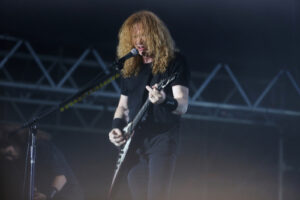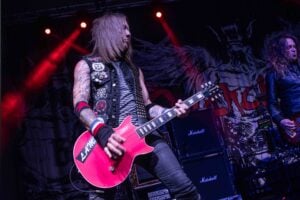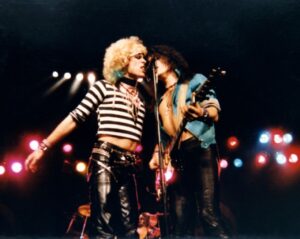
Feature Photo courtesy of Mach Bell. Not to be used without explicit consent.
Best known as the frontman of the Joe Perry Project, Mach Bell’s got his start with Thundertrain, who came up amongst a hard-hitting ‘70s Boston rock scene.
With Thundertrain, Bell dazzled audiences at The Rat, toured with The Dead Boys, and recorded a cult favorite record, Teenage Suicide, before the wheels came off in 1979. After that, Bell was working 9-to-5, before a call from none other than Joe Perry’s management changed everything.
With Perry, Bell’s task was to carry eight of the Aerosmith catalog, along with Perry’s first two Joe Perry Project releases. He took on the challenge, recording 1983’s Once a Rocker, Always a Rocker, an album that didn’t hit it big, but remains beloved.
This arrangement might have carried on if not for Aerosmith’s sudden reunion in 1984, leading to Bell becoming disillusioned and leaving the music biz altogether. Since then, Bell has lain low, though he still plays shows now again—and of course, has written three books about his career.
It’s with that in mind that Bell settled in with ClassicRockHistory.com to dig into Thundertrain, Joe Perry Project, and more.
What are your earliest memories of music in your life?
When I was two or three, we had a black and white TV set, and pianist Liberace did a weekday 15-minute-long show. I used to pull my toy piano up close to the TV. I set a little candlestick up on the lid. I played my dinky piano alongside Liberace and his grand piano, with the big silver candelabra on top.
One of your earliest bands was The Mechanical Onions, which was later renamed the Cynics. What are the origins there?
In ’67, I was digging The Electric Prunes, and I needed a name for my far-out new group. I thought, “electric/mechanical, prunes/onions… Mechanical Onions. Yeah, man. [laughs]}
From there, how did Thundertrain form? I read somewhere that you said, “Bands like Thundertrain aren’t made, they’re born.”
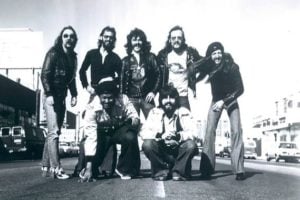
Thundertrain roared to life in Summer’74. Constructed from the remains of Biggy Ratt, which was Bobby Edwards and me, and the Provost brothers’ Doc Savage. We found lead guitarist, Steven Silva, down in New Bedford.
Rock bands on our local Boston-area scene at the time included Daddy Warbux with Ralph Morman and Punky Meadows, The Sidewinders with Billy Squier, Andy Paley, Modern Lovers with David Robinson, Jonathan Richmond, Reddy Teddy, James Montgomery Band, and Johanna Wild with Jon Butcher.
We all had our own band houses and big trucks to haul our lighting and sound gear around because there were lots of gigs for full-time rock bands like Thundertrain back in the early ‘70s, after the drinking age fell to 18.
There’s a Van Halen connection when it comes to Thundertrain. You opened for them in the late 70s, right? Did they borrow the title for the 1984 track of the same name?
“Hot For Teacher” was the big Thundertrain single in 1976. WBCN and WCOZ were both playing it here in Boston, making it a local hit. “Hot For Teacher” did well in Great Britain, too; we charted in the Top 10.
Eventually, “Hot for Teacher” came to the attention of this other band, Van Halen, and in 1978, Thundertrain was scheduled to open for this new L.A. sensation. So, we drove from Boston to the Agora Ballroom in Cleveland to open the show.
But headliner Van Halen never turned up. Roadmaster filled in for them. Thundertrain guitarist Steven Silva wrote “Hot for Teacher and his song sounds nothing like the song of the same name recorded by Van Halen many, many years later.
Thundertrain became a staple at The Rat Club. What was that scene like back then?
Thundertrain started as a heavy glam band, with glitter and platform shoes. I was taking cues from Silverhead and Slade, but our lead guitarist, Steven, injected pure Johnny Winter rock’n’roll into our frantic sound.
I was forever getting combative and mouthy with suburban club audiences, which gave Thundertrain a “bad guy band” rep. It was the summer of ’76 when Thundertrain began hitting the Rat in Kenmore Square while Hot For Teacher was taking off.
We already had two years of rock’n’roll stage experience and plenty of buzz. Little did we know, punk rock was about to hit the Boston rock scene hard.
Still, Thundertrain’s Teenage Suicide remains a cult classic.
Thundertrain was getting write-ups in Billboard, Rock Scene, Playboy, 16, Time, and the Boston Groupie News. So, Jelly Records, the local label we were signed to, encouraged Thundertrain to rush-release an album of original songs to capitalize on the growing—and free—publicity we were getting.
In very late 1976, we recorded Teenage Suicide live in the studio, straight to tape. It only took a couple of hours. They just mic’d us up, and we performed our show. No overdubs. The only multi-tracked tunes on the whole LP are “Hot for Teacher” and the flip, “Love the Way (You Love Me)” from the original ’76 single.
In 1977, Thundertrain did a particularly memorable 12-show run in New England and NYC with The Dead Boys. What was that like?
I’ve played on shows with lots of musicians: Gregg Allman, Ric Ocasek, Huey Lewis, Joan Jett, Robin Zander, Joey Ramone, Steven Tyler… but Stiv Bators and I really got on well together. I learned plenty from talking business with Stiv and watching him work. After Dead Boys and Thundertrain broke up, we both tried to stay in touch while he was out singing with the Lords of the New Church and I was out touring with Joe Perry Project.
Why did Thundertrain break up?
In April 1979, they began kicking the 18-year-olds and underage girls out of the rock clubs, and they raised the drinking age. Thundertrain lost a huge chunk of our regular audience overnight. It quickly became difficult to maintain our Thundertrain lifestyle. Road crew, truck, rehearsal space, all the gear, girls…
Is that when you hitchhiked out to L.A.?
Yeah, I hitchhike a lot. In fact, I wrote a book about it… check out I Gotta Rock on Panther Rock Books. So, when Thundertrain began in ‘74, I had just thumbed out to Hollywood to become a rock star. After Thundertrain ended, at the end of ’79, drummer Bobby Edwards and I decided to head out west. Before we got to L.A., we both joined Circus Vargas in Phoenix.
Was Thundertrain back on your radar after you came back to the East Coast?
Thundertrain is always on my radar, Andrew! [laughs] After my stint leading Llamas and chasing “escaped” dogs around the Circus Vargas big top, Bobby and I returned to Boston to start the power-trio Mag 4 along with Thundertrain bassist, Ric Provost.
But you were still working a 9-to-5 until you got a call from Joe Perry…
Yeah, my grandfather and my father owned a high-end audio shop in Wellesley. I was singing with Mag 4 at night and working in the Music Box service lab by day, replacing broken phono needles in kiddie record-players. That’s when I got the call to join Joe Perry. It was his management office that asked me to audition for the Joe Perry Project.
What was the audition like?
Brad Whitford was there; he had just joined. Founding Joe Perry Project member Ron Stewart was on drums, and newest member Danny Hargrove had just been added on bass and vocals the day before my audition.
The office gave me half a dozen Joe Perry Project songs to learn, plus “Same Old Song and Dance.” We ripped through my homework songs and then continued to jamming on “Going Down” and maybe the Yardbirds “Ain’t Got You.”
Once the smoke cleared, I left the rehearsal room quickly because everything was going so great, and I didn’t want to blow it! I don’t think they auditioned any other singers.
Was it tough to join a band that had two albums under its belt, plus a cache of classic Aerosmith songs to cover?
That was very hard for me. The first Joe Perry Project singer, Ralph Morman, is vocally untouchable, and I longed to be able to sing blues in the early Rod Stewart-style that Ralph excels at on songs like “Let the Music Do the Talking.”
Charlie Farren, the next Joe Perry Project singer, is another phenomenal talent, a wonderful guy, full of musicality, and beloved by fans all over New England. Don’t forget Joe always kept some Aerosmith songs in his setlist. So now, I gotta sing all this acrobatic Tyler stuff, too. [laughs]
I have no cover band experience, and I don’t know how to mimic other voices. I’m just an original proto-punk wailer, a pagan with a bad attitude. Coming off five years grinding with Thundertrain, non-stop at the Rat, CBGBs, and Max’s Kansas City on all-night bills with a tough crowd (Mink DeVille, Suicide, The Fast, Alex Chilton, Fleshtones, and the Dead Boys).
So, I immediately started writing new Joe Perry Project songs from day one with Joe. And that was mainly because I wasn’t sure how to vocally approach the stuff he’d already recorded with all those other singers.
Once a Rocker, Always a Rocker came from that…
It’d take me a book to walk you through the creation of the LP. [laughs] In fact, I did write that book: Once Rocker Always a Rocker: A Diary on Panther Rock Books. Our manager, Tim Collins, finally found Joe a deal with MCA Records.
And the band, now with Joe Pet on drums, quickly got to work cutting a whopper of an album at Blue Jay Studios in Carlisle, MA. Joe Perry directed production with lotsa studio help from pianist Harry King. It took a month for us to make the record during the record-breaking heatwave of Summer ’83.
What was it like working with Joe, who some say was not in good shape at the time?
Firstly, in Joe’s defense, I sang 226 concerts with the Joe Perry Project all over the USA, South America, and Canada, and there was only one date (05/17/1982, Jacksonville, NC) where Admiral Perry was unable to complete a performance we had started.
Joe made it to every show, and he was standing tall at every recording session, directing us. Joe stayed up late in the recording studio, experimenting and mixing, long after I would split for the night. Songwise, generally Joe wrote the main riffs, and I did the lyrics. Joe and I collaborated on song titles and melodies. The whole band arranged the tunes, on the road mostly.
Given Joe’s issues at the time, did he lean on his bandmates?
I joined the Joe Perry Project in February 1982, and those first few months were pretty hard. Fortunately, we had Brad Whitford in the line-up through most of that wobbly stretch. Admiral Perry immediately started looking and sounding a whole lot better after he split with Elyssa Perry during late Spring, 1982.
While Once a Rocker, Always a Rocker didn’t sell well, it’s looked back on fondly.
I’ve been told the Once a Rocker, Always a Rocker would be the biggest-selling JPP album if MCA had given it half the distribution, press, and push that CBS Records gave the Project debut.
So, why didn’t they?
Why? Because the rock music biz had changed a lot since 1979. After Danny and I joined the Project, MTV emerged as a terrific sales force. My music lawyer friend said, “’Women in Chains,’ and ‘King of the Kings’ should have had professionally produced music vids to give ‘Thriller’ some real sales competition!”
Not sure about all that, but the Once a Rocker album dropped in Sept 1983, and in only two months, it had sold over 40 thousand copies to faithful Joe Perry fans. This was with spotty distribution and virtually no promotion from the record label.
But it didn’t end there. In 1993, during the chart resurgence of Aerosmith, MCA re-released Once a Rocker for the first time on CD. More sales. That led Columbia House record club to feature the decade-old Once a Rocker album in their club catalogs all over again. More sales.
In 2008, Japan released a special 25th Anniversary Once a Rocker CD package. More sales. Once a Rocker continues to be pressed and sold in 16 countries, including Russia. The last time I saw Tim Collins, he guessed that Once a Rocker had finally sold enough worldwide for at least Gold status.
You mentioned Brad, who was important to the band at the time. What was he like back then?
Loved jamming with Brad. Loved talking with Brad. I first saw Aerosmith playing at local dances up the street from my town back in 1971. That was before Brad had joined the Aerosmith line-up. I remember the night I showed up at Hopedale Town Hall, the very first time I saw and heard Whitford and Perry rock together. It cost two dollars to get inside, and I knew they would make history.
Was the Aerosmith reunion inevitable, or was it a shock?
Joe doesn’t talk much. He certainly never had good things to say about Aerosmith or Steven, and he seemed consumed with his own band. So yes, it was a total shock to me. Joe’s manager, Tim Collins, broke the news to us that Joe was quitting his own band. My mind was blown. I’m still trying to recover from the Joe Perry Project.
As you mentioned, you penned a book called Once a Rocker, Always a Rocker. After so many years away, what led you to that?
I keep diaries. My diaries of my Joe Perry Project years sat in a box for years. Rocker/interviewer, Michael Butler, invited me on his podcast in early 2019, and after hearing some of my diary entries, his Rock and Roll Geek Show listeners encouraged me to publish them as a book.
Given the success of your books, are you at all tempted to record new music? What’s next?
My third memoir, Rock Survival on Panther Rock Books, is available at all online booksellers with more Joe Perry Project and Thundertrain stories. There’s also how I met Frank Sinatra, my L.A. motorcycle crash, my date with Jennifer Connelly, my 2023 induction into the New England Music Hall of Fame, and lots more.
I still play rock dates. I’ve got a band, MBE, that plays my Project and Thundertrain material, but we are currently on hiatus. Right now, I’m starring in rehearsals for a sci-fi rock opera called Beasties. Check out my website oncearocker.com.
Check out similar articles on ClassicRockHistory.com Just click on any of the links below……
Read More: Artists’ Interviews Directory At ClassicRockHistory.com
Read More: Classic Rock Bands List And Directory
Read More: 100 Essential Albums From The 1960s That Everyone Should Own
An Interview With Mach Bell, Formerly Of The Joe Perry Project & Thundertrain article published on ClassicRockHistory.com© 2026
Classicrockhistory.com claims ownership of all its original content and Intellectual property under United States Copyright laws and those of all other foreign countries. No one person, business, or organization is allowed to republish any of our original content anywhere on the web or in print without our permission. All photos used are either public domain Creative Commons photos or licensed officially from Shutterstock under license with ClassicRockHistory.com. All photo credits have been placed at the end of the article. Album Cover Photos are affiliate links and the property of Amazon and are stored on the Amazon server. Any theft of our content will be met with swift legal action against the infringing websites.