

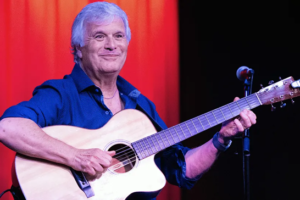
Photo: By Phil Guest from Bournemouth, UK (Standing ovation) [CC BY-SA 2.0 (https://creativecommons.org/licenses/by-sa/2.0)], via Wikimedia Commons
The follow-up album, Moving Waves, arrived in 1971. By then, Dresden and Cleuver had departed, with Cyril Havermans taking over on bass and Pierre van der Linden on drums. The album featured the classic single “Hocus Pocus,” which introduced audiences far beyond the Netherlands to the band’s unusual combination of rock, jazz, and classical music.
Like so many progressive rock bands, Focus released a steady stream of records throughout the 1970s. The changing musical landscape at the end of the decade seemed to influence progressive rock’s fortunes. The success of bands like The Ramones, Blondie, and The Sex Pistols turned much of the public’s attention away from progressive rock and toward punk and new wave.
Many progressive rock groups broke up in the late 1970s before returning in later decades, and Focus followed its own path through changes and reunions. The band returned to recording in the 2000s and continued releasing new music long afterward, including Focus 11 in 2018 and Focus 12 in 2024. These ten tracks reflect both the band’s early breakthroughs and the musicianship it carried into later years.
# 10 – Tommy
We open our top 10 Focus songs list with the great guitar-driven track “Tommy.” It appeared on the band’s second album, Moving Waves, released in 1971. Just when you thought Rush had come up with the idea for a great album title, here was Focus with Moving Waves a decade before Rush released Moving Pictures.
“Tommy” is actually a section of the sprawling “Eruption” suite, which occupies the second side of Moving Waves. Credited to Tom Barlage of the Dutch band Solution, the section gives Jan Akkerman room to deliver the kind of expressive guitar playing that made Focus such an exciting progressive rock group.
# 9 – Bennie Helder
“Bennie Helder” appears as the third track on Mother Focus, with a sound that feels surprisingly modern for 1975. It blends the warmth of the band’s 1970s instrumentation with a forward-looking sense of rhythm and tone. The wah-wah guitar immediately catches the ear, creating a fluid, almost conversational texture that helps establish the song’s character.
Written by Thijs van Leer, the track features van Leer on keyboards, Jan Akkerman on guitar, Bert Ruiter on bass, and David Kemper on drums. Mother Focus was credited as produced by the band. The composition leans toward jazz fusion without completely abandoning the progressive rock identity that defined Focus’s earlier recordings.
Each instrument finds space within the mix, with Akkerman’s guitar phrasing complementing van Leer’s subtle electric-piano touches. “Bennie Helder” stands as a statement of transition and confidence, revealing a band willing to experiment with groove and atmosphere while maintaining the musicianship that had always set it apart.
# 8 – Brother
“Brother” begins with a tender, reflective piano passage that establishes a mood of melancholy and restraint. Its phrasing recalls the early ballad work of Elton John. As the piece unfolds, that gentle introduction gives way to a more expansive arrangement and a vocal performance by P. J. Proby, whose soulful tone brings to mind Leon Russell and American rhythm and blues.
The track was recorded in 1977 for Focus con Proby, released in 1978 and produced by Yde de Jong. Thijs van Leer plays keyboards, Bert Ruiter handles bass, and Steve Smith plays drums. Guitarists Eef Albers and Philip Catherine both contributed to the album, with Proby supplying the lead vocal on “Brother.”
The song stands as one of the most emotionally resonant moments on the record, contrasting with the instrumental compositions that dominate much of Focus’s catalog. Its slow piano introduction, shifting dynamics, and vocal depth illustrate the band’s willingness to explore new territory late in the 1970s while retaining its melodic sophistication.
# 7 – Focus 10
The opening moments of “Focus 10” deliver an immediate burst of precision and grace, with Menno Gootjes’s guitar tone setting the piece in motion. His phrasing has a fluidity that borders on the lyrical, with smoothness and tonal control reminiscent of Allan Holdsworth. The guitar leads throughout, weaving through shifting rhythmic patterns with a wonderful sense of melodic exploration.
The track was recorded in 2012 at Wedgeview Studios in the Netherlands, Fieldwork Studios in Belgium, and additional sessions at Skystudio and Bassbob Studios. Bobby Jacobs and Geert Scheijgrond produced the recordings. Thijs van Leer contributes Hammond organ, flute, and vocoder, with Jacobs on bass and Pierre van der Linden on drums.
Together, the musicians create an intricate yet balanced soundscape that feels both spontaneous and deliberate. Gootjes’s guitar perfectly complements van Leer’s subtle keyboard accents. Featured on Focus X, released in November 2012, “Focus 10” demonstrates how the band continued to evolve while preserving the rich interplay that had always defined its work.
# 6 – Happy Nightmare
“Happy Nightmare,” also known as “Happy Nightmare (Mescaline),” carries a haunting sense of melody that sets it apart from the rest of Focus Plays Focus. The song reveals the band’s early interest in mixing pop, jazz, and classical influences. Recorded in January 1970 at Sound Techniques in Chelsea, London, it was produced by Hubert Terheggen, with Jerry Boys serving as engineer.
Thijs van Leer contributes an array of instruments across the album, including Hammond organ, piano, electric piano, Mellotron, harpsichord, vibraphone, and flute. Jan Akkerman supplies the guitar, Martijn Dresden plays bass and sings lead on “Happy Nightmare,” and Hans Cleuver handles drums. Wouter Möller adds cello to the track.
The song is a memorable vocal highlight on an album that already showed Focus’s instrumental ambitions. Although Focus Plays Focus did not become a major international chart success, it earned an Edison Award in the Netherlands. “Happy Nightmare” also appeared on the group’s first Dutch single, paired with “Why Dream.”
# 5 – Sylvia
Every note of “Sylvia” feels like a quiet revelation, an instrumental that lets melody do the speaking. Recorded in 1972 at Olympic Studios under producer Mike Vernon, the composition appeared on the double album Focus 3. It features Thijs van Leer on Hammond organ, Jan Akkerman on electric guitar, Bert Ruiter on bass, and Pierre van der Linden on drums, with van Leer’s distinctive falsetto vocalizing adding another unusual touch.
When “Sylvia” entered the United Kingdom Singles Chart in January 1973, it climbed to number four, becoming Focus’s biggest British hit. In the United States, it reached number 89 on the Billboard Hot 100. Van Leer had originally written the melody for singer Sylvia Alberts, with lyrics that she declined to use. Focus later reshaped the music as an instrumental and named it after her.
The piece is praised for its elegance and restraint, with Akkerman’s guitar lines carrying a sense of clarity and power while van Leer’s organ adds warmth and atmosphere. The rhythm section holds everything together with precision and confidence. Its success brought an even larger audience to Focus 3 and reinforced the band’s reputation for balancing technical mastery with genuine emotion.
# 4 – Hamburger Concerto
“Hamburger Concerto” unfolds like a musical journey, bridging the grandeur of classical composition with the energy of progressive rock. Recorded during the early months of 1974 at Olympic Sound Studios and AIR Studios in London, it was produced by Mike Vernon and became the title track of Focus’s fourth studio album.
The performance features Thijs van Leer on Hammond organ, flute, and Mellotron, Jan Akkerman on guitars, Bert Ruiter on bass, and Colin Allen on drums and percussion. Structured in six movements, the piece draws on a theme from Johannes Brahms’s Variations on a Theme by Haydn, weaving classical ideas into a multi-part rock suite.
The music shifts between intricate instrumental passages, moments of grandeur, and quieter reflections. The entire composition fills the second side of the original vinyl album, showing just how ambitious Focus could be when given room to develop an idea.
# 3 – Round Goes the Gossip
“Round Goes the Gossip” opens with a Latin passage drawn from Virgil’s Aeneid, establishing a dramatic and intellectual mood before moving into its repeating English refrain. Recorded in July 1972 at Olympic Studios in London, the track was produced by Mike Vernon and engineered by George Chkiantz.
Thijs van Leer sings the Latin lines and plays organ, while Jan Akkerman contributes guitar, Bert Ruiter plays bass, and Pierre van der Linden handles drums. Vernon also contributes vocals to the layered, hypnotic chorus. The unusual combination of classical language and driving rock rhythm gives the song a character unlike anything else on Focus 3.
It stands apart as one of the album’s most striking vocal pieces, bridging the group’s instrumental work with its more lyrical experiments. Its mixture of progressive rock composition, Latin text, and rhythmic intensity captures the adventurous spirit that defined Focus during this era. “Round Goes the Gossip” remains one of the band’s most distinctive recordings.
# 2 – House of the King
“House of the King” is a tightly composed instrumental released as a single in January 1971. Recorded by the original Focus lineup, it was added to later editions of the debut album Focus Plays Focus, also known internationally as In and Out of Focus. The song later appeared on the 1972 double album Focus 3.
Jan Akkerman plays acoustic guitar through the main section and adds a brief electric guitar solo, while Thijs van Leer’s flute supplies one of the song’s most memorable melodies. Hans Cleuver plays drums and Martijn Dresden provides bass. Unlike the sprawling suites Focus would later become known for, “House of the King” lasts less than two and a half minutes and reached number ten on the Dutch charts.
Rooted in baroque pop, the instrumental has a fascinating origin linked to a June 1970 performance in Majorca, where the band’s equipment was cut off after the musicians exceeded their allotted time. Accounts of exactly how Akkerman developed the composition differ, but its success helped secure Focus’s future during a turbulent period.
The song also found a second life on television, serving as the theme for the 1970s ITV program Don’t Ask Me and, decades later, the Steve Coogan comedy series Saxondale.
# 1 – Hocus Pocus
It’s possible you may not know the band Focus, but if you’ve been listening to rock music since the 1960s or 1970s, chances are you’ve heard this classic song. “Hocus Pocus” was the band’s biggest American hit and remains its signature recording. Written by Thijs van Leer and Jan Akkerman, it appeared on the 1971 album Moving Waves.
Produced by Mike Vernon, the track alternates between a driving rock riff and van Leer’s wonderfully eccentric solo passages featuring yodeling, flute, organ, whistling, scat singing, and accordion. Pierre van der Linden’s precise drumming and Akkerman’s guitar work hold the whole thing together. Nothing else sounded quite like it, and that is still a big part of the song’s appeal.
The original album version runs six minutes and forty-two seconds, while a shorter version was prepared for radio. Following the band’s appearance on The Old Grey Whistle Test in late 1972 and a successful British club tour, “Hocus Pocus” reached number twenty on the United Kingdom Singles Chart in 1973.
In the United States, it reached number nine on the Billboard Hot 100 and number four on the Cash Box Top 100. The group also recorded a faster alternative version known as “Hocus Pocus II.” Its combination of rock intensity and eccentric musicianship made it one of the most distinctive tracks of its era and the perfect song to close our Top 10 Focus songs list.
Updated October 15, 2026.
Check out similar articles on ClassicRockHistory.com Just click on any of the links below……
Read More: Artists’ Interviews Directory At ClassicRockHistory.com
Read More: Classic Rock Bands List And Directory
Top 10 Focus Songs article published on ClassicRockHistory.com © 2026









you forgot the real no 1 . BIRTH