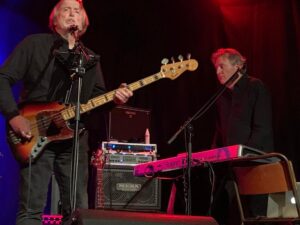
Feature Photo by Damien Doherty
Irish group Horslips might not have always topped the charts, but their importance cannot be understated. Afterall, they popularized what would become known as “Celtic rock,” paving the way for the likes of U2 and Thin Lizzy to become wildly popular later on.
But Horslips, which consisted of multi-instrumentalist Jim Lockhart, guitarist Johnny Fean, multi-instrumentalist Charles O’Connor, drummer Eamon Carr, and bassist Barry Devlin, and who reeled off nine fabulous albums between 1970 and 1980, weren’t interested in working for the man or being tied down.
They formed their own record label, managed themselves, stayed tight as a unit, and remained true to the spirit and sounds they wanted to represent. This mindset—and mode of operation—led Horslips to pave the way for later “indie” rock bands.
In more ways than one, Horslips carried the torch for Ireland and rock alike. After amicably disbanding in 1980, Devlin went on to work with U2 in a multimedia capacity, while continuing his music career, including later reunions with Horslips, which lasted from 2004 to 2006 and again from 2009 to 2012, and resulted in one final studio album, 2004’s Roll Back.
These days, Devlin wears many hats and still works with U2. At 79, he has nothing but gratitude for his journey. “Regrets,” he questions. “I’ve had a few. But then again, too few to mention. I did what I had to do and saw it through without.”
What are your first memories of music in your life?
Children’s favorites on BBC, like Nelly the Elephant and the Runaway Train, and Big Rock Candy Mountain.
What mainly drew you to the bass, and when did you decide the sort of player you wanted to be?
I was originally a rhythm guitarist in Horslips. Gene Mulvany was our bassist, and we were a six-piece. It was 1970, though, and I was quick enough to spot that Jimi Hendrix wasn’t using a rhythm guitarist, nor was Eric Clapton. I’m ultra observant, me. [laughs]
So, I swapped instruments, bought a bottom-of-the-range red Hofner, and learned on the job. It sort of suited Gene as well, as we were based in Dublin and he had a long bus ride from the country. And it was the bass which decided what sort of player I would be, not the other way round.
I needed to learn the bass parts that suited the modal riffs of trad really quickly. I was learning piece by piece and only got the bigger picture when I stopped running to stand still, as it were.
How did the scene you grew up in impact you as a player?
Growing up deep in the country as I did, I was very aware of Irish traditional music as well as English pop. Sean O’Riada—who was composing film music at the time in 1960 for Mise Eire and Saoirse—showed anyone who wanted to listen what could be done to make Irish tunes.
These are, by convention, single-instrument, single-note tunes without harmonic embellishment. They’re more harmonically rich… but everyone approved, by the way. I loved what I heard and brought with me to Dublin a desire to do something like that, but also involving the music I loved. Mainly at that stage, this was The Beatles, The Who, The Stones, etc.
The ‘60s and ‘70s were a wild time to come of age. How did that affect you as you were getting into things?
1969/1970 was a huge transition year. Fusion was the thing: jazz rock, classical rock, country rock. Bands like the Flock and Tull were using the flute and violin to make eclectic, electrifying sounds. I had just met Charles O’Connor, who played fiddle, among other things, flautist Jim Lockhart, drummer Eamon Carr, and our first guitarist, Declan Sinnot. They were as excited as I was about doing something new, different, and distinctively Irish. The rest, as they say, is (ancient) history. [laughs]
Tell us about the formation of Horslips. What was the idea behind the band’s sound?
See above. We were all country boys who had drifted into Dublin and didn’t know anyone really, so we had to stick together. So, we formed our own record label, Oats, and paid for our studio sessions by gigging. We became very popular very quickly in an age when dancing in the big ballrooms was still popular.
You couldn’t dance to Horslips, but hundreds of kids showed up in these big dance cathedrals. We licensed our albums (12, count ’em) to RCA, Atlantic, DJM, and Polygram. Charles, who was an art school graduate (the rest of us had been at University in Dublin), designed the sleeves, and Eamon Carr and I wrote what we hoped were quirky sleeve notes. And the sound was what was called “Celtic rock.”
What are your memories of Horslips’ trajectory throughout the ‘70s, and how you were received, given the unique blend of sounds and genres?
We became very popular very fast. Our first album, 1972’s Happy to Meet, Sorry to Part, was the fastest-selling album in Ireland for the entire ‘70s, only knocked off its perch by Abba’s last release. We had Bowie-esque costumes and, later, a dress style that nodded to the mythical tales we told on albums like The Tain and Book of Invasions.
But that early-stage gear was quirky rather than pompous, I hope. We didn’t take ourselves too seriously, though we were very serious about trying to forge something that was excellent musically as well as novel. We didn’t always succeed. But we always tried. And the kids loved us. Mad stuff…
Do you feel Horslips got a fair shake? Was it hard for bands from Ireland to break through?
Can’t complain. Our record labels always gave it their best shot, and we worked very hard. That we were working for ourselves, not for some company suit, definitely helped. We had one American Hot 100 album and a couple of British and German hits, but we never made a really big breakthrough.
This, in a way, gave us license to be quirky. That may have been part of the reason we remained an “indie’ band in the public consciousness. As for the second part of the question, the fact that the IRA was bombing England at the time didn’t help us very much.
In fact, the English were more than fair to us. No one ever told us to go back home. But if you were an English kid who wanted to fixate on a favorite band, Horslips wouldn’t have ticked too many boxes.
What led to the initial end of Horslips?
We sort of ran out of steam. We had worked out the trad-seam of Irish tunes we could use in our songs, and we had played over 2,500 gigs in our ten years on the road. The arrival of punk on the scene didn’t help.
We decided it would be better to bow out gracefully while we still liked each other than drag our carcasses around to dwindling numbers of the same faces. So, we didn’t do a farewell tour or anything like that. We just shook hands after our last gig in Belfast in 1980 and got on with part two.
Since the ‘80s, you’ve had a long-running association with U2. Tell us about that.
I still work with U2. I did their first demos in Keystone studios in Harcourt Street in 1978, I think. And from about the time of [U2’s 1984 album] The Unforgettable Fire, began to write and direct documentaries, specials, and videos such as I Still Haven’t Found What I’m Looking for and All I Want Is You for them. It’s been great fun working with the band… they still find fun things for me to do, especially as I’ve been a fan since day one!
What’s been the key to your bass rig, and where does it stand today?
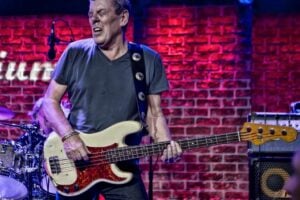
In the ‘70s, it was a big 200-watt Ampeg amp and cabinet—which [U2 bassist] Adam Clayton later used—and one of three basses: ’73 Ampeg Dan Armstrong plexiglass, a ’74 starburst Fender Jazz, and my unique ’76 John Birch Shamrock Bass (Google it).
I didn’t use any effects, and I usually played fingerstyle, though sometimes with a pick. Ooher! These days, it’s usually a hired Markbass Combo mini. Simple but effective… oh, and a Hofner Violin bass, which I’d always wanted but never bought.
About three months ago, I went into a guitar shop near where I live to pick up a bunch of picks and walked out with it. I’ve only played a few gigs with it, and it’s very different in heft from the Fender. But I like it. And I can pretend I’m [Paul McCartney] Maccer… [laughs]
What’s something about you as a musician—and listener—that might surprise fans?
Not that surprising, I guess. I’m a huge fan of the baroque and early classical canon, particularly JS Bach. Aside from the fact that his walking bass lines are an example to us all, Bach’s melodies are simply extraordinary. Wachet Auf Ruft Uns die Stimme is my favourite cantata, and the Concerto for Two Violins is my favorite piece, but I’ll take any and all of it.
What’s next for you?
I’ve had a career as director and screenwriter since Horslips finished (first time!) with a fair few features and TV series to my name. I currently have an 80-minute animated feature in production. It’s called Outfoxed! It’s about foxes caught up in a hunt. It’s really exciting and funny. Due for release in April ’27. Remember, you heard it here first, folks.
Check out similar articles on ClassicRockHistory.com Just click on any of the links below……
Read More: Artists’ Interviews Directory At ClassicRockHistory.com
Read More: Classic Rock Bands List And Directory
An Interview With Barry Devlin Of Horslips article published on ClassicRockHistory.com© 2026
Classicrockhistory.com claims ownership of all its original content and Intellectual property under United States Copyright laws and those of all other foreign countries. No one person, business, or organization is allowed to re-publish any of our original content anywhere on the web or in print without our permission. All photos used are either public domain Creative Commons photos or licensed officially from Shutterstock under license with ClassicRockHistory.com. All photo credits have been placed at the end of the article. Album Cover Photos are affiliate links and the property of Amazon and are stored on the Amazon server. Any theft of our content will be met with swift legal action against the infringing websites.