Feature Photo by Mike McMillen
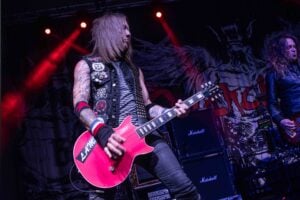
With JetBoy in the ‘80s and from 2009 through today, Billy Rowe brought swagger and hard-edged style to his personal brand of rock music.
Since 2020, he’s done the same with Buckcherry, while managing his guitar company, Rock N Roll Relics. All that is to say that with a cache of great music under his belt, plenty of live shows, and a stable of gnarly guitars to build, life is good for Billy Rowe.
As for how he’d like to be remembered, he tells ClassicRockHistory.com, “Hmm, that’s a big question? I’d say that I was a straightforward guitar player who was a true fan through and through of all the bands and musicians that I grew up on and were influenced by.”
He continues, “I hope the music I was part of ignites that same feeling inside them as it did for me, of all the musical heroes that I love so much. To this day, when I listen to albums that I discovered as a kid, I get the same feeling I did when I was first exposed to them. That to me is the ultimate legacy to leave behind.”
What are the earliest memories of music in your life?
My earliest memories are listening to my am radio in the early/mid ‘70s. I remember being drawn when I first heard songs from Elton John, Glen Campbell, Cliff Richard, and the Bay City Rollers. Also, from TV jingles with ‘70s TV sitcoms and commercials, which had super catchy hooks and melodies. This all led me to become obsessed with music.
What inspired you to pick up the guitar, and when did you decide what type of player you wanted to be?
It all started when I got a copy of Kiss’ Alive! for Christmas in 1975. When I opened up the insert booklet and got to the last page of Ace Frehley with his tobacco Les Paul, I was instantly obsessed. I never really thought about what type of guitar player I wanted in the beginning; I just wanted to be a guitar player.
How did the scene you grew up in affect you as a player, and overall, as a young musician?
When I entered the local music scene as a fan in the clubs in San Francisco and around the Bay Area, there were a few local bands that caught my attention. One of them was a band called Head On, which took the whole page of what I loved about music and their look.
The ’80s were a wild time to come of age. How did that, and the popular music of the era, shape you and what you wanted to pursue?
Looking back, I see more now that the ‘80s were a wild time. But when you’re in it and in the moment, it’s just the way your life is. Looking back, I can now see that it was a magical time that could never be replicated.
It is amazing to see kids today that are the age we all were back in the ‘80s so obsessed with that time all these years later, it’s really cool. For me, I can see all these years later that this era of my life completely shaped me into who and where I am today.
How did you first meet the guys in JetBoy, leading to the formation of the band? What appealed to you about JetBoy musically?
Fernie and I founded JetBoy. We met at a club in San Francisco called the Old Waldorf, which was Bill Graham’s small venue/nightclub. Fernie used to be a roadie for a great local band called Head on, as I mentioned earlier. The guy teched for was Frank Wilsey, who later went on to play with Stephen Pearcy in Arcade.
Fernie and I hit it off and started to hang out all the time. He said to me one day while hanging out at our friends’ parents’ house, “We should start a band.” So, we started to write songs and put the pieces together with the members. I knew our drummer, Ron Tostenson, so he joined in, and we started jamming in my parents’ garage.
Fernie knew Todd Crew, and then he joined. The four of us worked up about 8-10 songs, but with no vocals. Todd said, “I know this guy who I think would be perfect for what we are doing here,” and that guy was Mickey Finn. Once Mickey joined, he immediately wrote lyrics and melodies to all the songs we had written for the musical. Then, a few months later, we did our first gig in August of 1984.
What can you say about JetBoy’s sound and vibe compared to other so-called “hair metal” acts, and how you were different?
JetBoy really had its own sound compared to a lot of the bands that surrounded us at that time. In the early JetBoy years, we had one foot in punk rock and one foot in rock ‘n’ roll with a good chunk of pop in our sound. Once we got signed, we started to move towards a more AC/DC sound rhythmically.
Especially on our second album, Damned Nation, which was a much grittier and heavier-sounding album. But we always retained a pop sensibility in the melodies throughout the band’s career. But I would not call JetBoy ‘hair metal.’
We did have the hair, but what “hair metal” describes is far from what JetBoy are all about. The same goes with Guns N’ Roses, L.A. Guns, Faster Pussycat, Junkyard, Sea Hags, and The Hangmen. These bands all had one thing in common that separated us from this term, and that’s punk rock roots.
What do you remember about the recording of albums like Feel the Shake and Damned Nation? How did life change, for better or worse, after those records dropped?
I remember recording both these albums so well. With the first album, Feel the Shake, it was really quite easy and pretty fast for the most part. Working with Tom Allom was a lot of fun, and it was so cool to work with a guy who produced all those great Judas Priest albums that I grew up listening to as a kid.
When it came to the second album, the band had matured quite a bit from musicianship to songwriting. We all felt and still feel it was a stronger album because of this. Working with Duane Baron and John Purdell was an absolute blast.
They were such a great team, and they really pushed us, which in turn really brought all our strengths out of each of us. To this day, I am super proud of that album; they both should have been a lot bigger than they were.
How did grunge impact JetBoy’s fortunes, leading to the breakup, and how did you ride out the ’90s?
When grunge hit, it was time. The ‘80s scene was so big it became comical, so it was bound to take a big hit. The grunge movement really brought things back to a street vibe and not the over-the-top blingy rock star thing.
I personally did not connect with some of those bands, other than, say, Alice In Chains, Soundgarden, Nirvana, and a few others. When the next wave came with bands like Rancid, Marilyn Manson, and NIN, which was right when grunge became big, I was more drawn to this.
I rode out the ‘90s pretty good and played a lot with the band I started called American Heartbreak. By 1995 or so, I was super infected by the movement of bands that hit in the mid to late ‘90s.
It was bands like D-Generation, The Wildhearts, The Backyard Babies, Hellacopters, NY Loose, 3 Colors Red, and Baby Chaos. Most of these bands were from outside the US. These are the bands that really inspired me to form American Heartbreak.
What allowed JetBoy to get back together, and what’s kept things smooth since? Given the resurgence in that style of music, what have things been like this time around?
The rebirth of JetBoy started back in 2009, I think it was? Our friend Brian Perera, who owns Cleopatra Records, gave me a call and asked me what it would take to get JetBoy to play the release party for the Hollywood Rocks CD box set he was about to release.
I said, “Let me call Mickey and Fernie and see what they say.” I left both of them a message, and they called me back with the same answer, which was, “Let’s do it, book it!” From that time on, JetBoy has been active whenever we get the call to play.
With this second time around, it has not been easy, but it has not been hard, either. Since then, we’ve recorded a new song for bonus tracks on some old demo releases, we’ve done a few tours, played some of these 80’s festivals, and recorded an EP.
We had “Feel the Shake” licensed by the Philadelphia Flyers hockey team to use the song as their “scoring a goal” music. We signed a deal with Frontiers Records and recorded our first full-length album since Damned Nation.
Then, the most recent we signed again with Cleopatra Records and recorded a covers album, Crate Diggin, that came out in 2023. So, what’s around the corner for us next? Who knows? Something always comes our way when we’re not looking.
You’re also a member of Buckcherry, a group that’s had a lot of success, and tours and records heavily. How did that happen, and what’s that been like?
Yeah, I joined Buckcherry in 2020. I got a text message from the guitar player Stevie D, whom I’ve known for a while. He just asked if I would be up for playing with the band. This is when COVID hit the world. I didn’t say, “Yes,” and I didn’t say, “No.”
Shows were all being shut down, so the work was minimal at that time. I wasn’t too sure—and Stevie understood—because I have a guitar company, so I wasn’t sure how it would work with me being gone for a good amount of time.
And l here I am going on six years later. It’s been a really great opportunity, and it’s actually allowed me to grow my business and finally let go of some things in my shop that I had to let go of to grow. So, it’s been nothing short of amazing. I was always a fan of the band, and it really is in my guitar-playing wheelhouse.
Given Buckcherry’s schedule, do you almost see JetBoy as a side project now?
JetBoy doesn’t work on a continuous schedule, so it works. And if I can’t do a JetBoy show, I have someone who can fill in for me. I still run the business end for all-things JetBoy.
You’re the person behind Rock N’ Roll Relics, a guitar company doing awesome things. What’s the story there, and how are things going, given the state of the world?
Ever since I was a kid, I was into tinkering and building things. I was really into wood shop and art class in middle school and high school. With my first guitar, which I got as a kid, I was super into customizing things with new pickups or pairing it with a new color, etc.
My freshman year in high school, my wood shop teacher let us pick a project, and I chose a guitar. I can easily say that Eddie Van Halen was my big influence in customizing guitars. When I saw his red and silver striped Ibanez “Destroyer,” he called the shark guitar.
I wanted to build one similar. So, my wood shop project was a star guitar. I still have the body from this guitar, and someday I plan to bring it back to life. I never used it live with JetBoy, but I have photos of it behind me as a backup guitar in some super early live JetBoy photos.
What’s next for you, and do you have any regrets?
Next up is to continue to grow my Rock N Roll Relics guitar brand, Buckcherry, and JetBoy. I like to be challenged personally and creatively. As for regrets? I don’t have any. I’m where I am from all the challenges I’ve been handed in life, and life is great!
Check out similar articles on ClassicRockHistory.com Just click on any of the links below……
Read More: Artists’ Interviews Directory At ClassicRockHistory.com
Read More: Classic Rock Bands List And Directory
Read More: 100 Essential Albums From The 1960s That Everyone Should Own
An Interview With Billy Rowe Of JetBoy & Buckcherry article published on ClassicRockHistory.com© 2026
Classicrockhistory.com claims ownership of all its original content and Intellectual property under United States Copyright laws and those of all other foreign countries. No one person, business, or organization is allowed to republish any of our original content anywhere on the web or in print without our permission. All photos used are either public domain Creative Commons photos or licensed officially from Shutterstock under license with ClassicRockHistory.com. All photo credits have been placed at the end of the article. Album Cover Photos are affiliate links and the property of Amazon and are stored on the Amazon server. Any theft of our content will be met with swift legal action against the infringing websites.