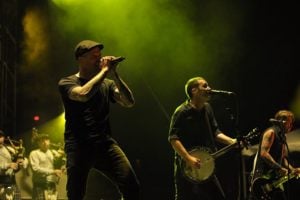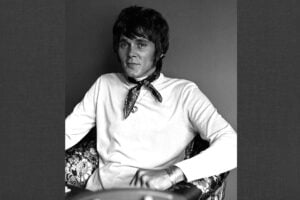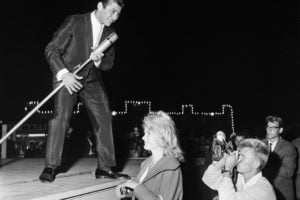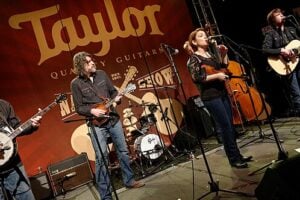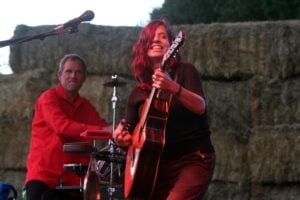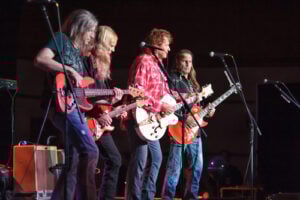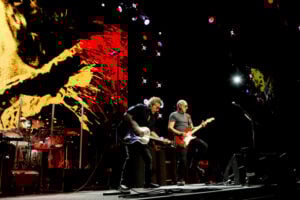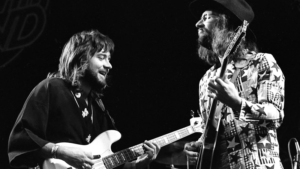
Image credit Goddard Archive Portraits
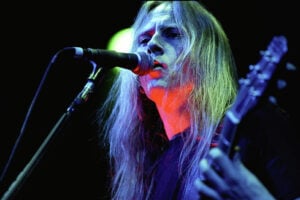
Growing up in New Zealand, singer/songwriter and guitarist Chris Thomson had big dreams. “Everything seemed possible at that time,” he tells ClassicRockHistory.com. Adding, “Ot that’s how I saw it, so when I heard The Beatles’ ‘I Saw Her Standing There.’ I knew that was what I wanted to be and do. I wanted to sing, play, and be successful. A dream that, in most ways, became true.”
Indeed, it did. In 1976, Thompson joined Manfred Mann’s Earth Band, adding new flavor to an already established mix. The results were immediate, with 1976’s The Roaring Silence producing a bit hit in “Blinded by the Light,” a cover of an old Bruce Springsteen song.
“The direction of the band became more mainstream as we added my voice to the songs Manfred wanted to record,” Thompson says. “That suited me as I felt I was making a nice contribution to a band that had quite a hardcore following in the USA.”
Thompson stayed until 1986 before going solo. He rejoined the Earth Band in 1996, before leaving for a final time in 1999. He admits that Mann was difficult to work with, but there was mutual respect. “We are still friends,” Thomson reveals. “I hope to get up and sing a song when we meet up in March.”
“But not to reunite,” he insists. “We won’t do that unless it’s for something special. But Manfred and I did ‘Night of the Proms’ in Germany in 2005, which was very successful.” When he looks back, Thompson has nothing but gratitude. He’s working on his final studio album and hopes listeners will tune in. “I hope fans understand that I put 110% into everything I did, recorded or live,” he says. “And that being my best at every show meant everything to me.”
“With Manfred Mann’s Earth Band,” he says. “I think my voice gave the band a very recognizable sound. So, I hope I did with all my own music, and other projects I was involved with.”
What are the earliest memories of music in your life?
I think, when I was about six years old, we had moved to New Zealand, and my father played his favorite 78s on our wind-up gramophone, like Louis Armstrong and hits of the late ‘40s and early ‘50s big band stuff. And then, of course, going with him to church choir practice, as he ran the choir, and then singing in the choir when I was about eight. So, lots of Church music, too
What inspired you to pick up the guitar, and when did you decide what type of player you wanted to be?
Skiffle music because of its simplicity. Pick up a guitar and start playing “Tom Dooley” immediately with a songbook. Jimi Hendrix, once you heard him as a young guitar player, that was it. Never quite achieved it, though.
How did the scene you grew up in affect you as a player, and overall, as a young musician?
The scene in New Zealand and the kind of places we could play demanded we played all the hits of the day, so we had to learn to reproduce the style and sound of what was on the radio, so there wasn’t any need for or room to be creative, so we played all kinds of musical styles, a great way to learn.
How did you first meet Manfred Mann and end up joining his band in 1976?
I met Manfred in 1975 by answering an advertisement in The Melody Maker. It said: “Band with record deal. Need singer/guitarist. No timewasters!” I went to his house to sing and go through a few songs before meeting the band and rehearsing at the Workhouse on the Old Kent Road.
I wasn’t good enough as a guitar player, as I was replacing Mic Rogers, who was a virtuoso. So, that was why they replaced him with Dave Flett and me. But I got the job because Manfred liked my voice, and because of my experience in New Zealand, I could sing anything.
What appealed to you about the band musically?
To be honest, I was a great ‘60sManfred Mann fan. We played a lot from the Five Faces record, and Paul Jones was a hero of mine because he was a great singer and Harmonica player. So, I was thrilled to get into the band with Manfred. I really liked “Joy Bringer,” which was a hit at the time, but I was surprised by the amount of instrumental, quite jazzy stuff they were doing in their show. I liked it. As I said, I needed to practice my guitar playing to catch up.
What can you say about the recording of “Blinded by the Light,” a song of Bruce Springsteen’s that went on to be a big hit for The Earth Band?
Recording “Blinded” was quite a task, as Manfred had a vision of making it a commercial single, but that is a very hard thing to do with a song like that. I never heard Bruce’s version until we were finished, not for any reason except that Manfred had the lyrics printed out.
He sang me the words in his funny voice, and I just did what I always did: tried to put my personality into his vocal version, with the chords around a piano. Singing all those words was a challenge, but again, I had sung lots of “mouthful” lyrics before.
How did things change for you and the band after that song became a hit?
Lucky for us, lots more people came to see us. We played all over the world, which was great fun and what I had dreamed of. The success of that song paved the way for the Earth Band and its offshoots to keep going to this day. We had other successful songs and albums, too!
Did you eventually get to talk with Bruce Springsteen after the song was a hit?
I’ve had a couple of nice conversations with Bruce, especially in the late 70s. We went out to dinner in Switzerland, where I asked him if he liked our recording of “Blinded by the Light.” I didn’t really get a straight answer from him, but in a roundabout way, I gleaned the fact that there were some things about it he didn’t like. I met him recently, and he was very nice and accommodating.
What was working with Manfred really like? The word is that he was overbearing and didn’t like to pay or credit his bandmates well. Is there any truth to that?
Firstly, Manfred is one of the most honest people I have met in my life, and he always wanted to make sure everybody was well paid and credited properly, so I don’t know where that comes from. He was, however, quite difficult to work with, in that he always wanted it his way. You could try anything you like, but if he didn’t like it, he was the boss. I always said Manfred Mann’s Earth Band was a democratic dictatorship. [laughs] We are still good friends.
What led you to leave the band? Looking back, do you wish things were different?
I just wanted to be in charge of the music I was making and felt I wanted to go in a different direction. I continued to work with Manfred after I left, so I had the best of both worlds: I could record and tour with the band while making my own music. I wish my own music had been more successful, but probably it wasn’t good enough. [laughs]
What’s next for you, and do you have any regrets?
I have just finished a new—and certainly my last—album of nine new original songs. We hope to have that out either before or after the summer of 2026. It will be on vinyl and available digitally. I’m in the final stages of finishing a musical I have been working on for years with my wife. We wrote the story, script, and music, called Do it For Love. As for musical regrets, I turned down the chance to do a solo album with Richard Perry in 1980.
Check out similar articles on ClassicRockHistory.com Just click on any of the links below……
Read More: Chris Slade: The ClassicRockHistory.com Interview
Read More: Artists’ Interviews Directory At ClassicRockHistory.com
Read More: Classic Rock Bands List And Directory
An Interview With Chris Thomson Of Manfred Mann’s Earth Band article published on ClassicRockHistory.com© 2026
Classicrockhistory.com claims ownership of all its original content and Intellectual property under United States Copyright laws and those of all other foreign countries. No one person, business, or organization is allowed to re-publish any of our original content anywhere on the web or in print without our permission. All photos used are either public domain Creative Commons photos or licensed officially from Shutterstock under license with ClassicRockHistory.com. All photo credits have been placed at the end of the article. Album Cover Photos are affiliate links and the property of Amazon and are stored on the Amazon server. Any theft of our content will be met with swift legal action against the infringing websites.