Feature Photo by Joe Schaeffer
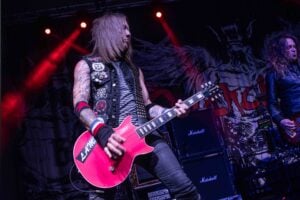
Chuck Wright has played bass alongside everyone from Slash to Alice Cooper. He’s a player’s player, a producer, and a songwriter. But what he’s best known for are his many stints with Quiet Riot.
Specifically, he contributed his four-stringed licks to the band’s iconic ‘80s metal classic, Metal Health. Though he’s been out of Quiet Riot for several years, he’s proud of his legacy within the band’s history and has been keeping busy with various projects.
As for how he hopes to be perceived beyond his heavier-than-heavy reputation, Wright tells ClassicRockHistory.com, “People probably think of me strictly as a rock bassist, but if you dig into my discography, it’s all over the map.”
He explains, “I’ve worked in so many different styles — reggae, flamenco, prog, rap-rock, metal, ambient music, ballads. I’ve always been drawn to music that has emotion and personality, no matter what genre it falls into.”
What are your first memories of music in your life?
One of my earliest musical memories goes back to when I was about six years old. My mom bought me a little organ that lets you play the melody with one hand while triggering full chords with buttons — songs like “House of the Rising Sun.”
It may have been a simple instrument, but it actually taught me a lot. I started learning the names of notes, chord structures, and how harmony worked. Around the age of eight, I moved on to acoustic guitar and took a few lessons. That was really the beginning of me realizing music wasn’t just something you listened to — it was something you could build.
What drew you to the bass, and when did you decide the sort of player you wanted to be?
I became a bass player almost by accident. The older kids in my neighborhood had a band and asked if I could play bass. I remember saying, “That’s only four strings, right?”
But once I got my hands on one, something clicked. I asked my mom if I could get a bass like Jack Bruce from Cream, and that became a huge influence on me early on. Jack wasn’t just holding down the bottom — he was melodic, fearless, improvisational. Cream taught me that bass could be expressive and adventurous, not just supportive.
And there’s actually a great full-circle story about that. In the mid-’90s, I was touring in Europe with Vanilla Fudge, filling in for Tim Bogert. The opening band’s bassist was a wealthy collector, and he invited us to his home — he had an entire memorabilia room. It turned out he owned the actual bass Jack Bruce played on “Sunshine of Your Love.”
Of course, I picked it up and played it — because that was the first song I ever learned on bass. It was one of those surreal moments where you realize how connected music history really is.
My first gig was at a UCLA frat party. I made $75, had my first beer, and the college girls thought I was cute. I was 15 years old. I went home and told my mom, “This is what I want to do. I don’t want the military school path anymore.”
She asked if I was sure — because she had invested so much time and money into that direction. And I just smiled and said yes. One of my proudest moments later in life was being able to present her with a platinum record plaque… with her name on it.
How did the scene you grew up in impact you as a player?
I was lucky because I grew up near Hollywood, which meant I got to see a lot of legendary bands right at the beginning of their rise. I saw Yes, Black Sabbath, Queen, Genesis — even David Bowie’s first-ever show in Los Angeles.
That was my classroom. I never really took formal bass lessons because I didn’t want to become someone else’s version of what a bass player should be. I wanted to develop my own voice, my own instincts, and my own musical personality by absorbing what the greats were doing in real time.
The ‘80s were a wild time to come of age. How did that affect you as you were getting into things?
I feel genuinely blessed to have grown up when I did. The ’70s, to me, were the greatest era of music — that’s where I learned how bands worked, how songs were built, and how musicians pushed boundaries.
The ’80s were when I started making my own mark. That’s when I began working with bands like Quiet Riot, Giuffria — where I got my first real touring experience on sold-out arena shows with Deep Purple and Foreigner — as well as Impellitteri and House of Lords.
I was also fortunate to work alongside some truly legendary artists over the years: Alice Cooper, Slash, Gregg Allman, Carmine Appice, Ronnie Montrose, John Waite, Pat Travers… the list goes on.
At this point, I’ve appeared on over 100 worldwide record releases, not only as a bass player but also as a songwriter and producer. And what people might not realize is how wide the range has been — everything from ambient trance and reggae to rap, country, and, of course, rock.
How did you end up working with Quiet Riot on Metal Health?
In 1981, I had a band called Satyr that was very popular in the local scene. The guitarist from that band eventually joined Kevin DuBrow’s group, which at the time was still called DuBrow. Kevin had started it after Randy Rhoads left to join Ozzy Osbourne.
Rudy Sarzo had been playing with DuBrow as well, but he also got the call to join Ozzy. When that happened, my guitarist suggested me as the replacement, and I got the gig. We started grinding it out in all the clubs.
Later, when my original band’s guitarist got fired, I suggested Carlos Cavazo from the band Snow. We went down with our producer and record company president, Spencer Proffer, to see him play. He was unbelievable — like Eddie Van Halen meets George Lynch — and we offered him the job.
Carlos had a song in Snow called “No More Booze,” which eventually evolved into “Bang Your Head.” Kevin liked the music but hated the original lyric. He got the idea for the new lyric after hearing from Randy about how audiences in England would literally bang their heads at shows. That’s how it all started coming together.
Now, there’s been a lot of back and forth on what you recorded and what Rudy Sarzo recorded. Once and for all: who did what?
I recorded most of the demos originally, and those demos essentially became the blueprint for what turned into the Metal Health album.
After Randy Rhoads was tragically killed, Rudy came back into the band. But my bass tracks remained on “Bang Your Head” and “Don’t Wanna Let You Go,” and I sang background vocals on every song.
We did a very specific vocal approach — Carlos, Kevin, and I would sing each harmony part in unison, double it, then move on to the next part, stacking everything layer by layer. It was very intentional, and it created that huge sound the record is known for.
They later brought me back again to do vocals on the Condition Critical album, and I played bass on the track “Born to Rock.” Rudy wasn’t thrilled about that — understandably — and after the tour, he left the band. Kevin then asked me to officially join Quiet Riot.
At the time, I was in Giuffria, and we had a hit with “Call to Your Heart.” But, creatively, it became frustrating because Gregg Giuffria and the singer David Glen Eisley didn’t really want anyone else writing songs. Craig Goldy and I both felt like we were being treated as hired hands, not band members. Goldy left to join Dio; I left to rejoin Quiet Riot, where I was a songwriter on the entire album QR3.
Does it upset you that there’s been a lot of misinformation out there about this topic?
[laughs] Well, I once saw an interview where someone asked me how I felt about Rudy’s “greatest contribution” to Quiet Riot being my bass parts. That’s pretty wild.
It’s always been a double-edged sword for me. On one hand, I’m proud to have been part of something historic. That album changed the fabric of rock music. Before Metal Health, it felt like mainstream rock was being dominated by New Wave skinny-tie bands — stuff like The Knack. Then “Cum on Feel the Noize” hit, and everything shifted.
I remember it like it was yesterday — Kevin arguing with me and Spencer Proffer about that song because he was dead set against doing covers. I kept telling him we needed a real commercial single. I said, “Think of it like Queen — big stacked vocals, maybe even some keyboard pads.”
The flip side is that because Rudy was in the early videos and tours, he became “the guy” in the public eye. Meanwhile, I was in Quiet Riot for 26 years, made nine albums with the band, and people still didn’t see me as “the guy.”
But the truth is: Rudy is a rock star. I’m more of a musician — a songwriter and producer — and I’ve always been driven by creating and building things, not just being seen.
What led you to leave Quiet Riot and join House of Lords with Gregg Giuffria? And what brought you back to Quiet Riot?
I left Quiet Riot after the QR III album because the label and management basically forced us to fire Kevin. After that, the band was treated with zero respect. Paul Shortino was brought in, along with him came Wendy Dio as a co-manager, and I could see the writing on the wall.
I moved on and did the Impellitteri album, and not long after that, Gregg Giuffria contacted me. He had a record deal through Gene Simmons, who had a custom label arrangement with RCA/BMG. He said, this time I’d be able to contribute songwriting.
So, we formed House of Lords. I had been working with James Christian in a band called Eyes, and I suggested him for the project. Then we saw Ken Mary playing with Alice Cooper and immediately agreed: that’s our drummer. Lanny Cordola stayed with Giuffria for their second album and later joined the new band as well.
You’ve worked with Slash, Alice Cooper, and Gregg Allman. Tell us about that.
Those are all long stories, but I’ll try to keep it short.
In the mid-’90s, I was working on film scores with Matt Sorum (The Cult / Guns N’ Roses) and my House of Lords bandmate Lanny Cordola. Slash played guitar on one of the films, and we ended up doing a live performance of the music when the movie premiered at Sundance. Duff came along as well, so it turned into this amazing moment.
As far as Alice Cooper — I was playing with Ronnie Montrose and Eric Singer, who was also in Alice’s band. Eric asked if I wanted to audition for Alice’s upcoming tour: 75 cities, 17 countries. I was mostly doing occasional club dates with Ronnie at the time, so I auditioned… and got the gig.
Touring with Alice was honestly one of the happiest periods of my life. Things shifted later when Ryan Roxie returned, and around the same time, Kevin contacted me about rejoining Quiet Riot.
Quiet Riot actually has a documentary titled “Well Now You’re Here, There’s No Way Back,” and I think I came and went from the band four or five times. Kevin used to jokingly call me “Chuck Wright-Now,” because I was in and out so often.
Up until a few years ago, you were back with Quiet Riot. Why did things end again, giving way to Rudy?
That was ultimately a management decision. I was bummed — and honestly pretty angry — especially after being loyal for so many years.
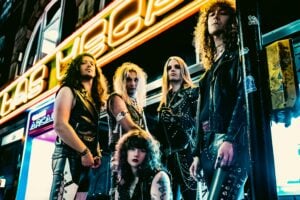
But literally the day after I announced I was stepping down from Quiet Riot, I got a call from former Great White singer Terry Ilous. He asked me to join an all-star band he had formed with Greg D’Angelo, the founding drummer of White Lion.
That band became Legends of Classic Rock, and I’ve been with them ever since. And I have to say, it’s been one of the most fun and fulfilling chapters of my life — especially performing as featured guest artists on Royal Caribbean’s newest ships, whether we’re in the Caribbean or the Mediterranean.
At the same time Rudy returned, we were coming out of the pandemic, and during that period, I was composing and recording constantly. That became my first solo album, Sheltering Sky. It features 42 incredible musician friends, and it’s the most personal record I’ve ever done.
I wasn’t trying to chase a genre — I was writing what I felt. So, you’ll hear progressive rock, jazz fusion, funk, industrial textures, Zeppelin-style rock… it’s all there. I had a huge palette, and for the first time in my career, no restrictions.
There’s always debate about who the “true bassist” and bass sound of Quiet Riot is and was. What’s your view on that?
I understand why fans debate it — Quiet Riot has had different eras and different lineups. But I think the reality is that both Rudy and I contributed important chapters.
Rudy is an iconic figure and absolutely part of the band’s visual legacy. My role was often more behind the scenes — writing, recording, production ideas, shaping harmonies, building the musical foundation. I’m proud of that, because it’s real.
At the end of the day, the “true” sound of Quiet Riot is bigger than any one person — it’s the chemistry of the players at a particular moment in time.
Are you and Rudy cool?
I honestly haven’t spoken with Rudy in years. The last time I remember seeing him was when his band with Tracii Guns opened for Quiet Riot. It was a long time ago — I can’t even recall the exact year.
What’s been the key to your bass rig, and where does it stand today?
For me, less is more. The real tone is in the hands — not the gear. Give me a Fender Precision Bass, plug it into an Ampeg SVT, and I’m good. That combination has everything I need.
What’s next for you?
In 2015, I started a live music event called Ultimate Jam Night at the Whisky A Go Go. We just celebrated our 11th anniversary — show #292. I organize around 50 professional musicians into themed nights where everyone knows what songs they’re playing and who they’re playing them with. It’s like producing a rock-and-roll event every month. I still can’t believe I did this every week.
My next show is coming up in a couple of weeks (ultimatejamnight.com), and then I’m off to the Caribbean again with Legends of Classic Rock (locrband.com). We also did a couple of Starbucks commercials last year — one went viral and hit over 50 million views.
Do you have any regrets?
As far as regrets… my biggest one is not being more aware on the business side earlier in my career. If I could give younger musicians advice, it would be simple: get everything in writing. If you agree to something, protect yourself. The music is the fun part — but the business side can define your entire future.
Check out similar articles on ClassicRockHistory.com Just click on any of the links below……
Read More: Artists’ Interviews Directory At ClassicRockHistory.com
Read More: Classic Rock Bands List And Directory
Read More: 100 Essential Albums From The 1960s That Everyone Should Own
An Interview With Chuck Wright, Formerly Of Quiet Riot, article published on ClassicRockHistory.com© 2026
Classicrockhistory.com claims ownership of all its original content and Intellectual property under United States Copyright laws and those of all other foreign countries. No one person, business, or organization is allowed to re-publish any of our original content anywhere on the web or in print without our permission. All photos used are either public domain Creative Commons photos or licensed officially from Shutterstock under license with ClassicRockHistory.com. All photo credits have been placed at the end of the article. Album Cover Photos are affiliate links and the property of Amazon and are stored on the Amazon server. Any theft of our content will be met with swift legal action against the infringing websites.