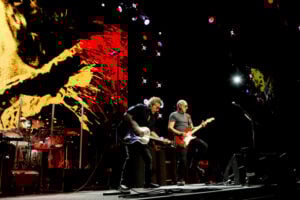
Feature Photo: by Danin Drahos
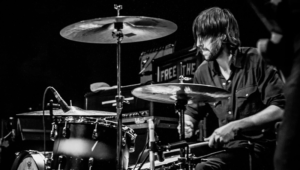
The task of occupying the drum stool and thunderous grooves, once held down by Steve Gorman, The Black Crowes’ original drummer, isn’t an easy task, but it’s one Cully Symington is taking on just the same.
In fact, despite Gorman being the driving force behind classic songs like “Twice as Hard,” “Sting Me,” and “Remedy,” the word on the street is that the hard-hitting, groove-heavy Symington is slowly but surely making fans forget.
“I appreciate hearing that,” Symington tells ClassicRockHistory.com. “I’m still working on it, but hopefully getting there!”
Maybe making fans forget is too strong. But then again, the Crowes’ live dates over the last few years—and the band’s two new songs, “Profane Prophecy,” and “Pharmacy Chronicles,” which come from the band’s upcoming album, A Pound of Feathers, due in March 2026—are showing that the proverbial boogie woogie is back with a bullet behind the drum kit.
“I just try to be and play like myself,” Symington shrugs. “At the end of the day, that’s all you can do.” Adding that he’s “really looking forward” to the yet-to-be announced tour that’s sure to follow A Pound of Feathers’ release.
All of this is to say that Chris and Rich Robinson’s Black Crowes seemed primed for big things. A lot of credit should go to Symington, who, along with fellow bandmates bassist Sven Pipien, guitarist Nico Bereciartua, and keyboardist Erik Deutsch, has bolstered the lineup that, at times, has been a revolving door.
But Symington, ever the capable technician, remains cool under pressure. “That’s cool to hear,” Symington says. I don’t really know, to be honest. I think I always just try to be myself. Support the song. Don’t overthink it.”
What are your earliest memories of music in your life?
My mom plays guitar and sings. So, I was hearing that when I was very young. My older brother was also a big influence. He was always blasting records in his room. He played guitar as well. So, I soaked that in for sure. Music was a big part of my life at an early age.
What specifically drew you to the drums, and when did you decide what sort of player you wanted to be?
I started on piano. Then I switched to guitar. But I didn’t connect with those right away. I began playing drums when I was eight. I wasn’t a natural, but I kept after it for some reason. I think I enjoyed the coordination aspect at first, trying to make my four limbs work together.
It was hard, and I liked the challenge. And I also just loved hitting them. By the time I was 11 or 12, I was obsessed, and I knew that’s what I wanted to do with my life. As far as what sort of player I wanted to be, I don’t know if I ever thought about that exactly.
I just followed what interested me—different genres, etc. But I’ve always liked hitting hard. So I was drawn to punk rock at first, and then I got more into [Keith] Moon and [John] Bonham and those guys in my teens.
How did the scene you grew up in affect you as a player?
Huge impact. I grew up in Austin [Texas], and I can’t imagine being born in a better city if you wanted to play music. It was a lot smaller back then, so you kinda got plugged in right away. I was playing tons of gigs when I was young. Practicing is great, but there’s no substitute for playing with people. And I was fortunate to have a lot of opportunities and to have a lot of great people help me out when I was coming up.
What led you to make the move to session work? How did you know you’d be versatile enough?
I wouldn’t really call myself a session guy, to be honest. I started touring with bands full-time in my early twenties, and that’s still mainly what I do. I wish I did more studio work. I always jump at it when I get the chance.
What sort of gear were you using in the early days?
I was using a C&C kit and Istanbul cymbals. It was, more or less, my usual stuff, but I did mess with the cymbals a bit. I downsized the hats, and I ended up settling on a ping ride. It cuts better in this band compared to something that’s big and washy.
Have you made any changes to your gear lately?
I might switch some things up this year. Still figuring that out. So, I’ll keep you posted!
You worked with Afghan Whigs for a bit. How did that happen, and what was that like?
I met Greg [Dulli] through one of my best friends, Jeff Klein. This was in ’07 or ’08. Greg and Mark Lanegan were starting a project called The Gutter Twins, and I ended up being the drummer for that. We toured for about a year or so. And when Greg decided to bring the Whigs back in ’12, he called me to do that as well. I did the reunion shows and made a record with them.
How about Connor Orbst, Cursive, and Sharon Van Etten? How did you get those gigs, and what was it like working with them?
I met Cursive when one of my first bands in Austin opened for them. A few years later, they needed someone kinda last-minute for a tour, and they called me. I remember the first gig was [David] Letterman and having to cram as best as I could.
The music was trickier than I was expecting, but really fun. I ended up playing in the band for a while. I love those guys. And I met Conor through them. Omaha connection. He’s one of my favorite songwriters. He’s also one of the best dudes you will ever meet. And Sharon Van Etten was through a producer friend. She’s amazing as well.
What led to your getting the call to join The Black Crowes to replace Brian Griffin?
My friend [bassist] Tim Lefebvre recommended me for the auditions in 2021. I didn’t get the gig, obviously, but it went pretty well. I came in second to Brian. And that was it. But then I got a call again in 2023.
You’re also playing a lot of parts originally laid down by Steve Gorman, the longtime backbone of the Crowes. What’s a nuance in his playing that makes that a challenge?
Steve is awesome. And the nuance is kinda the whole thing. The music and drumming might seem simple to a casual listener, but it’s not. The way everything grooves and fits together is very unique. There’s a lot happening. They’ve also played thousands of shows and hours and hours of music together. So, the challenge is just all that subtlety and instinct that comes with playing with the same people for a long time.
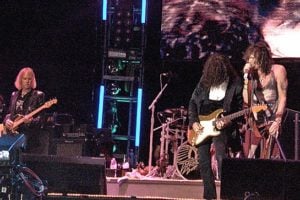
The Black Crowes were the openers for Aerosmith on what was supposed to be their Peace Out farewell tour. That tour was aborted, but not before you got a few shows in. Was it a trip touring, albeit for a short time, with Aerosmith?
It was great. Those were my first few shows with The Black Crowes. Wish it didn’t end because it was gonna be fun.
This version of the Crowes sees stable, musical, and ready to take on the world. What’s the secret to the sauce?
Things are great. I love the [Robinson] brothers and everyone in the band and crew. Good vibes all around. We have a record coming out in March [A Pound of Feathers], and we’ll be touring a lot for sure.
Check out similar articles on ClassicRockHistory.com Just click on any of the links below……
Read More: Artists’ Interviews Directory At ClassicRockHistory.com
Read More: Classic Rock Bands List And Directory
Read More: 1970s’ Saddest Rock And Pop Songs
Read More: 25 Best Classic Rock Live Albums Of All Time
An Interview With Cully Symington Of The Black Crowes article published on ClassicRockHistory.com© 2026
Classicrockhistory.com claims ownership of all its original content and Intellectual property under United States Copyright laws and those of all other foreign countries. No one person, business, or organization is allowed to republish any of our original content anywhere on the web or in print without our permission. All photos used are either public domain Creative Commons photos or licensed officially from Shutterstock under license with ClassicRockHistory.com. All photo credits have been placed at the end of the article. Album Cover Photos are affiliate links and the property of Amazon and are stored on the Amazon server. Any theft of our content will be met with swift legal action against the infringing websites.