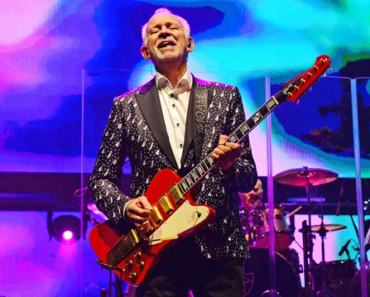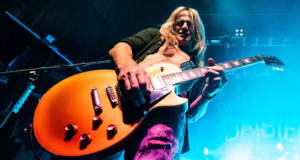
Feature Photo by Lorne Thomson
Doug Aldrich has seen it all. As a teen, he auditioned for Kiss as a potential replacement for Ace Frehley, and was in several cult bands, including Lion, Bad Moon Rising, and Burning Rain.
It all paid off when Aldrich hit paydirt as a sideman to metal icon Ronnie James Dio, and then, a perfect six-stringed foil to the big-voiced, golden-haired David Coverdale in Whitesnake. After that, Aldrich joined The Dead Daisies, where he cemented his legacy as a Les Paul-slinger, who lays down curb-stomping’ rock like no other.
Looking back on it all, Aldrich tells ClassicRockHistory.com, “I can only say that I really feel blessed to have music in my life. I’m so grateful to whoever or whatever it was that led me to the guitar.”
He continues, “I am not the greatest ever, probably, at anything in my life, but I really, really found my voice as a guitar player. After so many years of playing, there are a few things that I have always leaned on that kind of by default ended up being sort of a stylistic thing that I would do.”
To that end, when Aldrich is on a gig, people know he’s there. And once he’s gone, they miss him. Aldrich shrugs at this, saying, “Sometimes people notice that and realize, ‘Oh, that’s Doug…’ I don’t really take myself very seriously, but I take the guitar very seriously as an opportunity to be centered as a human.”
“I just truly love music,” Aldrich says. “I love listening to it. I love playing it. I love creating it, so I’m very happy.”
What are your earliest memories of music in your life?
Listening to the radio in my mom’s car was the first time I really recognized music and how it felt. This was the early 70s. Both of my sisters had a stereo system with a turntable, so they had records, and I would go listen to everything I could get my ears on.
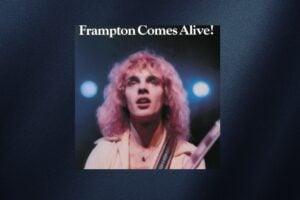
My older sister had Jeff Beck’s Blow by Blow, and that was for sure the first mind-blowing experience I had. She also had Peter Frampton and Stevie Wonder, Led Zeppelin, and my younger sister had Kiss and Queen, so overall there was a good mix of rock ‘n’ roll at my house.
What specifically drew you to the guitar, and when did you decide what sort of player you wanted to be?
Well, it was very innocent. I had a couple of friends in my neighborhood who we talked about making a band, so we could try and make some music and have some fun, and I said, ” Well, I’ll play bass guitar,” but my friend said, “No, I wanna play bass.
So, I said, “Okay, I’ll play guitar,” and that’s how it started. My younger sister had a classical guitar at her house, and one summer, when everyone was gone, there was nothing to do. I grabbed that classical guitar in the book and started to teach myself the basic chords, and it was amazing. Super fun.
How did the scene you grew up in affect you as a player?
Early on, the scene was basically rock ‘n’ roll. Hard rock and stuff on the radio was like Zeppelin, Hendrix, Deep Purple, you know what I mean… stuff like “Smoke on the Water,” and “Purple Haze.”
Very, very early on, before I actually started playing guitar. A group of kids had a gang, and I wanted to join the gang. They told me that if I brought them a single for “Smoke on the Water,” I could join the gang. So that was really early on, before I actually played guitar.
When I got to high school, I was hanging out with older kids. I was just playing rhythm guitar at that point and learning, and every chance to learn something from a few chords or a few licks was like discovering the lottery.
My friends and I would go to the basement for the whole weekend and just learn songs by Deep Purple, Rainbow, UFO, Led Zeppelin, and later Van Halen and Ozzy with Randy. Eventually, after high school, I moved to Los Angeles and got a job at a music store, barely supporting myself.
So, my goal was to start playing in original bands. We did learn some covers, but we also wrote some originals, and we started playing at Gazzaris on the Sunset Strip.
Tell us about how you ended up auditioning for Kiss. How close did you come to getting the gig?
During those gigs in Hollywood at some point, I got to meet [Kiss drummer] Eric Carr at a club where I was playing, and he actually said that he liked my playing and wanted me to audition for Kiss. It was pretty surreal, but kind of in my mind, I figured, “I guess that’s how it goes. You just moved to Los Angeles and audition for bands, and you find the right gig.”
He called me one day at my music shop, where I was working, and he said to come down and meet the guys. I went to the record plant in Los Angeles and met Gene [Simmons] and Paul [Stanley] for the first time. They asked me to play solos on some of their songs they were working on from the album Creatures of the Night.
Eventually, Gene wrote down three songs on a piece of paper and asked me if I’d be ready on Monday to audition live with them. We played for the first time in a giant auditorium in Hollywood, and it was my first time playing through multiple stacks of amps!
I remember standing back and jamming and watching Paul and Gene in front of me, and it was pretty surreal. They called me back a couple of weeks later to play again, and we did play again, but I could tell I was just very young hanging out with these world-class musicians and rock stars. I really was just a kid at 18.
Gene Simmons told you lose his number at one point. What’s the story there, and how did that motivate you?
Let me say this: I have the ultimate respect for Gene Simmons and Paul Stanley. Gene is, in my mind, a great man, a musician, a father to his kids, and a person of the people. I very much respect him and his outlook on life, and I think he’s pretty much 99% right on everything he does.
So, the story is that down the road, when Kiss was coming to Los Angeles, I still had Gene’s number, and I called it, and I thought it was funny because he was having a party at his house. He basically was like, “Please don’t call me again, just lose this number.” And it was all good, but the press has blown that up into this big thing, but it’s not.
I love Gene. I’ve known Gene and seen Gene in various situations, and he has always been super kind to me, including during my time with Whitesnake when he emailed me and asked me if I was happy. I said, “Yeah, I’m very happy, Gene, thank you.”
Anyway, I think at that time, Kiss was auditing a lot of people, and even Richie Sambora, apparently. I was just inspired by the whole situation. It made me want to work harder and get better.
Tell us about joining Lion.
After the whole Kiss thing, I had gotten a really good reputation around town as an up-and-coming musician. I was in a band with some friends from Philadelphia playing in Los Angeles, and we had a good following. I was teaching guitar at the time and had enough students to do it full-time, seven days a week. It was awesome.
One day, I got a call from [drummer] Mark Edwards about joining a band called Lion with an amazing singer called Kal Swan. I had known Mark from his time with Steeler with Yngwie [Malmsteen]. I saw them play, and, of course, I thought he was great, but I also thought Mark was amazing.
I joined the band [Lion], and we quickly had a really great following in Los Angeles, probably as big as anybody. A bunch of bands that got signed and moved on to big success were opening for us, but we always got passed on [by record labels]. Eventually, we did sign a deal, although it was not a great record deal, but we did sign a deal and had limited success until finally the band broke up.
Why do you think Lion failed to launch, and what led to the breakup of the band?
We had limited success because we signed a record contract that basically said the record company wasn’t held to any contractual obligation to support the band. Our attorney told us not to sign it, but we figured, “We’ve got a great record to make, so we’ll just renegotiate after.” In the end, it was really difficult to get out of our contract, and things just were on hold while trying to prove our freedom from our original contract.
You were invited to join Slaughter. You declined but still recorded for them, among other sessions. Tell us about that.
During the time when Lion was kind of in a hiatus and in no man’s land, I had a few offers from various people: Slaughter, Megadeth, and Dio. But I really didn’t want to leave my guys, as I thought we might be able to pull through and get a new record deal.
I had offers to do various gigs here and there, and I had offers to do sessions, which I loved. One of them was the House of Lords, and I played on their demos for the Sahara record on Simmons Records. It’s funny how it’s such a small world in music. It’s really crazy.
Eventually, I went back with Kal Swan, and we formed Bad Moon Rising, worked on three records, and had a blast working together. We had a good following in Japan, Asia, and parts of Europe, and that was great.
I was also doing sessions at my house with anybody who wanted to record with famous guitar players or musicians and other bands to rap artists who wanted the place to come do their thing. I did it all. Just making ends meet.
In the ‘90s, you formed Burning Rain. How did that band come together?
Burning Rain came out of the ashes of Bad Moon Rising, as I wanted to get back to the kind of heavy, blues-based rock that I loved and we did in Lion and Bad Moon Rising. I met singer Keith St. John and started writing with him, and it was clear we had a good vibe on the first album [Burning Rain]. Eventually, we did a second album [Pleasure to Burn].
But I got a call to join Dio again, and this time, I took it. The third and fourth albums [Epic Obsession and Face the Music] from Burning Rain came about during my breaks from Dio or Whitesnake, and it’s kind of a private pleasure of mine to work on the Burning Rain records. We haven’t really had anything behind us to make it stick long-term with a label.
How did you get the Dio gig? And once you did, why was it like working with Ronnie?
Around 2001, I did a recording session with Bob Kulick, who was producing a cover record for a label, and I did a session with [bassist] Jimmy Bain from Dio, who asked me if I would be interested in joining the band again.
And then, it was around Christmas time in 2001, and I still hadn’t gotten any clear word from the Dio camp about any serious plans. I called Jimmy, and I said, ” Listen, tell Ronnie to call me or else I’m gonna look at other options…” On December 26th, right after Christmas 2001, Ronnie, Jimmy, and I met at a pub in Los Angeles, and Ronnie offered me the gig.
He said, “Let’s start tomorrow,” and that was it. That was my first time feeling like I was joining a family. It was really cool. We had a great time making the record [Killing the Dragon]. I got to write two songs with Jimmy and Ronnie, and we toured the world. It was amazing.
We were on a big tour with the Scorpions and Deep Purple, and hard rock from the ‘70s and ‘80s was just starting to get popular again and have a resurgence. So, Ronnie was really at the top of the mountain.
What were Ronnie’s expectations of his guitar players, and what classic songs were hardest to cop?
Ronnie has been basically from the first time [they met] in 1989, he was very supportive of me in my guitar playing. And when I joined the band years later in 2001, he was super supportive and trusting of me. After a couple of days, he knew that he had nothing to worry about that. I knew what I was doing, and he just let me go and encouraged me to be the best I could be.
At one point before rehearsals, I asked him, “When it comes to guitar solos, how close do you want me to be?” He said, “Just hit the main melodies, and of course, you know, put your own spin where you feel like it’s the best.” My style of guitar playing was closer to [former Dio guitarist] Vivian Campbell’s, as we are both fans of Gary Moore.
With regard to Richie [Blackmore], it was a little bit more of a stretch, but I was able to pull it off, mainly due to the whammy bar on my Strat! [laughs] Tony Iommi was also an influence when I was a kid, and he and I both, aside from being born on the same day, February 19, had similar aspects to our playing. So, that was awesome to play those Dio songs from his time in Black Sabbath.
You joined Whitesnake and proved to be a huge shot in the arm for David Coverdale. How did that happen?
I was on tour with Dio, and David called me and said that he had a tour the following year and wanted me to sit in with him. I had heard about Whitesnake going back on the road, but I heard it was going to be with John Sykes. I said, “David, why do you need me? You’ve got John Sykes?”
He said, “No, it’s not gonna work with John. I want you. I said, “Okay, I’ll talk to Ronnie and see if I can work it out for two months.” It was all good except for the fact that David and I got along so well that he asked me to join the band for the rest of the year, which was upsetting to Ronnie and upsetting to me as well, because I loved working with Ronnie.
David and I hit it off, and eventually we started writing songs together. It was just like a perfect match and really super rewarding for me as a guitar player and songwriter.
After years of bouncing around, what did that success with Dio and Whitesnake mean to you?
It was kind of a confirmation that I was good at one thing, which is basically hard, heavy blues rock, and that I could put on a show alongside some of my heroes like Ronnie and David. I was able to inspire and bring musical ideas to both the guys, but especially with David. I knew what he needed. We needed to marry the blues-rock Whitesnake to the ‘80s Whitesnake. I knew how to do that, and it was rewarding for me.
Why did you eventually stop working with both Dio and Whitesnake?
I was actually getting ready to have my son Ryder. Ronnie asked me to do a tour with him in 2009, and I said, “Please just call David, and you guys work it out. I’m good to go if you want to do it,” which we did. It was all good until Ronnie got sick with cancer, and that was the end of it.
Ronnie and I stayed in touch, and I actually had a friend who was able to help admit him into a hospital at one point. But in the end, Ronnie was too far gone. He passed away, unfortunately, in May 2010.
Regarding my end with Whitesnake, it was basically years later. I was going through a relationship breakup, and my ex-wife wanted to go and travel and pursue some personal things that she needed to do, and I also supported her, so I really needed to be home and take care of my son.
During that time, David asked me to help him with an album and asked if I could relocate to his neighborhood, because he really wanted to work together. But I really needed to spend time with my son and take care of him. I need time off the road to be a dad, and that was my choice. And to be honest, it was the greatest decision I ever made.
The Dead Daisies have been your main gig for a long time. What’s made that stick, and what can you say about the chemistry the band shares?
So, after being off the road for some time, I took a gig in Las Vegas with some buddies, Howard Leese from Heart, Hugh McDonald from Bon Jovi, Jay Schellen from Yes, and a bunch of other guys. We had a blast playing for about a year, but I got really tired of the routine in Vegas.
Around that time, I got an offer from The Dead Daisies to help them on some touring, but I had already committed to Glenn Hughes to do some dates in Japan, and I couldn’t do it. Eventually, they called me back and asked me to join the band, as Richard [Fortus] and Dizzy [Reed] were getting ready to return to Guns N’ Roses.
We were gonna make a record and tour, and that sounded great to me. I knew all the guys in the band; they were either ex-members from Whitesnake or other bands, but John Corabi was also my friend from high school in Philadelphia. I spoke at length to [guitarist] David Lowy, and we decided to have a go at it in January 2016.
For the first time since joining Dio, it felt like I was joining a family, and I really value that. Ever since then, it’s been a really great experience working with friends and what I consider family. The Dead Daisies is really an exercise in teamwork between management and musicians, and it’s really just a cool situation that is rewarding with its consistency and creativity.
The band was known for a slightly different sound and a more straight-ahead rock ‘n’ roll vibe than what I was used to, but I took it on as a challenge to learn and grow, and it’s been very cool for me.
Glenn Hughes was there for a while, but John Corabi seems to have that special “it” factor. What can you say about them both?
So, when I first heard about the Dead Daisies, John Corabi was the lead singer, and it was really a great fit. When I joined the band, I really felt like I was joining a family, with John kind of like the leader as the lead singer. We worked steadily for two or three years, just really working hard, and the schedule was kind of grueling for a singer, I would reckon.
Eventually, John had a solo album he wanted to promote and probably just wanted to rest and take some time off, but The Dead Daisies had tour dates offered, and we wanted to carry on. At that point, Glenn Hughes entered the conversation, and I have known him for years and also worked with him on tour, as I mentioned.
I thought this would be really interesting, you know, something like a really hard left turn for the band, but actually, David Lowy maintained that continual thread that we had had throughout the whole time. So, in the end, it was a really exciting period to go in a new direction with Glenn and me, and David held down the fort.
We did two albums with Glenn, and it was really amazing. We had great tours, a lot of fun, and a lot of laughs. But in the end, it was short-lived, and The Dead Daisies went on to do a best-of album, and Glenn went back to doing Deep Purple covers. I love Glenn and completely support him always, but when it came to doing the best-of album, he wasn’t really into it.
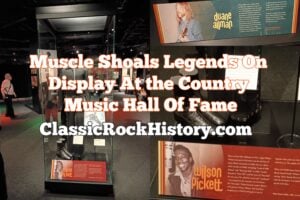
But John was very into it, so he came back. Since then, we’ve released two albums: one was the original songs album, Light ‘Em Up, which we toured for a couple of years. And then, we did a blues album called Lookin’ for Trouble, which was really awesome. We recorded it at Muscle Shoals, in Alabama, and it was seriously a blast. Playing those songs in the studio and live has been really invigorating.
Tell us about your notable guitars.
I’ve had hundreds of guitars through the years, bought, sold, traded everything, and what’s really come to mind in the past 20 years was that my first love was Gibson Les Pauls. And that’s still my love. I have some very special Les Pauls from the ‘70s, and I have a couple of really cool guitars from the ‘50s, like Les Paul Juniors, and a Les Paul Standard from 1968.
I recently acquired a 1953 Les Paul Gold Top, which reminds me of my first guitar: a Gold Top Les Paul. The guitar just had its neck reset, I bought some 1960s PAFs that sound incredible, and now that guitar is just primo. I also have some Custom Shop Gibsons that are amazing that I take on the road with me and sound as good as anything I’ve ever played.
At the moment, I probably have 70-plus guitars, but my favorite will always be the Les Paul. I think I have come full circle from the early ‘70s when I got my first Les Paul until now. In fact, right now, I’m sitting right here next to a Gold Top. [laughs] I still feel like I was just a kid learning how to play.
Catch us up on what you’re doing now and what’s next for you and The Dead Daisies.
At the moment, we are on a hiatus for this year. We’re gonna be doing some stuff privately, writing songs, maybe doing some recording, maybe putting together an album or something. But we’re not gonna tour in 2026 at this moment, although you never know, things always change in rock ‘n’ roll. Right now, I’ve been in my home studio, creating music, experimenting, and brainstorming for the future, so we’ll see what comes of that.
What are you most proud of when you look back on your life and career as a musician?
I think, in a weird way, I’m grateful to the guitar and proud that I somehow managed to make a living with that piece of wood and wire. And at this point in my life, I’ve been able to support a family playing guitar, creating original music, and I couldn’t be more blown away by that, actually.
There’s been some moments on stage and times when I’d be working with someone, for example, with Whitesnake with David, creating a piece of music that we knew was gonna be really cool, but no one had heard it. We created it just from our hearts, and it felt really amazing to do that, or play at a venue that was super famous.
You know, those things always feel amazing, but it all circles back to being a person or a human in this world—and the greatest human achievement I’ve ever done was to become a dad. And it’s thanks to the guitar, music, and the opportunities that I’ve been given that I’ve been able to have a normal life and be a dad and husband.
It’s really cool. I don’t take that lightly. I’m a musician. I’m a guitarist. That’s just what I am. It’s just if you think about me and you say my name, just think about a guitar in music, that’s what I am. That’s a given. But to be a family man and watch my children grow is the end game and the greatest accomplishment of my life.
Check out similar articles on ClassicRockHistory.com Just click on any of the links below……
Read More: Artists’ Interviews Directory At ClassicRockHistory.com
Read More: Classic Rock Bands List And Directory
Read More: 1970s’ Saddest Rock And Pop Songs
Read More: 25 Best Classic Rock Live Albums Of All Time
An Interview With Doug Aldrich Of Dio, Whitesnake & The Dead Daisies article published on ClassicRockHistory.com© 2026
Classicrockhistory.com claims ownership of all its original content and Intellectual property under United States Copyright laws and those of all other foreign countries. No one person, business, or organization is allowed to republish any of our original content anywhere on the web or in print without our permission. All photos used are either public domain Creative Commons photos or licensed officially from Shutterstock under license with ClassicRockHistory.com. All photo credits have been placed at the end of the article. Album Cover Photos are affiliate links and the property of Amazon and are stored on the Amazon server. Any theft of our content will be met with swift legal action against the infringing websites.