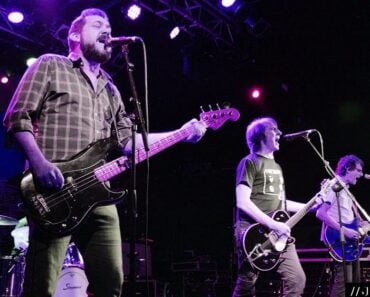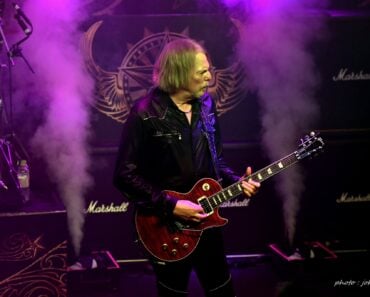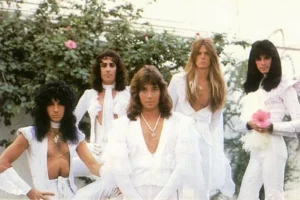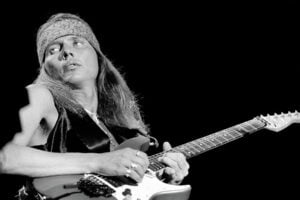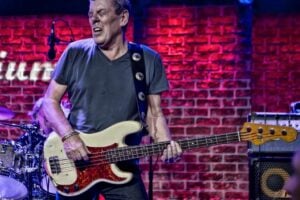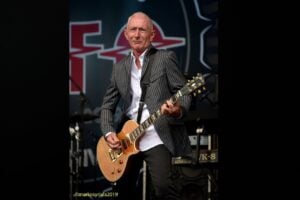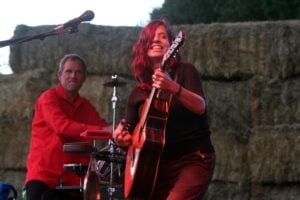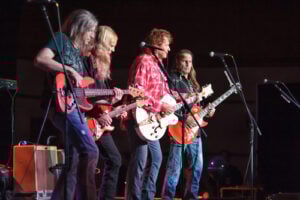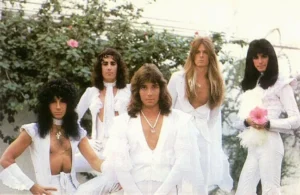
As bassist for Angel in the late ‘70s and early ‘80s, Felix Robinson helped shape the cult group’s pop-meets-heavy-meets-glam image, appearing on 1978’s White Hot, 1979’s Sinful, and the live album, 1980’s Without a Net.
After Angel’s ugly end, Robinson landed on his feet, picking up studio work and eventually helping to found White Lion. Like Angel, White Lion featured great musicianship and had huge promise, but Robinson didn’t stick around.
Robinson provided bass and more to White Lions’ debut, 1986’s Fight to Survive, and left to pursue a career in production and sound work. In the years since, he’s come to terms with the way things ended and even got back in the studio with old pal Punky Meadows and onstage with his former bandmates in Angel.
The latter might continue, though nothing is certain. Looking back, Robinson rejects the idea that his career has been defined by hard luck. “Angel was a great experience,” he tells ClassicRockHistory.com. “We all shared the good times and some not so good, but luck was not the important ingredient.”
“And White Lion, like any other band that I have played and recorded with, it was a blend of easy and also difficult times,” Robinson says. “If anything, my musical career has been almost entirely the result of good luck.”
What inspired you to pick up the bass, and what sort of sound were you going for early on?
I became the bass player in my first band when our bass player quit to join another group, so I dropped the lower strings on my Harmony guitar, and we carried on. The lower parts were easy for me because I had been playing piano, in addition to guitar, for some time and understood scales and notation, plus those were easy tunes.
When do you feel like you figured out the type of player you wanted to be versus what came naturally to you?
I never stopped playing guitar, so I got gigs with different high school bands with both instruments, plus played guitar in our School’s StageBand. That was an 18 Piece Big band playing charts from the top bands of the Swing era. While all that was happening, I was learning from every possible direction.
Of course, The Beatles were huge, so Paul McCartney’s very basic style connected directly with my sensibility as a rock bass player. I wasn’t yet trying to pattern a style; I just wanted to keep working wherever the opportunity arose. And opportunities came – by my senior year, I was in a Las Vegas-bound show band that worked six nights per week, from 12 to 5 AM.
How did the scene around you impact you as a young bassist, and what led to your becoming a professional musician?
After returning from Vegas, I was still only 17 years old. Soon, I got a very desirable gig with one of the most popular live and recording bands in St. Louis. So, before my 18th birthday, I was already a working pro. More great gigs came that brought me to Los Angeles in 1973 to record as a session player at A&M Records in Hollywood. There are so many parts to my story from those years, I guess that should be for another time.
What led to your joining Angel, and what do you think made you a good fit compared to Mickie Jones, whom you replaced?
I was living back in St. Louis from ’76 to ’77, and playing in a great hard rock club band, working constantly, when a friend called to tell me that he was supplying the sound system for a show at the Fox Theatre that night with two groups, Stars and Angel.
He suggested that I come to the show. He said that Angel was destined for success, although they needed a better bass player. About 6 months later, I had moved to L.A. to start a band, The Word, with a record deal planned.
While developing that group, I met Frank DiMino, Punky Meadows, and Greg Giuffria. They invited me to contribute to the songwriting for their next album. Again, there’s lot’s more to tell about so we can expand on all that another time.
What did you think of the musicianship and songwriting within Angel, and what did you bring to the table that made the band stronger?
The songwriting on their first three albums was very AOR and progressive, with some mystical, hard-to-define lyrics. The musicianship was very good, and I could see they had a wide range of musical styles within their skill set.
Whenever we first got together, we played really solid bluesy rock ‘n’ roll as a warm-up, so I realized they were capable of more than what their records seemed to imply. Barry [Brandt] and I just took off like a rocket, and that, I felt, brought Punky and Greg into a greater freedom of improvisation.
I play a very top-end style of bass tone that uses some guitar-style technique with simple chording, where the songs may need more grit, and that supported Punky’s very soaring leads to shine more live. Listen to our live album [Without a Net] to hear the contrast with the older songs, with me playing bass.
We were having really good times during rehearsal for White Hot, and that translated into a very cohesive and punchy rhythm section. Our style was evolving.
White Hot and Sinful are more pop and less prog compared to Angel’s earlier albums. Did you have anything to do with that?
Remember, we were competing with some new, very popular groups, Boston, Foreigner, Cheap Trick, Journey, Styx, all big-selling singles, radio hits. We had to start writing some good radio-playable tunes. We did try, and our manager suggested that we work with other composers, but we resisted, and that, I feel, was a mistake.
It wasn’t just me that changed our direction; it was our mutual understanding of the live music business that was creating our need to adapt. Maybe I brought in a fresh and aggressive way of playing both our existing material and also a different style to the new songs.
What gear did you use on those albums, and while on tour?
I spent too much on a custom bass amp system that I only used for the next tour, then we got the endorsement for Ampeg. I had six SVTs. I bought one of the first Music Man basses from Guitar Center, and had my old Precision modified into an 8 String Stereo. My sound was as much a result of the way I play the bass as it was about the equipment. I play loud. So, I was in the perfect group!
Do you feel Casablanca properly supported Angel and other groups, or was most of the attention on Kiss?
Casablanca and everyone involved did all they could, spent as much of our money as they could (much into their own pockets), and stayed on our side most of the time until our debts, not theirs, began to overwhelm their ability to continue.
It wasn’t just MTV, or Compact discs, or video games, or even the miserable economy that ended our ride. We had every chance and then several more to make use of the great publicity and media generated on our behalf.
We could have stopped touring, stayed at home, kept writing, collaborating, recording, and playing even smaller local gigs to improve ourselves, but the glamour of Hollywood and our semi-celebrity lifestyle were not helping.
Do you have any regrets about how Angel’s end was handled?
My regrets have mostly dissipated by now. Writing some of this has helped, so thanks for that question. Our end was not pretty. We all came together at various times for the next year or so, tried finding another record deal, hung out too much, and reached individual conclusions about what to do next.
I see different versions and descriptions of various people who claimed to have joined Angel during that time, and, of course, Frank and Barry gathered some other players and did some gigs as Angel years later. There are too many variations to bother trying to remember.
How did you end up joining White Lion, and what did you bring to the band, considering you were older than the others?
[laughs] I was only about 4 or 5 years older! After I moved to NYC to get married and start a family, I started getting regular calls from Mike Tramp telling me that I was the new bass player for his band, Lion. He was pestering me, so I told him to find a record deal and a manager and to let me know what was ready, and I would come for a visit.
It took another few weeks, I did a couple of sideman tours to make some money and then he calls me again tell me that he has everything I asked for. So, I drove over to Staten Island, went to the drummer’s house, and met Mike, Vito [Bratta], and Nicki [Capozi].
I plugged into a bass amp, we were in the basement of Nicki’s family home, and I said, “Okay, what do you want to play?” Vito said, “Angel tunes…” So, we did that for about 30 minutes. The drummer was incredible, Vito was all over the place and played some wild licks, sounded like Eddie [Van Halen], and Mike didn’t know any of the tunes.
So, I suggested that we listen to their original material and play some of that. They played some demo recordings of songs. Then they said they had some new songs. I said, “Let’s hear that!” They had a guitar lick intro, and a chorus Idea for maybe three songs, about 60 seconds each.
Did you join after that?
I met with their proposed manager and listened to plans for a record deal, which didn’t make much sense, but I played along, and time went by. We did have fun finishing the songs and composing several others. They had financial backing from club owners in Staten Island, and there were actual music-business-type managers involved, so I joined the band as a full partner.
What did you think of Vito? Could you tell he was special?
I remember Vito as a tireless player and a perfectionist in the Eddie Van Halen style, when not many guitar players could actually pull that off. He had the willingness to practice a lick or a fingering of a guitar part for hours. Yes, he is a special kind of guitar player. I tried to get him to loosen up and play other styles, like blues, Hendrix, and jazz, but Vito’s devotion to that power chord, dive-bomb, super-squeal thing is what made him great at it.
What was it like recording White Lion’s debut, Fight to Survive?
We went to Frankfurt, Germany, and recorded “Fight to Survive.” I played all bass, most of the keyboards, all background vocals, arranged almost every song, and co-wrote five tunes… should have taken credit for more. I had a good time until reality set in. Elektra decided to shelve our album. They released Dokken instead.
After recording with a player like Punky Meadows, how different were the sessions with Vito?
I know that Vito had great respect for Punky. However, he was just coming into his own as the player he eventually became. Vito should answer that question for himself.
How did your bass rig and approach change between Angel and White Lion?
After White Lion got its record deal, I got an endorsement from HiWatt. We only did a few live gigs, so I never got to fully build it out. I continued to use my MusicMan bass and still do.
Vito has said he’s not entirely happy with the sound of Fight to Survive. Do you agree?
When we started to mix, our producer asked us what we wanted to sound like. I think he was just trying to make his job easier. Vito and Mike suggested that we should sound like Scorpions. So, Peter [Hauke], bought their latest album, put it on a turntable in the control room, played a few tracks, and told the engineer, “Make them sound like that.”
I’ve listened to it a few times, and I agree with Vito—but I think it was poorly mastered. I have several ‘board tapes from those sessions, and they sound great, very full and powerful. If you crank up the volume and have a decent system, it does take on a much better sound. Headphones help.
Why did things break down in White Lion, leading to James LoMenzo replacing you? Would you have handled things differently now?
I didn’t want to play in bars again and had already started the rest of my life. So, I quit. And it didn’t particularly bother me that they took a new picture for the album cover and tried to erase me from all promotional material. Life goes on.
After I quit, they just hired players who were available and fit their look. I was a full partner. I wouldn’t change anything except that I would have been much more aggressive in pursuing my legal rights for my compositions and publishing payments.
I am owed considerable sums that I will probably not recoup, although I am currently looking for legal help with that. James LoMenzo is an accomplished musician and has done well after his time with Mike and Vito. Good for him.
What did you do after White Lion, and what led you to hook back up with Punky for his solo album, Fallen Angel, in 2016?
In 1983, I started a new career with Pro Sound, recording studios, Stadium Sound, plus Audio Visual System Integration. Punky and I have always been close, and I will help him whenever he asks. We’ve done regular work together since Angel disbanded, and I did five shows with him and Frank in 2024. I was asked to join full-time, but our timing wasn’t right. I may do more shows in the future.
Check out similar articles on ClassicRockHistory.com Just click on any of the links below……
Read More: Artists’ Interviews Directory At ClassicRockHistory.com
Read More: Classic Rock Bands List And Directory
Read More: 100 Essential Albums From The 1960s That Everyone Should Own
An Interview With Felix Robinson, Formerly Of Angel & White Lion article published on ClassicRockHistory.com© 2026
Classicrockhistory.com claims ownership of all its original content and Intellectual property under United States Copyright laws and those of all other foreign countries. No one person, business, or organization is allowed to republish any of our original content anywhere on the web or in print without our permission. All photos used are either public domain Creative Commons photos or licensed officially from Shutterstock under license with ClassicRockHistory.com. All photo credits have been placed at the end of the article. Album Cover Photos are affiliate links and the property of Amazon and are stored on the Amazon server. Any theft of our content will be met with swift legal action against the infringing websites.