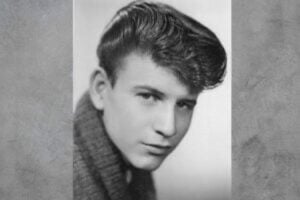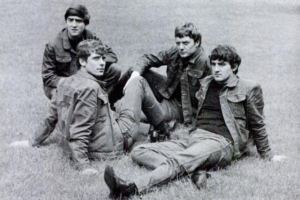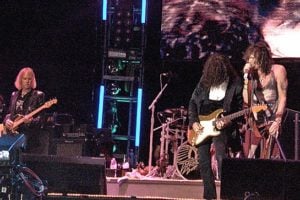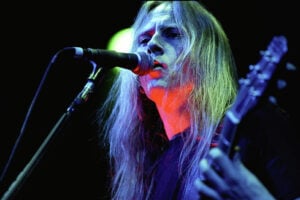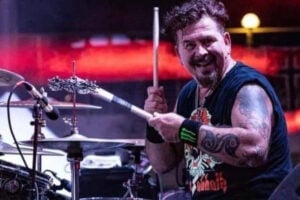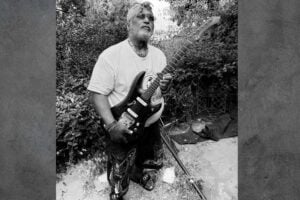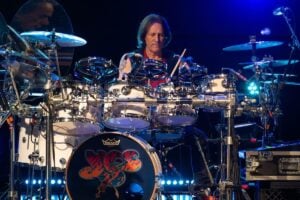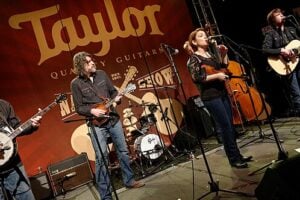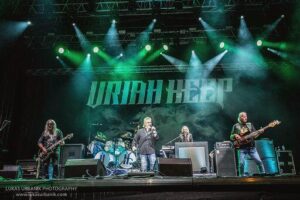
Photo courtesy of Paul Newton
Uriah Heep has been at it for over 50 years and has 25 studio albums under its collective belt. But no Heep albums have been more formative to the band’s sound and story than their first three, 1970’s …Very ‘Evy, Very ‘Umble, 1971’s Salsbury, and the album where original Heep bassist feels the band found its footing, 1971’s Look at Yourself.
Unfortunately for Newton, some of his bandmates and Heep’s management weren’t happy with his contributions, leading to his unceremonious firing and sending his music career into chaos. Still, it can be said that Newton laid the groundwork for the bass grooves that inhabited Heep’s music thereafter, but he refuses to take full credit.
“I sometimes hear one of their bass players doing something like ‘July Morning’ totally different from how I played because that’s how he plays,” Newton tells ClassicRockHistory.com. “Who is to say what’s right or wrong?”
After being fired from Uriah Heep, Newton got into session work, before lean times led him to a more traditional form of construction work. He barely played bass for years, but things changed after he became involved in the local music scene, leading to reunions with former bandmates and a whole lot of healing.
Looking back, Newton has no regrets. And why should he? Life might not have turned out how he imagined as a young gun with a bass in hand, but it all worked out in the end. As for how he looks at the bass and playing music these days, Newton says, “As a musician, I can only work reasonably well with people I get on with.”
Without a good vibe, you don’t make good music,” he explains. “Over the years, I have quit a few good bands because the vibe wasn’t there. I have always worked hard and routined my parts so I can go on stage and have fun. If the band isn’t having fun, the audience won’t. Without an audience, you don’t have a band.”
What are your first memories of music in your life?
I grew up in a house full of music as my mother loved all genres, classical, folk, opera, jazz, skiffle, and pop, so there was always music being played on records or the radio. This led me to get into the skiffle stuff, Lonnie Donegan, etc.
Then I got into rock ‘n’ roll and British pop groups like Cliff Richard, The Shadows, The Fentones, and The Tornadoes. And the beat groups, which led me to buy my first guitar and later a bass guitar, as nobody played bass much at the time.
Everyone wanted to be Hank Marvin, so when local players found out I had a bass, I began getting gigs, and it became my main instrument. Then came the great blues and R&B era, with outfits such as John Mayall’s Bluesbreakers, the Spencer Davis Band, the Yardbirds, and the Downliners Sect. I would sit in my bedroom with my bass and a little amp and play along with the records for hours. Wonderful times.
How did the scene you grew up in impact you as a player?
Massive impact. I used to go to all the package shows and local venues, as well as playing in young amateur bands. Music was my life. I was never into sports, football, etc. Music was my passion. I found myself drawn to bass lines when listening to music, so before I actually got a bass guitar, I would play them on my guitar, a Watkins Rapier. I guess it was meant to be.
The ‘60s were a wild time to come of age. How did that affect you?
The ‘60s were a great era to grow up in, a vibrant time for young people. We had come out of the Austere War era and got our own fashions, our own music. We were never bored, as there was always so much to do and so much choice in entertainment, gigs, etc. I count myself fortunate for being born at the right time. And my parents were always very supportive of my musical aspirations.
Tell us about the formation of Uriah Heep.
I had been working with a band called The Gods with Ken Hensley, Lee Kerslake, and guitarist Joe Konas. A great band at the time, in 1967, but I got frustrated by the lack of success and wanted to try something else. I answered an advertisement in Melody Maker, the musician’s “Bible” back then, for a band needing a bass player, which turned out to be Spice, featuring Mick Box and David Garrick, who later became David Byron.
We immediately hit it off musically and socially, and Spice rapidly became a popular, busy band working all over the UK. This led to a prestigious Saturday night residency at the famous Marquee Club in London’s West End. My father was our manager, and he got us loads of gigs.
He eventually negotiated a management/recording deal with Bron Artiste Management, where we spent a lot of time in the studio and used a session keyboard player for some tracks. It became obvious that we needed a permanent keyboard player, and so I suggested Ken Hensley.
I had kept in touch with Ken after leaving The Gods, who had by this time disbanded. He was working with a band called Toe Fat, and so Ken joined Spice, which was a little later to become Uriah Heep.
What can you say about the recording of Uriah Heep’s first few albums, and the chemistry the band shared?
We had a lot of fun making the first album, Very ‘Eavy, Very ‘Umble, which was 75% completed before Ken became a member. The second album, Salisbury, was maybe a strange follow-up, but an interesting project to work on, and not particularly well received by the critics.
Sadly, cracks were now beginning to manifest themselves and created tension within the band, partly due to one member becoming involved with drugs and another with alcohol, which led to disputes and unrest.
This caused our talented drummer, Keith Baker, to quit. Despite this, the third album, Look at Yourself, was wonderful. It’s one of the best Heep albums ever, and still a pleasure to listen to. It also marked the point at which our music became defined… this was the Uriah Heep.
Generally speaking, how was Uriah Heep received, and what set the band apart from other rock acts from that era?
Right from the start, Heep always played packed houses with mega fan support from the many Spice followers. But within the industry, it was different. Due to a large publicity campaign for our first album, the critics always classed us as a “hype band,” a label which stood for a long time.
Heep were probably the first band to effectively use five-part harmonies in their music, something that was subsequently copied by many others. But we were often classed as a “poor man’s Deep Purple or Led Zeppelin.” The band also had three charismatic members, Mick Box, David Byron, and Ken Hensley, who all possessed great stage craft.
What led you to leave Uriah Heep?
That’s an easy one. I was fired. For some time, the internal problems had been increasing, creating a bad atmosphere. The workload of constant touring and recording in those circumstances made life unpleasant. By this time, I was receiving a lot of criticism regarding my playing from both Hensley and Gerry Bron, our manager.
They had formed an unsavory alliance as Bron recognized the lucrative potential of Ken’s songwriting skills. They were not happy with my work on Look at Yourself, and this, coupled with a legal dispute between my father and Gerry Bron regarding unpaid monies due to my father for his work for us, led to me being called into Bron’s office one day.
He gave me £40—two weeks’ wages at the time—and informed me that I had been replaced. I was now an unemployed musician with 40 quid in my pocket.
Do you regret that given Heep’s longevity, and do you feel you’re given proper credit on the whole?
I sometimes hear this, but my take on it is that I just played bass lines that I felt were suitable for whatever the songs were. It may have set a sort of benchmark for our sound for future bassists, but we all play differently, so another bass player would no doubt have played them differently to suit his own style.
This is what subsequent bass players have, in fact, done. Davey Rimmer plays them his way, Gary Thain played them his way, etc. We are all individuals, and all have different styles, interpretations, and play with what feels right as individuals.
What did you do post-Uriah Heep?
It was a difficult period as they would not return my equipment, which meant I could not get any work. This went on for some time until a legal procedure eventually forced Bron to return it. A couple of roadies pulled up outside my flat and dumped some Marshall gear in the front garden—not all of my kit, but enough to enable me to work.
I picked up a few depping gigs and sessions until I was offered a well-paid job with a band called Festival, who had a residency with Mecca initially at a ballroom in Ilford, and then, at Tottenham Royal. Mecca would move their bands from time to time; one of these moves was to The Cat’s Whiskers in York, and later to a venue in Wakefield, which meant relocating.
It was a totally different ballgame from Heep as we played everything: covers of the current chart music, strict tempo, backing for visiting artistes. But it was bloody good money, no grueling tour schedules, and a good grounding for session work. I did this for a few years, but changing trends and tastes resulted in Mecca changing its policy, getting rid of the bands, and making the venues bingo halls.
So, I was to again become an unemployed musician, but at least I wasn’t skint this time. I wanted to get back into rock music, so I answered ads, attended auditions, but all to no avail. One of my muso mates was a session guitarist and fixer, and he got me into session playing, which gave me work and income.
How did that work out?
With the advent of electronic music, this began to dwindle. A machine could do what I did for far cheaper, so money began to get a bit tight. By now, I’d had enough. I was getting older, and I realized a change of direction in my life was necessary. I trained as a surveyor at college after leaving school and worked as one for a short time before becoming a professional musician.
So, I secured a job in the construction industry and have done that work ever since, eventually becoming a construction manager. I did not play for several years until moving to Herefordshire, where I got friendly with a bunch of local musicians.
This resulted in me dusting off my kit and gigging in various local bands in the evenings after work. It was just pubs and clubs—but all good fun with no pressure, which is how it should be.
What’s been the key to your bass rig, and where does it stand today?
Back then, I always used Marshall equipment and a Fender Jazz Bass. But for many years, at large venues, I have used Ampeg rigs and still do. Although nowadays, those occasions are fewer. For the type of work I do now, I use a TC Electronics or Trace Elliot rig.
And I use a Fender Jazz, or an old Music Man Stingray [bass], which all do the job. And I just D.I through the P.A, if necessary. Modern equipment has gotten smaller over the years, but more effective, unless you have a road crew that wants to lug a load of heavy gear around. [laughs]
What’s something about you that might surprise fans?
As a listener, I now have a very broad-minded taste. It’s not like my younger days, when you tend to get blinkered into a particular genre (e.g., blues & nothing else). There is so much good music out there, & I always say to people that there is no bad music; if something is not to your taste, it doesn’t mean it is bad.
Maybe a surprise to people, for example, would be that one of my favorite tracks is “You’re the One that I Want” [from the Grease soundtrack] because of the killer bass work by David Hungate from Toto that pushes the song along with a wonderful groove.
What are you up to now, and do you keep in touch with your old Uriah Heep bandmates?
I now work with two bands in my area of Ledbury in Herefordshire, where I live with my second wife and my cats. I have had cats since childhood, which has been an important part of my life. I had absolutely no contact with any of the Heep guys for 30 years, from the day I was fired until I got home from work one evening in 2000.
My wife said a guy named John Lawton had telephoned and wanted to speak to me. John had been the Heep vocalist for a while after David Byron was fired, but I had never met him. When I called him back, he explained that he was in touch with Ken Hensley, who was living in the USA, and that they were organizing a show in London.
It was for the Heep fanbase in the U.K. as “The Hensley-Lawton Band,” and he asked if I would be interested in joining them. My reaction was not initially very positive due to the bad blood way back between Ken and myself. But Ken subsequently contacted me and said we should “rebuild bridges.”
So, after a long chat, I agreed to take part. The event was a big success and paved the way for more events in Europe and Scandinavia over the next few years as “Uriah Heep Legends.” This also included drummer Lee Kerslake. It was a great band with four ex-Heep members.
We continued to do this until, sadly, Lee, John, and Ken all died within 12 months of each other, so that was the end of that project. In 2019, out of the blue, Mick Box contacted me to see if I would be interested in doing a guest spot with Heep, along with Lee and John Lawton, at a major festival in the Czech Republic, which I agreed to.
It was a very enjoyable couple of days with Mick and myself swapping tales from the old days. Sadly, Lee was too ill to travel due to his cancer. I also sometimes work with a German band, Circle of Hands, who do an excellent show featuring Heep music material from the 1970’s.
Check out similar articles on ClassicRockHistory.com Just click on any of the links below……
Read More: Artists’ Interviews Directory At ClassicRockHistory.com
Read More: Classic Rock Bands List And Directory
An Interview With Founding Uriah Heep Bassist, Paul Newton article published on ClassicRockHistory.com© 2026
Classicrockhistory.com claims ownership of all its original content and Intellectual property under United States Copyright laws and those of all other foreign countries. No one person, business, or organization is allowed to re-publish any of our original content anywhere on the web or in print without our permission. All photos used are either public domain Creative Commons photos or licensed officially from Shutterstock under license with ClassicRockHistory.com. All photo credits have been placed at the end of the article. Album Cover Photos are affiliate links and the property of Amazon and are stored on the Amazon server. Any theft of our content will be met with swift legal action against the infringing websites.