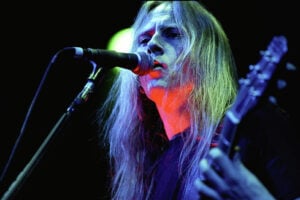
Feature Photo courtesy of Hideki Ishima.
In the late ‘60s and early ‘70s, droves of psych and hard rock bands rolled out of the United States, Europe, and the UK. Of course, this isn’t news—it’s been well documented. But what hasn’t been covered nearly as much is the influx of fabulous groups from the Far East that created these same types of sounds.
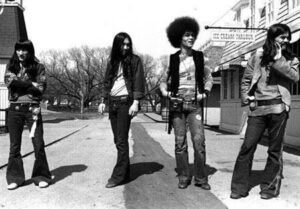
One such band was The Flower Travellin’ Band, which was spearheaded by vocalist Joe Yamanaka, drummer Joji Wada, bassist Ken Hashimoto, and guitarist/sitarist Hideki Ishima. The group, which had a penchant for gnarly covers of popular rock tunes of the day, was nothing short of psych-meets-proto-metal pioneers.
As for Ishima, he was a regular low-key guitar hero, blending Western guitar techniques with Oriental sitar touches to dazzling success. But despite their first two killer albums, 1970’s Anywhere, which consisted mostly of covers, and 1971’s Satori, which was all originals, The Flower Travellin’ Band failed to launch.
After the band broke up in 1973, Ishima released a cult favorite solo album, 1973’s One Day, before falling off the grid and creating a guitar-meets-sitar hybrid, the sitarla. Things might have stayed this way if not for vinyl record collectors beginning to hunt down original copies of the band’s records, reigniting interest in The Flower Travellin’ Band.
This led to a reformation in 2007, a new album in 2008 called We Are Here, and a slate of shows. Sadly, Yamanaka died in 2011, bringing to an end The Flower Travellin’ Band and leaving its remaining members to retreat into solitude.
Now 81, Ishima has no plans to record or tour, though he is proud of the Flower Travellin’ Band’s legacy, simply telling ClassicRockHistory.com: “I wish everyone many blessings,” before granting a rare and relatively candid, if not forgivably absent-minded interview.
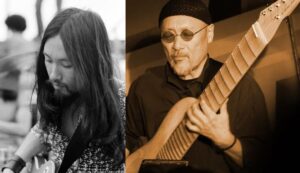
Feature Photo courtesy of Hideki Ishima.
Can you remember your first guitar and amp? Did the guitar come easily to you?
Yes. My first guitar and amp were both Guyatone. I started to learn by copying records that I had. It eventually came to me from there.
What was the music scene like around you growing up, and how did that impact you as a young player?
It was around the time when The Beatles first came out, and that was impactful. After that, I was very influenced by The Yardbirds, The Zombies, and The Kinks. A lot of British Invasion!
When did you decide the type of player you wanted to be?
I am not really sure. I just knew that I wanted to improve who I was as a player. So, I kept practicing guitar and stayed with a single-minded outlook on how I played, wanting to improve. Beyond that, I look at guitar as being invited by something, and I choose it if it rings a bell with me, if that makes sense.
When you formed The Flower Travellin’ Band, what was your intention as far as the band’s guitar sound?
It’s not fun to just keep copying, so we came up with the idea of finding our own identity. Of course, I learned a lot from copying, needless to say. [laughs] And it’s a bit of a long story… when I was doing group sounds, then from fans introduced to Gabor Zabo, I listened to him with interest.
I did some research, and I learned that he also played an instrument called the sitar, and I was curious. At the same time, I got the sitar after that, I started studying My Music My Life by Pandit Ravi Shankar. And we wanted to find a sound that only Orientals could produce, just like Eastern peoples. I think that we just wanted to express something exciting.
Tell us about your recording sessions for Anywhere and Satori.
I don’t remember exactly. But I liked the way those albums came out. I wish I could tell you more… but I can’t remember. It was a long time ago. Unfortunately, I don’t remember this clearly. Sorry about that!
What led you to quit guitar in 1990 and pick up the instrument that you created, the sitarla?
A lot of people think I didn’t pick up the sitar until then. This is wrong. I had been playing sitar, but as you said, this is when the sitarla came. Since I was in my thirties, I’d been thinking, “What is the most touching human instrument?” I kept thinking, and I was convinced it was vocals.
Of course, this is my opinion… but the reason is that I wanted to play the Sitarla like singing. It is really exciting to play with sitar techniques such as “meend,” “gamak,” “krintan,” and “zam zama.”
What led to the reformation of the Flower Travellin’ Band in the 2000s, and how did you bring the sitarla into the music?
Around that time, fans said we wanted to see the Flower Travellin’ Band play live again. So, we got together, and we said, “This is great news!” And with a lot of support, we decided to try to make an album. This album ended up being called We Are Here, which came in 2008. When making that, it wasn’t hard—I just enjoyed playing with my sitarla.
How would you describe yourself as a player now, and are there plans for The Flower Travelin’ Band to work together again?
As a player, I think it’s just about what my soul could have done more than anything else. I’ve done that. As for the second question, I’m very sorry to say that the Flower Travellin’ Band is over now that Joe Yamanaka has passed away.
What are you proudest of when you look back? And how do you view the legacy of the music you created?
We tried to see how much of our music could reach a foreign audience. We wanted to know if our music could do something to the world. It did. I think that it brings back the accumulation of time. And it was really interesting and fun!
Check out similar articles on ClassicRockHistory.com Just click on any of the links below……
Read More: Artists’ Interviews Directory At ClassicRockHistory.com
Read More: Classic Rock Bands List And Directory
Read More: 1970s’ Saddest Rock And Pop Songs
Read More: 25 Best Classic Rock Live Albums Of All Time
An Interview With Hideki Ishima Of Flower Travellin’ Band article published on ClassicRockHistory.com© 2026
Classicrockhistory.com claims ownership of all its original content and Intellectual property under United States Copyright laws and those of all other foreign countries. No one person, business, or organization is allowed to republish any of our original content anywhere on the web or in print without our permission. All photos used are either public domain Creative Commons photos or licensed officially from Shutterstock under license with ClassicRockHistory.com. All photo credits have been placed at the end of the article. Album Cover Photos are affiliate links and the property of Amazon and are stored on the Amazon server. Any theft of our content will be met with swift legal action against the infringing websites.