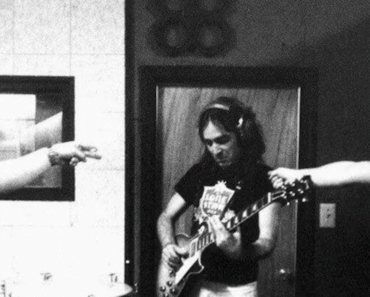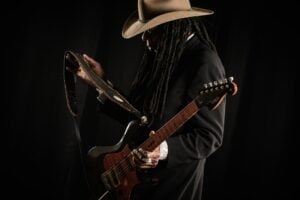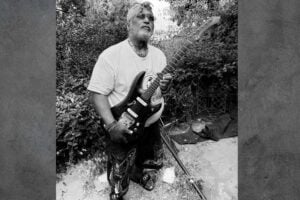
Feature Photo courtesy of Michael Hampton
Affectionately known as Kidd Funkadelic, Michael Hampton has been a mainstay of Parliament-Funkadelic for over 50 years. His solos are legendary, and his impact is towering, having influenced players across every and any genre.
Maybe that’s why now, after so many years in the game, Hampton is able to look back on what does and doesn’t work. “You’ve got to recognize the negative thoughts if they come, say, ‘that’s not me’, and then let them pass,” he tells ClassicRockHistory.com. “That’s not always easy, but it gets easier as you move along in life.”
Hampton has taken those lessons and applied them to his first-ever solo album, Into the Public Domain. “It’s just all the new sounds really,” he says of the album’s vibe. “The sounds that technology lets you make, that’s the biggest inspiration.”
He adds, “Even though I’m not playing super high-technology gear, hearing all the new sounds these musicians around you are making shows you how much is still possible in music as a whole. And these people using technology to play as one-man bands, that really opens up my imagination.”
It’s an interesting spot to be in, considering Hampton is a veteran, albeit an open-minded one. “Me being a guy whose career has spanned between the natural instrument age and the electronic sound age, I can’t help but be amazed by all these developments,” he says.
To that end, Hampton is having a blast and has more new music on the way to apply his newfound gadgetry toward. “I do have some new toys,” he says. “I keep a synth and a sound module to mess around with; I have a drum pad controller loaded with samples. I don’t use any of those to record or play live, and probably never will, but I like to spend time with those to get my imagination moving.”
What was your typical P-Funk rig like, and how has it changed today?
In my early Parliament days, I had a special 1970s Alembic Series 1 that I toured all over with. Early on, when I was in California with the band, I picked up a BC Rich Bich 10-string model. I used that on the “Knee Deep” solo from the One Nation Under a Groove album. I used to get a killer tone playing that with this metal pick a friend got me, a kind Aerosmith used to use, but I lost it.
Let’s see, late ‘70s into early’ 80s, I used a Gibson EDS-1275 Double-Neck. After that, I carried a Gibson 1983 Korina Flying V; I know Kirk Hammett from Metallica packed one of those in their early days. Flying V’s were a standby for me after that. Of course, I used Stratocasters now and then. I’ve been a Hendrix fan since day one.
For guitars on my latest album, Into the Public Domain, there were a few. I had an Ibanez RG series 7-string, which looks somewhat like the Steve Vai model. I had a Firebird-style guitar handmade in New Jersey by a friend of ours named Matt, that’s got some real magic. You can see it in the YouTube video for “Fight or Flight Response”.
The one I used most was a 2005 Epiphone SG Custom. It has a cheap, high-output ceramic humbucker from eBay in the neck and a Gibson USA humbucker in the bridge. I have quite a few PRS guitars too. I can’t recall which one I used, but a PRS is on the album.
I’ve never been a real pedal-head, but in the early days, I most often had a Big Muff with a Morley Wah set up. I plugged in some various Electro-Harmonix pedals now and then. I work with those these days too, but on occasion I like to go clean with the amp turned all the way up to achieve my drive.
It can be fun to try some of the boutique pedals the small companies and DIY guys are selling on sites like Reverb. My rhythm guitarist picked up one from off there called the Gay Frog, a mid-gain boost, that was on Public Domain. For time-based effects, I was using a Boss digital delay in combo with that; it was either a DD-3 or a DD-4.
How about amps? What was the key behind your tone?
For me, what comes out of an amp is really all in the fingers, so to be honest, I never got too picky. I was ok using whatever amps were available. A lot of the Parliament gear changed depending on sessions, then live, we actually used backline gear a lot.
I love discovering new tones and hearing the wild sounds guitarists get today, but I never needed a specific sound or had a desire to establish my own sound. All that being said, back then, I did have a personal liking for Marshall stacks, the JCM800 2203 setup, cranked to the maximum.
Right now, I use a Mesa Dual Rectifier half-stack, which I’ve been touring with for 10 to 20 years. That one is really the best of all worlds. Then, on the Public Domain record, the studio had a 1978 Deluxe Twin that had been modded into a Vibrasonic amp. I played through that a whole lot.
Are there any anecdotes from the recording process of your latest album?
We recorded at two places that had some seriously different vibes. Most of the record was recorded at a home studio in Canyon Country, California. There was a chicken coop about 50 feet from the door, it was a pretty isolated and low-key place. Then, the live tracks towards the end of the album were tracked at the legendary Sunset Sound in LA, in the same room where Prince did the Purple Rain album.
The engineers there told us how Prince tracked drums in the control room, and eventually stuck a cot in the corner. He would sleep in there after everyone went home for the day, then work after hours. He did that for weeks at a time, just trying to get the record perfect.
My band and I, for the album, in our downtime, talked about aliens and UFOs a whole lot, and all the videos and stories the government is starting to release. Most of us have had some really interesting personal experiences that deal with matters of that nature.
Then, during the sessions for King Kong, another album I have coming this spring, we were messing around with a Japanese guitar from the 1980s with a built-in cassette deck. The Casio EG5 Cassette Guitar it’s called, and you can record straight to it, then take the tape out and do whatever you want with it. We didn’t track much with it yet, but it’s coming into the lineup soon.
Oh, and I can’t forget, John Schreffler, our co-producer and pedalsteel player on Public Domain, he just won his first Grammy this year for his involvement in Robert Randolph’s record. Shout out to John! He was a huge factor in the sound we achieved on Public Domain, and his pedal steel playing was a secret sauce for the whole album.
What’s your favorite P-Funk song and solo, and why?
It’s impossible to choose just one. I can at least narrow it down to “Maggot Brain,” “Cosmic Slop,” “Not Just Knee Deep,” and “One Nation Under a Groove.” They’ve all come to take on different meanings for me over time, and they all cause different feelings for me as a player. My favorite one to play and how it makes me feel often change as a tour progresses.
One week it might be “Cosmic Slop” really doing it for me, then the next week, “Not Just Knee Deep.” I never get tired of “Maggot Brain.” There’s this intense, quiet energy that comes into the venue whenever we play that. Some people speak of it as almost a holy moment.
People’s eyes when we play that… I swear I’ve seen some souls once or twice. I’m so proud to represent Eddie’s tradition, so I’ll change my answer, let’s say “Maggot Brain.”
Tell us about what inspired you to pick up the guitar. Can you remember your first guitar and what the scene around you was like?
I was playing anything man, I just wanted to make sounds. As a young boy, I was jumping around the living room with a broom, and I could swear that thing was making sounds. I think my imagination was playing solos! I was inspired by all the music on the radio, and I got even more drawn in when vinyl first started coming around my house.
Not long after that, once I came to understand the details of guitars and saw artists with so many different ones, that was it, I was locked in, I knew I had to have one. I got my first guitar for either Christmas or my birthday. I can’t even remember what it was, but it was from DiFiore’s music on the west side of Cleveland.
My friends and I had been going in there for a long time because they had vinyl and instruments in the same place, and people used to jam along with the records they had on. I started nagging my parents for a guitar, and they eventually agreed to get me one, but nothing fancy, because you know how kids are, they want this thing one day and another thing the next day. They didn’t know if I was going to just throw it in the corner after a week or so and leave it there.
I do remember when we stepped into DiFiore’s that day, and the reality hit me that I was leaving with a guitar; it was as if I blacked out. It was like in the movies when a character’s jaw just drops, the lights around them get dim, and they can’t hear anything. It was as if the rest of the world didn’t exist in that moment. I had been to DiFiore’s so many times, looking at guitars, holding them, playing just a few notes, and now I was going to go home with one? It still makes me smile thinking of it.
A member of the DiFiore family helped me pick one out, and I was just so thankful when they handed it to me. It was like a gift from heaven. I didn’t even care to get a case or a bag with it. I was so excited that I think I just toted it all around the neighborhood in a big trash bag, showing all my friends, and kept it within a few feet of me wherever I was at home.
Did a career in music choose you, or did you choose it?
Music chose me, I believe. I have always loved playing, but the fact that Funkadelic sought me out, that is something you can’t choose to make happen; that was fate at work. And even before that, opportunities to play were always ending up in front of me. There were always people in my neighborhood needing a player.
Then that group would break up, and immediately I’d meet another crew. I just kept meeting those types of folks without even trying to; I was always getting to play with new people. But back to Funkadelic, I got the invite out of the blue to come play with them. Tiki Fulwood, their drummer, he called me from DC with the news.
So, a career in music was literally calling me. Tiki told me there was a guy in Detroit that they had been thinking about bringing in, but the guy had a bad acid trip, something of that sort, so I feel like the universe had something to do with that. There’s a chance I never would have played with them if that guy didn’t bug out.
I can’t say I didn’t have much choice in it all. I did have it locked into my mind as a kid that I was going to keep on playing no matter what, keep on practicing no matter what. That was in my mind from the day I started playing alone on my porch. But I mean, to end up in the Rock & Roll Hall of Fame, a lot of things way out of your control have to go right for you along the way.
Is it true that when you were 17, you played “Maggot Brain” note-for-note?
Ed Sparks, this guy I was acquainted with from my area’s music scene, he knew members of Funkadelic. At the time, Ed’s band Electric Sparks had just broken up, and he was trying to get playing again, so he let me and my cousin keep our equipment at his place to practice. We all became friends, and eventually Ed offered to take us to see Funkadelic at Public Hall in Cleveland, and told us we might be able to meet the band.
Ed knew the whole routine of getting into a big venue by going there early and just walking right in, looking and acting like you were supposed to be there. This was in the days before security started getting all tough, asking for your ticket or backstage pass, so we went there and slid right in. We waited in a corner, Parliament eventually went on, and my mind was blown.
After the show, they ended up coming to Ed’s house for an afterparty. We kept our equipment at Ed’s place in those days, and when we got there, people started playing, and Ed says, “Michael, Michael, go play ‘Maggot Brain’ for them…” Looking back, I think it may have been almost sort of an informal audition Ed had arranged.
That didn’t click for me at the time, though, or else I probably would have fallen on my face. I felt like I was just playing it for fun. My cousin grabbed a bass and played the rhythm part. He’s a bit more extroverted than me, so all his energy made me feel more at ease. It felt like the light on me wasn’t so blinding. And that was it, they were impressed. I eventually got the call to fly to DC and play at the Capitol Centre for my first gig.
I may have played it somewhere near note-for-note, but it was just what I knew it to be. I wasn’t aiming to be perfect with it; I didn’t go in trying to win them over by exactly replicating Eddie’s work. I was definitely practicing “Maggot Brain” in my spare time a whole lot in that era, but that night I just locked in, let it out, and hoped for the best. It went better than I could have ever imagined.
What was it like replacing and later working with Eddie Hazel?
From my early days, I was always good at picking up skills from players around me, and it was like that with Eddie, but on a whole other level. I learned a lot just by being near him. I was like a huge sponge, just soaking up everything he did, paying attention to his every move, every sound he made.
I can’t explain how impressed I was being close to him all the time. He had this enormous imagination and heart, which I could feel his original style was coming from. But also, and this is interesting, I actually think his hands were really different than most people’s. By his “hands,” I don’t mean his speed or touch; I mean his hands themselves. They were physically different and unique.
In the days when I didn’t know yet how to ask him to teach me something, he would almost sense my curiosity and silently teach. He would use the technique a lot, which I was wondering about, or play the part around me all day that I didn’t know yet.
But he wasn’t waiting around for me to pick anything up; he wasn’t slowing himself down. Then once I realized what was going on—that this guy was never going to show me where to put my hands for this song, or carefully demonstrate the arrangements—it made me feel like he believed in me, so that empowered me.
Once I got comfortable enough to really ask him some things and push for answers, I sort of became like his nagging little brother. Personality-wise, though, we really clicked. He was really patient with me, never got mad or said anything like “No, no, you’re not doing this right.” I’ll admit I was a knucklehead at times; I started getting brave and acting beyond my experience as a new guy. But I knew he could shut me down, and he did sometimes, thoughtfully.
Having Eddie around helped me keep my head on straight in those early days. He had quite a personality; he was a jokester on occasion. He would put out this wizard-y type vibe at times, we used to call him Smirnoff, which of course is a liquor, but it felt like it could be a wizard name. He would sometimes put off a pirate vibe, then other days a Three Musketeers-knight sort of vibe.
I guess it was an extension of the costumes we all wore. But he wasn’t just goofing around playing characters all the time; he was a real streetwise guy, too. When we started doing “Maggot Brain” together, he would usually kick it off, but only do a bit from the front end of the studio solo version. He just ran with his feelings live, wasn’t concerned about note-for-note.
Then, when he’d be done doing his thing, I’d start it all over again from the top, but this time play it more formally, how it was on the recording. He’d eventually dip back in, and we’d meet towards the end of the song and get heavy. We’d almost be battling at the end. In some venues, the mix would get so crowded and distorted that it would start to sound like one signal, as if we had united into one super guitar player.
As far as the biggest thing I picked up from him, it was his trademark, playing masterful rhythmic types of leads—almost playing rhythm and lead at the same time, but without stepping on his own toes, or anyone else’s toes in the band. Even these days, now and again, I go back and listen to him soloing to refresh my mind on that technique. I listen specifically to his nuances. I almost try to ignore the exact notes and just listen “around the edges,” if that makes sense.
Drugs were a big part of the P-Funk experience. When you look back, how did that impact the music and players?
They made the sessions really interesting, that’s for sure! It wasn’t just to feel good though, substances became an application to take us past the same licks, the same techniques, same progressions. We started attempting to do more creatively, instead of just being safe with the music. Substances can help you be more innovative, but at the end of the day, you can’t try and depend on them to create.
They can be like fertilizer to grow ideas better and faster, but too much fertilizer and you poison any plant, right? You can’t forget the natural growth elements, the sun, the soil, and the water. That is to say, the natural ways of becoming your best can’t be beat: practicing and more practicing, studying your heroes and learning how they play, taking time to prepare creatively before sessions, strategies like that.
If you could scrap who you are as a player today, and build yourself as a model, imagine in your head, would you do it?
I wouldn’t do that, because my development happened naturally, and that’s probably a big part of why people feel the energy they feel when I play. I’m not sure redesigning myself would even work, because if you force something creatively, it’s not going to come out right, you know? You got to just let go and let it happen.
You do have to practice, and you do have to set your sights on an end result —but don’t beat yourself up when creating, don’t say “I’m not good enough.” Everyone hears you differently than you do. They don’t hear those frustrating thoughts in your head. Sometimes they may even like what you think was a mistake you made!
Do you have any regrets?
Everyone has regrets once in a while, but if you dwell on them, you’re just wasting life. You can’t run from them; that’ll tangle you up, but you can’t dwell on them either. So sure, I think about how certain things could have gone differently sometimes, but I won’t let a bunch of negativity emerge from that.
On the flip side, what are you proudest of?
I’m most proud of having a full career in a group like P-Funk, spending my lifetime as a main element of that great legacy. You see bands all over that have one hit, then it’s done. They split up for stupid reasons. They start up as best friends, and the industry turns them into enemies.
They stop trying to improve and get cocky. And the heart of P-Funk has remained intact, in different forms, for decades and decades. I don’t think about it too often, but I know I have influenced many players, or so I’m told. It’s hard for me grasp sometimes. I mean, I still get nervous, too!
What’s next for you and P-Funk?
Much of the same is ahead, just continuing to spread the spirit we built, doing what we all love for the people who love it. Touring can get tiring, but still, I step on that stage, and a real energy is there every night. It’s a supernatural exchange between the band and the audience, and there’s nothing like it.
As far as my solo work, my band and the producers with me now, we’re on a roll. Our new album, Into the Public Domain, is a real accomplishment, and we’ve even got two more albums coming this year: King Kong and The Kidd. We’ve got some unpredictable viral happenings coming up, some super-limited merch drops, and even some secret shows in the works. Stay tuned on social media!
Check out similar articles on ClassicRockHistory.com Just click on any of the links below……
Read More: Artists’ Interviews Directory At ClassicRockHistory.com
Read More: Classic Rock Bands List And Directory
Read More: 100 Essential Albums From The 1960s That Everyone Should Own
An Interview With Michael Hampton Of Parliament-Funkadelic article published on ClassicRockHistory.com© 2026
Classicrockhistory.com claims ownership of all its original content and Intellectual property under United States Copyright laws and those of all other foreign countries. No one person, business, or organization is allowed to re-publish any of our original content anywhere on the web or in print without our permission. All photos used are either public domain Creative Commons photos or licensed officially from Shutterstock under license with ClassicRockHistory.com. All photo credits have been placed at the end of the article. Album Cover Photos are affiliate links and the property of Amazon and are stored on the Amazon server. Any theft of our content will be met with swift legal action against the infringing websites.