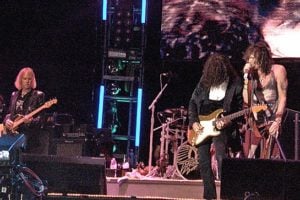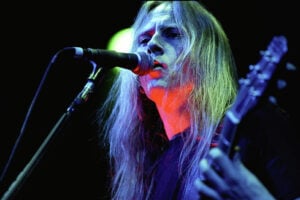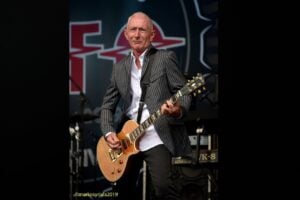
In the late ‘70s and into the ‘80s, Neil Carter lived out his rock ‘n’ roll dreams, joining UFO and then Gary Moore before leaving the music business altogether.
But things changed in 2019, when Carter resolved to see UFO “one last time,” leading him to reconnect with his old bandmates and rejoin the band for its final run. Sadly, said run was truncated, and the Covid-19 pandemic cut the band short.
Still, Carter—who is still friends with UFO frontman Phil Mogg and has joined his Moggs Motel project—looks back on his second act as a rocker fondly. “I have to say the experience was one of the happiest times of my life,” he tells ClassicRockHistory.com.
“So, imagine what a blow it was to have Covid come and ruin it,” he says. “We had so much planned.”
What are your earliest memories of music in your life?
I can remember that as a child, there was always music around me, mostly classical, and I learned the piano and clarinet from when I was 10 years old. My mother was very involved with the local operatic society.
As time went on, I played clarinet in the orchestra for that, and in the Brighton Youth Orchestra. All I ever concentrated on at school was music, and I was going on to make a career as a classical player, but fate intervened when I was given a bass guitar for Christmas when I was 14.
When did the guitar come into the picture, and when did you decide what sort of player you wanted to be?
I started on bass with my first band, but I was heavily into David Bowie and Queen, and both Mick Ronson and Brian May were my heroes, so I progressed on to six-string pretty quickly. I missed out on [Eric] Clapton and [Jeff] Beck and the late ‘60s early ‘70s guitarists because I was a bit younger, so glam rock was what I started with.
Mick’s playing on Aladdin Sane, the sound and the vibrato, and Brian May’s musical mastery on Queen II were my touchstones. The early Queen and Bowie albums I knew back to front, but I also listened to Ritchie Blackmore and Jimmy Page.
Funnily enough, there is a song on Moggs Motel that I played lead on, and Phil made a comment (favorably) that it was “a bit Mick Ronson…” Well… you see, fifty-plus years later, it’s still an influence.
How did you make the jump from amateur to professional musician?
I joined a band called Wilder, who were semi-professional with big aspirations. We played covers and some original material. I was the lead singer and didn’t play an instrument with them.
However, in 1978, the entire band was given the opportunity to be Gilbert O’ Sullivan’s backing group for a tour of the UK and Ireland as he wanted more of a rock sound. As the singer, I was surplus to requirements, but I played a number of instruments, so I was useful. And it gave me a taste of what I wanted to achieve.
What gear were you working with early on, and what inspired those choices?
Well, I went through so many guitars, mostly copies when copies were frowned upon, but I had an Ibanez and eventually a couple of Gibsons, an SG, and another one that I can never remember the name of. I still had that when I joined UFO, which was only just over two years after making the jump to being professional.
With Gilbert, keyboards were provided, but there was a Fender Rhodes, a Clavinet, a Solina string machine, and the most bizarre thing, an electric harpsichord. All very organic! I was also playing flute and saxophone. He bought the flute for the tour, and I still have it. I tended to go for the type of guitars my heroes played, as I’m sure most people do when they start.
What led to your joining UFO in the early ‘80s?
I was in a band called Wild Horses, my first proper band, formed by Brian Robertson from Thin Lizzy and Jimmy Bain from Rainbow, and Dio. I played guitar, some lead, and sang backing vocals. It was a real rock ‘n’ roll outfit with all the excesses of the time.
But I felt after a while that I wanted a change, and UFO came along at just the right time. They were about to headline the Reading Festival in England, so it was a big deal and an incredible step up for me. I was recommended to them by Phil Collen, then of the band Girl.
What are your memories of making those early to mid ‘80s UFO albums?
The Wild the Willing was almost done when I joined, but I added the backing vocals and the dreaded saxophone. It was very exciting for me as the band was doing well, but there was a lot of waste financially with that album; they were producing themselves, so nobody was in control.
With Mechanix, we went to Queen’s studio in Montreux, which was wonderful, and I can remember some great times there. It did go on a bit longer than it should have, as the producer was as bad as the band in the party department.
In fact, at the start of Making Contact, we had to draft in another producer to put us back on track. By then, Pete Way had left, and we had parted company with our old manager. That period of UFO is divisive amongst the diehard UFO/Michael Schenker fans.
People feel it wasn’t like the “old” UFO, but you do the best you can and hope people like it as much as you do. Technology had come on so much and we sort of went with it. With Phil singing, it’s never anything but UFO, though.
What led to the end of your time with UFO back then, and how did you end up with Gary Moore?
UFO sadly were crashing and burning due to a number of factors, none of them musical, I might add, and we decided to quit midway through a very grim European tour. Pete’s leaving was the beginning of the end, but the band had also been on a treadmill for so many years, and it took its toll.
There were some great and some not-so-great times. After a regroup and farewell tour of the U.K., that was it. Although if you’d told me then I’d be with them again 36 years later, I wouldn’t have believed it!
But, at the last gig, I had an approach from Gary to come and have a play as he needed someone to do a tour of the US. It was only meant to be for that one tour, but we really clicked, and I got taken on permanently. It helped that I could play guitar, keys, and sing, so all bases were covered.
What was working with Gary like, and what lessons did you learn from him?
He was quite exacting of both himself and us, and sometimes that was a challenge, but it really worked well and produced some excellent work. He was very professional back then, and it was a breath of fresh air after the chaos of the 1980s UFO.
Also, as we had a rather large cast of drummers over the years, I got to play with some fantastic people, like Ian Paice, Eric Singer, Paul Thompson, and Cozy Powell. That’s not to mention the people we auditioned!
You ventured away from rock music before rejoining UFO years later. What led to that?
In simple terms, Gary making a blues album! At the end of the 1989 tour, I could sort of see he was getting frustrated with rock music and wanted to do something else. In hindsight, it was the best thing he could have done, but I was left somewhat dangling!
I went back to the beginning and studied classical music, started teaching to keep myself busy, and then it was like an avalanche! I loved it and ended up with a full-time post at one of the UK’s top independent schools. I think I was there for 22 years.
Gary’s children went to the school, and that’s how we reconnected, and it led to me playing with him again in 2010, just before he passed. After that, I decided rock wasn’t a good fit for me, so I sold my gear, and in 2014, we relocated to the Canary Islands.
I gave up work apart from continuing as a music examiner. Whilst back in England in 2019, I noticed UFO were on their final tour, so I thought, “I must see them one final time.” I really loved it. It was such a great atmosphere, and you could see the warmth there.
As we know, shortly after that, Paul Raymond passed away, and Phil asked me if I’d finish the tour with them. I had no gear at all; I had to buy a guitar, which, where I live, wasn’t the easiest thing; I used Paul’s keys.
Is UFO truly done, and how do you look back on it all if it is?
The band is sadly no more, which was inevitable, really, but it was a good run! I have great memories and really miss the guys, especially Andy Parker. Phil asked me to be involved in a new project, and Moggs Motel has done really well.
I was amazed to be creating new music after such a long time. We are in regular contact, and I have a house near him, so when I go back to check on it later in the year, I’m hoping we can get together. We have a shared sense of humor, and I consider him a friend, and I’m very fond of him.
Where does your rig stand today, and what goes into your choices?
Well, I’m not playing live at the moment, but I have a small home studio and have been writing some new stuff for Moggs Motel. I now possess three guitars: a Gibson Nighthawk, which was the one I bought to rejoin UFO.
And I have a guitar made for me by Nicholas Guitars in Connecticut, and a Duesenberg, which is a sexy-looking thing. If Moggs Motel does some gigs, I think I will revert to the tried and trusted 50-watt Marshall stack.
But I’m not sure what keys I would get. My tech in UFO was trying to get me to use an iPad and controller keyboard, but that sort of goes against the grain for an old fogey like me. [laughs]
What’s next for you in all lanes?
I have done a couple of collaborations, one with a Swedish-Irish folk band that has reimagined a couple of Gary’s songs, which have been fun. And of course, the Motel might be taking bookings and playing some shows, but I still play the clarinet and examine music, so I’m as busy as I want to be.
Check out similar articles on ClassicRockHistory.com Just click on any of the links below……
Read More: Artists’ Interviews Directory At ClassicRockHistory.com
Read More: Classic Rock Bands List And Directory
Read More: 100 Essential Albums From The 1960s That Everyone Should Own
An Interview With Neil Carter Of UFO, And Formerly Of Gary Moore’s Band article published on ClassicRockHistory.com© 2026
Classicrockhistory.com claims ownership of all its original content and Intellectual property under United States Copyright laws and those of all other foreign countries. No one person, business, or organization is allowed to republish any of our original content anywhere on the web or in print without our permission. All photos used are either public domain Creative Commons photos or licensed officially from Shutterstock under license with ClassicRockHistory.com. All photo credits have been placed at the end of the article. Album Cover Photos are affiliate links and the property of Amazon and are stored on the Amazon server. Any theft of our content will be met with swift legal action against the infringing websites.