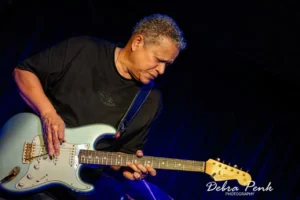
Feature Photo by Debra Penk
Mick Jagger, Blondie, Run-DMC, Robert Palmer, Steve Winwood, and David Lee Roth are some of the biggest names music has to offer, let alone from the ‘80s. Grandeur aside, one thing they all have in common is that their music was forever changed by session maestro, Eddie Martinez.
Palmer’s “Simply Irresistible,” and “Addicted to Love,” Roth’s Crazy from the Heat EP, and Run-DMCs “Rock Box,” and “King of Rock” are a few notable examples of Martinez’s heavy-hitting, yet tasteful playing. With that, it’s obvious that Martinez is nothing short of a guitar hero, albeit in a different form than the likes of Eddie Van Halen and Steve Vai.
Ever the humble technician, Martinez rebuffs this idea, telling ClassicRockHistory.com, “That praise is flattering, but the guitar hero praise vibe isn’t real. If anything, I’m humbled by it but not defined by it.”
He explains, “Simply put, I was playing on some killer songs, and my job was to find parts, hooks to enhance the song, and most importantly to serve the song. It’s a big mistake for anyone to believe all that guitar hero sh*t.”
As for what he can confidently lay claim to, Martinez says, “What I do believe is that I had a sound that tapped into the zeitgeist at that time, and for that I’m grateful. What is real is managing things when all the blocks do fall into place.”
“All of this is fleeting,” Martinez reminds. “And conversely, the blocks do fall out of place if you’re in this business for a long time. Personally, I like to keep an even keel about things, so I never get too stoked when things are riding high and never too down when things aren’t. That’s real.”
What are your earliest memories of music in your life?
There was always a lot of Latin music at home, and especially around the holidays. Tito Puente, Machito, Eddie Palmieri, and Tito Rodriguez were my parents’ favorites. I was drawn to music on TV as well as the radio.
So, theme songs for TV shows were big for me. I still recall how complex and dissonant Nelson Riddle’s Theme from the TV show The Untouchables was, or Peter Rugolo’s theme for The Fugitive was; I just loved the pizzicato strings in that theme.
I do remember being really little and seeing Jerry Lee Lewis on American Bandstand. That rocked in a very big way, and I never forgot it. I remember telling Dick Clark about that when I did Bandstand with Lenny White, who is one of our great drummers.
What specifically drew you to the guitar, and when did you decide what sort of player you wanted to be?
For me, it started with The Beatles. I saw the Beatles on Ed Sullivan. Over and above their look, the music was so new, fresh, and to me at such a young age, it rang differently in my ears compared to everything else on Top 40 radio.
Then came Hendrix, Jeff Beck, Eric Clapton, Albert King, B.B. King, and Mike Bloomfield, and my mind was totally blown. I wanted to be a versatile player who could lock in with a rhythm section and, conversely, crank up a Marshall and create a siren’s wail, power chords, and more.
How did the scene you grew up in affect you as a player?
That’s an interesting question that I don’t quite know how to answer. There weren’t too many kids listening to the aforementioned guitarists in my neighborhood in the South Bronx. I was literally in my own world within my neighborhood. But luckily, in high school, I managed to find friends who listened to the same music that I did.
What led you to make the move to session work?
I believe it was a logical progression for me. I didn’t want to tour incessantly and wanted to immerse myself in the recording world. It was my objective and not an easy one to break into, but I was determined. It’s something that I wanted to do from the get-go.
More importantly, in the late ‘80s, I had a family and didn’t want to be on the road endlessly, missing out on seeing my daughter grow up. And, when I did tour with Robert Palmer, luckily the tours were in months and not years, as other big tours of that time. How ironic that now, in 2026, performing and touring are the dominant commodities, and a thriving recording scene is a shadow of what it once was.
How did you know you’d be versatile enough?
In regard to versatility, I’ve always been a believer in learning as much as you can and tucking it in the back of your mind. Those things will find a way of coming to the fore when you need it. When I was a kid, starting out, my desire and energy to play and contribute preceded most things, including the fear of perhaps not being versatile.
Plus, if I were worried about that, it would be such a waste of mental space. Overthinking things can really get you stuck, and most importantly, you won’t be present to what is happening in the moment, especially if you’re trying to be in a collaborative space. Plus, having amazing mentors was a real blessing, as well as understanding guitar parts, hooks, motifs, etc.
What sort of gear were you using in your early days, and what was your intention from an artistic perspective?
When I first started doing sessions, it was a ’58 [Fender] Strat that I bought at We Buy on 48th Street [in New York City], still in High School, for $270. That was all the money back then! That was it, along with a couple of pedals, probably a Boss Chorus when it first came out, and an early Boss Overdrive pedal.
Then, I got the early grey Boss pedalboard. Looking back, it sure was primitive, but it was all I had, and it served a purpose. Then, around ’81, I got a DiMarzio Strat body along with a Schecter neck and EMGs. John Suhr put it all together for me, and it was a great workhorse guitar that powered some of the hits along with my Hamer Prototype that Jol Dantzig put in my hands.
That was a DiMarzio-powered guitar with pickups modded by Steve Blucher. That was an amazing guitar, right for that time. My plan was to have the best D.I. clean sound for the funky and pop stuff to cut through the dense reverbs and synths back then, and a Humbucker-powered guitar for big sounds and solos, along with Strats.
In those days, the guitar amps in most studios were sketchy and sounded like crap, so D.I. made the guitar sound tighter for funk and pop.
You worked with Blondie for a bit. How did that happen, and what was that like?
I got a tip that Blondie was holding auditions at a rehearsal studio on the West Side [of New York City] in the 30s. I called and set up an audition. Honesty, I didn’t feel I would fit the casting call. So, I went down with the sole intention of having fun and not necessarily trying too hard to get the gig.
I plugged in my Strat and dimmed the amp. We played for a couple of hours. Debbie Harry took a Polaroid at first, then, after playing, I got back on the D train to The Bronx. When I arrived at my apartment an hour or so later, there was a message with a phone number. I called and was told the gig was mine.
Albums like Robert Palmer’s Riptide, Steve Winwood’s Back in the Highlife, and David Lee Roth’s Crazy from the Heat put you on the map. What was it like working on those, and how did your life change thereafter?
Riptide, Crazy from the Heat, and Back in the Highlife were huge for me. Riptide, in particular, was a much more involved musical project that encouraged experimentation. It wasn’t an ad hoc recording session. I was able to have a larger voice in shaping my guitar tones with Robert Palmer, Bernard Edwards, and engineer Jason Corsaro.
The size and fidelity of that record still hold up. Robert was such an explorer, an incredible composer, and without fear. And, above all that he was an incredible vocalist. Bernard was at the helm of melding big, explosive sounds along with music that sold in the millions.
He was brilliant in his economy in how he constructed his productions. Addicted sounded huge and different in how it popped sonically. I knew it was a hit while recording it. And Back in the Highlife was a mind-blower as well. Steve Winwood is such a consummate composer and singer.
Hearing his vocals while playing “Higher Love” and “Freedom Overspill” was very special. He’s an extraordinary artist, and again, I knew it was going to be an enormous hit. Russ Titleman’s production was impeccable. And David Lee Roth’s Crazy from the Heat was cut live in Studio A at Power Station, with all the amazing players assembled in the room playing at the same time… how novel!
I believe we cut a track a day, the music was performed live, and no additional layering of parts. The vocals were done later. Dave was cool and thanked us all for being available for the project. Producer Ted Templeman was chill and a pleasure to record with.
Was there ever a thought of joining any of those artists full-time?
I felt the closest connection to Robert’s music; it was such a blend of huge-sounding Rock, along with funk, percolating along with Robert’s incredible knowledge of polyrhythms and harmony. I felt that there was a very special musical chemistry that I, along with Dony Wynn [drums] and Frank Blair [bass], had with Robert onstage and in the studio.
It was magical. I had stopped touring after Blondie until the Robert Palmer tours. In fact, I refused the first time I was asked to tour. Robert’s drummer, Dony Wynn, flew to NY to hang, and I kinda convinced me to jump in. I’m glad I did; it was a total blast!
What was it like working with Mick Jagger on She’s The Boss? Were you a big Stones fan?
Working with Mick Jagger was great! I recorded with him in the Bahamas and in New York. Bill Laswell called and asked if I could get to Compass Point Studios to help out with cutting tracks. Recording with Jeff Beck was really special because he had always been a hero.
What an incredible guitarist and inspiration, but when recording, it was about the music, but deep inside, I was playing with a true hero with a singular voice. It was quite an incredible group of musicians, with Chuck Leavell, Sly and Robbie, and Michael Shrieve, in the Bahamas. I also recorded quite a bit in NY with Mick, along with Nile Rodgers, who was producing.
You also played with Mick at Live Aid. Was that a lot to take in?
The energy and power of what we put out with Mick, along with Tina Turner, Daryl Hall, and John Oates, was met with an energy by the audience that I don’t think I’ve felt again since that moment. There was such a thunderous roar from everyone in JFK Stadium in Philadelphia. Mick and Tina put on an incredible performance.
I’ll never forget that feeling. It was an absolutely incredible once-in-a-lifetime experience. It was great to play with G.E. Smith as well. It’s a funny thing about those big moments because you know it’s historic, but you have to compartmentalize those emotions and focus on the music and the performance at hand. That’s the job; reflection comes later.
What led to your getting the call to work with Run-DMC, an innovative collaboration that led to rock and hip-hop colliding?
Larry Smith, who wrote and produced those early, groundbreaking records, was a dear friend. We played in bands together, along with Omar Hakim and Denzil Miller, when we first started out. Larry and I played in punk bands as well. He called me for the big guitar crunch on “Rock Box” and “King of Rock.”
While working with Run-DMC, did you realize you were making history?
No, I honestly didn’t know it would make history, but I’m grateful that it has become historic. When it came out, it really blew up in a great way!
Artists like Prince and Questlove have praised your work with Run-DMC. What does that mean to you?
Accolades from Prince and Questlove are something quite special to absorb. I first met Questlove backstage at Jimmy Fallon several years ago. Roots Guitarist Kirk Douglas was a gracious host and introduced me to Questlove and Jimmy. Questlove’s quite an incredible drummer and musician, and is a musical encyclopedia. He is brilliant, and I’m flattered by his comments.
In regards to Prince, I met him and heard his band before he became a superstar. We toured together when I was playing with drummer Lenny White and Twennynine on Rick James’s tour. Rick James was the headliner, Prince was second billed, and we opened the show.
When we heard them play at soundcheck, I knew it wouldn’t be very long before Prince would be the headliner. It was very much like hearing the future in the present. He was an iconoclast in every way. I’m still friends with Dez Dickerson and Andre Cymone to this day. Man, that first band was so special!
Tell us about recording “Simply Irresistible” with Robert Palmer, which became a huge hit.
It was always great recording with Robert, and this time was no different. “Addicted to Love” was tracked live, but “Simply Irresistible” was ostensibly an overdub vibe for me. It was waiting for me when I arrived in Milan. It was a skeleton track with drums, bass, and synths.
I fleshed it out with lots of guitars, hooks, etc. It was magical putting it together, and I can still see the smile on Robert’s face when we put the guitars on. It was just the two engineers and us, Tim Kramer. I remember Dony Wynn coming in for a second and coining the phrase “Rhino” after listening to it.
It was a beautiful canvas to paint on. Sometimes you can feel a song is going to be huge, and that’s how I felt about “Simply Irresistible.” The Heavy Nova album was recorded on SR Dolby, and Riptide was on a Sony 24-track digital. Although I’m a big analog fan, I prefer the sound and fidelity of the Riptide album.
Throughout the ‘90s and 2000s, you steadily put out work. What kept you inspired and pushing boundaries?
Working with great artists, musicians, composers, amazing engineers, and producers who inspire you. That was the vibe at Power Station back then, and the same today when playing with musical friends.
Tell us about your guitars, along with the amps and pedals that accent your tone.
I’m pretty much a Stratocaster player, but humbucker-driven guitars fit the bill in the mid-80s. In those days, I wouldn’t put a humbucker in a Strat. I was late to the Floyd Rose as well because I was drawn to the Fender tremolo, but seriously, the Floyd Rose became a necessity because of the demands of the music in the ’80s.
As far as my guitar arsenal is concerned, I use Suhr guitars as well as Fenders and guitars built by Randy Wood, Saul Koll, Bill Chapin, and Jack Briggs. I also have vintage Gibsons and Fender Strats. As far as amps are concerned, I use amps by Suhr, Benson, Bludotone, Fender, and Boogie.
When you’re on a project, your presence is immediately felt. Can you put your finger on that?
That is one of the kindest things I’ve ever heard said about me. I’ve always believed that there is strength and power in humility. It’s all about a quiet confidence and not to get too deep, but if you’re projecting a vibe of camaraderie to your fellow musicians onstage and being present to project to the audience as well, I’m convinced the audience will feel it.
Catch us up on what you’re doing now and what’s next for you?
Well, I have an EP that’s way overdue titled Elephant The ’95 Sessions, and it’s ready to drop. I’ll be beginning on a new album this year and have some very cool recording projects I’m embarking on as well.
Do you have any regrets?
Regrets? Of course, there are regrets and failures that have happened along the way. It manifests itself in many ways, such as poor choices or intellectual property being lifted, stolen, however you want to call it. Nobody, no matter how successful, is immune to it happening to them.
That said, you want to minimize that shit—but it’s how you adjust to adversity because the past has no bearing on today in the present. Dwelling on the past serves no one, and it becomes a racket in your mind that can consume you. I let that shit go a long time ago and focus on now and today.

Feature Photo by Paul Natkin
Check out similar articles on ClassicRockHistory.com Just click on any of the links below……
Read More: Artists’ Interviews Directory At ClassicRockHistory.com
Read More: Classic Rock Bands List And Directory
Read More: 1970s’ Saddest Rock And Pop Songs
Read More: 25 Best Classic Rock Live Albums Of All Time
An Interview With Session Legend Eddie Martinez article published on ClassicRockHistory.com© 2026
Classicrockhistory.com claims ownership of all its original content and Intellectual property under United States Copyright laws and those of all other foreign countries. No one person, business, or organization is allowed to republish any of our original content anywhere on the web or in print without our permission. All photos used are either public domain Creative Commons photos or licensed officially from Shutterstock under license with ClassicRockHistory.com. All photo credits have been placed at the end of the article. Album Cover Photos are affiliate links and the property of Amazon and are stored on the Amazon server. Any theft of our content will be met with swift legal action against the infringing websites.