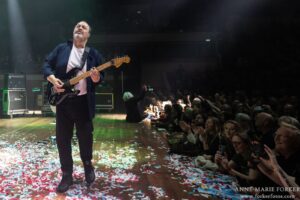
Feature Photo by Forker Fotos-Anne Marie Forker
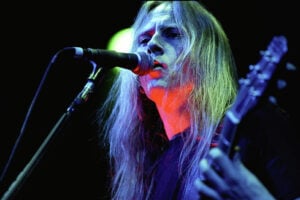
Steve Rothery is a prog rock icon who helped spearhead the ‘80s neo-prog movement, but he admits that at the time, he didn’t get as much attention as the shredding six-stringers who perpetrated hair metal on the Sunset Strip.
“I didn’t really get that much attention from the guitar magazines,” Rother tells ClassicRockHistory.com. “Our style of music was so unfashionable, and a lot of journalists didn’t really get its appeal.”
The “our” in question is Marillion, an outfit out of the UK, who rattled off albums like 1983’s Script for a Jester’s Tear, 1984’s Fugazi, and 1985’s Misplaced Childhood, which eventually would become classics.
Beyond those albums, despite changing trends and the music business’s general volatility, Marillion kept at it. Now, they’re working on their 19th record, which is due out toward the end of 2026. Through it all, Rothery has kept a level head. “I think I’ve influenced some young players,” he says.
Adding, “But I don’t know how much, as my playing has always been more about melody, atmosphere, and emotion rather than shredding. I try to play just what the song needs with as much passion as possible. Every note counts, so I probably look like I’m concentrating on playing more than throwing shapes.”
As for regrets, Rothery has but one: “My only regret,” he says. “Is spending way too much money on Porsches when I should have been paying off my mortgage, but generally I think everything has turned out pretty well.”
What are your earliest memories of music in your life?
Probably listening to The Beatles. About thirty years ago, my uncle played me a tape recording of me singing “Love Me Do” from when I must have been around three. I was around thirteen when I started buying albums of film soundtracks by John Barry and Ron Goodman.
What specifically drew you to the guitar, and when did you decide what sort of player you wanted to be?
From around the age of ten, I always thought that there was something quite magical about the guitar, but I suppose it was when I started listening to Alan Freeman’s Rock Show on a Saturday afternoon that I discovered Genesis (amongst others), and that style of music deeply resonated with me.
How did the scene you grew up in affect you as a player?
There wasn’t really a scene in Whitby at that time. It felt like they’d only just discovered Elvis! There was one local band I liked called North Star that played original music and were great musicians.
You grew up into punk music, right? With that in mind, what made you the right guitarist for Marillion?
Most of the people I was in my first band with were heavily into punk, but although I quite liked The Jam, The Stranglers, and The Clash, I was a lot more into progressive rock. I think I passed the audition for what was, at the time, The Silmarillion, because we shared a lot of the same influences and because I wrote original ideas.
What sort of gear were you using in the early days of the band, and what was your intention from an artistic perspective!?
I used a Laney 4×12 cabinet and an Orange overdrive amp with a couple of pedals. I bought a Stratocaster copy when I was 15, followed by a Fender Stratocaster when I was 17, followed by a Yamaha SG2000 when I was 18. I wanted to create interesting guitar sounds, even if I was playing Beatles covers in a dodgy pub. I started using tape delays and trying to experiment with different pedals.
Marillion went on to spearhead the ‘80s neo-prog movement. Did you have any idea that you might be doing something different?
Not really; we were just playing a style of music influenced by what we grew up listening to and what we loved. I suppose we were slightly unusual in that we were also influenced by the punk/new wave movement in terms of the energy and passion in what we did.
It seemed very natural to us, really. There was no master plan, just to play the kind of music that resonated with us. By this time, there was a generation hungry to discover their own style of music and not the punk/new wave of their elder siblings.
Script for a Jesters Tear, Fugazi, and Misplaced Childhood went on to be classics. What do you recall about putting them together, and how did you feel about them then versus now?
Script was a steep learning curve, but a fantastic experience. We stayed together in a house in London and worked at the Marquee studios in Soho, that was attached to the club, where we’d be let in by the security to watch whatever bands were playing that day. London in 1983 was a very different kind of place from Aylesbury, where I’d lived since moving down from Whitby in 1979.
Misplaced Childhood was the album that changed our lives. After Fugazi failed to sell as well as Script, we were close to being dropped by EMI, so we decided to make one last album and to make it a concept album, so at least we’d go out doing what we loved.
The writing of the album came together quite quickly, and recording in Berlin with Rolling Stones producer Chris Kimsey finally captured the energy we had as a live band. The first fifteen minutes of side one were recorded in a single take with very few overdubs.
Berlin was a fascinating place, pulsing with a dark energy, and although with all the partying, I think we aged about two years in the two months we recorded there. The unexpected success of “Kayleigh” led to platinum albums and stadium tours (at least in Europe).
What kept Marillion going despite lineup changes and differing musical trends in the ‘90s?
We never lost our passion for music or the desire to create something special. We were never fashionable, so we just plotted our own course and had the support of an amazing fan base that believed in us. We just managed to survive even when things looked very grim financially after getting dropped by EMI.
When you look back on the band, how do you view its impact on prog music? And how about your own impact on prog guitar?
I think we’ve added something to the Prog scene over the years, although for me it’s not really about how Prog we’ve been, but more about how we’ve blended influences to produce something different over the last 44 years and 18 albums.
Throughout the 2000s, you steadily put out solo work. What kept you inspired and pushing boundaries?
Music is my life, and it’s still what I think about constantly. I feel like there’s so much that I want to write and record while I can and while there’s an audience for it—before AI-generated music completely takes over. This is the final nail in the coffin for most musicians trying to make a living, especially with most music being consumed by streaming these days.
Tell us about your notable guitars, along with the amps and pedals that accent your notable tone.
After the Yamaha SG 2000/Laney/Orange setup I used for Script, I discovered the Roland JC-120 amplifier, which I used with a Stratocaster-type guitar, various Boss pedals, and a Marshall JCM 800 amplifier.
I used variations of this setup until 1999, when I started using Groove Tubes valve amplifiers and a Blade RH4 Super Stratocaster with a TC-2290/Lexicon MPX G2 and various pedals (Hughes and Kettner Rotosphere and Roger Linn Adrenalinn pedal).
I started using guitars built for me by Jack Dent after the Marbles album. On more recent albums, including my Bioscope album and the album that’s coming out with Steve Hackett in June, I use an Eventide H90 pedal quite a lot.
Catch us up on what you’re doing now and what’s next for you?
We’re currently in the studio writing and recording for the new—and 19th—Marillion album that will hopefully come out later this year. We have many concerts across Europe from the summer onwards, including two sold-out shows at Pompeii, which I’m really looking forward to. The album with Steve Hackett, which took us eight years of two or three-day sessions twice a year, is coming out, and I’m very excited to hear people’s reaction to it.
Check out similar articles on ClassicRockHistory.com Just click on any of the links below……
Read More: Artists’ Interviews Directory At ClassicRockHistory.com
Read More: Classic Rock Bands List And Directory
Read More: 25 Best Classic Rock Live Albums Of All Time
Steve Rothery Of Marillion Interview article published on ClassicRockHistory.com© 2026
Classicrockhistory.com claims ownership of all its original content and Intellectual property under United States Copyright laws and those of all other foreign countries. No one person, business, or organization is allowed to republish any of our original content anywhere on the web or in print without our permission. All photos used are either public domain Creative Commons photos or licensed officially from Shutterstock under license with ClassicRockHistory.com. All photo credits have been placed at the end of the article. Album Cover Photos are affiliate links and the property of Amazon and are stored on the Amazon server. Any theft of our content will be met with swift legal action against the infringing websites.