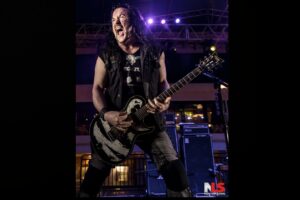
Feature Photo Credit NLS-Neil Lim Sang Courtesy of Tommy Bolan
Like many of us who are born and raised in New York, guitarist Tommy Bolan’s energy is undeniable. “I’m an overcaffeinated New Yorker,” Bolan tells ClassicRockHistory.com. “I am always a pedal to the metal, with a ‘get it done now’ kind of mentality. [laughs]”
That style served Bolan well, as he found himself beside metal icon Doro Pesch in the late ‘80s, leading to a gig with German powerhouse Warlock and the recording of the now-classic 1987 album Triumph and Agony.
Fans will remember the hit song, “All We Are,” from that record. It features Bolan’s hyper-charged style and defines a generation for power metal-loving fans. Since then, Bolan formed Freight Train Jane with Black N’ Blue’s Jamie St. James and hooked back up with Doro for various reunions to celebrate Warlock’s music.
“There was definitely immediate chemistry,” Bolan says of his vibe with Doro. “She always said she wanted us to be like the next Bon Scott and Angus Young. She even said Metal Hammer magazine at the time I joined, ‘Tommy is absolutely amazing. I’ve never been so impressed by a guitarist in my life. He’s somebody I really need. His inspiration and playing make me sing better!’”
As for what it is that Bolan possesses that keeps Doro—and others—coming back for me, he says, “My high school friend John Evans, who would also teach for me, described my playing back then as ‘slash n crash.’ I still have that energy and interpretation of the instrument and push my limits all the time as best I can.”
“I’m still playing from the heart,” he insists. “I always have passion in my playing, whether it’s writing a song, riffing, or bringing it live to the stage—it has to be real to me.”
Indeed. And Bolan is still keeping it real. This time, with his band, N.Y.C., who have a new record out called Built to Destroy. “All of these songs mean something to me,” Bolan says. “They capture different elements of my life, and allow me to express, vent, and heal.”
“Overall,” he says. “I am proud of the theme of the album. It captures the element of where I’m at in this moment in my life. It’s like the title says: I’m built to destroy. [laughs]”
What inspired you to pick up the guitar?
I would have to say it would be when I discovered Kiss. I really dug the music and the whole look and energy of the band, and it really inspired me a lot. Before I was even playing guitar, I did one of those” fake” Kiss shows, and I got a few friends, and we all dressed up as Kiss.
I cut out cardboard guitars and got empty ice cream containers from Baskin-Robbins Ice Cream Parlor and painted them as a drum set. We charged admission and sold tickets for a show in a backyard in Queens [New York].
We basically came out jumping around and lip-syncing to Alive! and parts of Destroyer and Rock n Roll Over. It was crazy, and there’s even a pic of me as Gene Simmons on my Instagram from that show! A month later, I started taking guitar lessons.
Did the guitar come easily to you?
It was tough for the first six months, and then suddenly it broke through from all my practice, and it became easier. I excelled very quickly, so I was told. And then, after two and a half years of lessons, I was asked to teach at the Music Studio where I took lessons, Larry Downes Music Studio in Jackson Heights, Queens.
What was the scene around you like growing up, and how did that impact you as a young player?
The scene for me was basically all cover bands, trying to play all the local clubs and network—always trying to get the good gig and the great club, and all the headache of getting that together. As for impact, it made you jam with a lot of people and also figure out a lot of music by ear. So, it helped my “ear” a lot to hear it and then just play it.
When did you decide the type of player you wanted to be, and what led you to want to make music your career?
I would have to say the player I have evolved organically from all that I was doing. The minute I started playing shows in clubs at 15, I wanted to do this forever. There was never any doubt—I was committed to it, or I would eventually be committed. [laughs]
What gear were you working with when you started out?
I eventually went through a bunch of amps. I discovered a lot at the studio I gave and took lessons at, as they also sold and bought gear. So, literally, a lot of choices were right in front of me, and I would read anything I could get my hands on, like magazines.
I played all the gear in Sam Ash, driving them nuts as I would play for hours in there. [laughs] So, the next was a Stage 720 2-12, then a Sunn Sceptre on a 3-12 vertical Sunn cab. Then, I put a Sunn Beta Lead 2-12 combo on top of the 3-12.
After those blew up, I got some old Marshalls and had many Peaveys along the way. I had a Bandit, Classic, Renown, and even a Mace, and eventually VTM’s. As for my main guitar, it was a Gibson tobacco burst Les Paul special from maybe 1973, with P-90’s and a badass bridge- I added DiMarzio DLX pickups to it.
And eventually, I added a Kahler, but for my first six years of playing, I never had a whammy bar. I did buy a ‘73 cream-colored Fender Strat, but I kept throwing it out of tune. [laughs] And then came some Kramers with Floyd’s and Dean and Charvels and Jacksons. After that, I would endorse ESP for many years, but now I am rockin’ and endorsing Schecter’s, which are great.
What led to your getting the gig with Doro Pesch’s Warlock? Was there an audition?
The producer of my band at the time, Venus, was Joey Balin, and he started working with Doro. Joey was a very big fan of my playing, and it turns out, he was talking about me to Doro and her manager for a while, etc.
So, one day my singer, Willy Mosquera, tells me, “Joey Balin wants you to call him at one am…” I go, “One AM… what the fuck?” [laughs] But as Joey is serous person, I made the call. He said he was working with Doro and wanted me to come down and play on some demos and bring all my gear.
I said,” All of it?” He said, “Yes.” He told me to rent a van, and he’d pay for it. At this point, I had about six stacks of amps and over a dozen or so guitars… yes, I was out of my mind. [laughs] And at the end of the conversation, he said very quietly to me, almost covering the phone, “This could be good for you… really good for you.”
How did you react to that?
The hair on the back of my neck went up. [laughs] After I hung up, I then broke out the Rockman and played for two hours. [laughs] So, I bring it all and go to the Power Station in Manhattan, where we would later record Triumph and Agony.
I got there and set up, and eventually Doro got there and saw all my gear and me warming up and working myself into a full lather in the other room, you know, through the studio glass, and playing with a lot of energy, as if I was live on stage. For me, the studio is very much like the stage with the element of passion, etc.
Also, I guess Joey wanted me to bring all the gear so she could see my commitment to my craft. And I remember she asked, “Is this all yours?” [laughs] Anyway, Joey had three songs for me to play on: “East Meets West,” “Three Minute Warning,” and “Make Time for Love.”
What was it like working with them?
It was always easy to work with Joey, so I already had that chemistry. I just started creating stuff where he needed it and created a lot of the guitar hooks and tattoos around her voice that eventually wound up the same on the final record as that demo.
After a bit of playing, Doro asked if I wanted to play on an album. At this point, she was really digging my energy, and after I said, “Yes,” she started clapping her hands, smiling, and talking to her manager, who was there, in German. She sounded extremely happy.
How did you find out that you got the gig?
We took a break after a bit, and Joey said to me in the Hallway, “You’re doing great and making me proud. This is great. Now you’re going to Germany to do the album.” I finished the session and went home, and Joey called me the next day to say I aced it, and everyone loved what I did.
He called and said, ” Come to Manhattan. I’ve got a surprise for you…” I got all dressed up, got a 220v haircut, and went to like the 80th floor of some huge building on 8th Avenue. There I met Joey, Doro, and her other manager, Alex.
He proceeded to tell me how much he loved my playing and what I did on the songs, and Doro did as well. He goes, “We want you to join Warlock.” I said, “Yes,” and Doro started clapping and smiling again with happiness. And then, the manager goes, “Oh, by the way… you can’t tell anyone for two weeks…”
Why was that?
They still had to sort some stuff out with members who would be leaving. So, I kept quiet as best I could. [laughs] But Doro and Joey’s belief in me back then changed my life forever.
Was your chemistry with Doro immediate? What was it like working with her?
The chemistry was immediate, as I worked closely with her and Joey on the album after the other members went home, with no other guest studio players. It was Joey, Doro, and me working on the record. I was putting down the final guitars, and she was doing her vocals, and then I redid most of the other rhythm guitarist’s tracks at her request, as she wanted my energy there. And I was there for the final mixing of the record as well
How did your life change after joining Warlock?
It was really easy going, and we did it at the Power Station. I remember the Chinese food we kept ordering in was awesome. [laugh] It was great to see all the moving parts of a band move together- we were recording and on tour, and making a video
We were being planned around, and people all over the world were working towards this album’s success, like Polygram Records, press, and promotion. I was now living in Manhattan. I’d never seen all of the business stiff that that up close before… it was awesome to be part of and to be considered a valuable part of the situation as well.
What do you remember about the sessions for Triumph and Agony, which ended up being very successful?
One recording session story that stands out was the time we rented John Suhr’s Bradshaw rig… Joey and I went to his place before we started recording, and he had a full rig with the “Jose [EVH] Modded “Marshall, and Joey figured this would save studio time and get all the sounds we needed quickly in the studio, etc.
The rig sounded great, and John was a super cool guy, too. So, John brings it on the first day, and I am getting ready to record “I Rule the Ruins.” Well, unfortunately, John accidentally unplugged the speaker from the amp and plugged it into the “Bradshaw brain” input, basically cooking it.
So now, it had near no sustain and was basically near cooked. I remember him calling Bradshaw and everyone trying to figure it out. I kept redoing parts, but there was no sustain for the lead work and riffs. I played so hard in the solo in multiple takes that my fingers started bleeding, and I even broke a string at the end of the actual solo on the album.
But I managed to work a line out and keep it in tune, but that’s why that song has an overall different sound than the others on the album. After hours of that, we switched to my rack and amps for the rest of the album. [laughs]
You kept working with Doro after Warlock ended. Tell us about the bond you share.
There is a bond, in my opinion, that is still there. The Triumph and Agony album has had a big impact on both of us—and in a good way. So, I hadn’t played or really even talked with Doro in many years, although when I moved to LA the year after Warlock and started my new band Freight Train Jane with Jamie St. James from Black N/ Blue.
By coincidence, Doro was in town. Gene Simmons and Tommy Thayer were working on and producing her new album [Doro], and I would see Tommy around. He would say she always talks so positively about me. This was proven to me again when Jamie told me one day, as I arrived at his house, “There’s a message on my machine for you…”
It was a message left for Jamie from Gene Simmons. In part of it, Gene said to the effect, “I’m here working with Doro, and there’s a song here that would really be cool for your boy Tommy to play on.” I was stunned, and it was cool to hear Gene say that and talk about me.
But unfortunately, as Freight Train Jane had such serious momentum and serious people behind us at the time, I never followed up on that and stayed solely on the Freight Train Jane track. Looking back now, I wish I had. It would have been really cool.
After that, I saw her once in Manhattan in 2000 when she was playing with Dio and Yngwie [Malmsteen]. It was so great to see her, and I could feel the energy from her, as Doro is very big into the vibes and reading your energy. She pulled me into the hallway from the dressing room and said, “You are the best guitar player I ever played with. I made the biggest mistake letting you go.”
How did that make you feel?
It was awesome to hear that and a bit sad, as I will always wonder what music we could have created together if there hadn’t been, as I say, “Too many cooks in the kitchen” at the time when the Triumph and Agony tour ended.
Then, in 2015, I jumped on stage in Anaheim and Hollywood and played with her and the band, and the energy was great. This was followed by a call from her to play on the anniversary of Triumph and Agony. I came back for some European and USA festivals, like Wacken, Sweden Rock, Hellfest, etc., as well as some USA tour dates.
Also, there was the recording of the Triumph and Agony live album. I also recorded and wrote/sang on her Forever Warriors Forever United album. There was a cool song called “If I Can’t Have You, No One Will” that was written by me, Doro, and Johan Hegg [Amon Amarth], who added some lyrics and also sang it with Doro. Doro has said to me many times, “I always know where your heart is.”
What led to the formation of your band, N.Y.C.?
I basically had enough of everything. [laughs] I was fed up and disgusted with all the bullshit, so it was great branching out on my own. Now, I had creative control, started writing a lot of music, and at this time decided to start singing.
I actually recorded my first real three-song demo for this project with my friend Tommy Henriksen, who was Warlock’s bassist and is also with Alice Cooper and Hollywood Vampires, engineering it. He played on one song as well.
The next step was to have my best friend, Chaz Pease, former Freight Train Jane drummer, get involved. We tried and worked like hell, but could not get it to the point we needed. After this ran its course, I played with Richie Ramone and did his comeback record and tour for Entitled.
Then, I got the call from Doro and was back into that rockin’, as I mentioned earlier. And then, it all changed when I met Adrenalizing Media. They got involved with me, and N.Y.C. was back and in overdrive.
This was awesome, as the owner, Markus Liedtke, was fully behind the band. It opened a huge number of opportunities. They are a great company and great people as well. Not only was I able to branch—but I grew a whole fucking forest! [laughs]
What’s the story behind the new N.Y.C. album, Built to Destroy?
As I mentioned, when Adrenalizing Media got involved, the playing field changed. I was able to write, make, and produce the album I wanted to hear. It also gave me the opportunity to work with some great people and friends. We had a great studio to record at Deep End Music Studios in Burbank, CA. I had Kenny Meriedeth engineering it, and Robert Vosgien mastered it.
I had VFX Wizard and Oscar-winning Walter Schulz work on my videos. And I had Stet Howland, who was with W.A.S.P. and Metal Church, on drums, and Steve Unger, who was also with Metal Church, on bass. I was already friends with Stet, and when Warlock and Metal Church toured together recently, I got to talking to them and mentioned what I was up to.
It was then that I saw what I now call “The N.Y.C. Rhythm Section from Hell.” [laughs] They came in for three days of rehearsal and two days of recording and nailed it. I then added the vocals and final guitars after they left, and they are ready to rock this on tour as well.
Are there plans to work with Doro in the future?
Actually, Doro also just called me three days ago. She wants me to play with her at the Hells Heroes Festival on March 19, 2026, in Houston, Texas. This will be a cool Warlock show, as I have played this festival with her before
As for N.Y.C., what does the future hold?
Up next is touring and some shows worldwide. And then we will do more gigs and shows. After that, we’ll book another tour and throw in a few festival shows. So, on the road we go! I hope everyone digs it, takes the time to check it out, and feels the energy we have put into this.
It’s been getting a great response and reviews so far. There are some great opportunities coming up, and I can’t wait for people to see this live. After all that, there will be af follow-up recording and more touring.
What are you proudest of when you look back?
I would have to say my work with Warlock and the Triumph and Agony album. And seeing how much that album has meant to so many people, after talking with fans that I’ve met, and reading their comments about it.
But most recently, I would have to say this N.Y.C. album, Built to Destroy. It was and is a great ongoing experience, and it has opened up a whole new world for me. I made the album that I wanted to hear.
![Built to Destroy [Explicit]](https://m.media-amazon.com/images/I/41fpgQAI0sL._SL500_.jpg)
Check out similar articles on ClassicRockHistory.com Just click on any of the links below……
Tommy Bolan of Warlock & Doro: 15 Albums That Changed My Life
Read More: Artists’ Interviews Directory At ClassicRockHistory.com
Read More: Classic Rock Bands List And Directory
An Interview With Tommy Bolan Of Warlock, Doro Pesch & N.Y.C. article published on ClassicRockHistory.com© 2025
Classicrockhistory.com claims ownership of all its original content and Intellectual property under United States Copyright laws and those of all other foreign countries. No one person, business, or organization is allowed to re-publish any of our original content anywhere on the web or in print without our permission. All photos used are either public domain Creative Commons photos or licensed officially from Shutterstock under license with ClassicRockHistory.com. All photo credits have been placed at the end of the article. Album Cover Photos are affiliate links and the property of Amazon and are stored on the Amazon server. Any theft of our content will be met with swift legal action against the infringing websites.