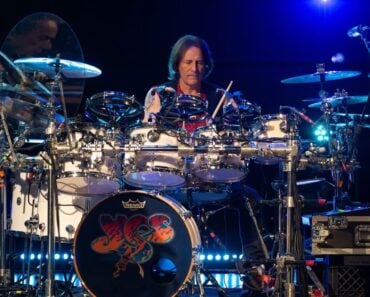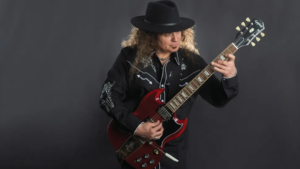
Feature Photo by GRETCHEN-JOHNSON
For Vinnie Moore, the guitar and the music he’s created have always been an extension of his mind and body. “Music was always there,” Moore tells ClassicRockHistory.com. “What you listen to is always going to influence and inspire, you gravitate toward things you like.”
What Moore liked, and still likes, is six-string-based instrumental rock, accented by melodic interludes and gnarly solos. It comes naturally to him, mainly because it’s bred from his core. “I love what I do,” Moore says.
“It’s all I ever wanted to do,” he adds. “There’s not much more to it, other than I keep moving forward and doing what I love. Thank God I could keep going… it wasn’t always easy, but I kept pushing.”
You might know Moore’s licks from his classic solo records, 1986’s Mind’s Eye, 1988’s Time Odyssey, or 1991’s Meltdown. And then there’s the record he made with Alice Cooper, 1991’s Hey Stoopid, which also featured Steve Vai, Slash, and Mick Mars, and the supporting tour that followed.
Elsewhere, you might have caught Moore’s vibe while he was with UFO from 1999 through 2024, where he featured on seven records and numerous tours. That makes Moore the band’s longest-tenured lead guitarist, and the kind of player whose presence you miss when he’s not around.
“That is something that I was not aware of,” Moore admits of his importance to UFO’s soundscape. “But I have had people tell me that they knew it was me when they’ve heard something, and that’s actually a huge compliment to me for sure.”
Even after all these years, Moore still isn’t sure what makes his playing stand out from the rest. “I can’t put my finger on what makes me whatever people perceive me as being,” he shrugs. “No clue. I don’t even want to think about that.”
“Maybe I should start to throw knives at my guitars onstage,” he laughs. “Then people would be like, ‘Oh, yeah, that’s the guitar stabber guy.’ [laughs] Sounds like a great gimmick, especially since I don’t breathe fire. [laugh]”
What are your earliest memories of music in your life?
First memories are of hearing songs on the radio and records being played in my house. Music was everywhere, and for as long as I can remember, it has touched me in a very deep way. Songs would make me feel strong emotion, and I just naturally connected with them. It’s amazing how you can hear a song, and it will take you right back to where you were when you first heard it.
What specifically drew you to the guitar, and when did you decide what sort of player you wanted to be?
I was into bands like The Beatles, Led Zeppelin, Deep Purple, and Queen, which are all guitar-oriented, of course, and that was why I was attracted to guitar. I have never decided what type of player I wanted to be, actually. That happened organically.
I was influenced by the music I was listening to and just rolled with it. Even later on, there was never really a plan. You get into music that moves you, and that shapes what you do as a player.
What led you to play on Vicious Rumors’ debut, Soldiers of the Night?
I had been talking to Mike Varney at Shrapnel Records about recording something, and one day he called to mention that he was doing a record with Vicious Rumors and asked if I would be interested in being a part of it. I liked their demos and thought it would be a cool thing.
Was there talk of you joining the band? Tell us about recording “Invader.”
So, I went out to CA to rehearse with them for the record. Initially, the plan was for me to be in the band. I was there for four months, and we rehearsed and eventually made the album. During that time, the band started to grow and change a little, but I wasn’t quite moving in the same direction as them.
I started to question whether it was the right fit for me and also if I was the right guy for them. At a certain point, I started to feel that I wanted to start my own band where I would be writing more of the music and could move in my own direction stylistically. I am happy to have been a part of that, and I think it was a really good thing for all of us. We made a record that people still talk about all these years later.
Tell us about recording “Invader.”
As far as “Invader” and all of the other solos on the record, I have always been critical, pretty much like everything I have ever recorded. [laughs] I did all of those solos in about six hours one evening. I could have done better, but I was pressured by the limited amount of time.
My demo of “Invader” was much better than the version on the album. I wish I could find that tape; I’ve been searching for it over the years, but so far, no luck. I tried to dismiss the record for quite a while because I was not so happy with my performance.
But it was one of my first learning experiences as far as being in the studio, and that was very important. I learned that six hours just ain’t enough and that I don’t respond well to being rushed. [laughs] But you do the best you can at all times.
You mentioned Mike Varney. How did you two meet?
I started talking to Mike after sending him my demo for his column in Guitar Player Magazine called Spotlight for New Talent. I ended up being featured in that a few months later. That, fortunately, led to many good things for me, including the Pepsi commercial. After the Vicious Rumors thing, my intention was to put together a band with a vocalist.
What led to your going solo?
The demo I had sent to Mike included a couple of vocal songs that I had written, but it was mostly instrumental stuff. A couple of months down the road, Mike brought up the idea of me making an instrumental album. He thought I excelled at that sort of thing and that it could be a good move.
I didn’t actually see myself going in that direction and resisted for quite a while. But the more I thought about it, the more I began to realize that it could be a good idea. I sure as hell didn’t have a singer, so it started to make more sense. I had been heavily inspired by guitar and instrumental stuff from Jeff Beck to Al DiMeola, to Larry Carlton, etc. S
So, I decided to go with it and started to get busy writing songs, but in the beginning, I honestly didn’t know how I was going to come up with a full album’s worth of material. Seemed like a daunting task. Luckily, I was able to get into a groove, and it all started to flow song by song, one at a time. Little steps until I had enough.
Once you got going in that direction, did you have a specific vision in mind?
The thinking at the time was that I would make the Mind’s Eye record to try to establish a name for myself and then put a band together with a singer for a follow-up. However, when the album came out, it surprisingly did much better than we had anticipated and created a huge buzz for me. So, we had to rethink the plot.
With it doing so well, it was pretty clear that I had to follow it up with another instrumental record… which was good because I’ve always been a little “mental” anyway. [laughs] So, that’s how it all happened. I didn’t plan for things to go that way, but I just kept getting pulled in deeper, you know, “Just when I thought I was out, they pull me back in.” [laughs]
Did you feel at home in the so-called “shred era?”
At the time, I was totally unaware of a shred era or any era at all, for that matter. Mind’s Eye was recorded in 1986, and the so-called “shred” thing was something that really wasn’t talked about until two or three years later. I was lucky enough to be at the forefront of all that, I guess.
To be honest, I hated the term “shred.” To me, it referred to someone playing fast all over the guitar without any substance. From the very beginning, I wanted to write songs with catchy melodies that created moods. The technical part of it was secondary for me.
But I did have some chops, and of course, that would naturally be in the recipe. It always meant more to me for someone to say I made a great song as opposed to someone saying, “Man, that guy can shred.” Everyone can shred, who cares?
With that in mind, while recording Mind’s Eye, Time Odyssey, and Meltdown, did you feel pressure to compete with other players?
I was never thinking about competing with anyone other than myself. Just tried to do the best I could with the writing and the playing. I loved doing it and just followed my own path wherever the music led. One thing I can tell you about those records is that there is no way I could ever record all those parts anywhere near that quickly now.
All the guitars on Mind’s Eye were recorded in five days. Doubled rhythms, harmonies on every song, solos everywhere… not sure how I was able to do all that. I really like to take my time with things, and as I mentioned, I hate being rushed.
It’s beyond amazing that we can track at home nowadays with something like Cubase and take as much time as you feel you need. Back then, I would spend hours writing and recording demos at home, and then I’d get into the studio and try to recreate them all with the clock ticking. Not very conducive to being creative. So glad that’s no longer a thing.
How did you end up on Alice Cooper’s Hey Stoopid album?
I had a deal with Epic Records at the time, and Alice was also on with Epic. He was doing the Hey Stoopid record, and they were having different guitarists guest on it. His A&R guy heard the Meltdown rough mixes and suggested me.
They already had Vai, Satriani, Mick Mars, and Slash, so it was good company to be in. At first, it was just a guest spot on two different songs, but later, I was asked to do the tour. So, I joined for the Operation Rock ‘N’ Roll tour, which was with Judas Priest, Motorhead, Metal Church, and Dangerous Toys all through the US in the summer.
You toured with Alice but didn’t stick around. Was there talk of joining his band long-term?
Meltdown was finished at that point and was scheduled to come out in October. After the Operation Rock ‘N’ Roll tour, the plan was for Alice to go back out and do his own tour in the US. That lined up perfectly with Meltdown coming out, as I would be on tour with him with a new record out.
But somewhere during that summer, they changed plans and decided to instead go to Europe. My label thought it would be pointless to release Meltdown in October, with me being out of the US for six months. So, they were going to push the release back to the following year.
So, I suddenly found myself in a difficult predicament where I had to choose between two things. It was horrible timing. There were tour plans for me, and I just couldn’t let go of having my record come out and hitting the road. That’s where my heart was, and I felt like it was what I really needed to do.
I unfortunately had to pass on going to Europe with Alice, even though that was something I would have loved to do. But the Meltdown tour lasted for about eight months, and I was able to open for Rush on part of their Roll the Bones tour. It was something I had to do, and I went with it. A shame that these two things were happening at the same time and that I had to make a choice.
How did you end up joining UFO?
When my album The Maze came out in 1999, I did a 32-show US tour opening for Michael [Schenker]. During that time, I became friends with Peter Knorn, who was Michael’s manager. Three or four years later, UFO was looking for a guitarist and a songwriter.
Someone who had been our guitar tech on the Michael Schenker/Vinny Moore tour; they heard about it and suggested me. Peter was then managing UFO. So, between Jerry Carillo, the guitar tech, and Peter, I was suggested to Phil [Mogg]. I was asked to send him some of my music, and a couple of weeks later, I heard he liked it and wanted me to join the band.
There was never an audition. Phil and I had some phone conversations, talked through it all, and eventually got together in Germany to rehearse and record the You Are Here album. I wasn’t thinking of it as a long-term thing, but it ended up turning into 20 years. Who would have known?

Was it tough to cop Michael Schenker’s style on a lot of those classic ‘70s UFO songs?
I’ve never tried to copy anyone else’s style. When you’re a kid and learning, then yes, you copy many players on the way to finding your own thing. But once you get to a certain point, you’re on your own path. I already had six or so records out when I joined the band and was well into doing my own thing.
So, I was just being myself on all of our albums. Of course, we covered many of the older songs onstage, and I played the parts that needed to be played. For solos, I was mostly just improvising, as always. It was clear when I first joined the band that Phil wanted me to be myself, which was perfect because I wouldn’t have wanted to do it if he wanted me to just copy everything.
As you said, you didn’t expect the UFO gig to last so long, but it did. What can you say about your time in the band, and what you contributed?
Yeah, it’s funny how things just sort of take on a life of their own. I really enjoyed my time in the band. It was a lot of fun, and we all became good friends and did some awesome things—a very good experience. I contributed my all as I always have with anything I do, as well as my marvelous, humorous personality. [laughs]
Tell us about the guitars that you’ve relied on over the years.
I’ve had a few signature model guitars over the years, which is always a great thing because you get to have them tweaked to exactly what you like. I have always been a Super-Strat guy, and all of the signature models have been just that. When I record, there are a bunch of guitars here at the studio that I pull out for different parts.
Variety is always a good thing, although it sometimes drives me nuts having too many choices. There has been one guitar that seems to have made it on all my records over the years. I have never used it onstage, but it has been an invaluable workhorse for me since getting it in the early ’90s.
It is a custom Stratocaster made for me by Fender. I asked them to make a Strat with the body just a little smaller than the standard. It has a stock Fender bridge, a humbucker, and two single-coil spaced pickups—also, an ebony fret board with big frets.
What sort of pedals shape your tone?
For pedals, I have a few different overdrives that I like—the AnalogMan King of Tone, Digitech Bad Monkey, J Rocket Archer, Wampler Tumnus, etc. I have about 25 overdrives, and sometimes one I don’t use much will sound great on a certain part. At other times, I try five or six different pedals, and they all sound the same. I really do think that a lot of it is in your touch.
Catch us up on what you’re doing now and what’s next for you? Do you have any regrets?
I just went through a long period of writing and recording. Have about 20 new songs. Too early to talk about where I’m going with it yet. But soon. Anyway, after finishing the songs, I actually started just playing guitar again, which is something I hadn’t done while I was working on tunes. Feels good to just play.
Check out similar articles on ClassicRockHistory.com Just click on any of the links below……
Read More: Artists’ Interviews Directory At ClassicRockHistory.com
Read More: Classic Rock Bands List And Directory
Read More: 1970s’ Saddest Rock And Pop Songs
Read More: 25 Best Classic Rock Live Albums Of All Time
An Interview With Vinnie Moore Of UFO article published on ClassicRockHistory.com© 2026
Classicrockhistory.com claims ownership of all its original content and Intellectual property under United States Copyright laws and those of all other foreign countries. No one person, business, or organization is allowed to republish any of our original content anywhere on the web or in print without our permission. All photos used are either public domain Creative Commons photos or licensed officially from Shutterstock under license with ClassicRockHistory.com. All photo credits have been placed at the end of the article. Album Cover Photos are affiliate links and the property of Amazon and are stored on the Amazon server. Any theft of our content will be met with swift legal action against the infringing websites.