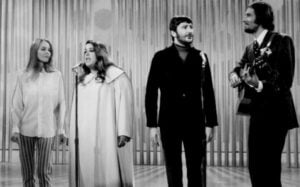
CBS Television, Public domain, via Wikimedia Commons
Our Complete List Of The Mamas & The Papas Band Members takes a look at the singers who formed one of the most successful and influential American vocal groups of the 1960s. When you think about the music that came out of California during that decade, it’s almost impossible not to think about The Mamas & The Papas. Their beautiful harmonies, unforgettable melodies, and extraordinary collection of hit records helped define an entire generation. Songs like “California Dreamin’,” “Monday, Monday,” “Dedicated to the One I Love,” and “Creeque Alley” became an important part of the soundtrack of the 1960s.
I’ve always thought The Mamas & The Papas were one of the most fascinating groups of that era because their musical personalities were so different. John Phillips had a wonderful gift for songwriting and vocal arrangements. Denny Doherty possessed one of the smoothest male voices in popular music. Cass Elliot had an extraordinary voice that could fill an entire recording with warmth and emotion, while Michelle Phillips contributed the beautiful higher harmonies that helped give the group its unmistakable sound. When those four voices came together, something magical happened. There simply wasn’t another group that sounded quite like them.
The original Mamas & The Papas formed in 1965, bringing together musicians who had already spent several years performing in the folk music scene. John Phillips had worked with the Journeymen, while Cass Elliot and Denny Doherty had been members of the Mugwumps. Michelle Phillips joined John and Denny in the New Journeymen before Cass became part of the group. After spending time rehearsing in the Virgin Islands, the quartet relocated to Los Angeles, where producer Lou Adler helped them secure a recording contract with Dunhill Records. Their first major success came with “California Dreamin’,” released in late 1965 and becoming an enormous hit in 1966.
Although the group enjoyed tremendous success, its original career was surprisingly short. Personal disagreements and changing relationships eventually created tensions that became difficult to overcome. The original quartet separated in 1968, briefly reunited to record again in 1971, and then went their separate ways. However, the history of The Mamas & The Papas didn’t end there. John Phillips and Denny Doherty later participated in a new version of the group during the 1980s, joined by singers who helped bring those famous songs to another generation of audiences.
The Mamas & The Papas were inducted into the Rock and Roll Hall of Fame in 1998, an honor that recognized their extraordinary contributions to American popular music. This complete band-members article begins with the original four singers, then looks at Jill Gibson, who briefly replaced Michelle Phillips in 1966. We also cover the musicians who became part of the later New Mamas & The Papas touring lineups. It’s important to separate those different periods because the original group’s legendary recordings were created by a very specific combination of voices.
The Original Mamas & The Papas Band Members
John Phillips – Vocals, Guitar, Songwriting, Vocal Arrangements (1965-1968, 1971)
John Phillips was one of the founding members of The Mamas & The Papas and the principal songwriter behind many of the group’s most famous recordings. Born on August 30, 1935, in Parris Island, South Carolina, Phillips became involved in the folk music scene during the late 1950s. He eventually moved to New York, where he performed in Greenwich Village and became part of the thriving folk revival. His early career included the folk trio the Journeymen, which also featured Scott McKenzie and Dick Weissman. Those experiences helped establish Phillips as an accomplished singer, guitarist, and arranger before he became internationally famous.
John met Michelle Gilliam in the early 1960s, and the two eventually married and began performing together. After the original Journeymen disbanded, John and Michelle joined forces with Denny Doherty in the New Journeymen. Cass Elliot eventually completed the lineup that would become The Mamas & The Papas. John played an essential role in developing the group’s vocal arrangements, understanding how the four singers’ different ranges and personalities could be combined into something extraordinary. His acoustic guitar also contributed to the group’s folk-rock sound, although their recordings frequently featured some of Los Angeles’s finest session musicians.
Phillips wrote “Monday, Monday,” the group’s only number-one single on the Billboard Hot 100. He also co-wrote “California Dreamin'” with Michelle Phillips and collaborated with other members of the group on additional recordings. Songs such as “Creeque Alley,” “I Saw Her Again,” and “Twelve Thirty (Young Girls Are Coming to the Canyon)” demonstrated his remarkable ability to combine memorable pop melodies with lyrics that reflected the changing world of the 1960s. I’ve always thought his songwriting was one of the biggest reasons the group became so successful. He understood how to write songs that sounded simple enough to become hits while incorporating sophisticated vocal harmonies and arrangements.
John Phillips also played an important role in organizing the 1967 Monterey International Pop Festival alongside producer Lou Adler. He wrote “San Francisco (Be Sure to Wear Flowers in Your Hair),” which became an enormous hit for his longtime friend Scott McKenzie. After The Mamas & The Papas originally disbanded, Phillips released solo material, including the 1970 album John Phillips (John, the Wolf King of L.A.). He later revived the group with Denny Doherty and new singers in the early 1980s. Phillips passed away on March 18, 2001, at the age of sixty-five. His songwriting and arranging remain central to the musical legacy of The Mamas & The Papas.
Michelle Phillips – Vocals, Songwriting (1965-1966, 1966-1968, 1971)
Michelle Phillips was one of the four founding members of The Mamas & The Papas and remains the last surviving member of the original quartet. Born Holly Michelle Gilliam on June 4, 1944, in Long Beach, California, she grew up in California before becoming involved in modeling and the folk music scene. She met John Phillips while he was performing with the Journeymen, and the two married in 1962. Michelle eventually began singing with John and Denny Doherty in the New Journeymen, helping establish the musical partnership that would lead to The Mamas & The Papas.
Michelle’s voice was an essential part of the group’s sound. While Cass Elliot and Denny Doherty frequently handled the more prominent vocal passages, Michelle contributed the higher harmonies that gave the recordings their beautiful layered quality. I’ve always thought this was one of the most interesting things about The Mamas & The Papas. No single singer was responsible for that famous harmony sound. All four voices had to fit together, and Michelle’s lighter vocal tone provided an important contrast to Cass’s rich lower range and the two male singers.
Michelle also contributed as a songwriter, most famously receiving co-writing credit with John Phillips on “California Dreamin’.” The composition became one of the most recognizable recordings of the 1960s and one of the defining songs of the California folk-rock movement. She also shared songwriting credit on “Creeque Alley,” which told the story of the musicians and events that led to the group’s formation. Although she wasn’t the principal songwriter, her involvement in those compositions was an important part of the band’s creative history.
Michelle briefly left the group in the summer of 1966 during a period of personal disagreements. Singer Jill Gibson replaced her for several weeks, appearing in performances and participating in recording sessions. Michelle eventually returned, restoring the original quartet. After The Mamas & The Papas disbanded, she pursued a solo recording career and became a successful actress. Her work included films such as Dillinger and Valentino, along with a prominent role on the television series Knots Landing. Michelle also published her memoir, California Dreamin’: The True Story of the Mamas and the Papas, in 1986, offering her perspective on the band’s remarkable history.
Cass Elliot – Vocals (1965-1968, 1971)
Cass Elliot, known to millions of fans as Mama Cass, possessed one of the most beautiful voices in the history of American popular music. Born Ellen Naomi Cohen on September 19, 1941, in Baltimore, Maryland, she developed an interest in music and theater while growing up. Before joining The Mamas & The Papas, Cass worked in the folk music scene and performed with several groups, including the Big Three and the Mugwumps. The Mugwumps also featured Denny Doherty, John Sebastian, and Zal Yanovsky, making the group an important connection between The Mamas & The Papas and the Lovin’ Spoonful.
When Cass joined John Phillips, Michelle Phillips, and Denny Doherty in 1965, she completed one of the greatest vocal combinations of the decade. Her rich alto voice added an extraordinary amount of warmth and depth to the group’s harmonies. I’ve always thought that Cass was one of those singers who could make a recording sound beautiful simply by opening her mouth. She didn’t need elaborate vocal tricks or excessive production. There was something naturally emotional about her voice, and that quality made her one of the most memorable singers of the era.
Although Denny Doherty handled the lead vocals on several of the group’s early hits, Cass became an increasingly prominent featured vocalist. Her performances on songs such as “Words of Love” and “Dream a Little Dream of Me” demonstrated her remarkable ability to interpret different types of material. “Dream a Little Dream of Me” became especially important because her 1968 recording helped launch her solo career. She took a song that had originally been written decades earlier and made it sound completely natural for the late 1960s. It remains one of her most beloved recordings.
Following the breakup of The Mamas & The Papas, Cass enjoyed a successful solo career, recording songs such as “Make Your Own Kind of Music,” “It’s Getting Better,” and “New World Coming.” She also became a popular television personality, appearing on variety programs and hosting television specials. Her personality was just as memorable as her singing, and she became one of the most recognizable figures in popular music. Sadly, Cass Elliot passed away on July 29, 1974, in London, England, at the age of thirty-two. Her career was far too short, but the music she left behind continues to touch listeners more than fifty years later.
Denny Doherty – Lead Vocals, Background Vocals (1965-1968, 1971)
Denny Doherty was one of the founding members of The Mamas & The Papas and the singer responsible for some of the most beautiful lead vocal performances in the band’s catalog. Born in Halifax, Nova Scotia, Canada, Doherty began performing professionally during the late 1950s and eventually became part of the Canadian folk music scene. He performed with the Halifax Three before moving to the United States, where he joined the Mugwumps alongside Cass Elliot. After that group dissolved, Doherty joined John and Michelle Phillips in the New Journeymen, setting the stage for the formation of The Mamas & The Papas.
Doherty possessed a wonderfully smooth tenor voice that was perfectly suited to the group’s arrangements. His lead vocals on “California Dreamin'” and “Monday, Monday” became an essential part of those recordings’ enormous popularity. I’ve always loved the way Denny sang because he had such a natural sense of melody. He didn’t need to push his voice or overemphasize the emotional parts of a song. His singing was relaxed and beautiful, giving the recordings a warmth that helped separate The Mamas & The Papas from many other vocal groups of the period.
Denny also contributed to the group’s songwriting, sharing credit with John Phillips on “I Saw Her Again.” That recording became another major hit in 1966 and demonstrated how effectively the band could combine sophisticated harmonies with an exciting pop arrangement. Doherty’s musical relationship with Cass Elliot was particularly important because the two had already developed a strong understanding of each other’s voices while performing together in the Mugwumps. That experience helped the original quartet develop its vocal sound more quickly.
After The Mamas & The Papas originally separated, Doherty pursued a solo career and released albums including Watcha Gonna Do in 1971 and Waiting for a Song in 1974. He also worked extensively in theater and television, including providing voices and narration for the children’s series Theodore Tugboat. Doherty reunited with John Phillips during the New Mamas & The Papas period in the 1980s and early 1990s. He later developed the autobiographical musical Dream a Little Dream, which revisited the group’s history. Denny Doherty passed away on January 19, 2007, at the age of sixty-six. His magnificent voice remains one of the defining elements of The Mamas & The Papas’ recordings.
The Mamas & The Papas Temporary Original-Era Member
Jill Gibson – Vocals (1966)
Jill Gibson holds a unique position in the history of The Mamas & The Papas because she was the only singer to replace a member of the original quartet during the band’s initial recording career. Gibson was already involved in the California music scene during the 1960s and had worked as a singer, songwriter, and visual artist. She also had a musical association with Jan Berry of Jan and Dean. When Michelle Phillips was dismissed from The Mamas & The Papas during the summer of 1966, producer Lou Adler introduced Gibson to the group as a possible replacement.
Jill joined John Phillips, Cass Elliot, and Denny Doherty and began performing with the group during one of the busiest periods of its career. She appeared in concerts and television performances while the band was continuing work on its second studio album. The group needed a singer who could handle Michelle’s higher vocal parts, and Gibson had the experience and ability to step into that position. Her involvement lasted only several weeks before Michelle returned, but it was long enough for Jill to become part of the group’s recorded history.
One of the most interesting questions surrounding Gibson’s membership concerns how many of her vocals remained on the group’s second album, released in September 1966. Gibson participated in recording sessions, but some tracks were revisited after Michelle Phillips rejoined the band. Accounts from Gibson, producer Lou Adler, and other people associated with the sessions have differed over the number of released recordings that feature her voice. What is clear is that Gibson was a genuine member of The Mamas & The Papas during the summer of 1966, not simply a session vocalist. Any complete history of the band’s membership should include her.
The New Mamas & The Papas Members
Although the original Mamas & The Papas disbanded in 1968 and briefly reunited in 1971, John Phillips eventually decided to revive the group. During the early 1980s, he brought together a new lineup that combined original members with singers from a younger generation. The group became known as the New Mamas & The Papas, touring with the classic songs while occasionally developing new material. John Phillips and Denny Doherty were the original members involved in the initial revival, joined by Mackenzie Phillips and Elaine “Spanky” McFarlane.
The revived group went through several personnel changes over the following years. Some singers remained for extended periods, while others participated in particular touring lineups. These musicians were not members of the original 1960s recording quartet, but they contributed to the later history of the name. The following profiles cover the principal revival members and the additional singers associated with subsequent touring versions.
Mackenzie Phillips – Vocals (1982-1991, with interruptions)
Mackenzie Phillips joined the New Mamas & The Papas when her father, John Phillips, revived the group in the early 1980s. Born on November 10, 1959, Mackenzie had already established herself as an actress, appearing in the 1973 film American Graffiti and becoming widely recognized for her role on the television series One Day at a Time. Although she was best known to the public as an actress, Mackenzie grew up surrounded by musicians and was familiar with her father’s songs and arrangements.
When the New Mamas & The Papas began performing in 1982, Mackenzie took the higher female vocal position originally associated with Michelle Phillips. She performed alongside John Phillips, Denny Doherty, and Spanky McFarlane, helping recreate the group’s famous four-part vocal arrangements. The new lineup toured extensively, introducing the music to audiences who had never seen the original group perform. Mackenzie remained associated with the touring band through much of the 1980s and into the early 1990s, although her participation was interrupted at different times.
Mackenzie’s involvement was particularly interesting because she brought a direct family connection to the original group while representing a different generation of performers. She continued working in acting and music after her time with the New Mamas & The Papas. Her participation remains an important chapter in the history of John Phillips’s attempts to revive the group’s sound.
Elaine “Spanky” McFarlane – Vocals (1982-1993)
Elaine “Spanky” McFarlane was one of the most recognizable musicians to join the New Mamas & The Papas. Long before becoming part of the revived group, she had enjoyed major success as the lead singer of Spanky & Our Gang, one of the great American sunshine-pop groups of the late 1960s. That band scored hits with songs such as “Sunday Will Never Be the Same,” “Lazy Day,” and “Like to Get to Know You.” McFarlane possessed a strong and expressive voice, making her an excellent choice to handle the richer female vocal parts associated with Cass Elliot.
Spanky joined John Phillips, Denny Doherty, and Mackenzie Phillips when the group reunited in 1982. Her background in harmony-rich pop music was especially valuable because she understood the style that had made The Mamas & The Papas famous. She also brought her own personality to the performances rather than simply attempting to imitate Cass Elliot. That’s an important distinction. Cass had such a unique voice that no singer could truly replace her, but Spanky was a talented performer in her own right.
McFarlane remained with the New Mamas & The Papas through various changes in the lineup, continuing to tour into the early 1990s. Her participation helped establish the revived group as more than a brief reunion project. She brought her experience, vocal ability, and history as a successful 1960s recording artist to the stage, making her one of the most important members of the later touring lineup.
Scott McKenzie – Vocals, Guitar (Late 1980s-1998)
Scott McKenzie was a natural choice to become involved with the New Mamas & The Papas because his musical relationship with John Phillips went back decades. Born Philip Wallach Blondheim on January 10, 1939, McKenzie had performed alongside Phillips in the Journeymen during the early 1960s. He later became internationally famous for recording “San Francisco (Be Sure to Wear Flowers in Your Hair),” a song written by John Phillips that became one of the defining anthems of the Summer of Love in 1967.
When Denny Doherty departed the revived Mamas & The Papas during the 1980s, McKenzie eventually joined the group as one of its male vocalists. His familiarity with Phillips’s songwriting and musical style made him an obvious fit. Although McKenzie hadn’t been part of the original Mamas & The Papas lineup, he had been closely connected to the musicians who formed the group. That history gave his later participation a special significance.
McKenzie continued working with the touring group through much of the 1990s. His voice helped recreate the harmonies associated with the original recordings, and his own solo success made him a recognizable figure to audiences who remembered the music of the 1960s. Scott McKenzie passed away on August 18, 2012, at the age of seventy-three. His work with the Journeymen, his famous solo recording, and his later involvement with the New Mamas & The Papas all connect him to an important chapter in American folk-rock history.
Laurie Beebe Lewis – Vocals (1986-1993, Intermittently)
Laurie Beebe Lewis became part of the New Mamas & The Papas during the mid-1980s, when the touring group began experiencing changes in its lineup. She was already an experienced singer and keyboard player, having worked with a re-formed version of the Buckinghams during the early 1980s. Her background in 1960s-style pop music and vocal harmonies made her a good fit for the songs John Phillips wanted to continue performing.
Lewis joined the New Mamas & The Papas in 1986, initially stepping into the female vocal position associated with Mackenzie Phillips. Her involvement was intermittent during the late 1980s as different combinations of performers appeared with the group. She eventually became a more regular member, remaining associated with the touring band into 1993. During those years, the group performed a mixture of the original Mamas & The Papas hits and additional material that reflected the musicians’ backgrounds.
What makes Lewis an important part of the group’s history is that she helped keep the touring operation going through a period of considerable personnel changes. She wasn’t associated with the original 1960s recordings, but she contributed to the later performances that introduced those songs to new audiences.
Lisa Brescia – Vocals (1993-1998)
Lisa Brescia joined the later New Mamas & The Papas touring lineup during the 1990s. She was one of the singers brought in as the group continued evolving after the departure of earlier revival members. By this point, the band had become an established touring production, performing the familiar hits for audiences who continued to love the music of the original quartet.
Brescia contributed vocals to the expanded group during the mid-to-late 1990s. She later became known for her work in musical theater, including major Broadway productions. Her theatrical background was particularly well suited to a touring vocal group whose performances depended on carefully arranged harmonies and the ability to recreate familiar recordings onstage.
Deb Lyons – Vocals (1993-1998)
Deb Lyons was another singer associated with the New Mamas & The Papas during the 1990s. She joined the group’s touring lineup around the same period as Lisa Brescia, contributing to the female vocal harmonies that remained central to the band’s sound. The later version of the group continued performing songs such as “California Dreamin’,” “Monday, Monday,” and “Dream a Little Dream of Me,” with different singers filling the roles established by the original quartet.
Lyons was an experienced performer whose work extended into musical theater and other vocal productions. Her participation reflected the increasingly theatrical nature of the later touring group, which needed professional singers capable of handling demanding harmony arrangements over extended concert schedules.
Barry McGuire – Vocals (Late 1990s)
Barry McGuire had an important connection to the original Mamas & The Papas long before he appeared with the later touring group. He was already a successful folk and pop singer during the 1960s, best known for his number-one hit “Eve of Destruction” in 1965. McGuire had also worked with the New Christy Minstrels and was part of the Southern California folk-rock community that helped bring The Mamas & The Papas together.
His connection to their early recording career was particularly significant because the quartet contributed background vocals to his 1965 album This Precious Time. Their appearance helped bring them into contact with producer Lou Adler and the recording opportunities that eventually led to their own success. McGuire later appeared with the New Mamas & The Papas during the late 1990s, providing another link between the original folk-rock scene and the group’s later touring history.
Additional New Mamas & The Papas Touring Personnel
By the end of the 1990s, the New Mamas & The Papas had experienced further personnel changes. Later touring rosters included additional professional singers who helped continue performances under the group’s name. These musicians should not be confused with the original recording members, and their involvement was associated with the later concert organization rather than the classic Dunhill Records period.
Chrissy Faith – Vocals (Late 1990s)
Chrissy Faith was among the singers identified with the later New Mamas & The Papas touring lineup around 1998. As the group moved further away from its original personnel, professional vocalists were brought in to maintain the harmony arrangements associated with the famous recordings. Faith was part of that later period, contributing to the continuation of the group’s live performances.
David Baker – Vocals (Late 1990s)
David Baker is also listed among the performers who participated in the New Mamas & The Papas during the late 1990s. His involvement came after several years of changes to the touring ensemble. Like the other later singers, Baker’s principal role was helping perform the group’s established repertoire rather than contributing to the original recordings that made the band famous.
Janelle Sadler – Vocals (Late 1990s)
Janelle Sadler was another member of the touring vocal ensemble associated with the New Mamas & The Papas around 1998. The group’s later performances required singers with the ability to handle intricate harmony parts, and Sadler was among the musicians who participated in that period. Her involvement belongs to the band’s extended touring history rather than its original four-member lineup.
Mark Williamson – Vocals (Late 1990s)
Mark Williamson joined the later touring organization as additional personnel changes took place near the end of the 1990s. He is associated with the period following the reduction of John Phillips’s and Scott McKenzie’s performing involvement. Williamson’s role was part of the final continuation of the New Mamas & The Papas concert lineup, which had evolved considerably from the group formed in 1982.
Why The Original Four Mamas & The Papas Were So Special
When you look back at the complete history of The Mamas & The Papas, it’s important to distinguish the original group from the various lineups that followed. John Phillips, Michelle Phillips, Cass Elliot, and Denny Doherty created the recordings that made the group famous. Their four voices blended together in a way that was completely unique, and that combination became one of the defining sounds of the 1960s. Producer Lou Adler and the exceptional session musicians who worked on the records were also essential to their success, but the group’s vocal personality came from those four singers.
Some of the musicians who played on The Mamas & The Papas’ classic recordings included drummer Hal Blaine, bassist Joe Osborn, keyboardist Larry Knechtel, and guitarists such as P.F. Sloan. Those musicians made enormous contributions to the finished recordings, but they were studio players rather than official members of the original vocal quartet. That’s an important distinction when discussing a group whose name and public identity were built around four specific people.
Jill Gibson’s brief membership in 1966 was the one significant exception during the original recording years. The later New Mamas & The Papas represented a different period, with John Phillips and Denny Doherty initially joined by Mackenzie Phillips and Spanky McFarlane. Subsequent performers helped keep the music alive through concerts during the 1980s and 1990s, but none of those lineups recreated the exact combination of voices that made the original quartet so special.
I’ve always thought that the beauty of The Mamas & The Papas was that they could make a complicated vocal arrangement sound so natural. Listen to “California Dreamin’,” “Monday, Monday,” “I Saw Her Again,” or “Dedicated to the One I Love,” and you’ll hear how each singer contributed something important. Cass Elliot brought tremendous warmth and soul, Denny Doherty delivered those beautiful lead vocals, Michelle Phillips added her distinctive higher harmonies, and John Phillips provided the songwriting and arrangements that held everything together.
The group’s original career lasted only a few years, but the music has remained part of our lives for more than six decades. That’s a remarkable accomplishment. The Mamas & The Papas gave us some of the most beautiful songs of the 1960s, and their recordings still sound magnificent today. The musicians who created that sound deserve to be remembered, and that’s what this complete history of The Mamas & The Papas band members celebrates.
For a complete look at the various types of articles we have on the site, make sure to check out our Classic Rock Bands List and Directory.
Don’t miss our in-depth article on the Top 500 Classic Rock Songs Of All Time.
If you love interviews with legendary rock stars, you’ll find them in our Rock Star Interviews Directory.
Complete List Of The Mamas & The Papas Band Members article published on ClassicRockHistory.com © 2026
ClassicRockHistory.com claims ownership of its original editorial content under applicable copyright laws. Republishing this content without permission is prohibited. Photographs are credited to their respective owners or licensing sources.